Full Face Fat Grafting in Korea: 2 Real Cases With Recovery Photos at 2 Weeks and 1 Month
Full face fat grafting is one of the most popular facial rejuvenation procedures in Korea, and also one of the hardest to evaluate from photos alone. The problem is timing. At 1 week, the face is swollen and the patient looks overfilled. At 2 weeks, the swelling is subsiding but the result is still not final. At 1 month, the shape is settling but the fat has not finished absorbing. The true result does not appear until 3 to 6 months.
This creates a specific anxiety for patients who travel to Korea for fat grafting: they leave the country during the swelling phase and spend weeks wondering whether the puffiness will resolve or whether they were overfilled.
Two patients who had full face fat grafting performed by Dr. Jung Min-su shared their recovery photos at different stages. One at 2 weeks, one at 1 month. Both patients covered their nose and mouth area with stickers for privacy, which is standard practice in Korean patient review communities.
Key Takeaways
- Full face fat grafting harvests fat from the abdomen or thighs, purifies it, then injects it into the temples, cheeks, under-eyes, and forehead.
- Korean surgeons use a micro-droplet, multi-layer injection technique that improves fat survival rates to 40 to 70%.
- Two sessions are often recommended to achieve the ideal volume, spaced 3 to 6 months apart.
- Major swelling lasts 2 to 4 weeks. Final results appear at 3 to 6 months as absorbed fat stabilizes.
- Cost in Korea: $2,000 to $4,000. US equivalent: $5,000 to $10,000.
Case 1: 1 Month After Full Face Fat Grafting
This patient had fat harvested from her abdomen and injected into her temples, cheeks, under-eye hollows, and forehead by Dr. Jung Min-su. The photo at 1 month shows the swelling has largely resolved and the volume is settling into a natural shape.

Before Surgery
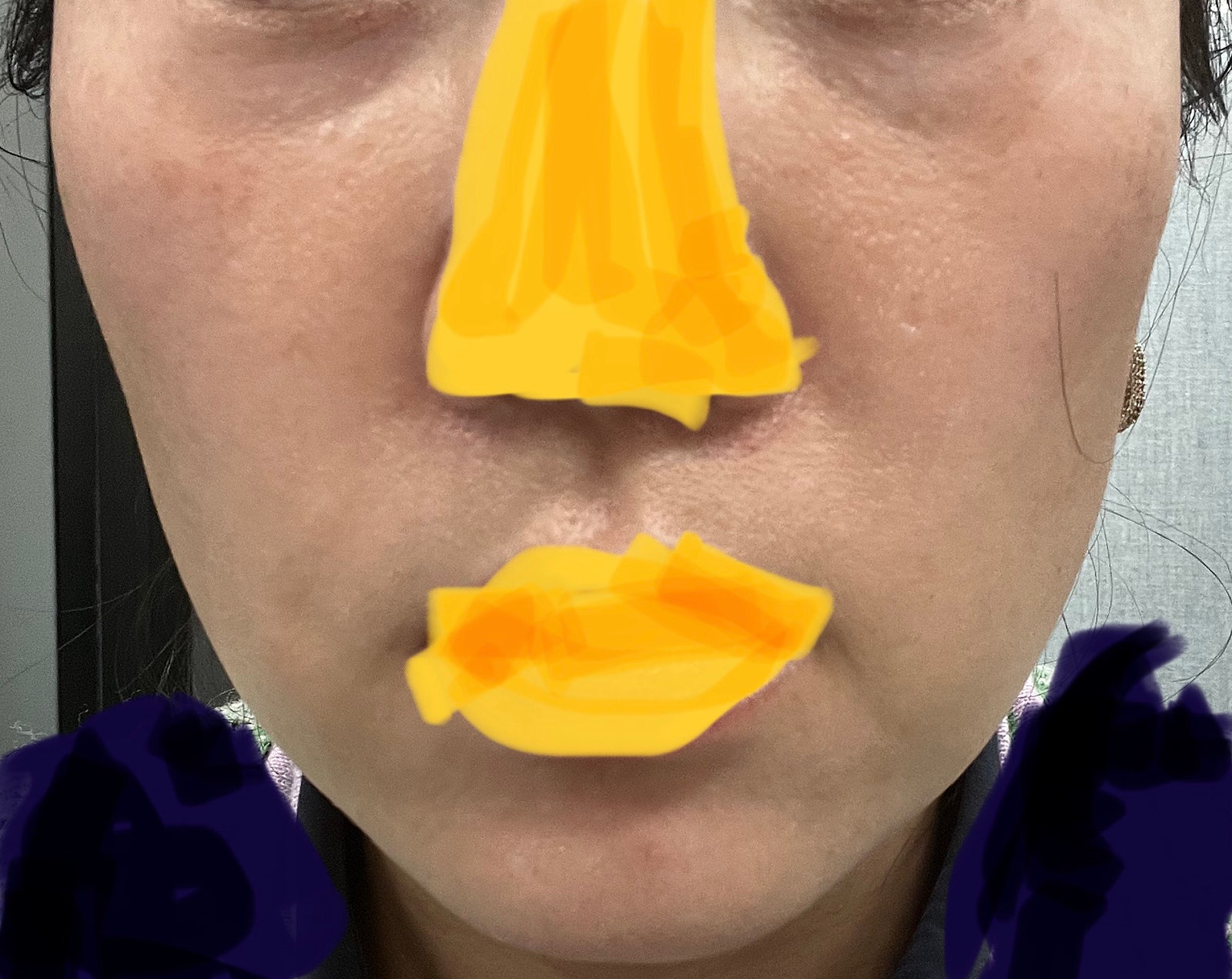
1 Month Post-Op
“One month after full face fat grafting with Dr. Jung Min-su. The swelling has gone down and my face looks fuller and more youthful. Really satisfied with the result so far.” — Patient review #760, March 2023, translated from Korean
Note the improved volume in the temples and mid-face area. The under-eye hollows are filled, creating a smoother transition from the lower eyelid to the cheek. The nose and mouth are covered by the patient’s own privacy stickers.
Case 2: 2 Weeks After Full Face Fat Grafting
This patient also had full face fat grafting performed by Dr. Jung Min-su. The 2-week photo still shows residual swelling, particularly in the cheeks, but the overall contour improvement is already apparent.

Before Surgery

2 Weeks Post-Op
“Two weeks after full face fat grafting with Dr. Jung. The swelling is going down day by day. My face already looks more balanced and the hollowness under my eyes is filled in.” — Patient review #737, March 2023, translated from Korean
At 2 weeks, this is still the swelling phase. The cheeks look fuller than the final result will be, because some of the visible volume is swelling rather than surviving fat. By month 3, the fat that has established a blood supply will remain permanently, and the excess volume from swelling will be gone.
How Full Face Fat Grafting Works
The procedure has three stages, and the quality of each stage affects the final result.
Stage 1: Harvesting
Fat is collected from a donor site, typically the abdomen or inner thighs, using a thin cannula through a small incision. The surgeon uses gentle liposuction to extract the fat while keeping the fat cells intact. Aggressive suction damages fat cells and reduces survival rates.
Stage 2: Purification
The harvested fat is processed to separate viable fat cells from oil, blood, and damaged cells. Korean surgeons commonly use centrifugation or filtration methods. Some clinics add growth factors or PRP (platelet-rich plasma) to improve fat cell survival, though evidence on this is mixed.
Stage 3: Injection
This is where the Korean technique differs most from Western approaches. Korean surgeons inject fat in micro-droplets across multiple tissue layers, rather than depositing large volumes in a single plane. This micro-droplet, multi-layer technique gives each fat cell better access to blood supply from surrounding tissue, which is the key factor in fat survival.
Common injection areas for full face fat grafting include:
- Temples: Fills hollowing that creates an aged, skeletal appearance
- Cheeks: Restores mid-face volume and creates a smooth contour
- Under-eyes (tear troughs): Fills dark hollows between lower eyelid and cheek
- Forehead: Creates a rounded, youthful forehead shape
- Nasolabial folds: Softens the lines from nose to mouth
Fat Survival Rate: What Stays and What Absorbs
This is the question every fat grafting patient asks, and the honest answer is: it depends. Survival rates for facial fat grafting typically range from 40 to 70%, meaning 30 to 60% of the injected fat will absorb over the first 3 to 6 months.
Korean surgeons account for this by intentionally overfilling. If the target is 10cc of permanent volume in the cheeks, the surgeon may inject 15 to 18cc, anticipating that some will absorb. This is why patients look puffy for the first few weeks. The puffiness is by design.
The fat that survives at 6 months is permanent. It behaves like the patient’s natural facial fat, gaining and losing volume with weight changes. This is both an advantage (permanent, natural-feeling result) and a consideration (significant weight gain can make the face look overly full).
At clinics like Link Plastic Surgery, where fat grafting is a core procedure, surgeons often recommend a second session 3 to 6 months after the first to fine-tune areas where absorption was higher than expected.
Why Two Sessions Are Often Recommended
A single session of fat grafting can produce a good result, but most Korean surgeons recommend planning for two sessions. The reasons are practical:
- Absorption is unpredictable. Different areas of the face absorb fat at different rates. The under-eyes may retain 60% while the temples retain only 40%. A second session corrects these imbalances.
- Conservative first session, precise second session. The first session establishes the overall volume. The second session fine-tunes specific areas that need more.
- Better long-term symmetry. Asymmetric absorption is common after the first session. The second session ensures both sides of the face match.
Not every patient needs a second session. About 30 to 40% of patients are satisfied with a single round. But budgeting and planning for two sessions prevents disappointment if the first session does not deliver the ideal result on its own.
Full Face Fat Grafting Cost: Korea vs. United States
| Procedure | Korea (Seoul) | United States |
|---|---|---|
| Full face fat grafting (single session) | $2,000 to $4,000 | $5,000 to $10,000 |
| Under-eye fat grafting only | $1,000 to $2,000 | $3,000 to $5,000 |
| Second session (touch-up) | $1,500 to $2,500 | $3,000 to $6,000 |
| Fat grafting + facelift combo | $6,000 to $12,000 | $15,000 to $30,000 |
Korean prices include fat harvesting, purification, injection, anesthesia, and all follow-up visits. The second session is priced lower because the technique is the same but the volume needed is smaller.
Recovery Timeline: What to Expect
| Timeline | What Happens | Swelling Level |
|---|---|---|
| Day 1 to 3 | Significant facial swelling, bruising at donor site, face looks overfilled | 100% |
| Day 4 to 7 | Swelling begins to decrease, bruising fading, still noticeably puffy | 70 to 80% |
| Week 2 | Most bruising resolved, can return to work with makeup, still fuller than final | 50 to 60% |
| Week 3 to 4 | Swelling subsiding, contour becoming visible, fat absorption beginning | 30 to 40% |
| Month 2 to 3 | Fat stabilizing, absorbed fat gone, shape settling | 10 to 20% |
| Month 3 to 6 | Final result, surviving fat is permanent | 0% |
The donor site (abdomen or thighs) also needs recovery. Expect soreness and bruising at the harvest area for 1 to 2 weeks, similar to mild liposuction recovery. Compression garments for the donor site are typically worn for 3 to 5 days.
Who Is a Good Candidate for Fat Grafting
- Patients with volume loss in the mid-face, temples, or under-eyes due to aging
- Patients who want a natural, permanent alternative to dermal fillers
- Patients with enough donor fat (at least a small amount from the abdomen or thighs)
- Patients willing to accept the 2 to 4 week swelling period
- Patients who prefer using their own tissue rather than synthetic fillers
Fat grafting is not ideal for patients who are extremely lean with minimal body fat (not enough donor material), patients who need very precise, small-volume corrections (fillers may be more appropriate), or patients who cannot take 2 weeks off from public-facing work.
Recommended for Fat Grafting Recovery
Products that patients commonly use during facial fat grafting recovery.
- Arnica Montana Tablets — reduces bruising on the face and at the donor site, start 3 days before surgery. Check price on Amazon
- COSRX Snail Mucin Essence — gentle hydration for the face during the healing phase when skin may feel tight. Check price on Amazon
- Silicone Scar Sheets — for the small donor site incisions on the abdomen or thighs. Check price on Amazon
- Beauty of Joseon Relief Sun SPF 50+ — critical for preventing hyperpigmentation on the face during the healing months. Check price on Amazon
As an Amazon Associate, GlobalBeautySpot earns from qualifying purchases.
Considering Fat Grafting in Korea?
Get a free remote consultation with a board-certified surgeon at Link Plastic Surgery. Send your photos through WhatsApp or KakaoTalk for a preliminary assessment and cost estimate.
Related Articles
- Korean Rhinoplasty Results at 1 Month: What Your Nose Actually Looks Like During Recovery
- Belly Button Surgery in Korea: Real Before-and-After Photos From 3 Patients
- Alar Reduction in Korea: What Nostril Narrowing Surgery Actually Looks Like
- Planning Plastic Surgery in Korea: The Complete Medical Tourism Guide
Patient photos from verified reviews at Korean plastic surgery clinics. Published with patient consent. Nose and mouth areas covered by patients for privacy. Results may vary.