Korean Rhinoplasty Results at 1 Month: What Your Nose Actually Looks Like During Recovery
Every rhinoplasty gallery on the internet has the same problem. The “before” photo is taken in harsh lighting with no makeup. The “after” photo is taken at 6 months with perfect lighting, sometimes with makeup, always from the most flattering angle. The gap between those two images skips the part that actually matters to someone about to book surgery: what does the nose look like during recovery?
Not at 6 months. Not at 1 year. At 1 month, when you are back at work, when your friends are staring at your face trying to figure out what changed, when the cast has been off for three weeks and you are still not sure whether you like the result.
This is the part nobody shows you. And it is the part that causes the most anxiety for patients who travel to Korea for rhinoplasty, because they fly home at 7 to 10 days and then spend the next several weeks wondering if what they see in the mirror is the final result.
It is not. And understanding that gap between “1-month nose” and “final nose” is what separates patients who panic from patients who wait.
Key Takeaways
- At 1 month post-op, 60 to 70% of swelling has resolved but the tip remains puffy. Final results appear at 6 to 12 months.
- Korean rhinoplasty prioritizes natural-looking results with a defined but not overdone bridge line.
- The nasal tip is the last area to settle. It can feel stiff and look slightly wide for 3 to 6 months.
- Cost in Korea: $3,000 to $6,000 for primary rhinoplasty. $4,000 to $8,000 for revision. US equivalent: $8,000 to $15,000.
- Real patient photos at 1 month look different from polished 6-month gallery photos. That difference is normal.
Real Patient: 1 Month After Korean Rhinoplasty
This patient had rhinoplasty at Link Plastic Surgery in Gangnam and posted her review at 1 month post-op. The photos show her nose from a close-up angle and a front-facing perspective.

Close-up, 1 Month Post-Op

Front View, 1 Month Post-Op
Notice the bridge line is well-defined and straight. The tip still has slight swelling, which is completely normal at this stage. The overall shape is natural, not the exaggerated “K-pop nose” that many Western patients worry about when considering Korean surgeons.
“I love my nose so much at 1 month! The bruising disappeared quickly.” — Patient review, translated from Korean
The Truth About Rhinoplasty Recovery: Week by Week
Here is what actually happens after Korean rhinoplasty, based on hundreds of patients who have been through the process.
| Timeline | What Happens | Swelling Level |
|---|---|---|
| Day 1 to 3 | Cast on, bruising under eyes, significant swelling | 100% |
| Day 5 to 7 | Cast removed, stitches out, nose still swollen and stiff | 80% |
| Week 2 to 3 | Most bruising gone, bridge shape visible, tip puffy | 60% |
| Month 1 | Presentable in public, bridge defined, tip still thick | 40% |
| Month 3 | Major shape settled, tip beginning to refine | 20% |
| Month 6 to 12 | Final result, tip fully refined, skin contracted | 0 to 5% |
The critical thing to understand: the bridge settles fast. The tip settles slow. If your bridge looks good at 1 month but your tip feels too round or wide, that is normal. The skin over the nasal tip is thicker and takes longer to contract around the new cartilage framework.

What Makes Korean Rhinoplasty Different
Korean surgeons approach rhinoplasty differently from Western surgeons in several fundamental ways:
Structural Philosophy
Western rhinoplasty is traditionally reductive. Surgeons shave down humps, reduce width, remove cartilage. Korean rhinoplasty is additive. Surgeons build up the bridge and tip using cartilage grafts (from the septum, ear, or rib) to create definition where there is none.
This structural approach is why Korean rhinoplasty results tend to look natural rather than “done.” Instead of removing what is there, the surgeon adds to what is missing.
Bridge Augmentation
Most Korean rhinoplasty patients want a higher, more defined nasal bridge. Surgeons achieve this using silicone implants (for the bridge) combined with autologous cartilage (for the tip). The implant provides the bridge height; the patient’s own cartilage creates the tip shape.
The debate between silicone and Gore-Tex implants continues, but Korean surgeons overwhelmingly favor silicone for its predictability and ease of revision if needed.
Tip Plasty
Tip refinement is where Korean surgeons invest the most time. Techniques include septal cartilage grafting, ear cartilage grafting, tip suturing, and columellar strut placement. The goal is a slightly elevated, defined tip that maintains a natural appearance from every angle.
Korean Rhinoplasty Cost Breakdown
| Procedure | Korea (Seoul) | United States |
|---|---|---|
| Primary rhinoplasty (bridge + tip) | $3,000 to $6,000 | $8,000 to $15,000 |
| Revision rhinoplasty | $4,000 to $8,000 | $10,000 to $20,000 |
| Tip plasty only | $2,000 to $3,500 | $5,000 to $8,000 |
| Alar reduction (nostril narrowing) | $800 to $1,500 | $2,000 to $4,000 |
| Deviated septum correction (add-on) | $500 to $1,500 | $3,000 to $7,000 |
Korean prices include surgeon fees, anesthesia, facility fees, cast/splint, and all post-operative follow-up visits. No hidden charges.
What to Expect as a Foreign Patient
Rhinoplasty requires a longer stay in Seoul than most procedures. Plan for a minimum of 10 to 14 days:
- Day 1 to 2: Consultation and pre-op testing
- Day 3: Surgery (1.5 to 3 hours depending on complexity)
- Day 4 to 7: Recovery at your hotel, daily clinic check-ups
- Day 7 to 8: Cast removal and stitch removal
- Day 9 to 14: Final check-up, clearance to fly
You will be presentable in public (with mild swelling) by day 10. Flying is safe after cast removal, but expect your nose to swell slightly from cabin pressure. This is temporary and resolves within 24 hours of landing.
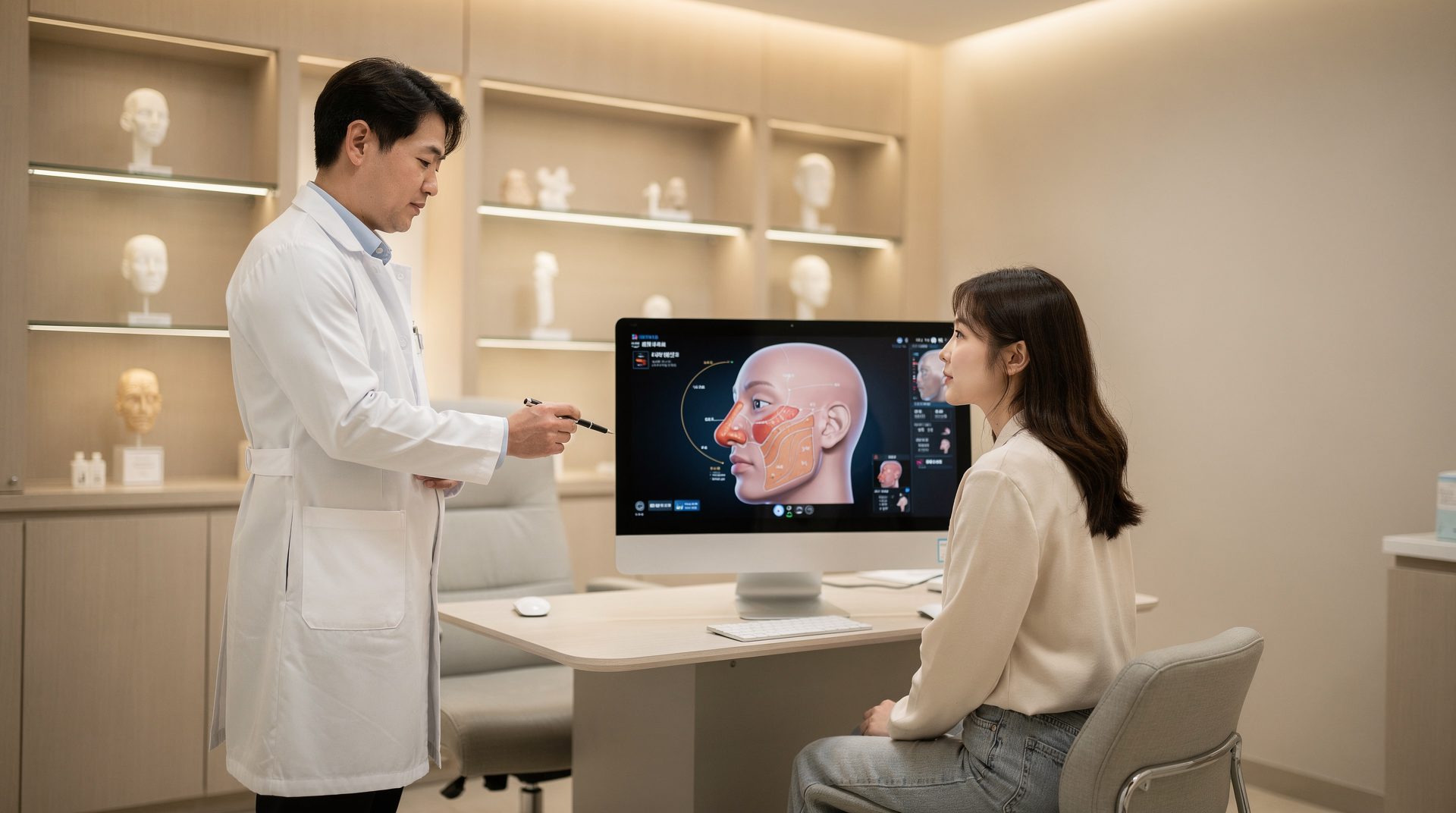
At Link Plastic Surgery, rhinoplasty consultations include 3D imaging analysis that shows projected results from multiple angles before surgery. Remote consultations are available via WhatsApp and KakaoTalk.
5 Things Nobody Tells You About Rhinoplasty Recovery
- Your nose will feel like it belongs to someone else for weeks. Numbness and stiffness around the tip are normal. Sensation returns gradually over 2 to 4 months.
- Smiling will feel weird. The upper lip connects to the nasal base. After tip work, smiling may feel restricted for 2 to 3 weeks. It comes back.
- One side heals faster than the other. Asymmetric swelling is the most common cause of post-op anxiety. Give it time. Symmetry returns as swelling resolves evenly.
- You will obsess over your nose in the mirror. Every patient does this. Set a rule: check once in the morning, once at night. More than that feeds anxiety without providing useful information.
- Month 3 is when you stop thinking about it. By month 3, the shape has settled enough that you stop analyzing it in every reflective surface. By month 6, it feels like it was always your nose.
How to Choose a Rhinoplasty Surgeon in Korea
- Check volume. How many rhinoplasties does the surgeon perform per week? Top Korean rhinoplasty surgeons do 10 to 20 per week. That volume matters.
- Look at revision cases. Any surgeon can show good primary results. A surgeon who can fix other surgeons’ mistakes has deeper technical skill.
- Ask about implant philosophy. Does the surgeon default to silicone, Gore-Tex, or autologous only? There is no single right answer, but you should understand the reasoning.
- Check Gangnam Unni reviews. This platform has verified patient reviews that are harder to fake than Google or Instagram.
- Consult at least two clinics. Different surgeons will suggest different approaches. Comparing plans gives you information that a single consultation cannot.
Recommended for Rhinoplasty Recovery
Products that patients commonly pack for nose surgery recovery in Korea.
- Arnica Montana Tablets — reduces bruising around the eyes, start 3 days before surgery. Check price on Amazon
- Bromelain Supplement (500mg) — pineapple enzyme that reduces post-surgical swelling. Check price on Amazon
- Travel Neck Pillow (Memory Foam) — sleeping elevated is mandatory after rhinoplasty, this helps. Check price on Amazon
- Bendable Straws — drinking through a straw avoids disturbing the nasal cast in the first week. Check price on Amazon
As an Amazon Associate, GlobalBeautySpot earns from qualifying purchases.
Considering Rhinoplasty in Korea?
Get a free remote consultation with a board-certified surgeon at Link Plastic Surgery. Send your photos through WhatsApp or KakaoTalk for a preliminary assessment and cost estimate.
Related Articles
- Korean Rhinoplasty vs. Western Rhinoplasty: What Is Actually Different
- How Much Does Rhinoplasty in Seoul Actually Cost for Foreigners in 2026
- Recovery After Plastic Surgery in Seoul: The Complete Foreign Patient Guide
- Planning Plastic Surgery in Korea: The Complete Medical Tourism Guide
Patient photo from a verified review at Link Plastic Surgery, Gangnam, Seoul. Published with patient consent. Eyes obscured for privacy. Results may vary.