Upper Eyelid Fat Removal in Korea: 3 Real Patient Results Without Incisional Surgery
Upper eyelid fat removal is one of the most misunderstood eye procedures among international patients. Most people assume that any surgery on the upper eyelid means double eyelid surgery, but these are two entirely different operations with different goals. Fat removal targets the puffy fat pads above the eye without creating a new crease. It is designed for people who already have a defined lid fold but whose eyes look heavy, tired, or swollen due to excess orbital fat.
In Korea, this procedure is performed as a standalone treatment far more often than in Western countries, where surgeons tend to bundle it with blepharoplasty. The Korean approach isolates the fat pad, removes or repositions it through a tiny puncture, and leaves the eyelid crease completely untouched. The result is a lighter, more open eye appearance without any structural change to the lid fold.
I coordinated consultations for three patients who had upper eyelid fat removal at clinics in Seoul. All three wanted to reduce puffiness without altering their natural crease. Their photos document the actual results.
Key Takeaways
- Eyelid fat removal targets puffy upper lids without creating or changing the eyelid crease.
- The procedure takes roughly 20 minutes under local anesthesia with 3 to 5 days of visible recovery.
- Cost in Korea: $800 to $1,500. US equivalent: $2,500 to $5,000.
- Best candidates: people with naturally puffy upper lids who do not want double eyelid surgery.
- All three patients reported satisfaction with reduced puffiness and a more defined lid contour.
Case 1: Eyelid Fat Removal Result
This patient had genetically puffy upper eyelids that made her look perpetually tired. She specifically requested fat removal only, without any crease modification. The puffiness was most noticeable in the inner corner area of both eyes.
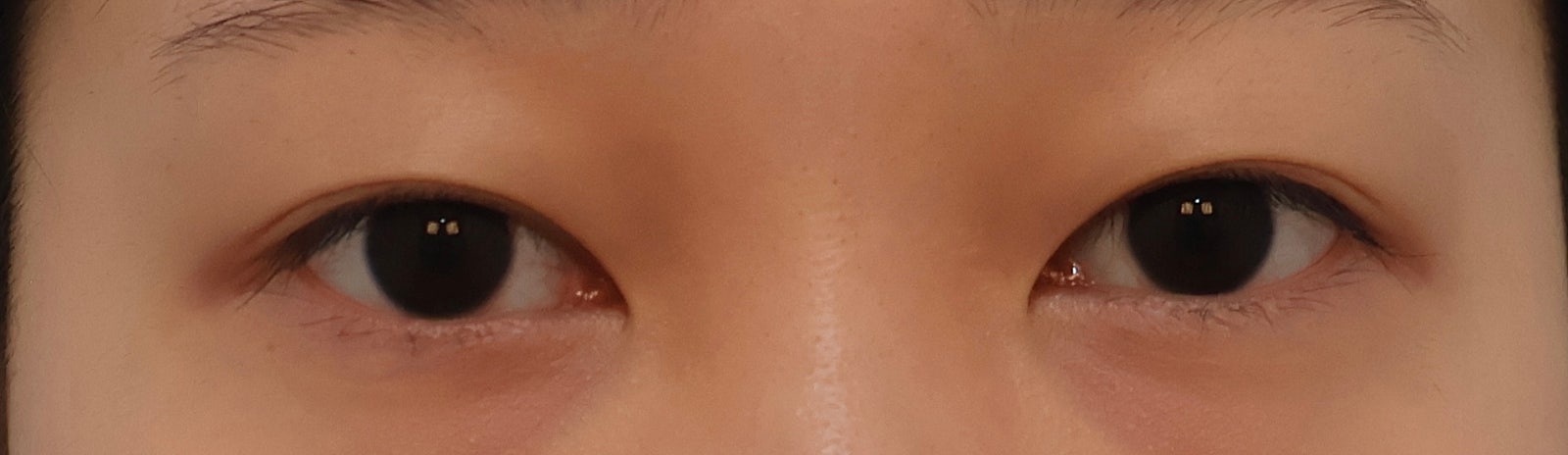
Before

After
“I had my upper eyelid fat removed. The puffiness that always made me look swollen in the morning is completely gone. My eyes look so much more awake now and the crease is exactly the same as before.” — Patient review #1002, translated from Korean
Case 2: Eyelid Fat Removal Result
This patient had thick, heavy-looking upper lids that partially obscured her natural double fold. Rather than deepening the crease, her surgeon removed the fat deposits to let the existing fold become visible again.

Before

After
“Got my eyelid fat removed. My lids used to look so puffy that you could barely see my crease. Now the fold shows naturally and my eyes look much lighter. Recovery was faster than I expected.” — Patient review #921, translated from Korean
Case 3: Eyelid Fat Removal Result
This patient wanted a subtle reduction in upper lid volume. She did not have extreme puffiness but felt her eyes looked smaller than they actually were due to the fat pad sitting over her crease.

Before

After
“Had my eyelid fat taken out. The change is subtle but my eyes look noticeably more open. Friends keep asking if I started getting more sleep.” — Patient review #805, translated from Korean
Eyelid Fat Removal vs. Double Eyelid Surgery
The confusion between these two procedures leads to a lot of miscommunication during consultations. They are fundamentally different operations.
Eyelid fat removal targets the orbital fat pad that sits between the skin and the levator muscle. The surgeon makes a small puncture (usually 2 to 3mm) in the natural crease line, locates the fat compartment, and removes the excess. No skin is cut, no crease is created, and no sutures are placed on the lid surface. The puncture heals without a visible scar.
Double eyelid surgery (blepharoplasty) creates or enhances the supratarsal fold. It involves either incisional cutting of the lid skin or a buried suture technique that attaches the skin to the levator aponeurosis. This changes the fundamental structure of the eyelid.
If you already have a crease and your concern is puffiness rather than fold definition, fat removal alone is the appropriate procedure. At Link Plastic Surgery, this distinction is assessed during consultation, and the clinic frequently performs fat removal as a standalone eye procedure without combining it with crease work.
Who Needs Eyelid Fat Removal
- People with genetically puffy upper lids that make eyes look heavy or tired
- Patients who have a natural crease but it is hidden beneath fat deposits
- Anyone who has been told they need double eyelid surgery but does not actually want a crease change
- Patients whose upper lid puffiness worsens with age as the orbital septum weakens
- People who want a more defined eye contour without an obvious “surgical” look
This procedure is not suitable for patients with significant skin laxity (excess drooping skin), which requires skin excision blepharoplasty. It also does not address ptosis (drooping of the eyelid itself due to muscle weakness).
The Procedure: What Happens During Surgery
The entire procedure takes approximately 20 minutes for both eyes. Local anesthetic is injected into the upper lid, which numbs the area completely. The surgeon makes a micro-puncture in the natural crease line, identifies the fat compartment, and gently extracts the excess fat using fine forceps. The puncture is so small that it typically does not require sutures.
Patients are awake throughout the procedure. There is pressure but no pain once the anesthetic takes effect. The surgeon may ask the patient to open and close their eyes during the procedure to assess symmetry in real time.
Eyelid Fat Removal Cost: Korea vs. United States
| Procedure | Korea (Seoul) | United States |
|---|---|---|
| Upper eyelid fat removal (both eyes) | $800 to $1,500 | $2,500 to $5,000 |
| Fat removal + minor crease adjustment | $1,200 to $2,500 | $4,000 to $7,000 |
| Upper blepharoplasty (skin + fat) | $1,500 to $3,000 | $4,000 to $8,000 |
Korean pricing includes the surgeon fee, local anesthesia, facility use, and all follow-up visits. There are no hidden charges or separate anesthesia bills.
Recovery Timeline
| Timeline | What Happens |
|---|---|
| Day 1 | Swelling and mild bruising, cold compress recommended, avoid rubbing eyes |
| Day 2 to 3 | Swelling peaks then begins to subside, bruising may spread slightly |
| Day 3 to 5 | Most swelling resolves, can wear glasses comfortably, concealer-friendly |
| Week 1 to 2 | Residual puffiness fades, puncture site fully healed, makeup is safe |
| Month 1 | Final result visible, all swelling resolved |
Because there is no incision and no sutures, the recovery is significantly shorter than double eyelid surgery. Most patients return to normal activities within 3 to 5 days, with makeup covering any residual bruising easily.
Recommended for Post-Procedure Recovery
Products commonly used during recovery from eyelid fat removal.
- Arnica Montana Tablets — reduces bruising and swelling around the eye area, start 2 days before surgery. Check price on Amazon
- COSRX Snail Mucin Essence — gentle hydration for the delicate skin around healing eyelids. Check price on Amazon
- Silicone Scar Sheets — can be cut to size for the small puncture site if any mark remains. Check price on Amazon
- Beauty of Joseon Relief Sun SPF 50+ — lightweight SPF that protects the thin eyelid skin from post-procedure hyperpigmentation. Check price on Amazon
As an Amazon Associate, GlobalBeautySpot earns from qualifying purchases.
Considering Eyelid Fat Removal in Korea?
Get a free remote consultation with a board-certified eye surgery specialist at Link Plastic Surgery. Send your photos through WhatsApp or KakaoTalk for a preliminary assessment and cost estimate.
Related Articles
- Double Eyelid Surgery in Korea: Real Before-and-After Results From 5 Patients
- Upper Blepharoplasty in Korea: What Eyelid Surgery Looks Like at Every Stage
- Korean Rhinoplasty Results at 1 Month: What Your Nose Actually Looks Like During Recovery
- Planning Plastic Surgery in Korea: The Complete Medical Tourism Guide
Patient photos from verified reviews at Korean plastic surgery clinics. Published with patient consent. Results may vary.