Incisional vs Non-Incisional Double Eyelid Surgery in Korea: 3 Real Patient Results Compared
The question that every patient researching double eyelid surgery in Korea eventually lands on: incisional or non-incisional? The internet is full of opinions. Clinics push the method they specialize in. Reddit threads spiral into arguments about scarring and longevity.
None of that is as useful as seeing actual results side by side. Same clinic, same surgeon, different methods chosen for different eyes.
These three patients had their procedures at Link Plastic Surgery in Gangnam between January and February 2026, all performed by Dr. Jung Min-su. Each patient had a different starting point and received a different combination of techniques. The photos were taken at 1 month post-op, when swelling has mostly resolved and the crease shape is close to its final form.
Key Takeaways
- Incisional and non-incisional methods produce different results because they solve different problems, not because one is “better.”
- Ptosis correction (weak eyelid muscles) is the most common add-on and makes the biggest difference in how alert the eyes look.
- Epicanthoplasty (inner corner release) widens the visible eye area without changing the crease itself.
- All three patients achieved natural-looking results at 1 month with no visible scarring.
- Cost in Korea ranges from $1,200 to $3,500 depending on complexity, versus $4,000 to $7,000 in the US.
Case 1: Incisional + Epicanthoplasty + Ptosis Correction + Fat Removal
Surgeon: Dr. Jung Min-su
Method: Incisional double eyelid surgery with epicanthoplasty (inner corner), ptosis correction, and upper eyelid fat removal
Photos: Before (left) and 1 month post-op (right)
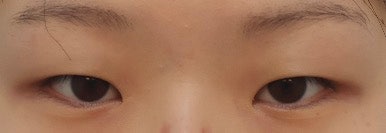
Before

1 Month Post-Op
This was the most comprehensive case of the three. The patient had a true single eyelid (monolid) with a strong epicanthal fold covering the inner corner. Thick upper eyelid skin and mild ptosis compounded the issue, making the eyes appear small and narrow.
The incisional approach was necessary here because of the fat volume that needed to be removed. Non-incisional methods cannot address excess fat or skin. The surgeon created a defined crease, released the epicanthal fold to expose more of the inner eye, corrected the ptosis to lift the eyelid margin, and removed surplus fat through the incision line.
The result at 1 month shows a clear, defined crease with visibly wider and more open eyes. The epicanthoplasty widened the horizontal eye dimension noticeably. No visible scarring along the crease line.
“A friend had her surgery here and it turned out so well that she recommended it. All the staff were kind, and they helped me get the best price. Everyone around me has been asking where I got it done.” — Patient review, translated from Korean
Case 2: Non-Incisional (Burial) + Epicanthoplasty + Ptosis Correction
Surgeon: Dr. Jung Min-su
Method: Non-incisional (burial method) double eyelid surgery with epicanthoplasty and ptosis correction
Photos: Before (left) and 1 month post-op (right)

Before

1 Month Post-Op
This patient had ptosis (weak levator muscles) as the primary concern. The eyes were asymmetric, and she had to use her forehead muscles to open her eyes fully, causing forehead wrinkles. But her eyelid skin was relatively thin with minimal fat, making her a candidate for the non-incisional approach.
The burial method uses sutures placed through tiny punctures to create the crease fold. No incision, no scar, faster recovery. Ptosis correction was performed simultaneously by tightening the levator muscle through the same access points. Epicanthoplasty opened the inner corners slightly.
At 1 month, the eyes are symmetrical with a natural-height crease. The forehead wrinkles from compensatory brow lifting have diminished because the eyelid muscles now open the eyes properly on their own.
“I always had to strain my forehead to open my eyes. After surgery, my eyes open easily and the crease looks completely natural. The staff and doctor were very kind and I felt comfortable the whole time.” — Patient review, translated from Korean
Case 3: Incisional Double Eyelid Surgery (Standard)
Surgeon: Dr. Jung Min-su
Method: Incisional double eyelid surgery
Photos: Before (left) and 38 days post-op (right)

Before

38 Days Post-Op
The simplest case of the three. This patient’s main complaint was a “sleepy” appearance. He had faint, uneven eyelid creases that gave his face a perpetually tired look. No significant ptosis, no excessive fat. The incisional method was chosen for crease permanence and precise placement.
The result at 38 days shows well-defined, symmetrical creases that transform the overall impression from drowsy to alert. The crease height was set conservatively to match a natural male aesthetic. Recovery was straightforward, and the patient reported returning to daily activities quickly.
“I always looked sleepy and it stressed me out. The staff explained everything clearly and the surgeon was thorough. The surgery went smoothly and I could go back to normal life quickly.” — Patient review, translated from Korean
Incisional vs Non-Incisional: How to Decide
The method isn’t a preference. It’s determined by your anatomy.
| Factor | Non-Incisional (Burial) | Incisional |
|---|---|---|
| Eyelid skin | Thin, minimal excess | Thick, excess skin present |
| Upper eyelid fat | Minimal | Significant (can be removed) |
| Scarring | No visible scar | Hidden in crease fold |
| Recovery | 3 to 5 days | 7 to 10 days |
| Permanence | May loosen over 5 to 10 years | Permanent |
| Cost in Korea | $1,200 to $2,000 | $1,800 to $3,500 |
| Cost in US | $3,000 to $5,000 | $4,000 to $7,000 |
Korean surgeons often combine the primary method with add-on procedures tailored to the patient’s specific anatomy. The three cases above illustrate this: same surgeon, three different combinations, three different results that all look natural because the approach was customized.
Common Add-On Procedures
- Ptosis correction strengthens the levator muscle so the eyelid opens wider. This is what makes the biggest difference in how “awake” the eyes look. Cases 1 and 2 both included ptosis correction.
- Epicanthoplasty releases the Mongolian fold at the inner corner, widening the eye horizontally. Particularly effective for patients whose inner corners are deeply hooded.
- Upper eyelid fat removal reduces puffiness above the crease. Only possible with the incisional method. Case 1 required this because of thick, fatty eyelid skin.
- Lateral canthoplasty adjusts the outer corner shape. Less common but sometimes added for patients who want a more elongated eye shape.
Why These Results Look Different From What You See Online
Most before-and-after galleries on clinic websites show photos taken at 3 to 6 months, with professional lighting and sometimes makeup. These photos were taken at 1 month with regular lighting and no retouching. That is why they look real.
The crease will continue to refine slightly over the next 2 months. Mild residual swelling at 1 month can make the crease appear slightly higher than its final position. By month 3, the fold settles into its permanent shape.
At Link Plastic Surgery, Dr. Jung Min-su has performed over 800 reviewed cases on Gangnam Unni with a 9.4 rating. Double eyelid surgery is the clinic’s most frequently performed procedure.
Recommended for Your Recovery
Products that patients commonly use before and after eyelid surgery.
- Arnica Montana Tablets — start 3 days before surgery to reduce bruising. Check price on Amazon
- COSRX Advanced Snail 96 Mucin Essence — gentle hydration safe for the eye area post-surgery. Check price on Amazon
- Silicone Scar Sheets — apply along the crease line 2 weeks post-op (incisional only). Check price on Amazon
- Beauty of Joseon Relief Sun SPF 50+ — lightweight sunscreen to protect healing skin. Check price on Amazon
As an Amazon Associate, GlobalBeautySpot earns from qualifying purchases.
Considering Double Eyelid Surgery in Korea?
Get a free remote consultation with Dr. Jung Min-su at Link Plastic Surgery. Send your photos through WhatsApp or KakaoTalk.
Related Articles
- Double Eyelid Surgery in Korea: Why Korean Surgeons Fix More Than Just the Crease
- Ptosis Correction in Korea: Costs, Top Clinics and What to Expect
- Under-Eye Fat Repositioning: 4 Real Patient Results
- Planning Plastic Surgery in Korea: The Complete Medical Tourism Guide
All before-and-after photos are from verified patient reviews at Link Plastic Surgery, Gangnam, Seoul. Photos published with patient consent. Results may vary.