Korean Rhinoplasty Recovery at One Month: What the Mirror Actually Shows (and Doesn’t)
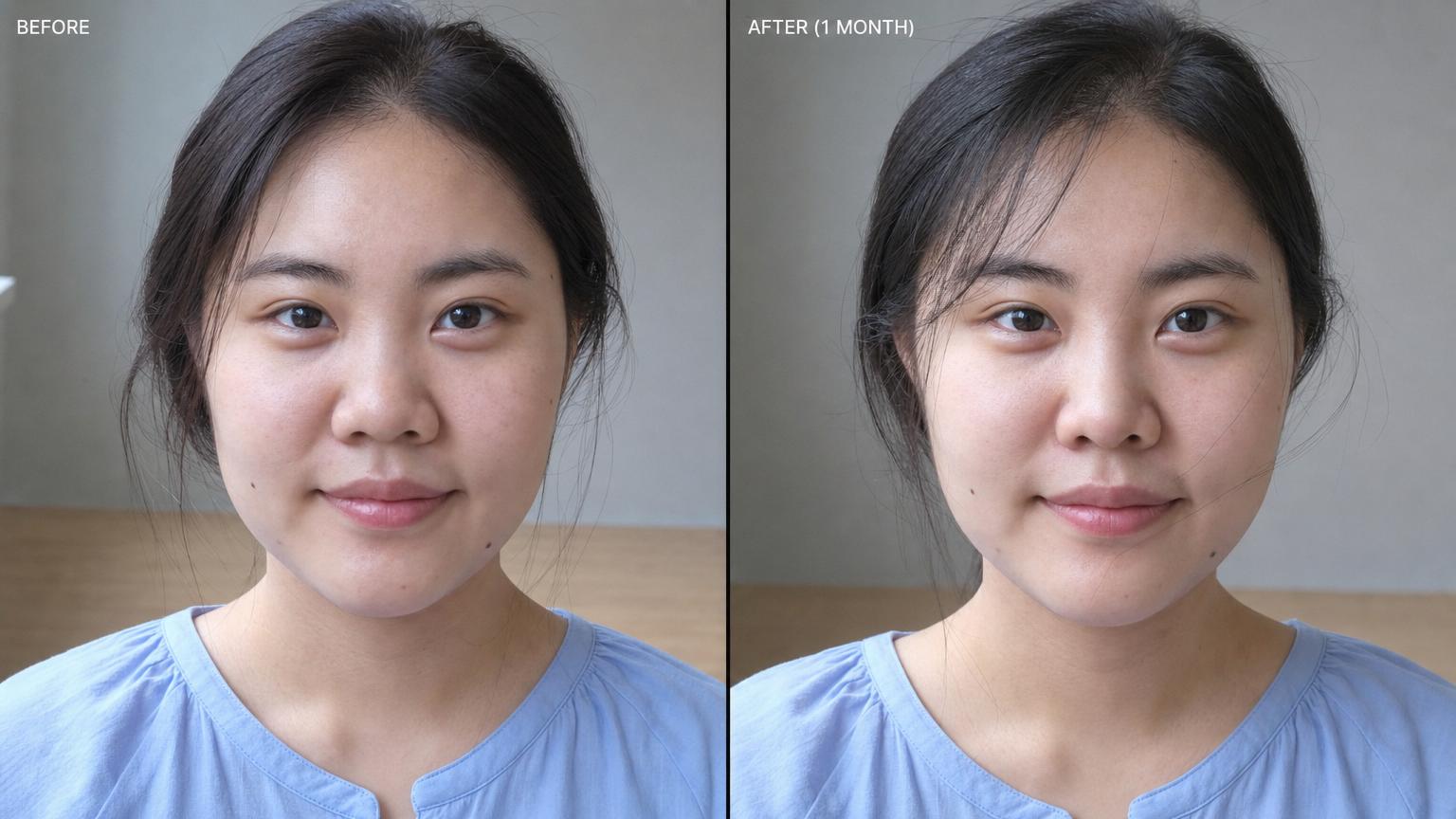
The first thirty days after Korean rhinoplasty is the period that almost nobody describes accurately online. Patients see week-one bruising photos that look much worse than they will ever look. They see six-month final-result photos that look better than they will look at one month. Between those two extremes — the bruising peak and the eventual final — sits the actual one-month state, and it is the most common moment a foreign patient is forced to walk back into their normal life and answer the question “did you do something to your face?”. This guide walks through what one month after Korean rhinoplasty actually looks like, why it is not the final result, and how to read your own mirror correctly so you don’t panic at week three or feel falsely reassured at week five.
This is the most-searched but least-clearly-answered window in the entire Korean rhinoplasty recovery timeline. Foreign patients who flew into Seoul, had the surgery, and flew home around day 10–14 spend the next 16–20 days alone with their face — without their surgeon’s daily reassurance and without other recent-rhinoplasty patients to compare against. The result is a lot of unnecessary anxiety, a lot of premature judgments about whether the surgery “worked,” and a lot of patients who think their result is final when they’re actually still seeing 10–15% residual tip swelling.
This guide is written specifically for the patient at day 21, day 28, day 35 — looking in the mirror, wondering if what they see is the answer. It draws on the recovery pattern that Korean clinics like Link Plastic Surgery document across their post-op patients, and on the way the standard 6-month rhinoplasty timeline actually unfolds in practice.
The One-Month State — What’s Actually Settled, What Isn’t
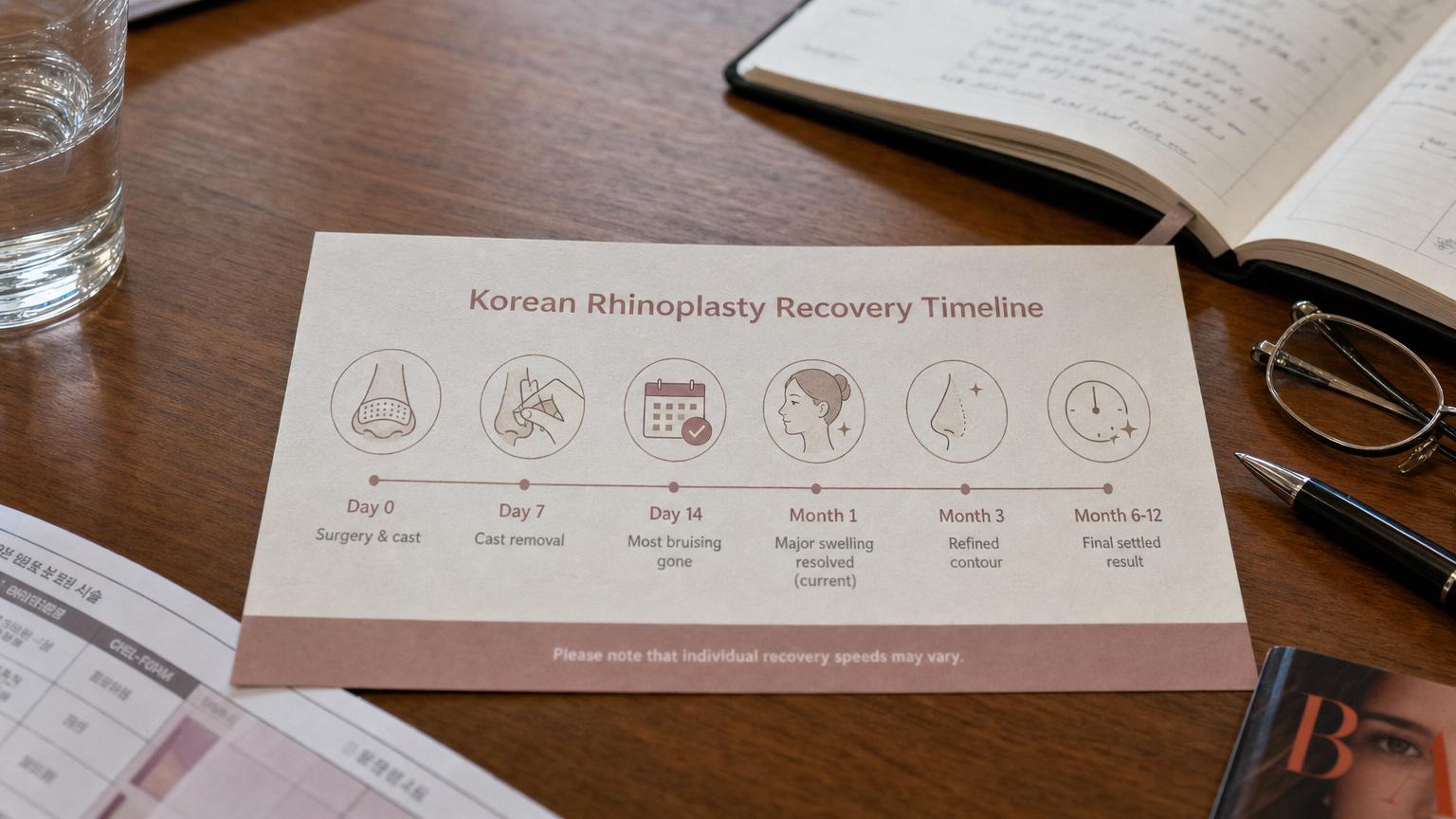
By day 30 after Korean rhinoplasty, about 70–80% of the visible swelling has resolved. That sounds like a lot — and it is the most rapid resolution phase of the entire timeline — but the remaining 20–30% is concentrated almost entirely in the nasal tip and along the bridge in subtle ways that the patient sees in the mirror but a casual observer does not. Understanding which parts have settled and which haven’t is the entire mental health management of the one-month window.
What Has Settled by Day 30
- The cast or splint is long gone. Removed at day 7 in standard Korean practice, so by day 30 there has been three weeks of free healing.
- Bruising is essentially resolved. Most patients have no visible bruising at day 14, and any residual yellow-green discoloration around the inner eye corners (most common spot) is fully gone by day 21–25.
- Major bridge swelling is gone. The dorsal contour at day 30 is close to its final shape — usually within 5–10% of where it will eventually settle. If your surgeon raised your bridge with an implant or cartilage graft, that height is now essentially what you’ll keep.
- Skin sensation is back to normal in most areas. The numbness on the nose tip and columella, which is universal at week one, has begun to return by day 30 (and continues to fully resolve over the next 2–3 months).
- You can wear glasses again carefully. Resting prescription glasses gently on the bridge is generally permitted from day 28–30, though heavy glasses should still wait until month 2.
What Has Not Yet Settled
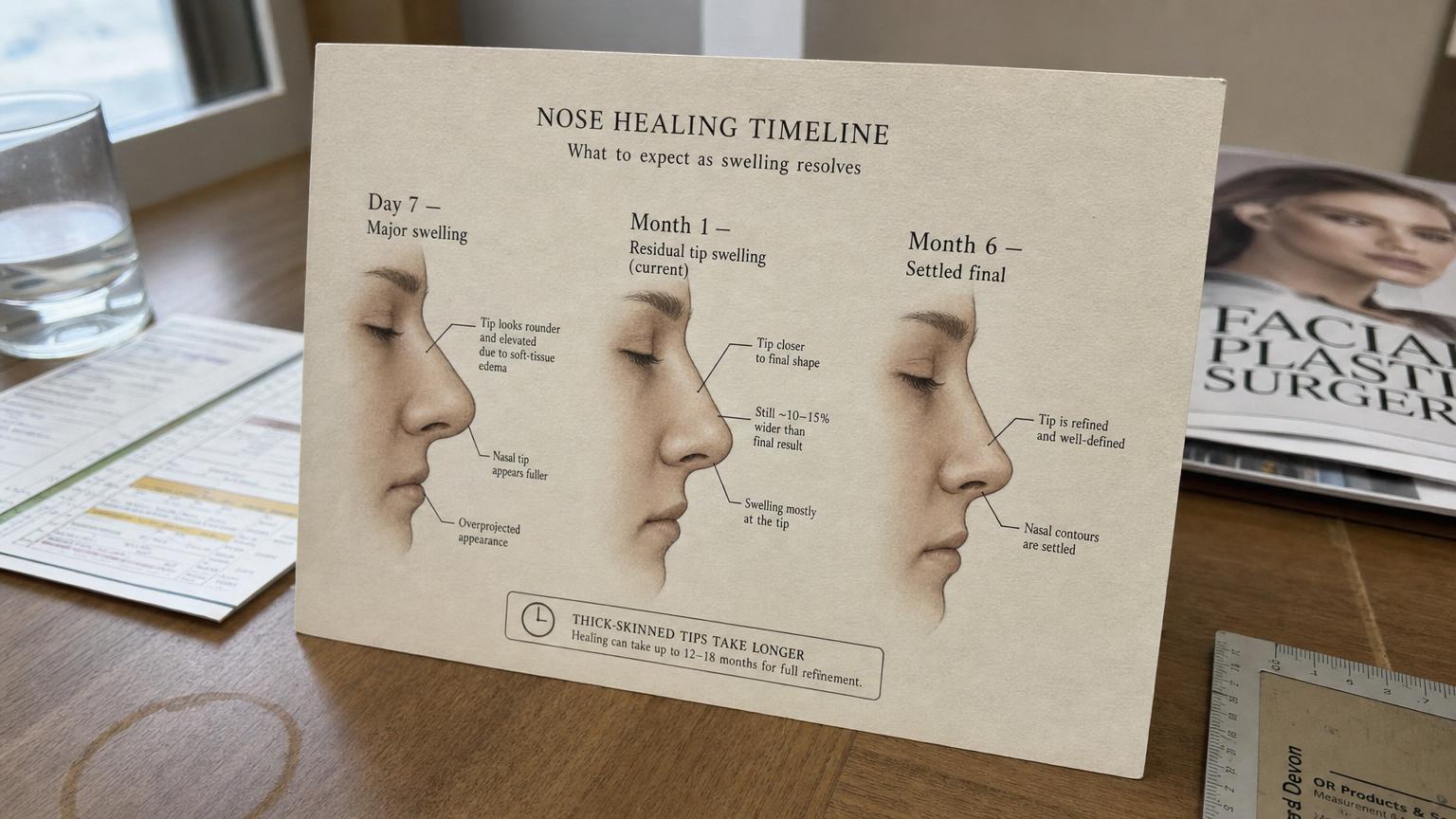
- Tip swelling. This is the single most important point in this guide. The nasal tip — particularly in patients with thicker skin (which includes most Asian noses) — retains residual swelling for 6 to 12 months after surgery, sometimes up to 18 months in the thickest-skinned patients. At day 30 your tip is probably still 10–15% wider and more rounded than it will eventually be.
- Final symmetry. Small asymmetries that you see at day 30 may resolve as the last of the swelling unevenly settles. Do not panic and do not photograph yourself obsessively for asymmetry comparison at this point — it will keep shifting until at least month 3, often month 6.
- Final feel and softness. The nose tip may still feel firmer than it should, slightly less mobile, slightly less natural to the touch. This is post-surgical scar tissue maturing — it will keep softening through month 3–6.
- Final smile interaction. The way the nose moves when you smile is the last thing to fully relax. At day 30 it may still feel stiff or unfamiliar. By month 3 it usually starts to feel like yours again; by month 6 it is yours.
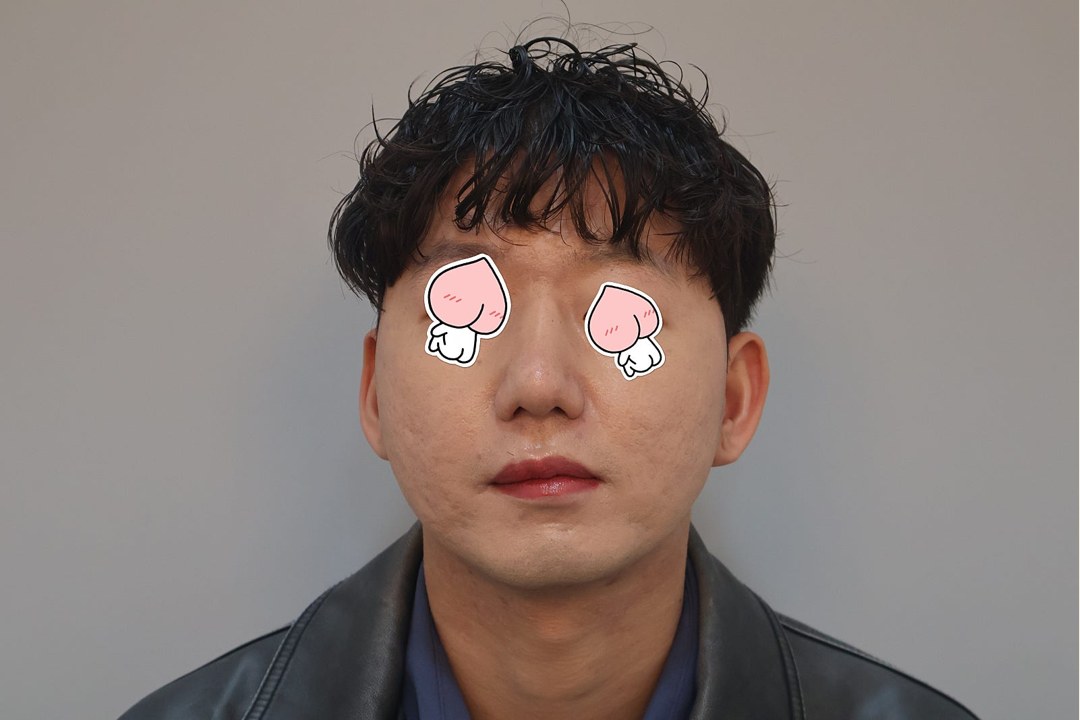
One Link Plastic Surgery patient who reached day 37 (just past the one-month mark) summarized the experience well in his cafe review: “It’s day 37 since surgery. Most of the major swelling is gone and it has settled fairly naturally. People around me say it looks very natural and that my overall impression has changed a lot. The surgeon told me there is still residual swelling and that I should expect even better results at six months. I’m so satisfied — and the staff said I had been positive throughout, which made me emotional.” This is the typical psychological pattern: visible improvement is real, the surgeon explicitly confirms that 6 months will look better still, and the patient settles into trusting the timeline rather than chasing daily comparisons.

A real Link Plastic Surgery patient at day 37 post-rhinoplasty (anonymized close-up, eye region covered for privacy). Note the natural-looking bridge and tip — the surgical change is real but restrained, the kind of result the Korean rhinoplasty aesthetic deliberately targets.
What Most Foreign Patients Get Wrong at One Month
The single most common mistake is reading the one-month state as if it were the final result, in either direction. Patients in two opposite categories make opposite mistakes at this point.
Mistake 1: Panicking Because “It Still Looks Swollen”
This is the most common foreign-patient anxiety at week 3 through week 6. They stand in the mirror, see a tip that looks slightly puffier than the AFTER photos on the surgeon’s website, and conclude that their surgery underperformed. They start typing “rhinoplasty revision Seoul” into their search bar. They consider asking for a refund. They lose sleep.
The truth is that the surgeon’s website AFTER photos are taken at 6 months or later — that’s the standard portfolio convention across Korean clinics, because at that point the tip has fully settled and the result is photo-stable. At one month nobody’s nose looks like a 6-month after photo. The patient who panics at week three is comparing themselves to a future version of themselves that takes another 5 months to materialize.
The countermove: do not look at the surgeon’s portfolio at month 1. Do not compare to 6-month after photos. The only legitimate comparison at this point is to your own pre-surgery photo. If your nose today is meaningfully different from your nose pre-surgery in the directions you wanted, the surgery is on track — even if the tip is still 10–15% over-settled.
Mistake 2: Feeling Falsely Confident Because “It Looks Done”
The opposite mistake is more common in patients with thinner skin and minor surgical interventions (e.g., a small bridge augmentation without significant tip work). For these patients, the one-month state can look surprisingly close to the final result, and they conclude that they are “done” and that the timeline they were given was just clinician conservatism.
This is also wrong, but less dangerous. The risk is that the patient resumes vigorous activity, contact sports, or aggressive facial massage too early and disturbs the still-fragile tip framework. The surgeon’s day-30 instructions are not aesthetic recommendations — they are structural protections of cartilage grafts that are still adhering. Even if your nose looks done at day 30, the underlying healing isn’t.
The countermove: follow the day-30 activity restrictions strictly, regardless of how good you think you look. Avoid contact sports until month 3 minimum, no rough nose-touching, no heavy glasses, no harsh skincare on the nose. Looking good at month 1 is not the same as being structurally settled.
The Real Recovery Calendar — Week by Week Through Month 1
Here is what each week actually looks like, in detail, so you can locate yourself on the timeline.
Recommended for Your Recovery
Products commonly used before and after Korean rhinoplasty 1 month recovery — same items routinely recommended in the recovery instructions Seoul clinics hand out at discharge.
- Arnica Montana Tablets — start 3 days before rhinoplasty to reduce nasal and periorbital bruising. Check price on Amazon
- Gel Eye Mask (Cold Compress) — cold compress for the under-eye bruising that typically peaks day 2 to 3 after rhinoplasty. Check price on Amazon
- Silicone Scar Sheets — apply along the columellar incision line from week 3 onward (open rhinoplasty only). Check price on Amazon
- Beauty of Joseon Relief Sun SPF 50+ — lightweight Korean sunscreen to protect the healing nasal skin and minimize post-inflammatory pigmentation. Check price on Amazon
As an Amazon Associate, GlobalBeautySpot earns from qualifying purchases at no extra cost to you.
Days 1–7 (Cast On)
You wear the surgical splint on the bridge. Visible swelling and bruising peak around days 3–5. Most patients sleep elevated on two pillows. Cold compresses on the cheeks (not on the nose itself) reduce bruising. By day 7 the cast is removed at the clinic, the nose is uncovered, and you see your post-surgical face for the first time. This first uncovered look is often more swollen than expected — this is normal and resolves rapidly over the next 7 days.
Days 8–14 (Bruising Fades)
The most dramatic visible improvement of the entire timeline. Major bridge swelling reduces, bruising shifts from purple-blue to yellow-green and rapidly fades. By day 14 most patients can be in public without anyone noticing they had surgery — concealer for the last yellow tones is usually sufficient. Foreign patients who flew in for surgery typically fly home in this window (day 10–14). One Link Plastic Surgery patient wrote at day 30: “It’s been one month after the surgery and I’m completely happy with it. The bruising disappeared so quickly.”
Days 15–21 (The Quiet Phase)
Little visible change day-to-day. Bruising fully resolved, bridge swelling at 80% resolution, tip still subtly swollen. The patient often experiences a flat psychological week here — the dramatic improvement of week two has slowed, and the slow tip-settling phase has begun. This is the week where overthinking starts. Resist it.
Days 22–30 (Approaching One Month)
Subtle continued improvement. The tip starts to look slightly less rounded. Skin sensation returning. Facial expressions becoming more natural. By day 30 you arrive at the snapshot point: the major work is visible, the major problems (bruising, asymmetric swelling, sutures) are gone, but the final refinement of the tip is still 2–11 months away.
Korea-Specific Recovery Realities Foreign Patients Don’t Anticipate
Several aspects of post-rhinoplasty recovery are specific to Korean surgical and aftercare practice, and foreign patients who don’t know about them are sometimes surprised when they return home.
Day 7 Cast Removal Is Standard, Not Premature
Some Western surgical traditions keep the splint on for 10–14 days. Korean clinics standardly remove at day 7 because the bridge fixation is already adequate by that point and earlier cast removal allows faster skin recovery underneath. If you flew home immediately after surgery without cast removal in Seoul, find a local clinic to remove it at day 7 — do not wait until day 14 because of a Western timing assumption.
Massage Protocols Vary
Many Korean surgeons teach specific tip-massage techniques starting at week 2–4 to encourage even swelling resolution and prevent fibrous nodules. If you were taught one of these techniques in Seoul, continue it — do not stop when you go home. If you were not taught one, do not improvise; aggressive untrained massage on a healing tip can disrupt cartilage graft adherence.
Korean Sun-Avoidance Is Stricter
Korean post-op skincare protocols emphasize 6–12 weeks of strict sun avoidance on the nose and full SPF 50+ daily, including indoors. This is not over-cautious — UV exposure on healing nasal skin produces lasting pigmentation marks (PIH, post-inflammatory hyperpigmentation) that can take 6–18 months to fade. Western patients who don’t follow this strictly sometimes end up with subtle nose-color irregularity that wasn’t there before.
Sleeping Position Continues to Matter
For the first 3–4 weeks Korean surgeons typically recommend sleeping on your back with the head elevated. Side-sleeping or face-down sleeping can apply pressure on healing cartilage and produce asymmetric outcomes. By week 4–5 most patients can return to side-sleeping carefully; face-down sleeping should wait until month 3 minimum.
Communication With the Korean Clinic Continues
Korean clinics that handle foreign patients well — including Link Plastic Surgery’s English-language rhinoplasty page — keep video or messenger consultation channels open for the first 3–6 months. If you have concerns at day 30, day 60, or day 90, contact the clinic. Do not consult random local plastic surgeons who do not know your case — they will often give conservative or unfamiliar advice that contradicts your surgeon’s specific surgical plan.
Cost and Combined-Procedure Considerations
If you are reading this guide as someone still planning Korean rhinoplasty (not in post-op), here is the price comparison for the primary procedure plus the typical Korean adjacent procedures that get added in the same surgical session.
| Procedure | Korea (Seoul) | USA | UK / EU |
|---|---|---|---|
| Primary Rhinoplasty (bridge + tip) | KRW 6–9M (USD 4,500–6,700) | USD 12,000–18,000 | GBP 8,000–13,000 |
| Revision Rhinoplasty | KRW 9–14M (USD 6,700–10,500) | USD 18,000–28,000 | GBP 12,000–18,000 |
| Alar Reduction (combined) | +KRW 1.5–3M | +USD 4,500–7,000 | +GBP 3,500–5,500 |
| Septoplasty (functional, combined) | +KRW 2–4M | +USD 5,000–9,000 | +GBP 3,000–6,000 |
The recovery profile for combined procedures is typically the same as the primary rhinoplasty alone — alar reduction and septoplasty heal within the same timeline window and rarely add visible downtime beyond the rhinoplasty itself. Adding combined procedures in the same operative session is usually more efficient than scheduling them separately.
If you are simultaneously considering related Korean cosmetic procedures, this guide pairs naturally with facial fat grafting (commonly combined with rhinoplasty when patients want both nose refinement and midface volume balance) and with the broader rhinoplasty consultation page.
Frequently Asked Questions
Why does my nose still look swollen at one month?
It does, and that is normal. The tip retains 10–15% residual swelling at day 30, particularly in thicker-skinned noses. The bridge is essentially settled, but the tip will continue to refine over months 2 through 6 (and up to 12–18 months for very thick-skinned tips). Compare your day-30 photo to your pre-surgery photo, not to your surgeon’s 6-month portfolio photos.
When will I see my final result?
Most of the visible refinement happens by month 3. The “photo-stable” final result is conventionally documented at month 6. For thick-skinned tips, micro-refinement continues through month 12–18. By month 6 you have what you’ll keep.
Can I exercise at one month?
Light cardio yes (jogging, walking, gentle yoga). Contact sports, heavy weight lifting with breath-holding, and anything that risks impact to the face — no, wait until month 3 minimum. Swimming in chlorinated pools should also wait until at least month 6 for full skin barrier recovery.
Can I wear glasses at one month?
Light prescription glasses gently resting on the bridge — usually yes from day 28–30. Heavy frames, sports glasses, or any glasses that press firmly on the bridge — wait until month 2 or use the “tape-and-forehead” workaround (tape the glasses’ nose bridge to the forehead with skin-safe tape so weight rests there, not on the healing nose).
Is the tip supposed to feel firm?
Yes. The tip will feel firmer and less mobile than the rest of your face for the first 3–6 months. This is post-surgical induration (firmness from healing) plus residual swelling. It softens over months 3–6 and the natural feel returns. Aggressive massage to “soften” it earlier is counterproductive — let it heal at its own pace.
What if I see asymmetry at one month?
Minor asymmetry at day 30 is extremely common and almost always resolves as the last of the swelling settles unevenly between months 2 and 6. Do not photograph yourself obsessively. Do not consider revision until at least month 6, ideally month 12. The asymmetry seen at day 30 is rarely the asymmetry you will have at month 6.
Can I fly at one month?
Yes, fully. Most foreign patients fly home around day 10–14 and the cabin pressure is no problem at that point. By day 30 any flight is completely fine.
What about the inside of my nose?
Internal healing parallels external. At day 30 internal scabbing is usually fully resolved, breathing is essentially normalized, and the nasal lining feels normal. If you have any persistent nasal congestion at day 30 that wasn’t there before surgery, mention it at your next follow-up — usually it resolves on its own but occasionally it indicates a minor internal issue worth checking.
When do I tell people what I had done?
Your call. At day 30 most people don’t notice consciously — they just register that you look different (“did you change your makeup?” / “you look more rested” / “did you lose weight?”). If someone explicitly asks, the choice to disclose or not is purely personal. Korean clinic culture is supportive of either — full disclosure is no stigma, and not disclosing is equally normal.
What if I’m not satisfied at six months?
At six months the result is mostly stable, and if there’s a specific concern that’s clearly imperfect (asymmetric tip, residual bump, etc.) it’s reasonable to discuss with the clinic. Korean clinics typically have a revision policy for surgically-caused issues — free or significantly discounted within the first 12 months, depending on the cause. Do not initiate revision discussions before month 6 — too early to know what is genuinely settled vs still resolving.

Closing
The one-month window after Korean rhinoplasty is the moment most foreign patients are forced to assess their result without their surgeon nearby, and it’s the moment they’re most likely to misread what they see in the mirror. The major swelling is gone, the bruising is gone, the cast is long gone — but the final tip refinement is still 2 to 11 months ahead. The right mental model at day 30 is “I am 70–80% of the way to the final, with visible structural improvement, and the rest will continue to refine through month 6.” Patients who hold that frame end up satisfied. Patients who compare themselves to 6-month after-photos at day 30 end up needlessly anxious.
If you flew into Seoul for rhinoplasty — and especially if you chose a clinic with deep foreign-patient experience like Link Plastic Surgery — the surgeon’s day-30 reassurance is built on the specific pattern they have seen in thousands of post-op patients with anatomy similar to yours. Trust the timeline. Take photos sparingly. Avoid the 6-month portfolio comparison. The result you flew for is mostly visible at day 30 and will continue to refine for the next five months.