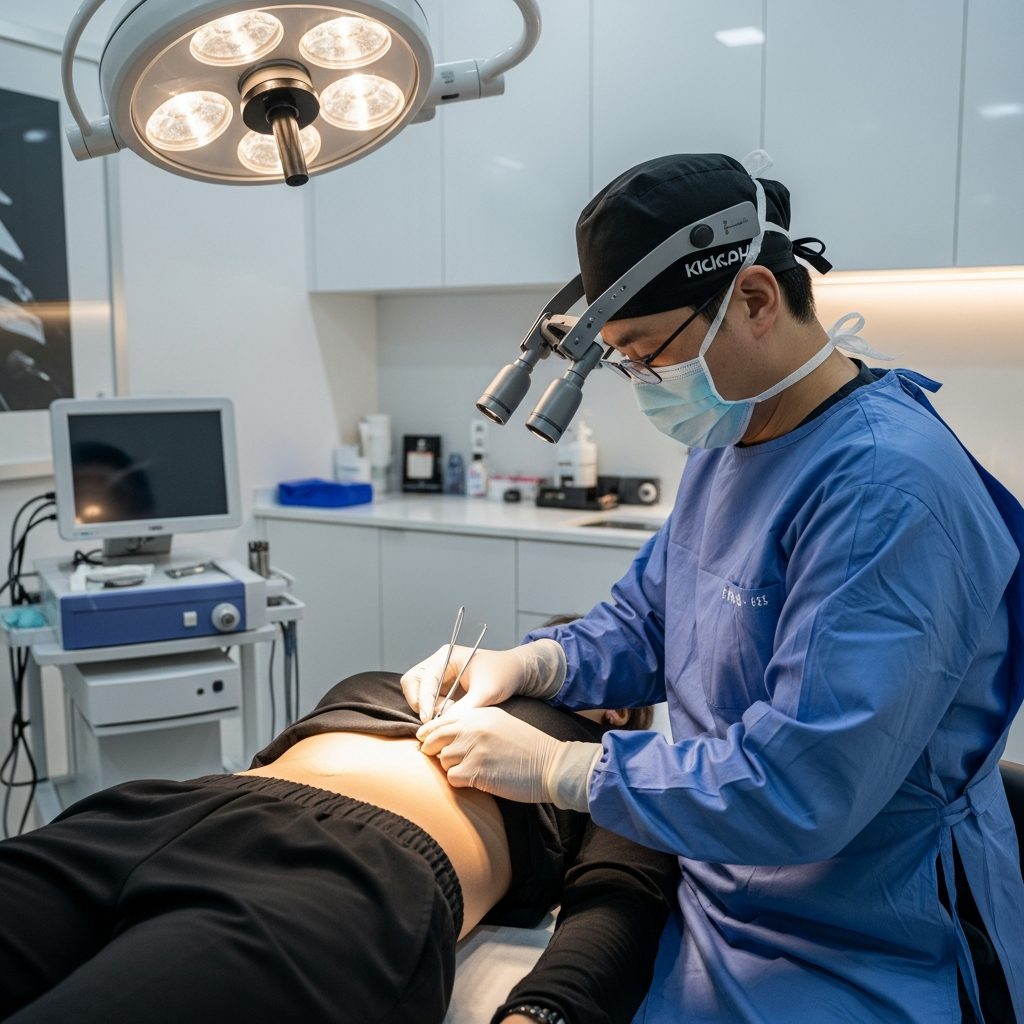
Belly Button Surgery After Tummy Tuck or Pregnancy: What Korean Surgeons Do Differently
The patient sitting across from me in the Apgujeong consultation room kept pulling up her shirt. Not to show the tummy tuck scar — that had healed fine. She was pointing at her belly button. “It looks like a hole someone punched into dough,” she said. The surgeon nodded like he’d heard this exact description a hundred times before.
He probably had.
Belly button complaints after abdominoplasty are more common than most patients expect. And the shape issues that pregnancy leaves behind — stretched, flattened, protruding — those barely get mentioned during the initial tummy tuck consultation. Surgeons in the U.S. and Europe tend to treat the navel as an afterthought. A functional necessity during abdominoplasty, not an aesthetic priority.
Korean surgeons don’t see it that way.
I’ve coordinated patients through umbilicoplasty revisions at clinics across Seoul — places like Link Plastic Surgery, Banobagi, and ID Hospital — and the level of attention given to navel shape and depth surprised me the first time I saw it. There’s a specific aesthetic standard here. The belly button should be vertically oriented, slightly hooded at the top, with a visible depth of about 1 to 1.5 centimeters. Not round. Not shallow. Not a slit.
Most Western surgeons aim for “doesn’t look weird.” Korean surgeons aim for a specific template — and they’ll spend an extra 30 to 40 minutes during a tummy tuck to get there.
Key Takeaways
- Belly button shape is treated as a standalone aesthetic concern in Korean plastic surgery — not just a byproduct of abdominoplasty.
- Umbilicoplasty in Korea typically costs 40–60% less than comparable revision procedures in the U.S., even at top-tier clinics.
- Recovery is short — most patients fly home within 5 to 7 days, with sutures removed before departure.
- Post-pregnancy navel reshaping can usually be done as a standalone 30-minute procedure under local anesthesia.
- The “ideal” belly button shape Korean surgeons reference is vertically oval with a slight hood — a detail rarely discussed in Western consultations.
What caught my attention during that particular consultation wasn’t the surgeon’s skill. It was his vocabulary. He used terms like “hood ratio” and “inner shadow depth” while sketching on a tablet. The patient — who’d flown in from Texas specifically for this — started laughing. She said her original surgeon in Houston had spent maybe two minutes discussing her belly button before the tummy tuck. Two minutes for a feature she’d end up staring at in the mirror every single day.
That disconnect is exactly why navel revision has become a quiet but growing category in Korean medical tourism. Patients aren’t coming to Seoul because their belly buttons are medically problematic. They’re coming because the result from their first surgery — or from pregnancy — doesn’t match what they expected. And Korean clinics have built specific techniques around fixing that mismatch.

Why Korean Surgeons Approach Belly Button Reconstruction Differently
Most patients don’t walk into a consultation asking about their belly button. They come in for a tummy tuck, or they’re three years post-pregnancy and frustrated that their abdomen still doesn’t look right. The navel comes up almost as an afterthought — and that’s exactly where problems start.
Korean plastic surgeons have a fundamentally different philosophy about umbilicoplasty compared to what I’ve seen in Western clinics. In the U.S. or Europe, belly button reshaping is typically treated as a minor add-on to abdominoplasty. A secondary concern. In Korea, it’s treated as its own procedure with its own surgical plan.
That distinction matters more than you’d think.
What Actually Happens to Your Belly Button After a Tummy Tuck
During a standard abdominoplasty, the surgeon separates the navel stalk from surrounding skin, removes excess tissue, pulls the abdominal skin down, and then creates a new opening for the belly button. The navel itself stays attached to the abdominal wall — it’s the skin around it that moves.
And this is where results vary wildly between surgeons. A belly button that heals too flat, too round, or with visible scarring is one of the most common complaints after tummy tuck surgery worldwide. I’ve coordinated patients who flew to Korea specifically because their post-tummy-tuck navel looked unnatural — like a hole punched into smooth skin with no depth or shadow.
Pregnancy does something different. The stretching doesn’t just affect skin elasticity. It can flatten the navel entirely, create a permanent outie, or leave the surrounding skin with a wrinkled, deflated appearance that no amount of exercise will fix.

The Korean Technique: Vertical Oval With Hooding
Most Korean surgeons I’ve worked with aim for a specific aesthetic — a vertically oriented oval with a slight upper hood of skin that creates natural shadow. This sounds oddly specific. It is. And that specificity is the whole point.
Western abdominoplasty often produces a round, symmetrical belly button. Korean surgeons argue — and I tend to agree with them on this — that round belly buttons look surgical. Natural navels are almost never perfectly round. They have slight asymmetry, a deeper superior fold, and vary in depth depending on the patient’s body fat distribution.
The technique involves:
- Creating a vertically elongated incision (not circular)
- Preserving or reconstructing the superior hood — that small fold of skin above the navel opening
- Defatting the surrounding tissue to create proper depth without making it look like a crater
- Internal sutures anchoring the navel stalk to the fascia at the correct tension
One surgeon at a Gangnam clinic once showed me two photos side by side — one belly button he’d done, one natural. I genuinely couldn’t tell which was which. That’s the standard they’re working toward.
Standalone Umbilicoplasty vs. Combined With Tummy Tuck
Not everyone needs a full abdominoplasty. Some patients — especially post-pregnancy patients with good skin elasticity but a distorted navel — are candidates for standalone belly button surgery. This is a much smaller procedure.
| Factor | Standalone Umbilicoplasty | Combined With Tummy Tuck |
|---|---|---|
| Surgery time | 30–60 minutes | 2.5–4 hours total |
| Anesthesia | Local (sometimes sedation) | General |
| Recovery to daily activities | 3–5 days | 2–3 weeks |
| Full recovery | 2–3 weeks | 6–8 weeks |
| Scarring | Hidden inside navel | Hip-to-hip line + navel |
| Hospital stay | Same-day discharge | 1–2 nights |
The standalone version is surprisingly quick. I’ve seen patients walk out of the clinic within two hours of arriving, including paperwork and consultation.
Cost: Korea vs. Western Countries
Pricing is one of the biggest reasons international patients consider Korea for this procedure. But the gap is wider than most people expect.
| Procedure | Korea (USD) | United States (USD) | UK / Europe (USD) |
|---|---|---|---|
| Standalone umbilicoplasty | $800–$2,000 | $2,500–$5,000 | $2,000–$4,500 |
| Umbilicoplasty + mini tummy tuck | $3,000–$5,500 | $7,000–$12,000 | $6,500–$10,000 |
| Full tummy tuck with navel reshaping | $5,000–$8,500 | $10,000–$18,000 | $9,000–$15,000 |
| Belly button revision (post-surgery correction) | $1,000–$2,500 | $3,000–$6,000 | $2,500–$5,500 |
These ranges reflect what I’ve seen across multiple clinics in Seoul — places like BK Plastic Surgery, Link Plastic Surgery, JW Plastic Surgery, and Grand Plastic Surgery. Pricing varies depending on the complexity of the case and whether general anesthesia is required. Revision cases tend to cost more because scar tissue from the first surgery makes everything harder.
One thing worth mentioning: Korean clinics almost always include aftercare visits in that price. In the U.S., follow-up appointments are often billed separately, which inflates the real cost beyond the quoted surgical fee.
Who’s Actually a Good Candidate
Not everyone who dislikes their belly button needs surgery. But certain situations make you a strong candidate:
- Post-tummy tuck patients with a flat, round, or scarred navel
- Post-pregnancy patients with a persistent outie or stretched, widened navel
- Patients with umbilical hernia repair that left cosmetic distortion
- Anyone with a naturally protruding or asymmetric belly button they’ve always disliked
Surgeons will typically evaluate skin quality, the amount of subcutaneous fat around the navel, and whether there’s any hernia involvement. If there’s a hernia, that changes the surgical approach entirely — and it needs to be repaired before or during the cosmetic work.
BMI matters too. Most Korean clinics prefer patients to be at or near their stable weight before operating. Significant weight fluctuation after surgery can distort results, and no surgeon wants to redo their own work.
Real Before & After: Link Plastic Surgery, Seoul
Actual patient results by Dr. Sung Ha-min. Individual results vary.


What the Recovery Actually Looks Like (Week by Week)
Most clinic websites show you the “after” photo at three months. They skip the ugly middle part. So here’s what happens between surgery day and that polished result.
Days 1–3: Your belly button area will be swollen, bruised, and covered in surgical tape or a small dressing. Pain level? Surprisingly mild for most patients — more of a tight, pulling sensation than sharp pain. Korean surgeons tend to use fine absorbable sutures internally, which means less irritation from stitch removal later. You’ll get prescribed pain medication, but many patients switch to over-the-counter options by day two.
Sleeping is the hard part. You can’t stretch out flat comfortably, especially if you had concurrent abdominal work. Prop yourself up at a slight incline. A travel neck pillow wedged behind your lower back actually helps more than you’d expect.
Week 1: Swelling peaks. Your new belly button will look nothing like the final result — puffy, possibly asymmetric, maybe a little alarming. This is normal. The shape hasn’t settled. Korean clinics typically schedule a follow-up around day 5–7 to check healing and remove any external sutures if non-absorbable ones were placed.
You can shower carefully after 48–72 hours at most clinics, but no soaking. No baths, no pools, no hot tubs for at least three weeks.
Weeks 2–4: Bruising fades. Swelling gradually decreases. You’ll start seeing the actual shape emerge around week three. Most patients return to desk jobs within 7–10 days, though anything involving core engagement — lifting, bending, exercise — stays off-limits for four to six weeks minimum.
And this is where patience gets tested. The scar inside and around the navel takes months to fully mature. It starts red or pink, sometimes slightly raised. By month three to six, it flattens and fades in most cases.

Choosing a Clinic in Korea — What Actually Matters
Board certification is baseline. Every legitimate plastic surgeon in Korea holds certification from the Korean Board of Plastic and Reconstructive Surgery. That’s your minimum filter, not a differentiator.
What separates clinics for umbilicoplasty specifically: volume of body contouring cases. A surgeon who does 200+ tummy tucks a year has reconstructed hundreds of belly buttons. That repetition builds a kind of spatial intuition for navel positioning and depth that you can’t learn from textbooks alone.
Clinics like Banobagi, Link Plastic Surgery, and 365mc handle high volumes of body contouring work, which means their surgeons deal with post-tummy-tuck and post-pregnancy navel reconstruction regularly. JW Plastic Surgery and THE PLUS also have dedicated body contouring teams. Ask specifically about umbilicoplasty case counts — some clinics will show you before-and-after portfolios if you request them during consultation.
One thing I’ve noticed sitting through consultations at different Gangnam clinics: the ones that spend time discussing belly button depth and hood shape tend to produce more natural-looking results. If a surgeon only talks about “making it smaller” without addressing three-dimensional contour, that’s a red flag.
Risks Nobody Mentions Until You Ask
Infection rates are low — under 2% at reputable Korean clinics based on what surgeons report. But minor wound separation happens more often than anyone advertises. The belly button sits in a natural skin fold that traps moisture and bacteria. Keeping it dry and clean during recovery is genuinely important, not just a box-check instruction.
Scarring is the bigger concern. Keloid-prone skin — more common in certain ethnicities — can produce raised, thickened scars inside the navel. Korean surgeons are generally aggressive about early scar management (silicone sheets, steroid injections if needed), but you should bring up your scar history at consultation. Don’t wait for them to ask.
Asymmetry. Not every belly button heals symmetrically. Mild unevenness is common and usually improves over six months as swelling fully resolves. Significant asymmetry — rare, but it happens — may need a minor revision. Most Korean clinics include one revision within the first year as part of the original surgical fee. Confirm this before booking.
And the thing that catches people off guard: sensation changes. The skin around your navel may feel numb or hypersensitive for weeks or months after surgery. It almost always resolves, but nobody prepares you for how strange it feels to have a body part that doesn’t register touch normally. I watched a patient in a recovery room genuinely confused because she couldn’t feel the nurse cleaning the area. Completely normal. Temporary. Still unsettling.

Practical Tips That Make a Difference
Bring high-waisted, loose pants. Not leggings — actual loose-fitting pants with a soft waistband. Your belly button area cannot tolerate compression or friction for the first two weeks. Korean clinics sometimes provide an abdominal binder, but for daily wear, you need bottoms that sit above or well below the navel.
Stock up on saline wound wash and cotton-tipped applicators before surgery. Post-op belly button cleaning is delicate work. You’re gently cleaning inside a healing wound twice daily. Regular soap is too harsh. Saline spray and a cotton swab — that’s it.
Skip vitamin E oil on fresh scars. This advice floats around constantly online, and most Korean dermatologists I’ve spoken with actively discourage it during early healing. Silicone-based scar gel after full wound closure (usually week 3–4) is the standard recommendation.
If you’re combining umbilicoplasty with a tummy tuck — which is common — recovery timelines overlap but the tummy tuck dominates. Your abdominoplasty restrictions (no lifting, compression garment, limited movement) already cover what the belly button repair needs. The navel work doesn’t add significant recovery time in a combined procedure.
One last thing. Take a photo of your belly button before surgery. Front-facing, side angle, and top-down. Patients forget what they started with, and having a reference point makes it much easier to appreciate the result at three months — even when your brain has already adjusted to the new shape and stopped noticing the improvement.
FAQ
I got a tummy tuck 6 months ago and my belly button looks like a weird slit — is that fixable in Korea?
Yes. Korean surgeons see this constantly from overseas tummy tuck patients. A standalone umbilicoplasty can reshape it into a natural vertical oval — usually under local anesthesia, about 40 minutes.
How long after pregnancy should I wait before getting belly button surgery?
Most Korean surgeons want at least 6 months postpartum. If you’re breastfeeding, they’ll typically say wait until you’ve fully stopped. And if you’re planning another pregnancy, they’ll flat-out tell you to hold off — the results won’t survive another round of stretching.
Does umbilicoplasty hurt? I have a really low pain tolerance.
It’s done under local. You’ll feel pressure but not much else. Post-op pain is mild — most patients describe it as a dull ache for 3-4 days.
Can they fix a belly button hernia and reshape it at the same time?
Depends on the hernia size. Small umbilical hernias — yes, Korean PS clinics handle both in one session. Larger hernias get referred to general surgery first. Two separate procedures in that case.
I’ve seen Korean belly buttons that look completely different from Western results. What are they actually doing differently?
Smaller incisions, for one. But the real difference is depth control. Western tummy tucks often create a shallow, wide belly button because the focus is on the abdominal contour. Korean surgeons obsess over the navel shape itself — they suture the deeper layers to create that subtle hooded look with a defined rim. It’s a different priority system.
What if I fly to Korea for this and something goes wrong after I leave?
Complications from umbilicoplasty alone are rare. Minor infection or stitch issues, mostly. Korean clinics with international departments will do follow-ups over video — I’ve seen coordinators check wound photos over KakaoTalk at 11pm. But you should plan to stay at least 5-7 days for stitch removal before flying.
Is it worth going to Korea just for belly button surgery? It feels like a small procedure to fly across the world for.
If it’s truly standalone, the travel cost might not make sense. Where it makes sense is combining it with something else — a revision tummy tuck, liposuction, skin tightening. Most patients I’ve seen bundle procedures. That’s when the Korea trip pays for itself.
Recommended for Your Recovery
Products that patients commonly use before and after surgery in Korea.
- Arnica Montana Tablets — start 3 days before surgery to reduce bruising and swelling. Check price on Amazon
- COSRX Advanced Snail 96 Mucin Essence — gentle hydration for healing skin post-surgery. Check price on Amazon
- Silicone Scar Sheets — apply 2 weeks post-op to minimize incision scarring. Check price on Amazon
- Beauty of Joseon Relief Sun SPF 50+ — lightweight Korean sunscreen, essential for post-surgical skin protection. Check price on Amazon
As an Amazon Associate, GlobalBeautySpot earns from qualifying purchases.
Final Thought
Belly button surgery is small but it’s one of those things you’ll notice every single day. If your navel got wrecked by a tummy tuck or pregnancy and it bothers you, a Korean surgeon can probably fix it in under an hour — just don’t fly 14 hours for a $800 procedure unless you’re combining it with something bigger.
Considering a procedure in Korea?
Get a free consultation with top-rated clinics in Seoul. We help you find the right surgeon for your goals.
You might also like
- Double Eyelid Surgery in Korea: Why Korean Surgeons Fix More Than Just the Crease (Incisional vs Non-Incisional Guide 2026)
- Botched Under-Eye Surgery Abroad? How Korea’s Revision Specialists Actually Fix Failed Fat Removal and Repositioning
- How Much Does Rhinoplasty in Seoul Actually Cost for Foreigners in 2026: Full Price Breakdown