The first question many foreign patients ask about a nose job is not about the result but about the scar: will there be a visible mark on the outside of the nose? For a certain kind of case, the answer in 2026 is increasingly no. Closed rhinoplasty, where every incision is made inside the nostrils, leaves no external scar at all. It has become a talking point precisely because the idea of a scar-free nose surgery is appealing. But the honest picture is more nuanced than the marketing: closed rhinoplasty is excellent for the right case and wrong for others, and the choice between it and the open approach is a surgical decision, not simply a matter of avoiding a scar. A consultation at Link Plastic Surgery can assess which approach suits your nose.
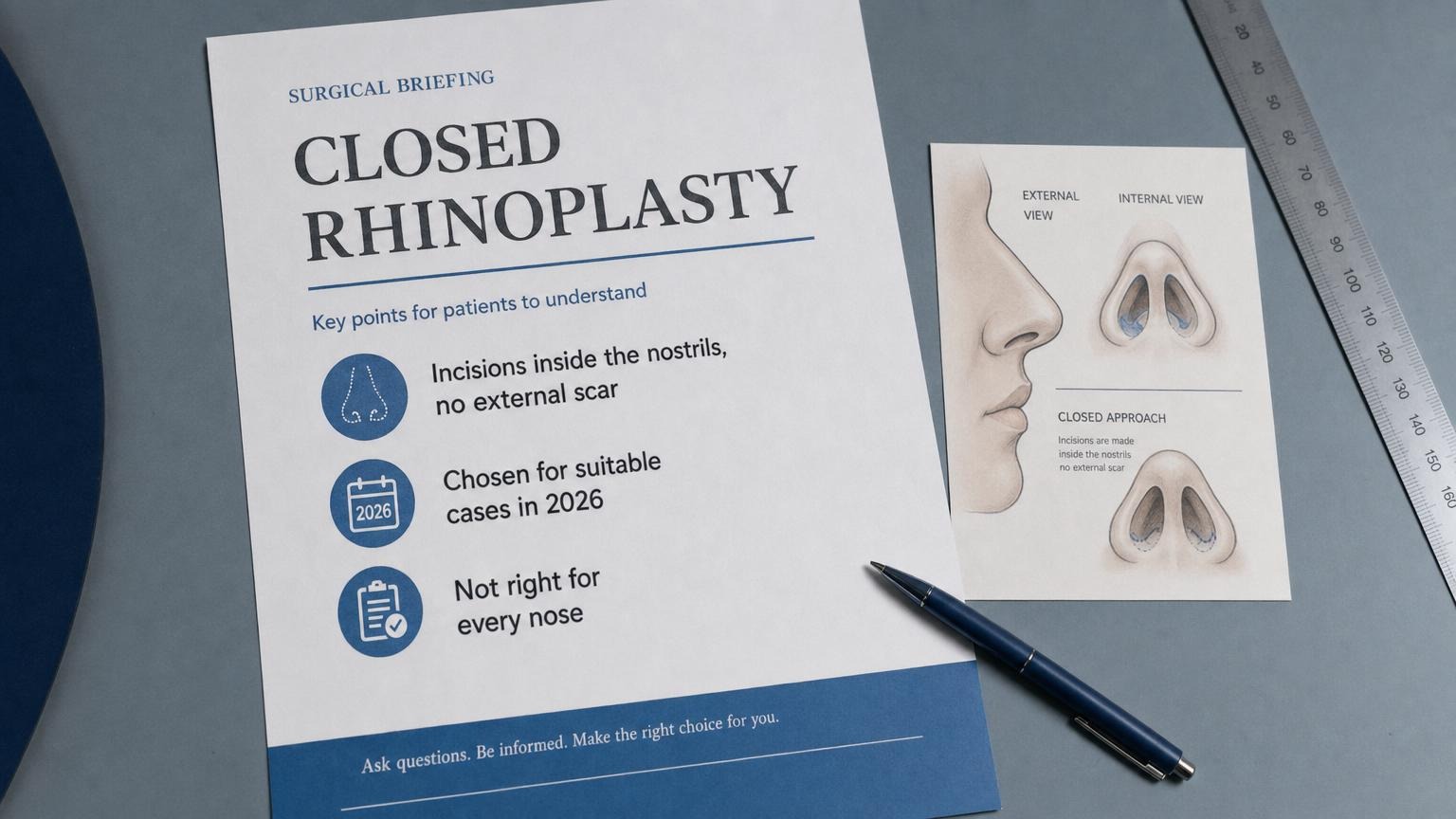
A 2026 talking point in rhinoplasty is the closed approach, where incisions are made entirely inside the nostrils so there is no external scar. It appeals to patients who want a scar-free result, but it suits certain, less complex cases and is not right for every nose. Understanding what closed rhinoplasty is, how it differs from the open approach, who it suits, and why the result should drive the choice is what keeps expectations sensible.
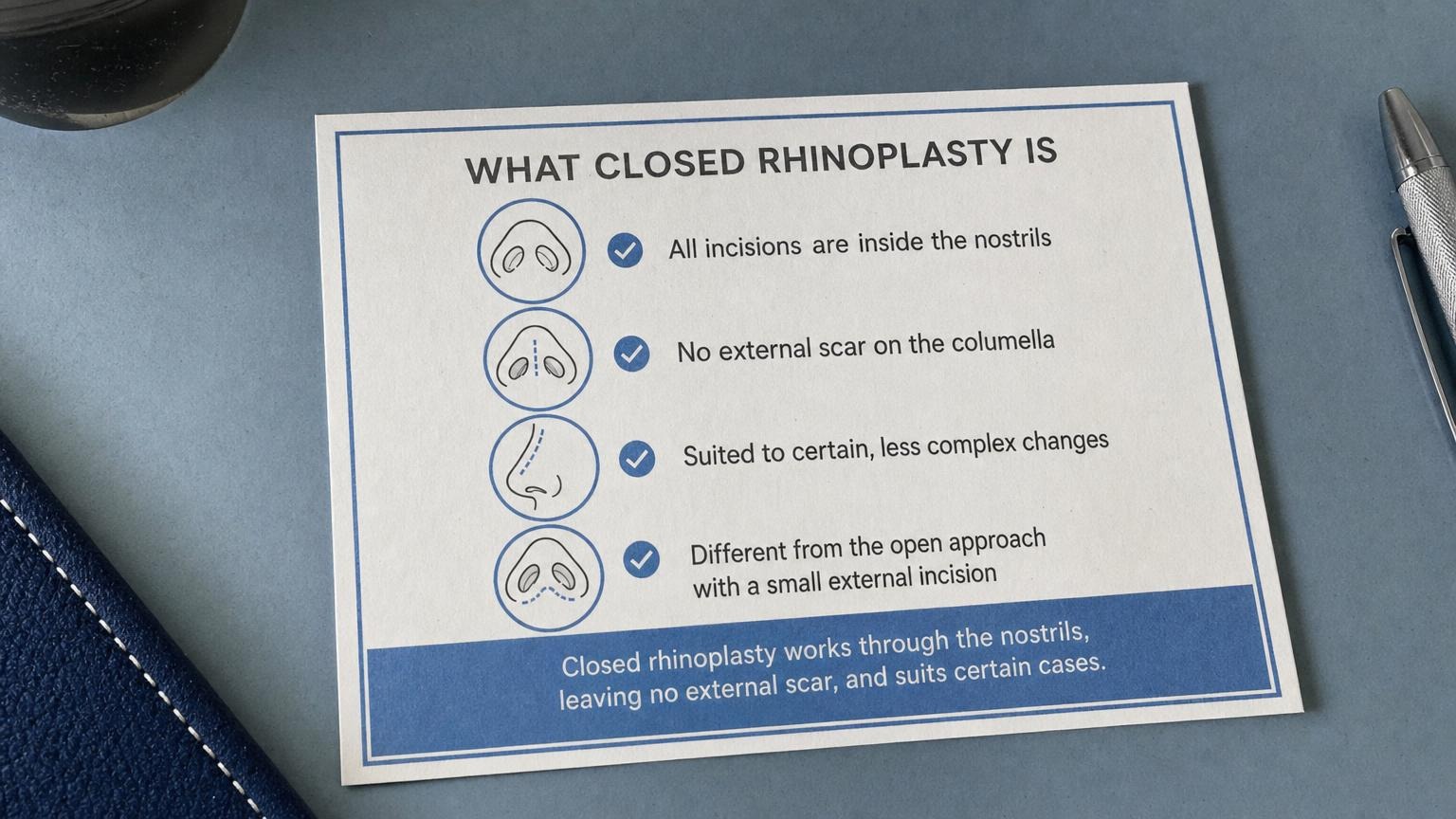
What Closed Rhinoplasty Is
The defining feature is where the incisions go. In closed rhinoplasty, all incisions are made inside the nostrils, so there is no external scar anywhere on the nose. It suits certain, less complex changes, and it differs from the open approach, which uses a small external incision across the columella, the strip of skin between the nostrils. That tiny external incision is what closed rhinoplasty avoids, at the cost of somewhat less direct access for the surgeon.
So closed rhinoplasty works through the nostrils, leaving no external scar, and suits certain cases. The appeal is obvious: for a suitable nose, you can get the change you want with no visible scar and often somewhat less swelling. This scar-free option sits within the broader, structure-first philosophy of Korean rhinoplasty, where the method is chosen to fit the nose rather than the other way around. The absence of an external scar is a genuine benefit when the case allows it.
Closed vs Open
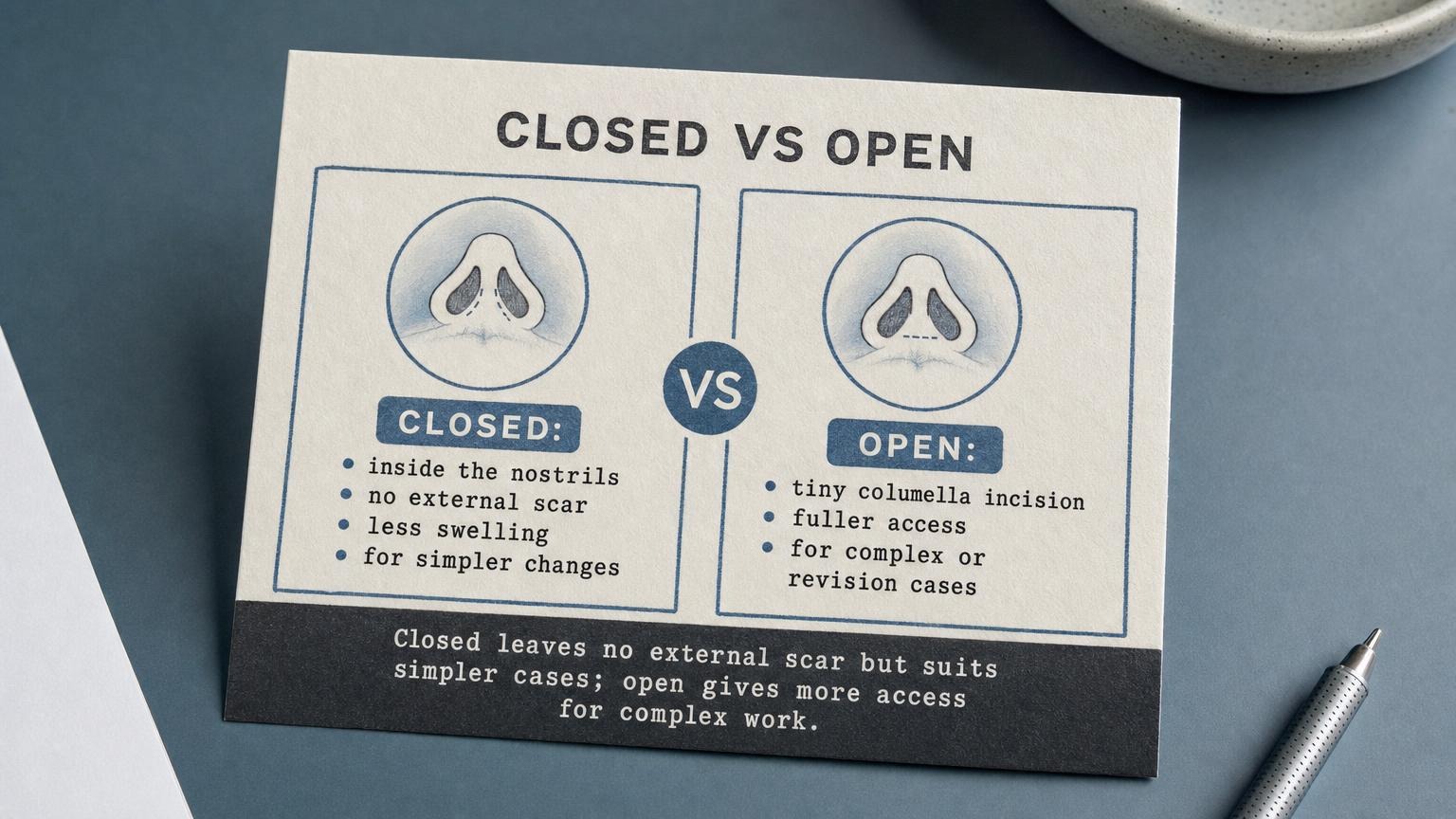
The two approaches are tools for different jobs. The closed approach works inside the nostrils, leaves no external scar, tends to involve less swelling, and suits simpler, well-defined changes. The open approach uses a tiny incision across the columella, giving the surgeon fuller access and direct visibility, which matters for complex or revision cases. Neither is universally better; each fits certain situations, and a good surgeon selects between them based on what the specific nose needs.
The honest framing is that closed leaves no external scar but suits simpler cases, while open gives more access for complex work. For a large reshaping, a structural rebuild, or a revision where the surgeon needs to see and work extensively, the open approach is often the right choice despite the tiny scar, which typically fades well. This is the same careful, case-by-case thinking that governs revision rhinoplasty, where access frequently matters more than avoiding a scar. The choice is about the result, not the scar alone.
Is It Right for You
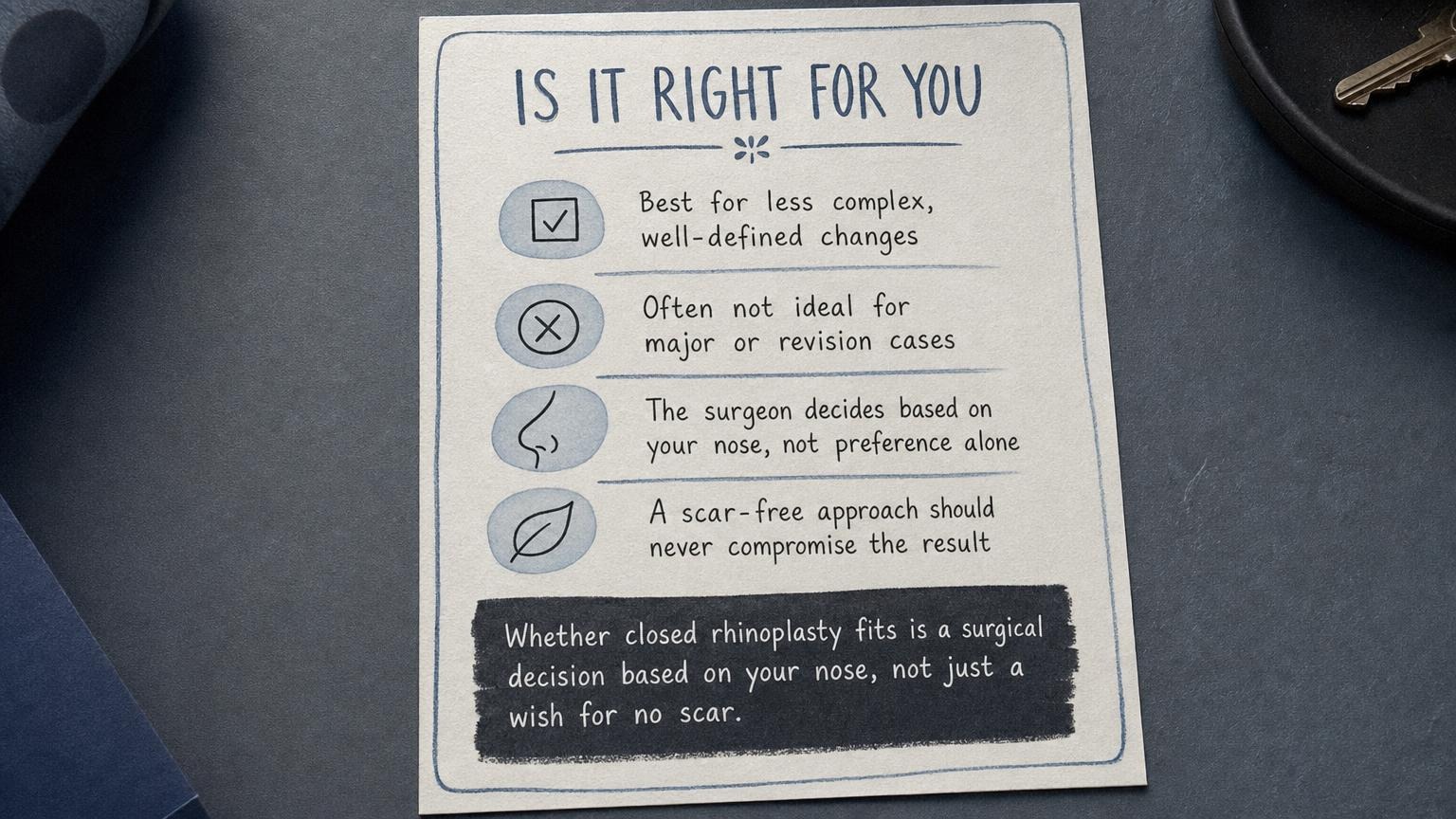
Whether closed rhinoplasty fits is a surgical judgment. It is best for less complex, well-defined changes where the surgeon can achieve the goal through the nostrils. It is often not ideal for major reshaping or revision cases that need fuller access. The surgeon decides based on your nose, not on preference alone, and a scar-free approach should never compromise the result. Wanting no external scar is understandable, but it cannot be the sole basis for the decision.
The principle is that whether closed rhinoplasty fits is a surgical decision based on your nose, not just a wish for no scar. A good surgeon will tell you honestly whether your case suits the closed approach or whether the open approach would give a better outcome. If a clinic promises a closed, scar-free procedure for a complex case where open would be more appropriate, that is a warning sign, not a selling point. The right approach is the one that gives you the best result for your specific nose.
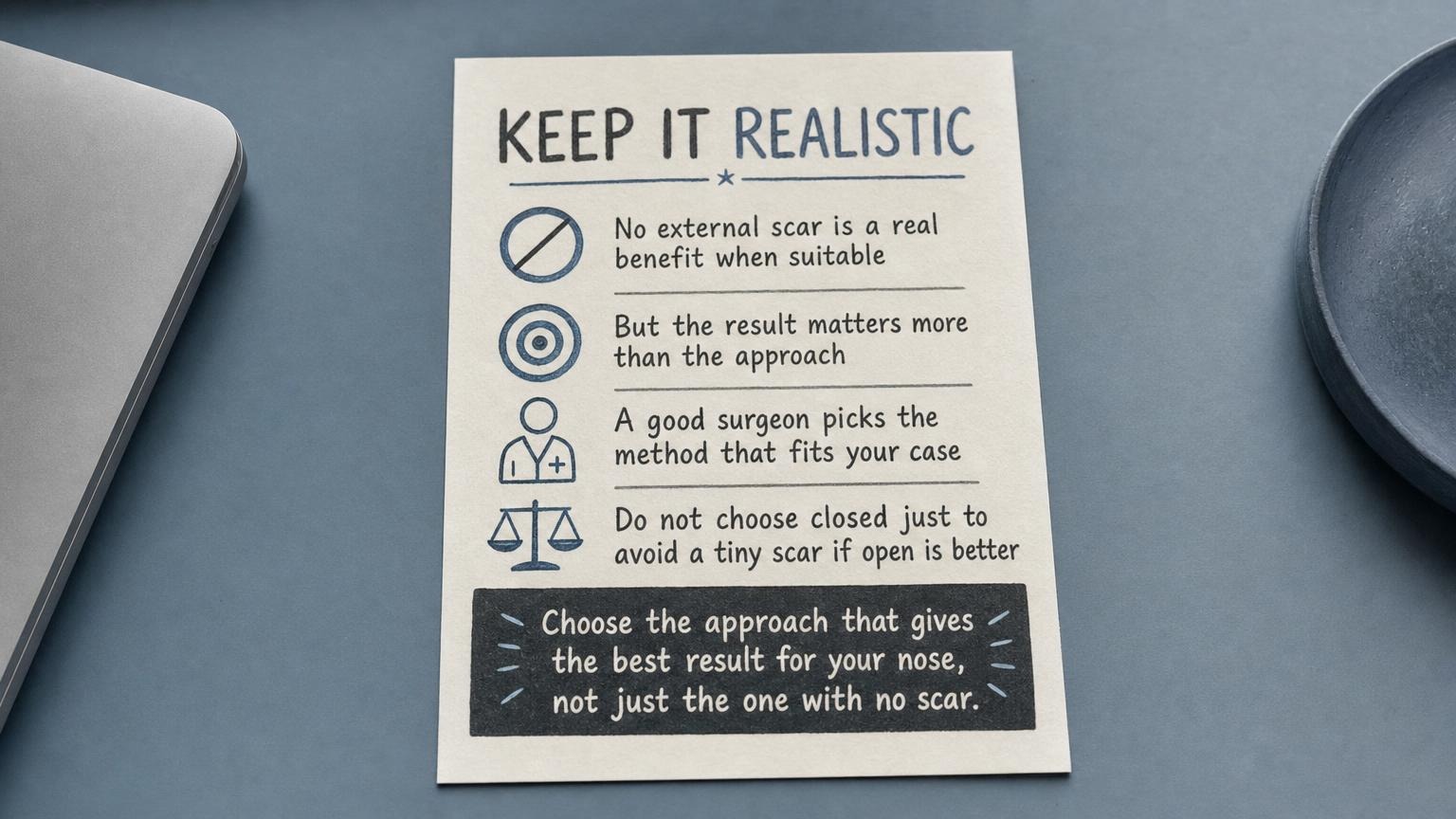
Keep It Realistic
It helps to hold the benefit in proportion. No external scar is a real advantage when the closed approach is suitable. But the result matters more than the approach, and a good surgeon picks the method that fits your case, not the one that sounds most appealing. You should not choose closed just to avoid a tiny scar if the open approach would give a better outcome, because a slightly visible columella scar that fades is a small price for a better nose.
The honest bottom line is to choose the approach that gives the best result for your nose, not just the one with no scar. The closed technique is a genuine benefit for the right patient and a poor choice forced onto the wrong one. The mark of a good surgeon and clinic is that they recommend the approach based on your anatomy and goals, explain why, and are honest when the open approach is better despite the small scar. That honesty, more than any scar-free promise, is what protects your result.
Cost and How to Plan It
Closed and open rhinoplasty are generally comparable in cost, since the difference is in approach rather than complexity per se, and complexity is what usually drives price. A simpler closed case may cost less than a complex open rebuild, but that reflects the complexity, not the incision choice. As with all rhinoplasty in Korea, prices are generally below the equivalent abroad. The sensible way to plan is to get a quote for your specific case after the surgeon has determined which approach suits it, rather than assuming the scar-free option is automatically cheaper or better value.

Before committing, five questions keep the decision sound. Has the surgeon assessed whether my nose suits the closed or open approach? Is the recommendation based on my anatomy and goals rather than a scar-free selling point? For my case, does the closed approach give the best result, or would open be better? If open is recommended, is the reason clearly explained? And am I choosing on the result rather than only on avoiding a scar? A surgeon who selects the approach for your nose, and is honest about it, is the one to trust. For trip-planning details, visit Link Plastic Surgery’s official website.
Frequently Asked Questions
1. What is closed rhinoplasty?
Closed rhinoplasty is a nose surgery in which all incisions are made inside the nostrils, so there is no external scar anywhere on the nose. It suits certain, less complex changes. It differs from the open approach, which uses a tiny incision across the columella between the nostrils for fuller access. The closed approach avoids that external incision entirely.
2. Does closed rhinoplasty really leave no scar?
It leaves no external scar, because every incision is inside the nostrils. This is its main appeal. The open approach, by contrast, leaves a tiny scar across the columella that typically fades well. For a suitable case, closed rhinoplasty gives the change you want with no visible scar, which is why it has become a 2026 talking point.
3. How is closed different from open rhinoplasty?
Closed works entirely inside the nostrils, leaves no external scar, tends to involve less swelling, and suits simpler changes. Open uses a tiny columella incision that gives the surgeon fuller access and direct visibility, which matters for complex or revision cases. Neither is universally better; each fits certain situations, and the surgeon chooses based on what your nose needs.
4. Is closed rhinoplasty better?
Not universally. It is better for the right case, less complex, well-defined changes, where it delivers the result with no external scar. For major reshaping or revision needing fuller access, the open approach is often better despite the tiny scar. Better means the approach that gives the best result for your specific nose, which is a surgical judgment, not a fixed ranking.
5. Can any nose have closed rhinoplasty?
No. Closed rhinoplasty suits less complex, well-defined changes the surgeon can achieve through the nostrils. It is often not ideal for major reshaping or revision cases needing fuller access. Whether your nose suits the closed approach is a surgical decision based on your anatomy, not simply a matter of wanting no scar. The surgeon determines suitability at consultation.
6. Should I insist on the closed approach to avoid a scar?
No. Insisting on closed just to avoid a tiny scar can compromise your result if the open approach would be better for your case. A small columella scar that fades is a minor trade-off for a better nose. Trust a surgeon who recommends the approach based on your anatomy and goals, and be wary of one who promises closed for a case that needs open.
7. Is recovery faster with closed rhinoplasty?
The closed approach often involves somewhat less swelling since it avoids the external incision and some dissection, which can make early recovery a little easier for suitable cases. However, recovery depends far more on the extent of the work than on the incision choice. A simpler change recovers faster than a major rebuild regardless of approach, so complexity matters more than closed versus open.
8. Is closed rhinoplasty cheaper?
Not inherently. Cost is driven mainly by complexity, not incision choice, so a simpler closed case may cost less than a complex open rebuild because it is simpler, not because it is closed. Get a quote for your specific case after the surgeon determines which approach suits it, rather than assuming the scar-free option is automatically cheaper.
9. Can revision rhinoplasty be done closed?
Sometimes, for limited revisions, but many revision cases need the fuller access of the open approach because the surgeon has to see and work extensively on altered structure. Whether a revision can be done closed depends entirely on the specific case. The priority in revision is achieving a good, safe result, which often means open access matters more than avoiding a scar.
10. How do I decide as an international patient?
Have a consultation where the surgeon assesses whether your nose suits the closed or open approach, ask for the reasoning based on your anatomy and goals, and choose on the result rather than only on avoiding a scar. Trust an honest recommendation even if it is open. For scheduling and trip-planning details, visit Link Plastic Surgery’s official website.