How Much Does Rhinoplasty in Seoul Actually Cost for Foreigners in 2026
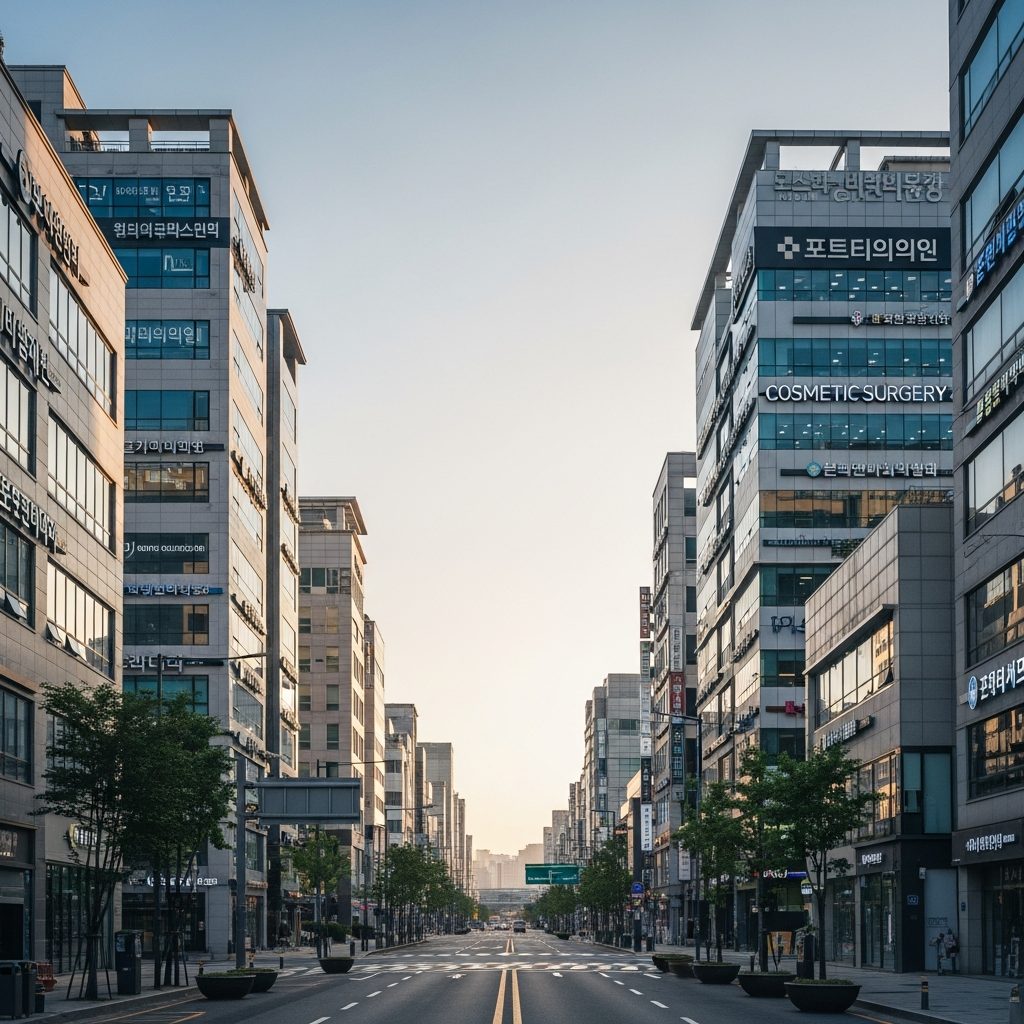
Two women were comparing quotes in the elevator of a Gangnam medical building last Tuesday. One had flown in from Dubai. The other, California. Both were getting rhinoplasty. And their price quotes were ₩7 million apart.
That gap stuck with me.
I’ve coordinated rhinoplasty patients coming to Seoul for years now — probably north of 300 cases — and pricing is still the thing that generates the most confusion. Not the surgical technique. Not the recovery timeline. The money. Because rhinoplasty pricing in Korea doesn’t work the way most foreigners expect it to. There’s no standard menu. No universal rate card. A revision case with rib cartilage and a simple bridge augmentation with implant sit in completely different cost universes, but clinics sometimes lump them under the same “rhinoplasty” label on their English websites.
And that’s where people get burned. Not by bad surgery — Korean rhinoplasty outcomes are genuinely excellent across the board — but by budgeting wrong. Flying home with a nose they love and a credit card bill they didn’t plan for.
The real cost isn’t just the surgery fee. It’s the anesthesia, the post-op splint removals, the hotel nights you didn’t think about, the airport transfer when your face is still swollen and you can’t exactly hail a cab comfortably. I watched a patient from London panic-book three extra hotel nights because her surgeon wanted one more follow-up before clearing her to fly. That was an unplanned $450.
So this breakdown covers everything. Surgery fees by procedure type, the hidden additions, what “foreigner pricing” actually means (it’s more nuanced than the Reddit threads suggest), and what a realistic total budget looks like for someone flying into Incheon specifically for a nose job in 2026.
Key Takeaways
- Primary rhinoplasty in Seoul ranges from ₩3,000,000 to ₩8,000,000 ($2,200–$5,900 USD) depending on technique — revision with rib cartilage can push past ₩15,000,000.
- Most clinics charge foreign patients the same surgical fee as Korean patients, but the coordinator and translation services sometimes add 10–20% to the total package.
- Budget an additional $1,500–$2,500 beyond the surgery fee for flights, accommodation, aftercare, and the recovery days you’ll inevitably extend.
- Closed rhinoplasty (no external incision) tends to cost less, but fewer surgeons offer it for complex structural work — don’t pick your technique based on price.
- Getting multiple consultations in Seoul before committing is standard practice and usually free, but flying in without at least two pre-booked appointments wastes money.
One thing worth understanding upfront: Korean rhinoplasty pricing operates differently from the U.S. or Europe. Surgeons here often quote an all-inclusive OR fee that bundles anesthesia, the operating room, and basic post-op visits into one number. But “all-inclusive” has a flexible definition. Some clinics include the CT scan. Others charge it separately — ₩100,000 to ₩200,000, depending on the facility. I’ve seen it go both ways at the same clinic in different years.
The quotes those two women were comparing in that elevator? Both were technically accurate. One included rib cartilage harvest from a separate donor site. The other was a straightforward silicone implant with tip work. Completely different surgeries wearing the same name.
What Korean Clinics Actually Charge for Rhinoplasty in 2026
Most pricing pages you’ll find online are outdated by at least a year. And the numbers clinics post on their English-language sites? Those are starting prices. The actual invoice looks different.
Korean rhinoplasty pricing operates on a tiered system that depends on complexity, not just the procedure name. A simple bridge augmentation using silicone implant sits at one end. A full structural rhinoplasty with rib cartilage harvest and tip plasty sits at the other. The gap between those two is enormous.

Base Procedure Costs at Seoul Clinics
| Procedure Type | Seoul Price Range (USD) | US/UK Equivalent (USD) |
|---|---|---|
| Silicone implant rhinoplasty (bridge only) | $2,800 – $4,500 | $6,000 – $10,000 |
| Implant + tip plasty (ear cartilage) | $4,000 – $6,500 | $8,000 – $13,000 |
| Structural rhinoplasty (septal cartilage) | $5,500 – $8,000 | $10,000 – $16,000 |
| Rib cartilage rhinoplasty | $7,000 – $11,000 | $15,000 – $25,000 |
| Revision rhinoplasty (previous surgery abroad) | $6,000 – $13,000 | $12,000 – $30,000 |
| Deviated septum correction (functional + cosmetic) | $4,500 – $7,500 | $8,000 – $15,000 |
These are 2026 figures based on what clinics in Gangnam and Apgujeong are quoting to international patients right now. Not last year. Not estimates.
One thing that catches people off guard — Korean clinics don’t always separate the surgeon’s fee from the facility fee. In the US, you’d get an itemized bill: surgeon, anesthesia, facility, post-op garments, all listed separately. In Korea, most quotes come as a single package number. Which sounds simpler until you realize that “package” means different things at different clinics.
Why the Price Range Is So Wide
A $2,800 rhinoplasty and an $11,000 rhinoplasty are not the same surgery. They’re barely the same category.
The biggest cost driver is cartilage source. Using the patient’s ear cartilage for tip work adds maybe $1,000–$2,000 to the base price. Harvesting rib cartilage — that’s a different operating room setup, longer surgery time, a second incision site, and significantly more surgical skill required. Rib cartilage cases typically run 4–6 hours compared to 1.5–2.5 hours for a standard implant procedure.
Surgeon reputation matters too, obviously. But not in the way most people assume. The most expensive surgeon in Gangnam isn’t necessarily the best choice for your specific nose. I watched a patient fly from Dubai to see a surgeon who charges $12,000 for primary rhinoplasty — a surgeon famous for creating very defined, high-bridge results. The patient wanted a natural, slightly upturned look. Wrong match entirely. She ended up consulting with three other surgeons and going with someone charging $6,500 who specialized in her nose type.
Expensive doesn’t mean right for you.
The Hidden Costs Nobody Puts in the Brochure
Surgery price is maybe 60% of your total trip cost. And that’s being generous. Clinics quote the procedure fee because that’s what they control. Everything around it falls on you.
| Expense | Estimated Cost (USD) | Notes |
|---|---|---|
| Pre-op blood tests + CT scan | $100 – $300 | Some clinics include this; many don’t |
| Anesthesia (general) | $300 – $800 | Usually included in Korean quotes, separate in Western clinics |
| Post-op medications | $50 – $150 | Antibiotics, painkillers, anti-swelling meds |
| Cast removal + follow-ups (5–7 days) | $0 – $200 | Most clinics include 2–3 follow-up visits |
| Accommodation (10–14 nights) | $700 – $2,500 | Recovery-friendly Airbnb or medical stay facility |
| Flights (round trip) | $400 – $1,800 | Varies wildly by origin country |
| Translation/coordination service | $0 – $500 | Some clinics provide; independent coordinators charge extra |
| Scar treatment (post-op) | $50 – $200 | Silicone tape, Cica cream — Korean pharmacies are cheap |
| Emergency buffer | $300 – $500 | Complications, extended stay, unexpected costs |
So a rhinoplasty quoted at $5,500 becomes a $7,500–$9,000 trip. Budget for $8,000–$10,000 total if you’re coming from North America or Europe and getting a mid-range procedure. From Southeast Asia or Japan, closer to $6,500–$8,500 because flights are shorter and you might already be familiar with the recovery stay setup.
Procedure Details: Time, Pain, Downtime
Surgery length depends entirely on what’s being done. A straightforward silicone implant placement takes about 1 to 1.5 hours. Add tip work with ear cartilage and you’re looking at 2 to 3 hours. Full rib cartilage structural rhinoplasty — 4 to 6 hours, sometimes longer if there’s significant deviation work involved.
Recovery timeline for foreign patients is the part that requires the most planning. You’ll have a cast or splint for 5 to 7 days. Most surgeons want to see you for cast removal, and then at least one follow-up 2 to 3 days after that. So minimum stay in Seoul: 10 days. I’d recommend 14 if your schedule allows it.
Pain is surprisingly manageable for most people. The first 48 hours involve significant swelling and congestion — breathing through your mouth, sleeping elevated, feeling like you have the worst cold of your life. But actual sharp pain? Most patients rate it 3–4 out of 10 by day two. The rib cartilage harvest site hurts more than the nose itself, which surprises almost everyone.
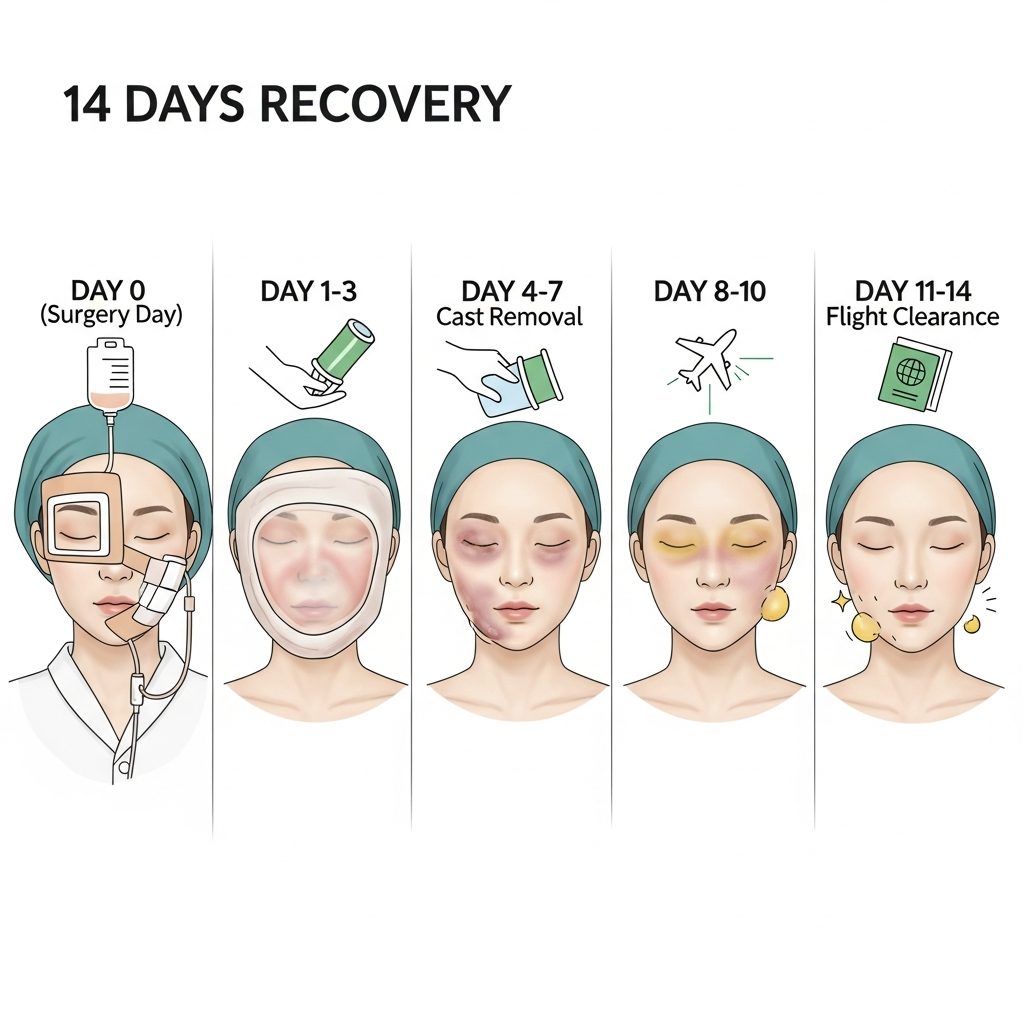
You can fly home after cast removal — around day 7 to 10 — but your nose will still be visibly swollen. Not dramatically, but enough that coworkers will notice something. Full results take 6 to 12 months to settle. And this is where the distance becomes a factor. If you need a minor revision or have a concern at month 3, you’re not just driving across town. You’re booking another international flight.
Insurance and Payment: What Foreign Patients Should Know
Cosmetic rhinoplasty isn’t covered by insurance anywhere. But if your procedure includes functional correction — deviated septum, turbinate reduction, airway obstruction — some portion might be claimable through your home country insurance after the fact. Keep every document the clinic gives you. Get the surgical report in English. Most Korean clinics will provide this if you ask before surgery, not after.
Payment is almost always upfront. Full amount, day of surgery or the day before during your final consultation. Credit cards are accepted at most Gangnam clinics, though some charge a 3–5% processing fee on international cards. Wire transfer in Korean won gets you the best rate. And bringing USD cash to exchange at Myeongdong money changers still beats most bank transfer rates — a trick that hasn’t changed in years.
What the First Two Weeks Actually Look Like
Most people obsess over the price. Fair enough — it’s a lot of money. But almost nobody prepares for what happens after the surgery itself. And that’s where Seoul trips fall apart for foreign patients.
Your first 48 hours will be spent in a recovery room or nearby hotel. Some clinics include post-op accommodation. Most don’t. You’ll have a splint on your nose, packing inside your nostrils (not every surgeon uses packing anymore, but many still do), and your face will look like you lost a boxing match. Swelling peaks around day 3. Not day 1. Day 3.
That catches people off guard.
You fly in feeling fine, get through surgery, wake up thinking “this isn’t so bad” — and then 72 hours later your eyes are swollen shut and you’re wondering if something went wrong. It probably didn’t. But nobody warned you, so you panic. I’ve watched this happen to patients who did months of research beforehand.

Pain — and Why Everyone Lies About It
Online forums are full of people saying rhinoplasty “wasn’t that painful.” And for some, that’s true. Bone work — osteotomy, where they narrow the bridge — tends to produce more discomfort than tip work alone. Rib cartilage harvest? Different story entirely. That donor site on your chest will bother you more than your nose for the first week.
The pain itself is usually manageable with prescribed medication. Korean clinics tend to be conservative with painkillers compared to Western standards. You’ll get acetaminophen-based prescriptions, maybe something slightly stronger for the first two days. Don’t expect opioids. Most surgeons here actively avoid them.
What actually bothers patients more than pain: the congestion. You can’t breathe through your nose for 5-7 days. Sleeping with your mouth open, waking up with a dry throat at 3 AM in a Seoul hotel room — that’s the part that wears you down. Buy a humidifier from Daiso before your surgery. Costs about ₩5,000. Best money you’ll spend.
The Appointment Schedule Nobody Plans For
After surgery, you’ll need follow-up visits. Splint removal around day 7. Stitch removal between day 7 and 14, depending on technique. And here’s where foreign patients run into problems — they book a 10-day trip thinking that’s plenty.
It’s not always plenty.
If your surgeon wants to see you on day 10 and your flight leaves day 9, you have a conflict. Changing flights from Seoul isn’t cheap, especially during peak travel season. Budget an extra 2-3 days beyond what you think you need. Some revision cases or complex reconstructions require an additional check at the 3-week mark, which means either extending your stay significantly or planning a return trip.
And return trips add cost. A second flight, another hotel stay, potentially another round of translation services. Factor ₩500,000-₩1,500,000 for an unplanned extension. Not everyone needs it. But those who do and didn’t budget for it end up stressed at exactly the moment they should be resting.
Communication During Recovery
Your coordinator is your lifeline. But coordinators handle multiple patients simultaneously — sometimes 5-10 on any given day. Response times vary. During Korean holidays (Chuseok, Lunar New Year), staffing drops. I sat in a clinic lobby once watching a patient try to explain a concern through Google Translate because her coordinator was out sick. It wasn’t ideal.
Prepare a basic medical phrase sheet before surgery. Write down questions you might need answered in an emergency. Save the clinic’s after-hours number — most reputable clinics have one, but you might need to ask for it specifically. And download Papago. It handles Korean medical terminology better than Google Translate does.
What Can Actually Go Wrong
Risks exist. Surgeons are legally required to tell you about them, but the consultation format — often 15-20 minutes with translation delays — means some details get glossed over.
Common complications: asymmetry (your nose won’t be perfectly symmetric — no nose is), prolonged swelling that takes 6-12 months to fully resolve, tip dropping as scar tissue contracts, and infection (rare but real). With rib cartilage grafts, there’s a small risk of warping over time. Silicone implants carry a risk of contracture or extrusion years later, though modern techniques have reduced this considerably.
The complication nobody talks about enough: dissatisfaction that isn’t technically a complication. Your nose healed fine. The surgeon did solid work. But it’s not what you pictured. This happens more often than actual medical complications. And it’s harder to fix because there’s nothing clinically wrong — you just don’t love it.
Revision rates for rhinoplasty globally sit around 10-15%, according to most published surgical literature. Korea’s rates aren’t magically lower just because the volume is higher. If anything, the high volume of foreign patients with different nasal anatomy (thicker skin, different cartilage structure) introduces its own complexity.
Practical Packing List Most Guides Skip
Beyond the obvious passport and medical documents:
- Button-up shirts only — you cannot pull anything over your head for 2 weeks
- Travel pillow — you’ll sleep elevated at 45 degrees; a wedge pillow from Coupang (Korea’s Amazon) costs ₩15,000
- Saline nasal spray — your surgeon may provide this, but having extra is worth it
- Straw cups — drinking from a regular glass with a swollen face is harder than it sounds
- Sunscreen SPF 50+ — sun exposure on healing skin can cause permanent discoloration
- Cash in ₩10,000 bills — some pharmacies near clinics don’t take foreign cards
One more thing people underestimate: boredom. You’ll be stuck in a hotel room for days, not wanting to go outside with a swollen face, eating delivery food, watching Netflix on hotel Wi-Fi. Bring a long book. Download entire seasons of something. It sounds trivial compared to surgical risks, but the psychological weight of sitting alone in recovery — in a foreign country — is real. And it affects how you perceive your results during those early, still-swollen days.
FAQ
Can I really get rhinoplasty in Seoul for under $3,000?
Yes, but you’d be choosing from the lowest tier of clinics — and probably skipping the experienced surgeons foreigners tend to want. Most patients from overseas end up in the $4,000–$8,000 range once they factor in the surgeon’s actual skill level.
Do Korean clinics charge foreigners more than Korean patients?
Some do. Not all. Clinics in Gangnam that market heavily to international patients often have a separate price sheet — sometimes 20–40% higher. Smaller clinics outside the tourist circuit usually charge the same rate regardless of passport.
What’s NOT included in the quoted surgery price?
Aftercare visits, medication, the compression tape, and sometimes even the splint removal. Ask specifically what’s bundled before you sign anything. I’ve seen patients get surprised by ₩200,000–₩500,000 in “extras” they assumed were covered.
Is it cheaper to book through a medical tourism agency or go direct?
Agencies get a commission from the clinic — which means the clinic already built that cost into your quote. Going direct doesn’t always save money, but it does give you more room to negotiate. And you skip the coordinator who’s incentivized to push one specific clinic.
How much should I budget for recovery costs beyond the surgery itself?
Around $1,500–$2,500 for two weeks. That covers a recovery guesthouse near Gangnam (₩80,000–₩150,000/night), food, pharmacy runs, and transport to follow-up appointments. Budget more if you want a proper hotel.
What if I need a revision — do I pay full price again?
Depends entirely on the clinic’s policy. Some offer free touch-ups within 6–12 months. Others treat revision as a completely new surgery with a new bill. Get this in writing before your first procedure. Not after.
Should I bring cash or can I pay by card?
Most clinics accept international credit cards, but some offer a discount — typically 5–10% — for wire transfer or cash payment in Korean won. Card payments sometimes trigger foreign transaction fees on your end too.
Recommended for Your Recovery
Products that patients commonly use before and after surgery in Korea.
- Arnica Montana Tablets — start 3 days before surgery to reduce bruising and swelling. Check price on Amazon
- COSRX Advanced Snail 96 Mucin Essence — gentle hydration for healing skin post-surgery. Check price on Amazon
- Silicone Scar Sheets — apply 2 weeks post-op to minimize incision scarring. Check price on Amazon
- Beauty of Joseon Relief Sun SPF 50+ — lightweight Korean sunscreen, essential for post-surgical skin protection. Check price on Amazon
As an Amazon Associate, GlobalBeautySpot earns from qualifying purchases.
Final Thought
The surgery itself is rarely the biggest expense. It’s the flights, the recovery housing, the extra week you didn’t plan for because swelling took longer than expected. Budget 30% more than whatever number you have in your head right now — and you’ll probably land close to what you actually spend.
Considering a procedure in Korea?
Get a free consultation with top-rated clinics in Seoul. We help you find the right surgeon for your goals.