Korean Flower Lift (Thread Lift) for Foreign Patients: Why Korea’s PDO Cog Threads Are a Foundation Layer, Not a Face Lift Substitute
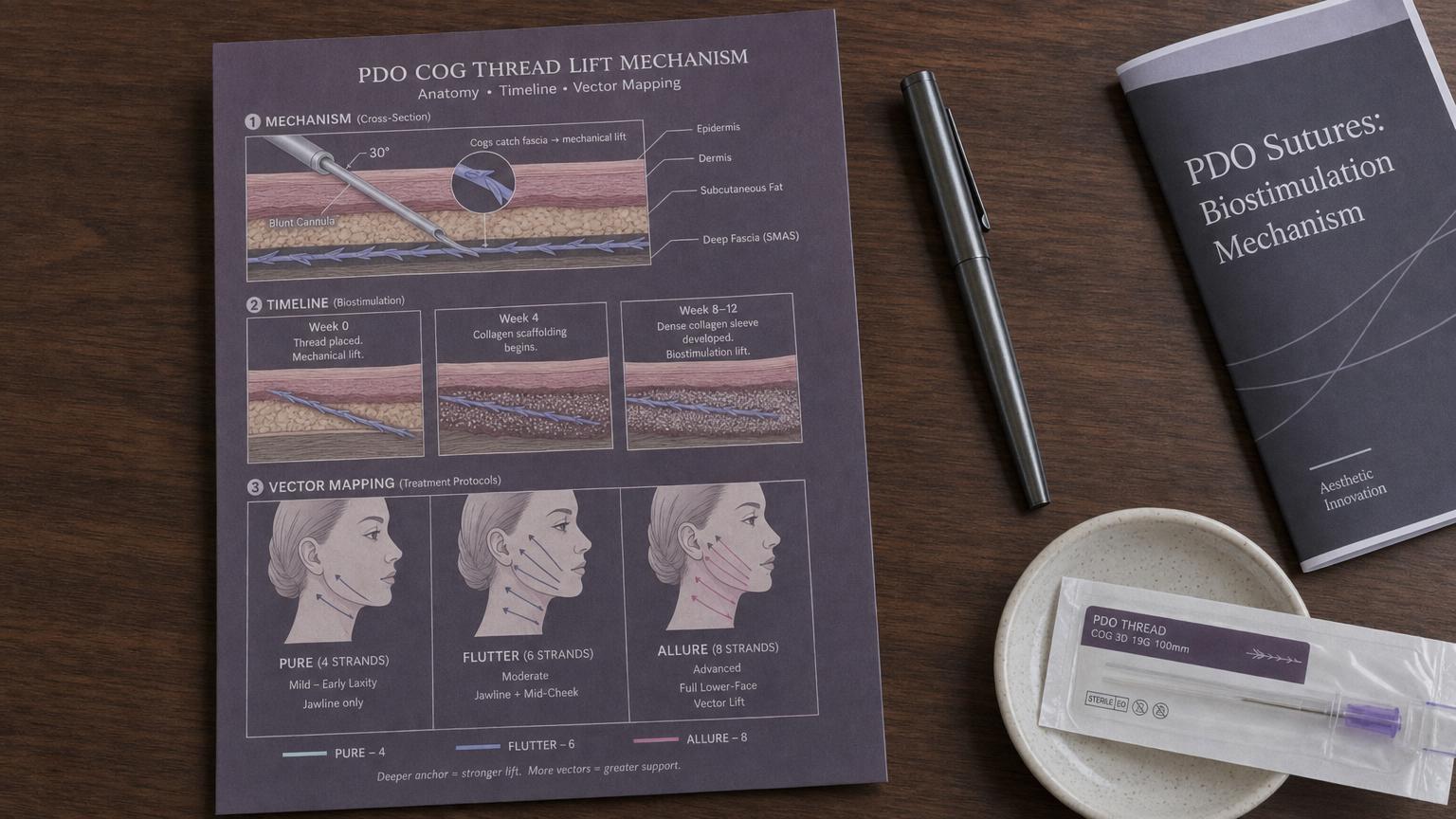
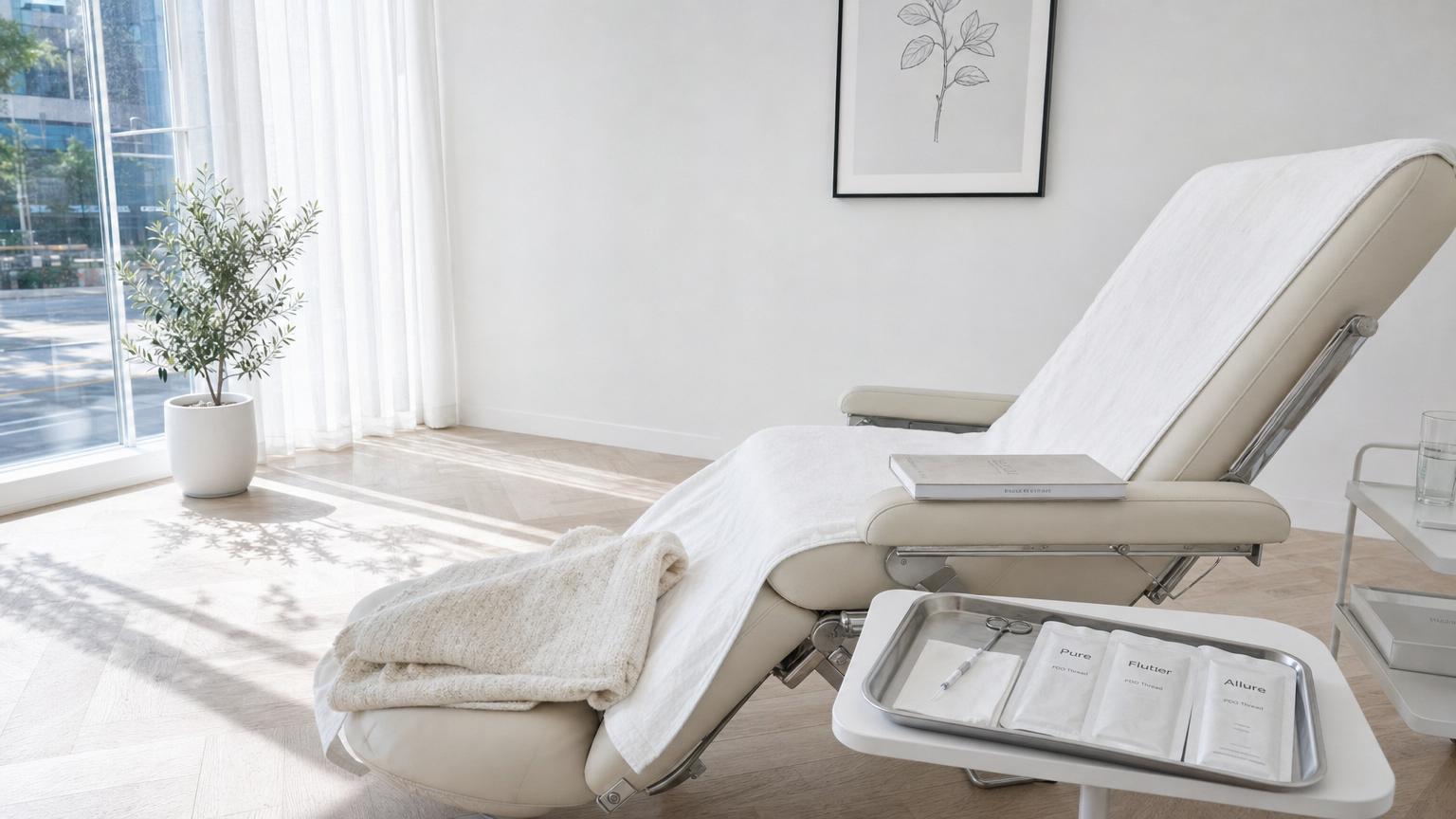
Foreign patients hear “thread lift” and most of them have the same reference picture in their head — a Silhouette InstaLift commercial from a US dermatology office, circa 2015, where a celebrity claims they got “a lunchtime face lift” with absorbable cones under the skin. That framing is wrong for what Korean clinics actually do. The Korean approach uses PDO cog threads in variants known by names like Pure (4-strand), Flutter (6-strand), and Allure (8-strand), hand-vector-mapped along facial tension lines, and they are positioned not as a face lift substitute but as a foundation layer of a multi-modality lifting stack that typically includes Volnewmer (monopolar radiofrequency) and Ultherapy (high-intensity focused ultrasound) on top. The threads sit at one depth. The RF sits at another. The HIFU sits at a third. Each addresses different tissue layers, and the Korean clinic’s role is to decide which combination matches the patient’s specific laxity pattern. Understanding this stacking concept, not the Silhouette-style face-lift-substitute concept, is the entire difference between a satisfied patient and one who feels the result was “too subtle.”
This guide is for the patient who has heard “Korean thread lift” or “Flower Lift” from a friend who flew to Seoul, from K-beauty Instagram, or from a clinic landing page, and wants to understand what the procedure actually is before booking. It explains the PDO cog material and three common strand variants, the Korean foundation-layer approach to combining threads with energy devices, the realistic 12-week recovery and collagen-scaffold timeline, and the cost comparison against thread lifts in Western clinics. It draws on the protocol Korean clinics — including Link Plastic Surgery‘s petit and face menus — apply across patients seeking mid-face and lower-face lifting without surgical face lift downtime.
Section 1 — What Korean Thread Lift Actually Is
The Korean “Flower Lift” name refers to a specific protocol built around polydioxanone (PDO) cog threads — absorbable monofilament threads with directional barbs (cogs) along the length that anchor into the dermis and subcutaneous tissue. PDO is the same suture material that has been used in cardiothoracic and reconstructive surgery for decades, so the safety profile and absorption mechanism are well understood. Within 6–9 months, the thread itself absorbs completely; what remains is the collagen scaffold the body has built around where the thread used to be, and that scaffold is what produces the long-term lifting effect.
The PDO Cog Material
Korean PDO threads are different from the early-generation absorbable lifting threads many Western patients have read about. Three things matter. First, the thread is a single PDO filament with bidirectional or unidirectional barbs cut into the material — the barbs grip tissue at multiple points along the length, not just at the ends. Second, the absorption timeline is predictable at 6–9 months, with no fragmentation into irregular pieces. Third, the collagen scaffold built around the thread persists for an additional 12–18 months after the thread itself is gone. The visible lifting result, in other words, comes from the patient’s own collagen organized along the vectors the thread originally defined — not from the thread holding tissue mechanically forever.
Hand-Vector Mapping — Why This Is Not a Template Procedure
The single most important technical difference between a Korean Flower Lift and a generic thread lift performed in a Western dermatology office is the mapping step. Before any threads are inserted, the clinician spends 10–20 minutes on the consultation evaluating which way the patient’s tissue actually sags. Sagging is rarely uniform. Most patients have asymmetric laxity — one side of the jawline drops more than the other, the marionette lines are deeper on one side, the cheek apex falls forward more on the dominant chewing side. The clinician maps individual thread vectors onto the patient’s face by hand, marking entry points behind the temporal hairline and exit points along the cheek and jawline. Thread placement follows these custom vectors. There is no template diagram on the wall that everyone gets. This step is what produces natural-looking lifts rather than the over-tightened “pulled” look that template thread lifts can produce.
Three Common Strand Variants
- Pure (4-strand). The entry-level variant for early laxity, typically patients in their mid-thirties to early forties with subtle jawline softening and mild mid-cheek descent. Four PDO cog threads per side, vectors mapped along the jawline and lateral cheek. Visible result is subtle — slight jawline definition, slight midface lift. Best for patients who want maintenance rather than transformation.
- Flutter (6-strand). The most commonly selected variant for patients in their forties with moderate laxity. Six threads per side, with additional vectors addressing the nasolabial fold and lower cheek. The added strands let the clinician distribute lifting force across more vectors, which is what produces a natural rather than over-pulled appearance. This is the “typical” Korean Flower Lift case.
- Allure (8-strand). The advanced variant for patients with more substantial mid-to-lower face laxity, typically late forties to early sixties, where simpler protocols cannot deliver enough lift to be visible. Eight threads per side, with vectors covering jawline, mid-cheek, nasolabial, and sometimes marionette lines. Patients who would otherwise be candidates for a mini-lift surgery sometimes choose Allure as a non-surgical alternative — with the understanding that the result is less dramatic than surgery but with no incisions and minimal downtime.
Patients should not pick the strand count by themselves. A clinic that recommends Allure to a 35-year-old with mild laxity is overselling, and a clinic that recommends Pure to a 55-year-old with significant lower-face descent is underdosing. The recommendation should come from the vector mapping during consultation.
Section 2 — The Korean “Foundation Layer” Approach
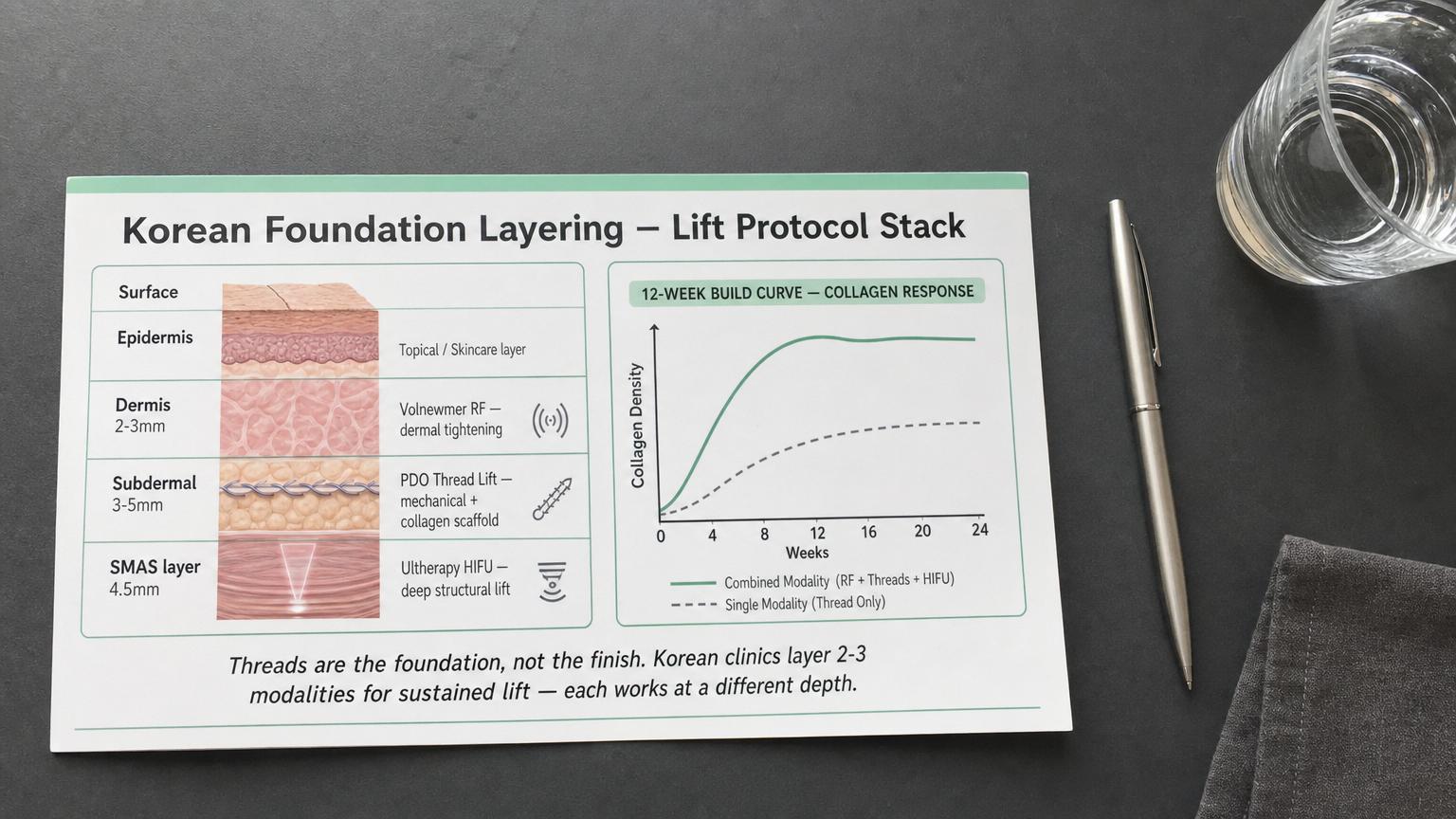
Here is where Korean practice diverges most sharply from the Western thread lift conversation. Western marketing positions thread lift as a standalone procedure — “the lunchtime face lift,” the single treatment that replaces surgery. Korean practice positions the thread lift as a foundation layer in a multi-modality stack, and the stack is typically what delivers the visible lift the patient came in for. Threads alone, in the Korean view, are a building block. The stack is the procedure.
Why Stacking Works — Depth Differentiation
The reason stacking is not just “more is better” marketing is anatomical. The face has multiple tissue layers that age differently and respond to different modalities. Surface skin texture and superficial dermis respond to fractional lasers and microneedling. The mid-dermis and subcutaneous fat respond to monopolar radiofrequency. The SMAS layer — the deep musculoaponeurotic system that face-lift surgery actually pulls up — responds to focused ultrasound. The dermis-to-subcutaneous interface responds to thread vector lifting. No single modality reaches all of these layers, which is why no single modality can produce a comprehensive lift on its own.
- Threads — 3 to 5 mm depth. PDO cog threads are placed at the dermis-to-subcutaneous interface, where the barbs grip mobile tissue and define the lifting vector. This is the layer that creates the actual mechanical lift in the short term, and the collagen scaffold in the long term.
- Volnewmer (monopolar RF) — 2 to 3 mm depth. Korean monopolar radiofrequency is applied above the thread plane, in the mid-dermis, where it tightens existing collagen via controlled thermal injury and triggers new collagen synthesis for 3–6 months after. The RF effect is texture and tone improvement on top of the thread vector.
- Ultherapy (HIFU) — 4.5 mm SMAS depth. Ultherapy delivers focused ultrasound to the SMAS layer below the threads, generating thermal coagulation points that tighten the deep support layer. The HIFU effect is the deep architectural lift that complements the surface threads.
When the three modalities are stacked, the result is layered correction — surface texture, mid-dermal tightening, and deep SMAS lift — that no single modality alone could produce. This is the lift that Korean clinic before-and-after photos actually represent. When patients see those photos and book a “thread lift,” they are sometimes booking only the foundation layer of what produced the photo.
Timing Within a Stack
Korean clinics do not perform all three modalities in a single day. The standard sequencing is:
- Session 1 — Flower Lift threads. This is the foundation. The clinician places the threads according to the vector map. Visible lift is immediate but partial — most of the “lifting” the patient sees in the mirror on day one is mechanical tension on the cog barbs, which will relax slightly over the next 4–8 weeks.
- Session 2 — Ultherapy or Volnewmer, 2–4 weeks after threads. The deep tightening modality is added after the thread entry sites have healed and the initial swelling has resolved. Most clinics start with HIFU for patients with deeper SMAS laxity, RF for patients with surface and texture concerns.
- Session 3 — The other deep modality, 6–8 weeks after threads. Patients who want both deep SMAS tightening (HIFU) and dermal texture improvement (RF) add the second modality at the 6–8 week mark, when the collagen scaffold from the threads is well underway.
Patients who fly in for a short Korea trip sometimes compress this into a single visit (threads on day 1, HIFU on day 5, RF on day 9), which is acceptable but not optimal — separating sessions by 2–4 weeks lets each modality settle and lets the clinician evaluate the response before adding the next layer.
Where Threads Cannot Substitute for Surgery
It is important to state plainly: Korean Flower Lift, including Allure 8-strand stacked with HIFU and RF, does not produce the same result as a face lift. A face lift surgically repositions the SMAS, removes excess skin, and tightens the platysma — none of which threads can do mechanically. For patients with significant skin redundancy (visible neck banding, deep jowls with hanging skin), the honest Korean clinic will say so during consultation and either recommend surgical mini-lift or set expectations that the thread protocol will reduce the appearance of laxity by perhaps 30–40%, not eliminate it. A clinic that promises face-lift results from threads is overselling. The accurate framing: threads are the right answer for moderate laxity in patients who are not ready for surgery, not a magical substitute when surgical correction is the actual indication.
Section 3 — The 12-Week Recovery and Collagen Scaffold Timeline

Foreign patients planning a Korea trip for Flower Lift need realistic expectations about what they will see in the mirror across the recovery window. The thread lift result is not visible immediately — what is visible immediately is mechanical tension. The actual lift, the one that lasts, comes from the collagen scaffold built around the thread over the following 8–12 weeks. Patients who judge the outcome at day 14 are reading the wrong signal.
Recommended for Your Recovery
Products commonly used before and after Korean flower lift thread lift — same items routinely recommended in the recovery instructions Seoul clinics hand out at discharge.
- Arnica Montana Tablets — start 3 days before facial surgery to reduce bruising in the treated area. Check price on Amazon
- Silicone Scar Sheets — for procedures with visible incisions, apply from week 3 onward to support scar maturation. Check price on Amazon
- Beauty of Joseon Relief Sun SPF 50+ — daily Korean SPF 50+ to protect freshly treated facial skin. Check price on Amazon
- COSRX Advanced Snail 96 Mucin Power Essence — Korean snail mucin essence to support the post-procedure skin barrier. Check price on Amazon
As an Amazon Associate, GlobalBeautySpot earns from qualifying purchases at no extra cost to you.
Day 0 — Procedure Day
The clinic applies topical anesthetic cream for 30–40 minutes, then injects local anesthetic at the entry points (behind the temporal hairline or along the lateral cheek depending on vector map). The threads are inserted via blunt cannula, advanced along the vector, anchored, and trimmed. The whole procedure takes 30–45 minutes for a Flutter 6-strand bilateral. Mild light sedation is offered for anxious patients but not standard. Immediately after, the patient sees real mechanical lift in the mirror — sometimes more than expected. This is the cog barbs pulling tissue, not the final result. Some clinicians ask patients to look up while in the chair so they can see where the lift will eventually settle once swelling resolves.
Days 1 to 7 — Micro-Entry Healing
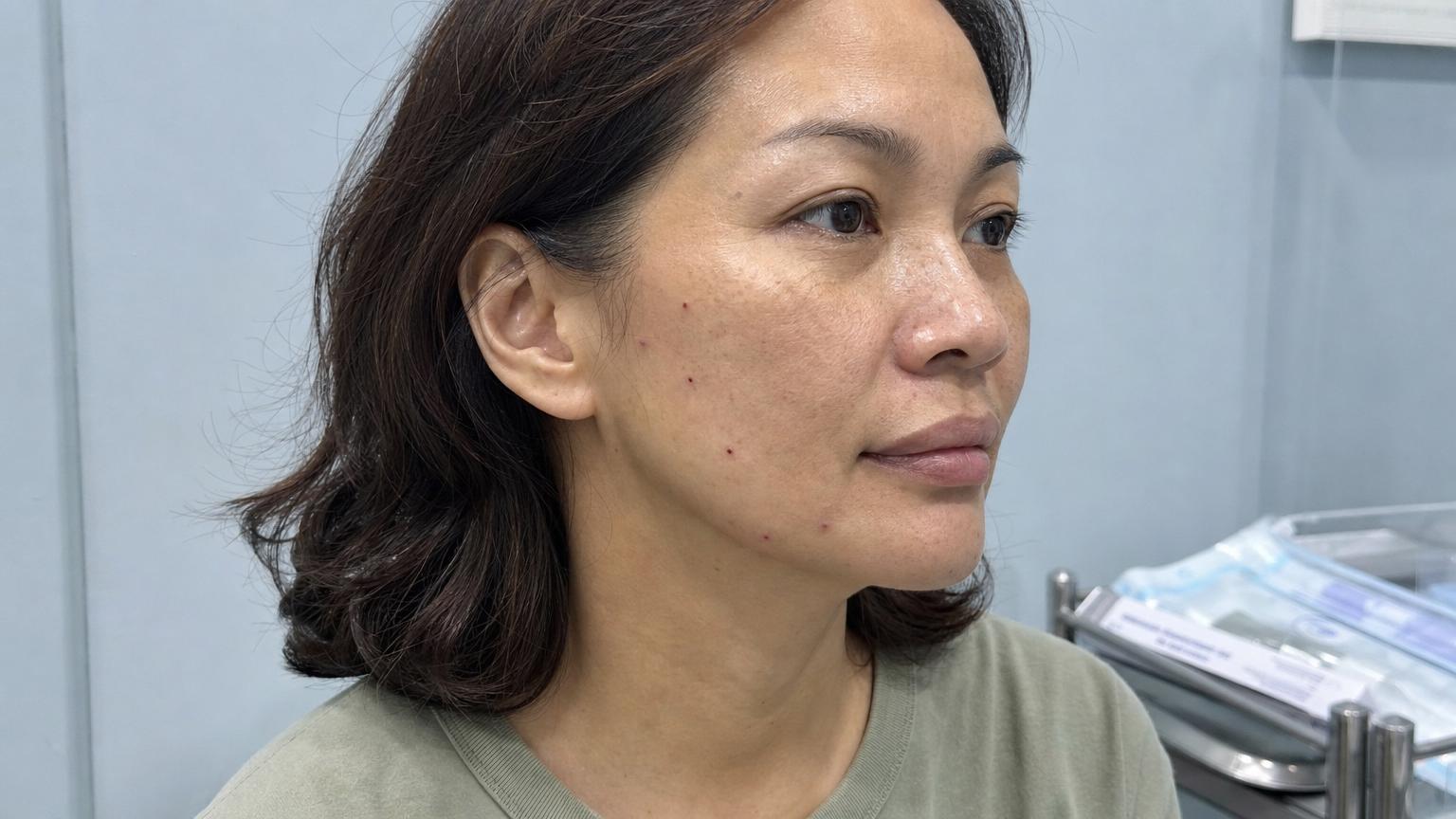
The entry points heal as tiny puncture wounds, not surgical incisions. Most patients have one to three small red marks behind the temporal hairline or at the lateral cheek that are essentially invisible under hair or with mineral powder. Bruising is uncommon — typical Korean PDO thread protocols produce visible bruising in fewer than 15% of patients, far less than HA filler bruising rates. Mild swelling at entry points and along the thread vectors is normal for 2–5 days. The “tightness” sensation is real and sometimes uncomfortable, particularly when smiling widely or yawning. Most patients return to office work on day 1 or day 2; social events with mineral makeup are fine by day 3 or 4.
What patients should avoid in this window: heavy exercise (especially anything where the head is below the heart, like inverted yoga poses or strenuous abdominal work), facial massage, deep facial treatments (dermaplaning, peels), aggressive cleansing, and sleeping face-down. The cog barbs need 1–2 weeks to anchor stably in the surrounding tissue. Mechanical disruption during this window can shift the threads and reduce the eventual lift.
Weeks 2 to 4 — Initial Tightening Phase
The mechanical tension from the cog barbs relaxes slightly during this window as the surrounding tissue accommodates. Patients sometimes panic at week 2 or 3 when they look in the mirror and feel that “the lift went down.” This is normal. What is happening is the initial over-tension that was visible immediately post-procedure is settling to what the threads can mechanically hold, while the collagen scaffold response has not yet built. The patient is in a transitional window where the immediate mechanical lift has eased but the structural collagen lift has not yet appeared.
Clinics that have done many Flower Lift procedures have heard the week-3 “did it stop working?” call hundreds of times. The reassurance protocol is simple: this is exactly the expected timeline, the collagen response is building underneath, photograph yourself in identical lighting now and compare at week 8. Patients who can wait through this window without requesting emergency re-treatment go on to see the full result.
Weeks 8 to 12 — Collagen Scaffold Complete
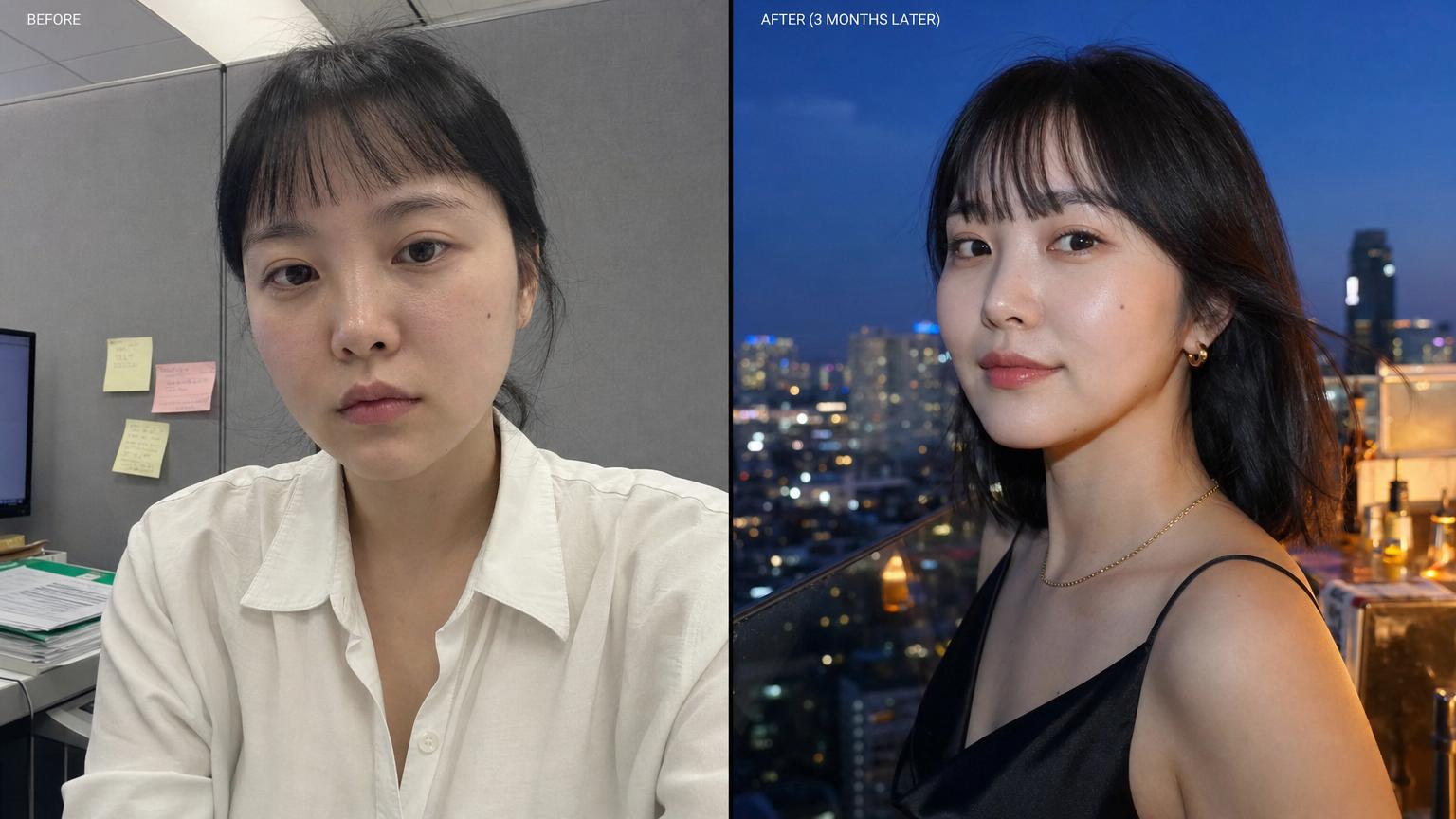
By the 8-week mark, the patient’s own collagen has organized along the vectors the threads defined. What the patient sees in the mirror at week 8 to 12 is the genuine result — restored jawline definition, lifted mid-cheek, softened nasolabial fold, fresher overall facial proportion. The change is visible but subtle. Patients describe it as “I look rested” rather than “I look pulled.” Side-by-side photographs in identical lighting show clear improvement; casual observers notice the patient looks different without identifying what changed.
This week-12 result is the photograph the Korean clinic will reference when discussing the patient’s response. If the clinic also added HIFU or RF on top of the threads in the foundation-layer stack, the week-12 photograph includes the cumulative effect of the stack. If only the threads were placed, the week-12 result is what threads alone can produce — which is real, but less dramatic than the photographs in clinic before-and-after albums that typically include the full stack.
Months 6 to 18 — The Long-Term Window
The PDO thread itself fully absorbs around months 6 to 9. Most patients do not notice this happening because the collagen scaffold around the thread is by then well established and continues to hold the lift. The visible result is stable from month 3 through approximately month 12, then begins to gradually decline as the patient’s own collagen ages naturally. Most patients return for a maintenance Flower Lift at the 12 to 18 month mark — typically the same strand count as the initial session, sometimes scaled down if the patient is on regular HIFU or RF maintenance.
PLLA cog threads (a longer-lasting cousin of PDO with similar mechanism but slower absorption) are also used in Korean clinics for patients who want a longer maintenance interval. PLLA threads absorb over 18–24 months instead of 6–9, and the collagen scaffold persists correspondingly longer. The mechanism is the same; the only difference is duration. Most Korean clinics offer both PDO and PLLA options and recommend based on the patient’s maintenance preference and budget.
Section 4 — Cost, Clinic Verification, and Coordinating With Other Korean Treatments
Korean Flower Lift is one of the more cost-competitive Korean petit procedures relative to Western thread lift pricing, primarily because Korean clinics have settled into specific protocols and the volume of patients per clinic keeps per-session costs predictable.
| Region | PDO Thread Lift (per session) | Notes |
|---|---|---|
| Korea (Seoul) — Pure 4-strand | KRW 800,000–1,500,000 (USD 590–1,110) | Entry-level, mild laxity, mid-thirties to early forties |
| Korea (Seoul) — Flutter 6-strand | KRW 1,500,000–2,500,000 (USD 1,110–1,850) | Most common selection, moderate laxity |
| Korea (Seoul) — Allure 8-strand | KRW 2,500,000–4,000,000 (USD 1,850–2,960) | Advanced, late forties and beyond, more substantial laxity |
| USA — PDO thread lift | USD 2,500–6,000 | Variable by clinic, often Silhouette InstaLift or Mint PDO, fewer threads per session |
| UK / EU — PDO thread lift | GBP 1,800–3,500 | Available in dermatology and aesthetic medicine clinics, fewer Korean-style cog variants |
| Australia — PDO thread lift | AUD 2,500–5,500 | Standard protocols, longer follow-up intervals |
The pricing on the Korean side is the threads only. Adding HIFU (Ultherapy 300 lines, KRW 1,500,000–2,500,000) or monopolar RF (Volnewmer per session KRW 800,000–1,800,000) to build the foundation-layer stack changes the math considerably. Patients booking the full stack across 6–8 weeks should budget KRW 4,000,000–7,000,000 (USD 2,960–5,180) for a Flutter-plus-stack protocol, which still falls below comparable Western multi-modality pricing.
Coordinating With Volume Restoration and Lip Shape
Korean Flower Lift addresses laxity and contour — it does not restore facial volume that has been lost with age, and it does not change permanent lip shape. Many Korean clinic patients combine thread lifting with other petit and surgical procedures to address adjacent concerns:
- Volume restoration alongside lifting. Patients with both laxity and volume loss (the classic late-forties presentation — gaunt temples, hollow mid-cheek, soft jawline) often pair Flower Lift with facial fat grafting. The threads define the lifting vector; the fat graft restores the volume that has receded along that vector. Sequencing is usually fat grafting first to establish stable volume, threads 8–12 weeks later once the graft survival rate is clear.
- Lip shape as a separate intervention. Patients who also want longer-term lip shape changes consider lip lift (philtrum reduction) as a separate surgical procedure. Threads do not affect lip shape, and lip filler is a different category of treatment. Sequencing these together is a clinic-by-clinic conversation; most Korean clinics will schedule the lip lift surgery first because it has a longer recovery, then add threads once the surgical site is fully healed.
- The full lift stack. For patients who want the comprehensive Korean lifting protocol — threads + HIFU + RF + maintenance — most clinics offer it as a coordinated 3–4 visit plan rather than a single transaction. The plan typically maps to Link Plastic Surgery’s Flower Lift page framework, with the strand variant selected during consultation based on the vector mapping.
Five Questions to Ask Any Clinic
- How do you map thread vectors for my specific laxity pattern? The clinician should answer this with a hands-on description (where they mark, what they evaluate, why your face needs a particular vector pattern), not a generic template diagram. If the answer is “we follow a standard pattern,” the clinic is doing template thread lifts, not Korean vector mapping.
- Which strand count do you recommend for my case, and why? Pure for mild, Flutter for moderate, Allure for advanced. The recommendation should come with a clear rationale tied to the vector map. A clinic that recommends Allure to everyone is upselling; a clinic that recommends Pure to everyone is underdosing.
- Do you typically stack with HIFU or RF, and how do you decide? The honest answer is “based on which tissue layer is your dominant concern” — SMAS laxity favors HIFU, dermal texture favors RF, both favor stacking. A clinic that always recommends the same stack regardless of patient profile is selling packages, not protocols.
- What is your protocol when I call at week 3 worried the lift has gone down? An experienced clinic has heard this hundreds of times and has a reassurance protocol (explain transitional window, encourage week-8 photo comparison, do not re-treat early). A clinic that sounds surprised by your concern is inexperienced. Ask explicitly.
- Honestly — am I a candidate for thread lift, or should I be considering surgical mini-lift? An honest clinic with significant skin redundancy or deep jowls will tell you that threads will improve the appearance by perhaps 30–40% and that surgical correction is the more definitive answer. A clinic that promises face-lift-equivalent results from threads is overselling — that is the single most common pattern of dissatisfaction in this category.
Frequently Asked Questions
Will there be visible scars after a Korean Flower Lift?
No. Thread lifts use micro-entry points that heal as tiny puncture wounds, not surgical incisions. Entry points are typically placed behind the temporal hairline or along the lateral cheek where any residual mark is hidden under hair or by mineral powder. Within 2–3 weeks the entry points are essentially invisible to casual observation.
How long does the result last?
The visible lifting result lasts approximately 12–18 months for PDO cog threads and 18–24 months for PLLA cog threads. The PDO thread itself absorbs over 6–9 months; what persists after that is the collagen scaffold built around where the thread used to be, and that scaffold gradually fades as the patient’s own collagen ages naturally. Maintenance sessions at the 12–18 month mark are standard.
When should I plan my next session?
Most Korean clinics recommend re-treatment when the patient notices the lift has visibly faded — typically 12–18 months after the previous session for PDO. Re-treating earlier than 9 months does not produce additional benefit because the previous threads have not yet fully absorbed and the new threads are competing with old thread tracks for vector placement. Patients who maintain consistently at 12–18 month intervals report stable lift for many years.
How does thread lift compare to surgical face lift?
Surgical face lift repositions the SMAS, removes excess skin, and tightens the platysma — it is a definitive structural correction with a 1–2 week visible recovery and a 6–8 week full recovery. Thread lift adds lifting vectors and collagen scaffold without incisions or skin removal, producing perhaps 30–40% of the lifting effect of a surgical lift with minimal downtime. Threads are the right answer for moderate laxity in patients not ready for surgery; surgery remains the right answer for significant skin redundancy and deep jowls.
How does Flower Lift compare to Ultherapy or Volnewmer alone?
Different modalities, different layers. HIFU (Ultherapy) tightens the deep SMAS layer; RF (Volnewmer) tightens the mid-dermis; threads create lifting vectors at the dermis-to-subcutaneous interface. No single modality reaches all of these layers, which is why Korean practice stacks them rather than choosing one. Patients with predominantly SMAS laxity may do well with HIFU alone; patients with predominantly surface-and-vector concerns may do well with threads alone; most patients benefit from the stack.
Can thread lift replace HA filler for cheek volume?
No — different mechanism, different target. Threads create lifting vectors; HA filler adds volume. Patients with both volume loss and laxity typically benefit from filler or fat grafting for volume restoration alongside threads for the lift. Treating the laxity component with threads while leaving the volume loss untreated produces a “lifted but hollow” appearance that most patients are unsatisfied with.
What anesthesia is used?
Topical anesthetic cream applied for 30–40 minutes before the procedure, plus local anesthetic injected at the entry points. Light sedation is offered for anxious patients but is not standard. General anesthesia is not used for thread lift — the procedure is comfortable enough with local anesthesia that adding deeper sedation creates more risk than benefit.
What exercise and activity restrictions apply after the procedure?
Avoid vigorous exercise, particularly anything with the head below the heart (inverted yoga poses, strenuous core work), for 2 weeks after the procedure. Avoid facial massage, dermaplaning, peels, and aggressive cleansing for 2 weeks. Avoid sleeping face-down for 1 week. Light walking and normal daily activity are fine immediately. The cog barbs need 1–2 weeks to anchor stably; mechanical disruption during this window can shift the threads.
Can male patients get Flower Lift?
Yes. Korean clinics treat male patients commonly, particularly for early jawline softening and mid-face laxity in the late-thirties to early-fifties range. The protocol is identical, with vector mapping adjusted to preserve masculine contour (more lateral cheek and jawline emphasis, less cheek-apex lift that would soften the face). Male candidates often pair threads with HIFU for the deep SMAS layer rather than with RF.
What is the typical age range for this procedure?
Korean clinics see Flower Lift candidates predominantly between the mid-thirties and early sixties. Patients younger than mid-thirties usually have minimal laxity and would not see meaningful benefit. Patients older than mid-sixties with significant skin redundancy are usually better candidates for surgical mini-lift or full face lift, with threads as an adjunct rather than the primary treatment. The “sweet spot” age range — where threads produce the most visible benefit relative to alternatives — is approximately 40 to 55.
Closing
Korean Flower Lift is one of the more refined absorbable thread protocols in dermatology, but only because Korean clinics treat it as a foundation layer in a multi-modality lifting stack rather than as a stand-alone face lift substitute. Foreign patients who walk in expecting Silhouette InstaLift commercial results will misread the day-one mechanical tension as the final outcome and judge too early. Foreign patients who book threads as a single procedure and skip the energy-device stacking will see a real but subtle improvement and may feel the result is “too modest.” Foreign patients who book the full Korean stack — threads as the foundation, HIFU for the SMAS, RF for the dermis, with the strand variant chosen by vector mapping rather than by template — see the layered lift that the clinic before-and-after photographs actually represent.
If you are planning a Korea trip and adding Flower Lift to your itinerary, plan for the consultation to drive the strand-count and stacking decisions, not the price list. Plan for the 8–12 week collagen-scaffold window rather than judging at day 14. Plan for maintenance at the 12–18 month mark rather than expecting a single session to produce permanent change. Choose a clinic that explains the foundation-layer concept honestly, that maps vectors by hand rather than by template, and that will say out loud if your laxity pattern is closer to a surgical indication than a thread indication. Clinics built around the Korean lifting protocol — including Link Plastic Surgery‘s petit and face menus — will set those expectations honestly during the consultation rather than after the procedure. That honesty, combined with the protocol fluency that comes from years of Korean clinical experience with PDO cog threads and the surrounding energy-device stack, is what makes Seoul the practical destination for non-surgical lifting protocols.