Korean Juvelook for Foreigners: The PLLA Collagen Booster That Works Like Filler at Day One and Like Your Own Tissue at Month Six

Most foreign patients asking about Juvelook treat it as if it were “just another filler.” That framing is wrong, and it produces two opposite problems. Patients who expect filler-style immediate volume are sometimes disappointed when the dramatic day-one plumpness fades by week six. Patients who expect Rejuran-style slow signaling are surprised when they look in the mirror immediately after the injection and see real volume already there. Juvelook is neither. It is a hybrid — a polylactic acid (PLLA) microparticle suspended in hyaluronic acid (HA) carrier that delivers the day-one mirror moment via the HA, then quietly stimulates the patient’s own collagen synthesis over 3–6 months via the PLLA. Understanding the two-stage mechanism is the entire difference between disappointment and the natural restored-volume result that Korean dermatology has built around this specific product.
This guide is for the patient who has heard “Juvelook” on Korean dermatologist Instagram, on K-beauty TikTok, or from a friend who flew to Seoul for treatments, and wants to understand what it actually is before booking. It explains the PLLA+HA hybrid mechanism, why Korean clinics treat it differently from Rejuran and Exosome (different indication, different timeline), the realistic 12-week outcome profile, and the cost comparison against equivalent Sculptra/Radiesse protocols in Western clinics.
It draws on the protocol Korean dermatology clinics — including Link Plastic Surgery‘s petit treatment menu — apply across patients seeking natural volume restoration without traditional HA filler bulk.
What Juvelook Actually Is — The PLLA + HA Hybrid
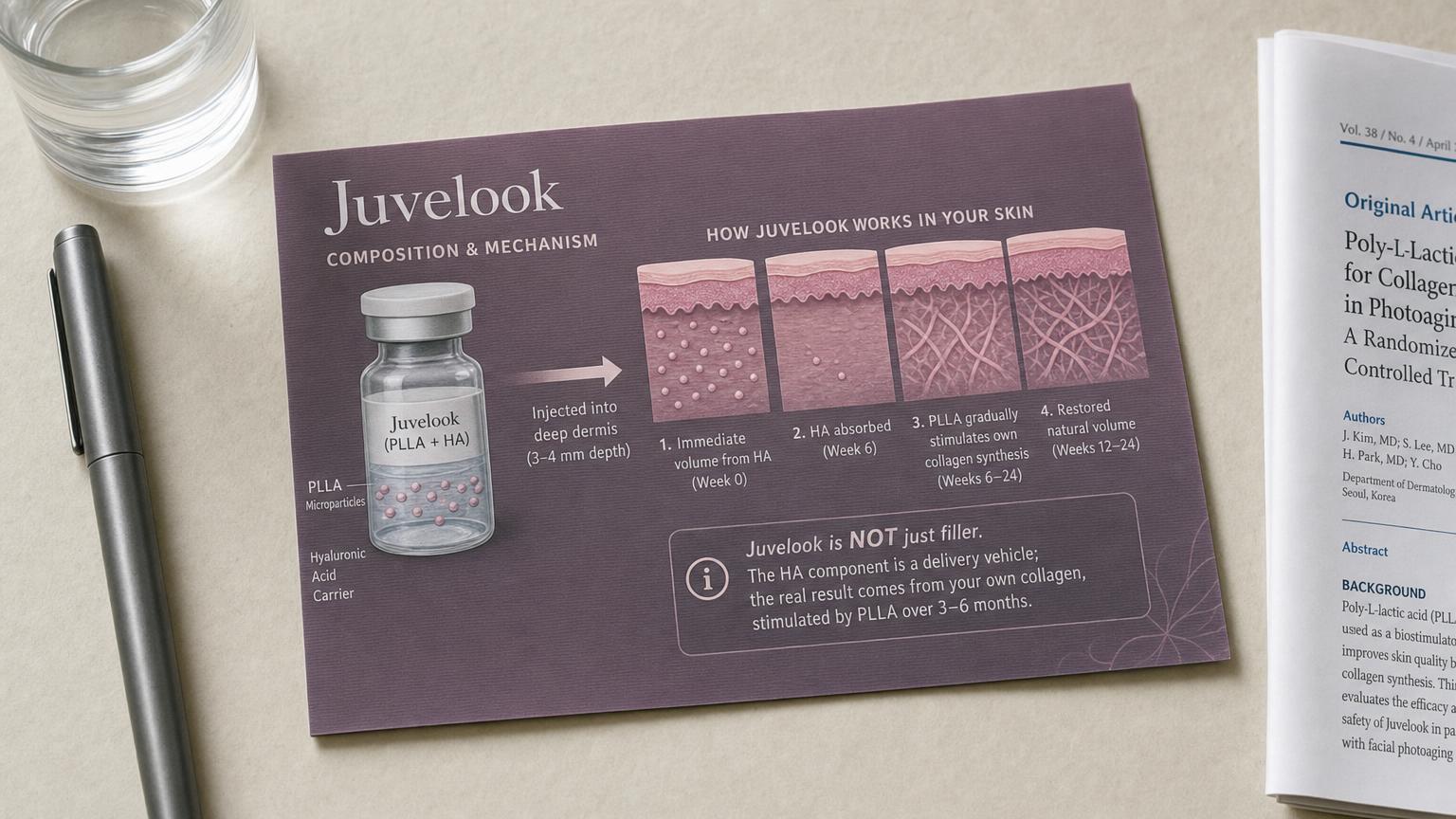
Juvelook is a Korean-manufactured injectable composed of polylactic acid (PLLA) microparticles suspended in hyaluronic acid (HA) gel carrier. Both components are biocompatible and have decades of clinical use independently — PLLA in Sculptra (US), HA in countless filler brands. Juvelook’s innovation is combining them in a single product so that the two phases work at different timescales.
The Two-Phase Mechanism
- Phase 1 (Day 0 to Week 6) — The HA delivers immediate volume. The HA gel component provides instant visible plumpness at the injection sites, exactly like a traditional filler. This is the “day-one mirror moment” patients see immediately after the procedure. As with any HA, the body gradually metabolizes this component over 4–8 weeks, so the immediate volume slowly decreases during this period.
- Phase 2 (Week 4 to Month 12+) — The PLLA stimulates the patient’s own collagen. While the HA fades, the PLLA microparticles remain in the deep dermis where they were injected, triggering a controlled foreign-body response that drives the patient’s own fibroblasts to synthesize new type I and type III collagen around the particles. This new collagen replaces the HA volume gradually over 3–6 months and produces the long-term result that is not filler — it is the patient’s own restored tissue.
The reason this matters: Juvelook patients have three distinct visible states across the treatment timeline, and each one looks different. Day 1 looks like filler. Week 4 looks like fading filler (and patients sometimes panic at this stage). Month 3+ looks like natural restored volume — the actual goal — and continues subtly improving for up to 12 months.
What Juvelook Is NOT
- Not pure HA filler. Pure HA gives you day-1 volume that lasts 6–18 months, then disappears completely without lasting tissue change. Juvelook’s long-term result is structural collagen, not maintained HA.
- Not Sculptra. Sculptra is pure PLLA without the HA delivery vehicle. It has no day-one volume, just gradual collagen build over 3–6 months. Patients who want both immediate gratification and long-term build choose Juvelook over Sculptra.
- Not Rejuran. Rejuran is polynucleotides (salmon DNA fragments) that signal fibroblasts for barrier and texture repair, not volume restoration. Different mechanism, different indication.
- Not Exosome. Exosomes are stem-cell-derived signaling vesicles. Different cargo, different effect, often combined with microneedling. Juvelook is intradermal injection at deeper depth for volume.
- Not for surface texture. Juvelook does not directly improve pore size, fine surface lines, or pigmentation. For those concerns, the Korean protocol stacks Juvelook with Rejuran or Exosome (different sessions, complementary mechanisms).
The Korean Treatment Protocol — Two Sessions, 12-Week Window
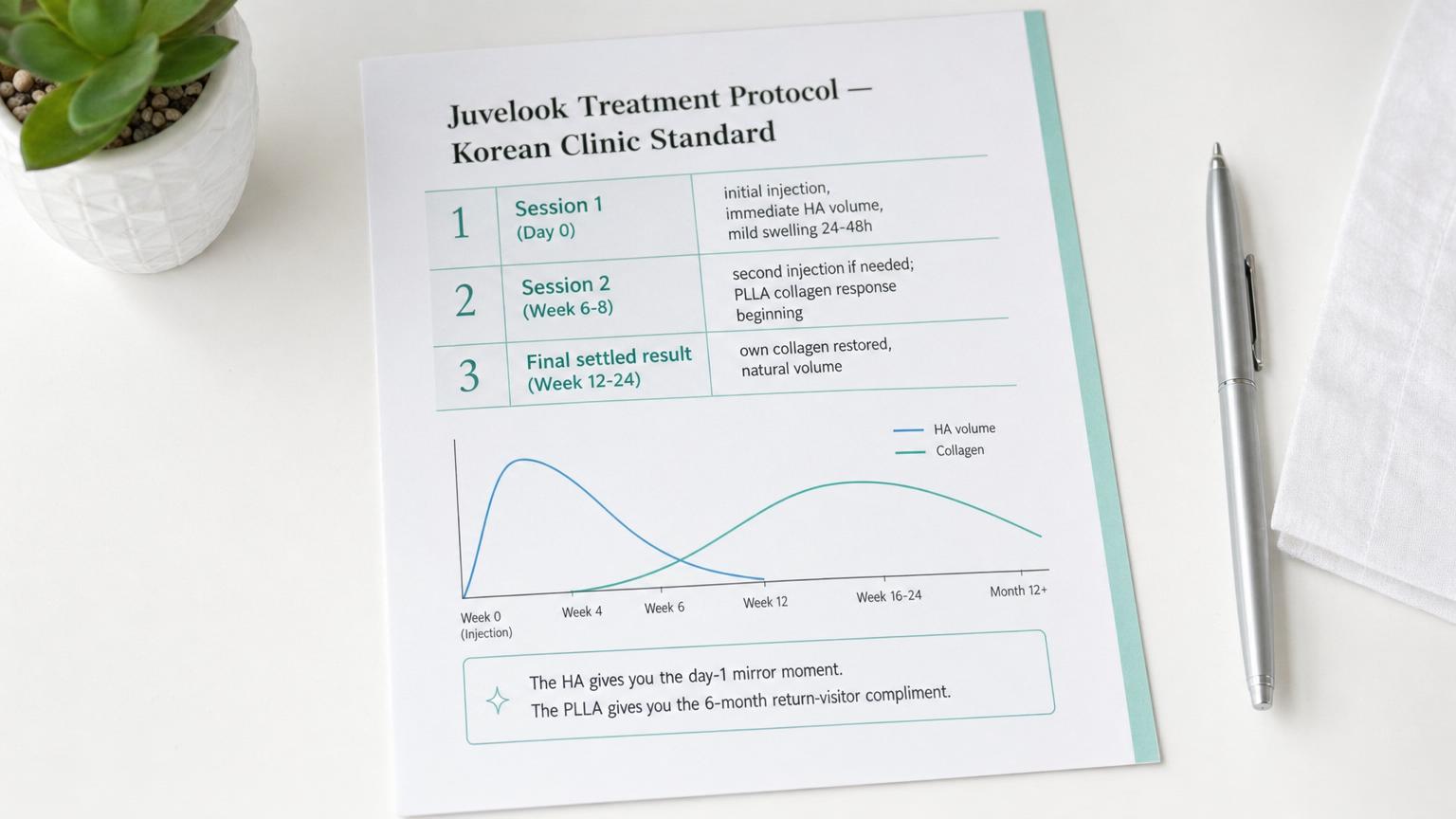
Korean clinics generally use a two-session protocol for Juvelook, spaced approximately 6–8 weeks apart, with the final settled result evaluated at week 12–16.
Session 1 (Day 0)
The clinician marks the injection sites — typically the temples, mid-cheek volume points, lateral cheek, and sometimes the chin and jawline depending on the patient’s specific volume loss pattern. Topical anesthetic cream is applied for 20–30 minutes. The injection itself uses a fine cannula or a 27-gauge needle, depositing Juvelook into the deep dermis at approximately 3–4 mm depth (deeper than Rejuran, deeper than typical surface mesotherapy). The session takes 30–45 minutes total. Immediately after, the patient sees real visible volume from the HA component.
Days 1–7 After Session 1
Mild swelling at injection sites for 24–48 hours, occasional minor bruising in 10–15% of patients. By day 3 most patients can resume full social life. The volume the patient sees in the mirror at this stage is mostly HA, not yet PLLA-collagen.
Weeks 2–6 — The “False Disappointment” Window
This is the most important section of this guide for patients planning treatment. Between weeks 2 and 6, the HA component gradually metabolizes and the visible volume decreases. Patients who do not understand the protocol sometimes interpret this as “the treatment wore off” and contact the clinic worried that the procedure failed. This is normal and expected. The PLLA-stimulated collagen response is just beginning at this stage, so the patient is in a transitional window where the day-one volume is fading but the long-term collagen result has not yet built. Do not judge the outcome at week 4. Do not request emergency re-treatment. Wait for the protocol.
Session 2 (Week 6–8)
Most patients receive a second Juvelook session at the 6–8 week mark. This serves two purposes: it adds a second wave of immediate HA volume (so the patient does not have a visible “valley” between treatments), and it deposits more PLLA to drive continued collagen response. The same injection sites are typically targeted, sometimes with slight refinement based on how the first session settled.
Weeks 8–16 — Collagen Response Builds
This is when the actual Juvelook result becomes visible. The patient’s own new collagen replaces the HA volume gradually, and by week 12–16 most patients are at the settled result they came in for: restored fullness in the temples, plumper but natural mid-cheek, softened nasolabial area, fresher overall facial proportion. The change is real, restored, and natural — not the bulky over-filled look of pure HA filler.
Maintenance (Month 12+)
The collagen response is not permanent — own collagen still ages and gradually declines. Most Korean clinics recommend a single maintenance Juvelook session at the 12-month mark to refresh the result. Patients who maintain consistently report stable natural volume for years.
Why Two Sessions Outperform One
A natural question patients ask: why not just do one bigger session and skip the second visit? The answer comes from the PLLA biology. A single larger PLLA dose risks visible papule formation as the microparticles aggregate before the collagen response can spread them naturally. Two smaller doses spaced 6–8 weeks apart deliver the same total PLLA load with better distribution, and the second wave of HA bridges the patient through the transitional week-6 window before the collagen result builds. The two-session protocol is biological optimization, not commercial upselling.
What Real Patients See — Three Cases Across Demographics
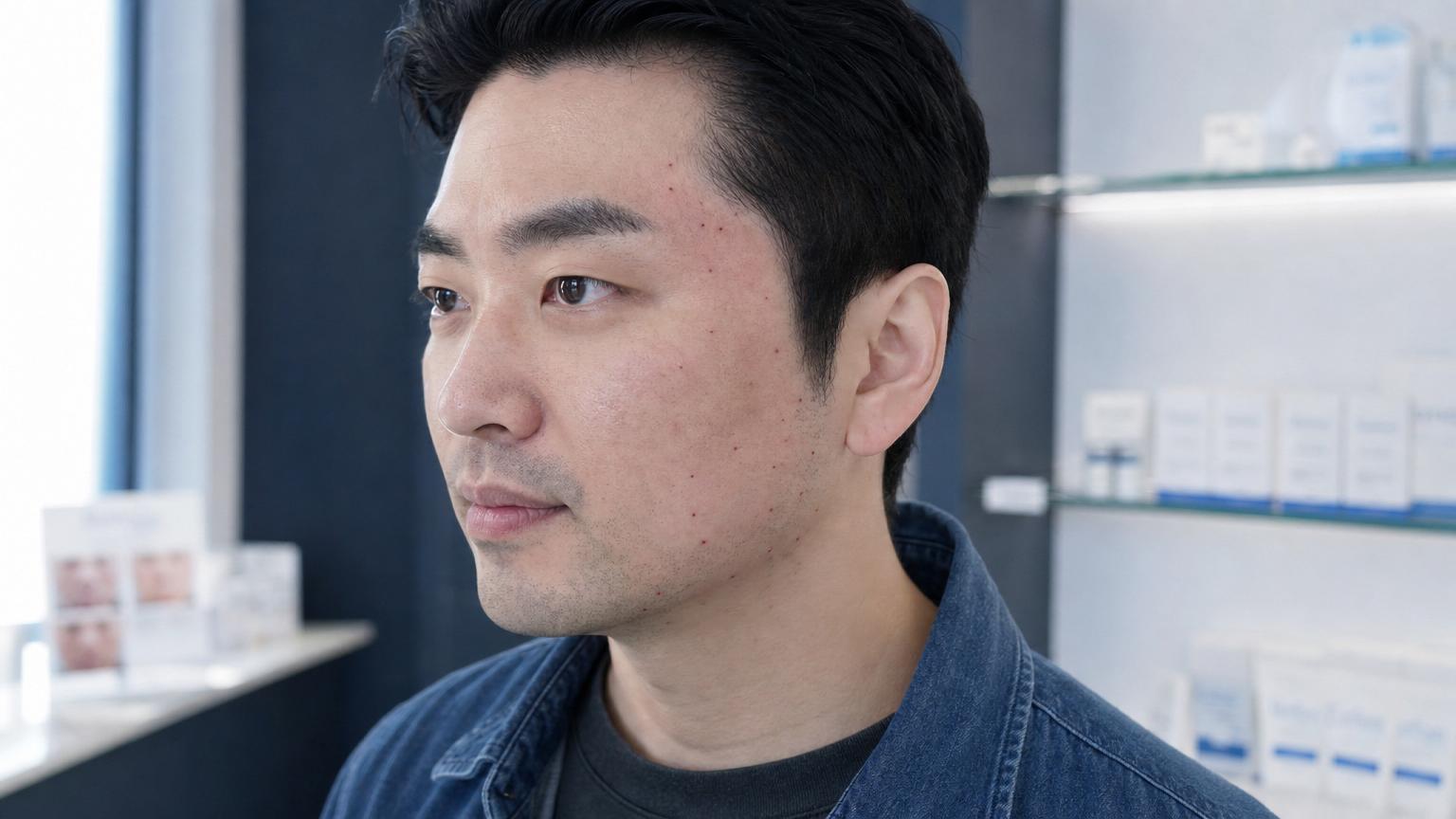
Korean clinics treat Juvelook patients across a wide range of demographics, and the protocol works the same way regardless of patient profile. Here are three representative cases that map to who actually walks through clinic doors in Seoul.
Recommended for Your Recovery
Products commonly used before and after Korean juvelook plla collagen booster — same items routinely recommended in the recovery instructions Seoul clinics hand out at discharge.
- COSRX Advanced Snail 96 Mucin Power Essence — Korean barrier essence to support skin between injection sessions and reduce post-procedure dryness. Check price on Amazon
- Beauty of Joseon Relief Sun SPF 50+ — lightweight Korean SPF 50+ — UV protection is critical after any injectable to prevent pigment irregularities. Check price on Amazon
- Gel Eye Mask (Cold Compress) — cold compress for periorbital or perioral micro-swelling in the 24 hours after a session. Check price on Amazon
- Arnica Montana Tablets — optional 1 to 2 day course around injection day to minimize bruising at injection points. Check price on Amazon
As an Amazon Associate, GlobalBeautySpot earns from qualifying purchases at no extra cost to you.
Case 1 — Mid-Forties Asian Woman with Temple and Cheek Volume Loss
The classic Juvelook indication. Patients in their forties beginning to experience age-related volume loss in the temples and mid-cheek, where the face starts looking slightly hollow and tired even after a full night’s sleep. Two sessions across 12 weeks produce restored fullness at the volume-loss points without the puffy “did she get filler?” look that pure HA can create. The improvement is subtle and brings the face back to the patient’s own previous proportion — restoration rather than augmentation.
Case 2 — Late-Thirties Male Patient with Subtle Volume Concerns
An increasingly common case in Korean clinics. Male patients who have noticed subtle hollowing at the temples or beginning loss of jawline definition, who specifically do not want anything that “looks done.” Juvelook is well-suited because the long-term result is the patient’s own collagen — there is nothing to see except subtly improved facial proportion. Male patients typically receive slightly more volume in the lateral cheek and jawline for masculine contour preservation, less in the cheek apex (which softens the face).
Case 3 — Mid-Thirties Asian Woman with Mid-Cheek Volume Loss
A younger demographic that is rapidly growing. Patients in their thirties with naturally narrow face structure who have lost subtle mid-cheek volume from significant weight loss, postpartum tissue changes, or simply early aging. Two sessions restore the natural mid-cheek apex and produce a slightly fuller, more rested facial appearance. The “feels like myself again” patient pattern.
The 12-Week Outcome — What Patients Actually Notice

Patients who complete the standard two-session protocol typically report a consistent pattern of observation across the 12-week window.
Day 1 — Immediate HA Volume
Patients see visible volume in the mirror immediately after the procedure. Some are pleased; some are surprised it is “more than expected.” This is the HA component and it will partially fade over the next 4–6 weeks. Do not assume this is your final result.
Weeks 2–4 — The Quiet Window
Skin and tissue feel different to the touch — slightly more elastic, slightly less papery. Visible volume is settling, neither dramatic nor concerning. Most patients are at their daily life normal during this window.
Week 6 — The “Where Did It Go?” Concern
This is the false-disappointment window described earlier. Visible HA volume is mostly gone, PLLA collagen response is just starting. Patients in this window who panic and request re-treatment are misreading the timeline. The clinic should reassure them that this is exactly when session 2 is scheduled to bridge into the long-term collagen result.
Week 8–10 — Collagen Becomes Visible
Following session 2, the new HA wave fills in while the underlying collagen response continues building. Patients start to see what looks like the result they wanted from the beginning, but this time it is structurally their own tissue, not filler.
Week 12 — The Photo Comparison
Side-by-side photos in identical lighting and angle (which patients should take routinely throughout the protocol) show clear restoration of natural facial volume. The change is real but subtle — colleagues notice the patient looks “rested” or “different” without identifying what changed. This is the signature Juvelook outcome.
Month 6 — Maximum Visible Result
Collagen synthesis peaks around month 4–6. The patient’s facial volume is essentially fully restored. From here, the result will be stable for 6–18 months before gradual decline begins, at which point a maintenance session keeps it level.
Cost and Why Korea Is the Practical Destination for PLLA Treatments
Juvelook is currently available primarily in Korea, with limited availability in select international markets that import the product. The cost difference and protocol experience favor Korea significantly for this specific treatment.
| Region | Per Session | Two-Session Protocol Total | Notes |
|---|---|---|---|
| Korea (Seoul) | KRW 400,000–700,000 (USD 295–520) | KRW 800,000–1,400,000 (USD 590–1,040) | Series pricing common, protocol fluency high (Juvelook is Korean-manufactured, used since 2018) |
| USA — Sculptra (similar PLLA mechanism) | USD 800–1,200 | USD 2,400–4,800 (3-session standard) | Different product (pure PLLA without HA delivery), longer protocol |
| UK / EU — Sculptra or PLLA imports | GBP 500–800 | GBP 1,500–2,400 | Juvelook itself less commonly available |
| Australia — Sculptra equivalent | AUD 700–1,100 | AUD 2,100–3,300 | Standard three-session pattern, longer downtime |
The cost advantage is real, but the more meaningful Korean advantage is protocol fluency with the specific HA+PLLA hybrid. Korean clinics have used Juvelook since 2018 and have settled into specific injection depth, dosing, and session spacing protocols that are difficult to source outside Korea simply because the product itself is less available globally. Western patients seeking similar outcomes typically receive Sculptra (pure PLLA, longer protocol, no day-one volume) rather than the Juvelook hybrid that produces both immediate and long-term effects.
If you are planning a Korea trip and coordinating multiple petit treatments, this guide pairs naturally with Korean Rejuran skin booster (different indication — barrier and texture repair rather than volume), with Korean exosome therapy (signaling for inflammation and healing, often combined with microneedling), and with the broader petit treatment menu at Link Plastic Surgery’s English consultation page. Patients with both volume loss AND barrier or texture concerns sometimes alternate Juvelook sessions with Rejuran or Exosome sessions across a single 12-week protocol.
Five Questions to Ask Any Clinic
- What injection depth do you use for Juvelook? The Korean standard is approximately 3–4 mm into the deep dermis. Too shallow risks visible papules from the PLLA microparticles; too deep wastes the volume effect. A clinician who cannot answer this specifically is not technically fluent with the product.
- Do you typically do one session or two for first-time patients? The Korean standard is two sessions 6–8 weeks apart. A clinic that recommends a single session is either underdosing or selling a starter package — they should explain why if your case differs.
- How do you handle the week 6 “where did it go” call? A clinic that has done many Juvelook sessions has heard this call hundreds of times and has a reassurance protocol. A clinic that has not will sound surprised by your concern. Ask explicitly.
- Where do you typically inject for a patient with my volume loss pattern? An experienced Juvelook clinician should map injection sites to your specific concern (temples vs cheek apex vs jawline vs combination) rather than defaulting everyone to the same template.
- What is your protocol if I am dissatisfied at month 3 evaluation? Realistic answer: micro-adjustment session at month 3 if specific sites are under-corrected. Honest clinics will tell you they cannot “remove” PLLA-stimulated collagen if it is over-corrected, so the conservative approach is preferred.
Frequently Asked Questions
Is Juvelook safer than traditional filler?
Both have established safety profiles when injected by experienced clinicians. PLLA has been used since the early 2000s (Sculptra), and the HA component is the same as any conventional filler. The “safety” question is really about delivery technique and clinician judgment, not the product itself.
Will I look puffy or “filled” like with HA filler?
The HA component during weeks 1–4 produces a subtle plumpness that some patients describe as “slightly filled.” This fades. The long-term collagen result at month 3+ is restored natural volume — not the over-filled look pure HA filler can produce.
How does Juvelook compare to Sculptra?
Sculptra is pure PLLA without HA carrier. No day-one volume; result builds entirely from collagen synthesis over 3–6 months. Sculptra typically requires three sessions; Juvelook usually two. Patients who want immediate visible volume in addition to long-term collagen choose Juvelook; patients who prefer purely gradual results choose Sculptra.
What if I want filler-style immediate volume only?
Then traditional HA filler is the right product for you, not Juvelook. The PLLA component of Juvelook means a portion of your investment is for long-term collagen, not just immediate volume — only worth it if you actually want the long-term restoration.
Can I get Juvelook in lips?
Generally no. Juvelook is designed for deep dermis injection in mid-face volume points (temples, cheek apex, jawline, chin). Lip enhancement uses dedicated HA lip products. PLLA in lips is not standard practice.
Will it interfere with future filler?
No — the PLLA-stimulated collagen integrates into the patient’s own tissue. Future HA filler can be added to the same areas if desired without conflict.
Are there visible bumps or papules?
If injection technique is correct (deep dermis 3–4 mm), no. Subcutaneous injection too superficial can rarely produce small visible papules from PLLA particle aggregation. This is a technique issue, not a product issue. Choose an experienced injector.
Can I exercise after a Juvelook session?
Light activity yes, immediately. Vigorous exercise, sauna, hot yoga, and facial massage should wait 48–72 hours to avoid additional swelling and to let the injected product settle at depth. Avoid significant facial pressure (e.g., heavy face-down sleeping) for 1 week.
Can men get Juvelook?
Yes — Korean clinics treat male patients commonly, particularly for subtle volume restoration at the temples and lateral cheek for masculine contour preservation. The protocol is identical, with injection site mapping adjusted to male facial structure.
How long do I have to wait between Juvelook and other Korean treatments?
Generally 1–2 weeks between Juvelook and Rejuran or Exosome sessions. Combined-day protocols are not standard for Juvelook because the deep injection means the injection sites need to settle before adding additional treatments. Korean clinics will sequence the schedule.
Closing
Korean Juvelook is one of the most clinically refined PLLA+HA hybrid injectables in dermatology — but only because Korean clinics treat it as a two-phase, two-session, three-month protocol rather than a single-shot filler. Foreign patients who walk in expecting filler-style instant gratification will be confused by the week-six fade. Foreign patients who walk in expecting Rejuran-style slow signaling will be surprised by the day-one volume. The treatment is neither, and understanding the hybrid two-phase mechanism is the entire difference between disappointment and the restored natural volume that the Korean K-beauty aesthetic has built around this specific product.
If you are planning a Korea trip and want to add Juvelook to your itinerary, plan for the two-session protocol across 6–8 weeks. Choose a clinic that explains both phases of the mechanism upfront. Have realistic expectations about the week 6 transitional dip and about the month 3+ settled result. Clinics that have built Korean dermatology reputations in this category — including Link Plastic Surgery’s Juvelook page — will explain the hybrid mechanism honestly rather than marketing it as “just better filler.” That honesty, combined with the protocol fluency that comes from years of Korean clinical experience with this specific HA+PLLA hybrid, is what makes Seoul the practical destination for PLLA collagen booster treatments.