For foreign patients researching Korean lip aesthetics, the moment of confusion almost always arrives at the same point: they hear the term “lip Rejuran” or “lip skin booster” in a Seoul consultation, search it online, and find descriptions that sound suspiciously close to lip filler — only to be told in the next sentence that the two are completely different procedures. Korean clinics, including Link Plastic Surgery and others in the petit aesthetic segment, treat Lip Rejuran as a lip skin regeneration procedure built around polynucleotides (PN), not a volumizing injectable. The molecule is different, the goal is different, and the result is different from hyaluronic acid lip filler. This guide explains what foreign patients actually receive when they book Korean Lip Rejuran, the 3-session protocol Seoul clinics use, and the misconceptions that lead to disappointment when patients confuse it with filler.
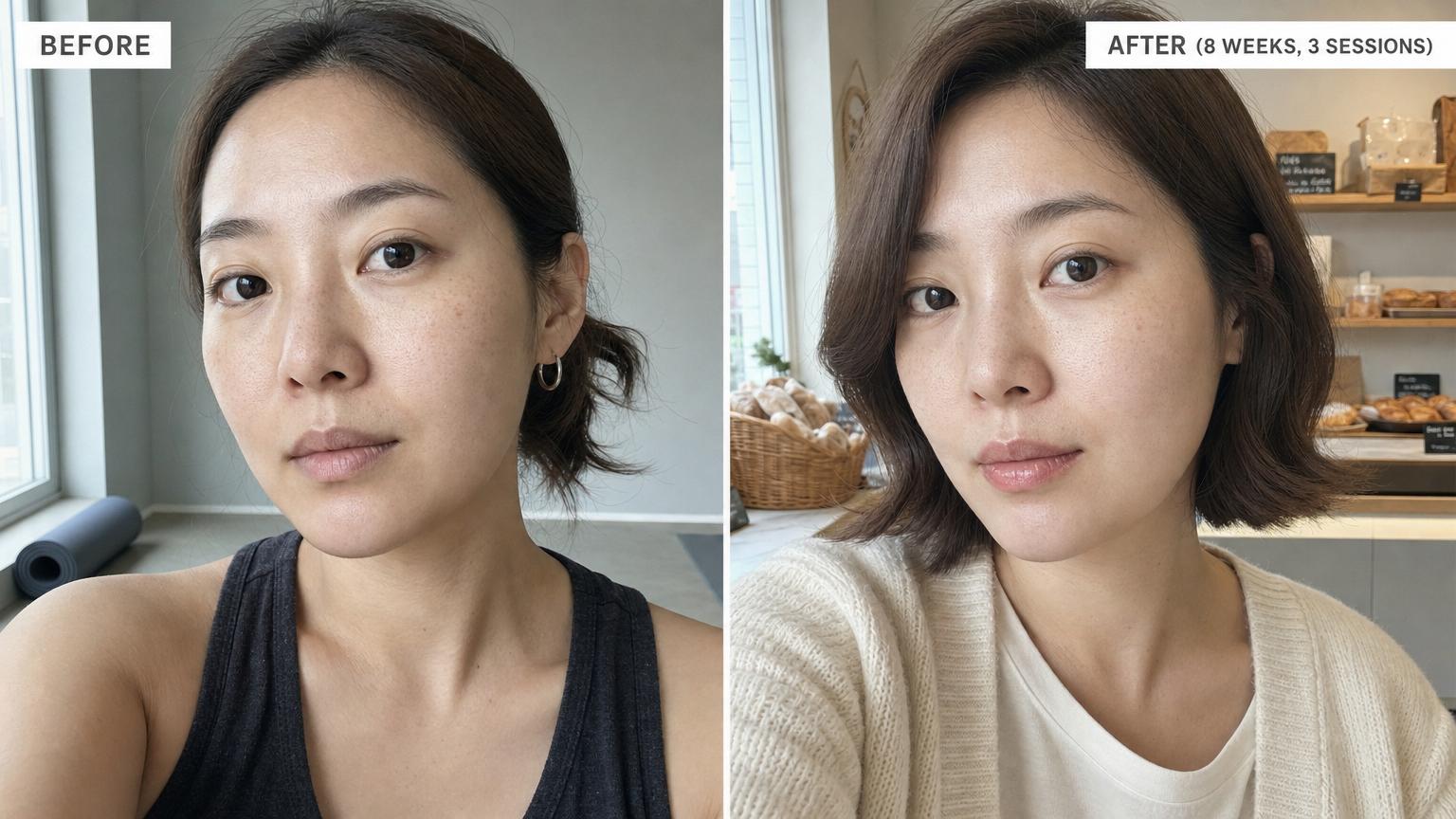
What Lip Rejuran Actually Is (And What It Is NOT)
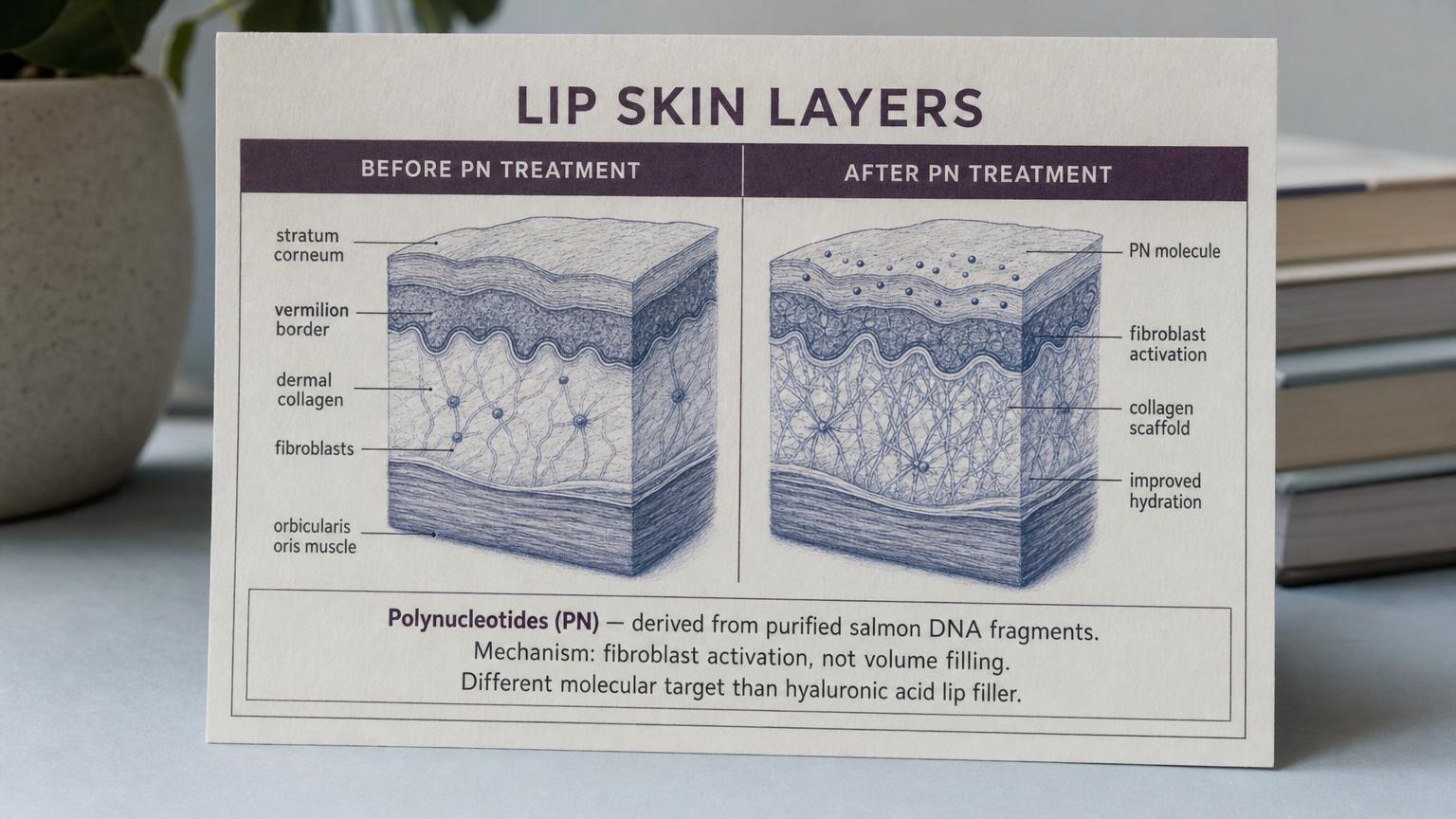
Lip Rejuran is a lip-targeted variant of the Rejuran family of injectable skin boosters originally developed in Korea using polynucleotides (PN) — purified DNA fragments derived from salmon. The “lip” version is formulated with viscosity and particle distribution adapted for the thin, mobile tissue of the vermilion, and the protocol is delivered as a series of micro-injections across the lip body and surrounding perioral skin rather than as a single placement.
The mechanism is regenerative, not volumetric. PN molecules act on dermal fibroblasts, supporting collagen scaffold maintenance and improving local hydration. The visible result over 8 to 12 weeks is improvement in lip skin quality — texture becomes smoother, vertical lip lines soften, vermilion border definition sharpens, and natural lip color appears more even. The lips do not become larger in the way that hyaluronic acid filler enlarges them. Any subtle plumpness that appears is a consequence of healthier, more hydrated skin rather than injected gel volume.
This is the single most important point for foreign patients to absorb before booking: Lip Rejuran is NOT lip filler. It is closer in concept to a skin booster than to a volumizer. Patients who book it expecting a fuller-looking pout are evaluating the wrong result.
What Lip Rejuran treats well
- Dry, dehydrated, chronically chapped lips that do not respond to topical balms
- Vertical lip lines (smoker’s lines, even in non-smokers, often appearing in mid-thirties onward)
- Loss of vermilion border definition with age
- Uneven or muted lip color, often described as “pale” or “washed out”
- Textured surface that no longer reflects light evenly
- Perioral skin that looks tired, with fine lines extending from the corners of the mouth
What Lip Rejuran does NOT do
- It does not add volume in the way filler does
- It does not change lip shape, projection, or proportion
- It does not correct anatomical concerns like a long philtrum (that would be a Korean lip lift / philtrum reduction consideration)
- It does not deliver an instantly visible “after” — the result builds over weeks
- It is not a single-session treatment
Lip Rejuran vs Lip Filler — Different Procedures, Different Goals
The clearest way to think about the two is that they answer different questions. Lip filler answers “I want my lips to look fuller or differently shaped.” Lip Rejuran answers “I want my lip skin to look healthier — smoother, more hydrated, with more even color.” Foreign patients who arrive in Seoul expecting these to be the same procedure with different marketing labels leave disappointed. Korean clinics that explain the distinction clearly tend to see far fewer dissatisfied second-visit requests.
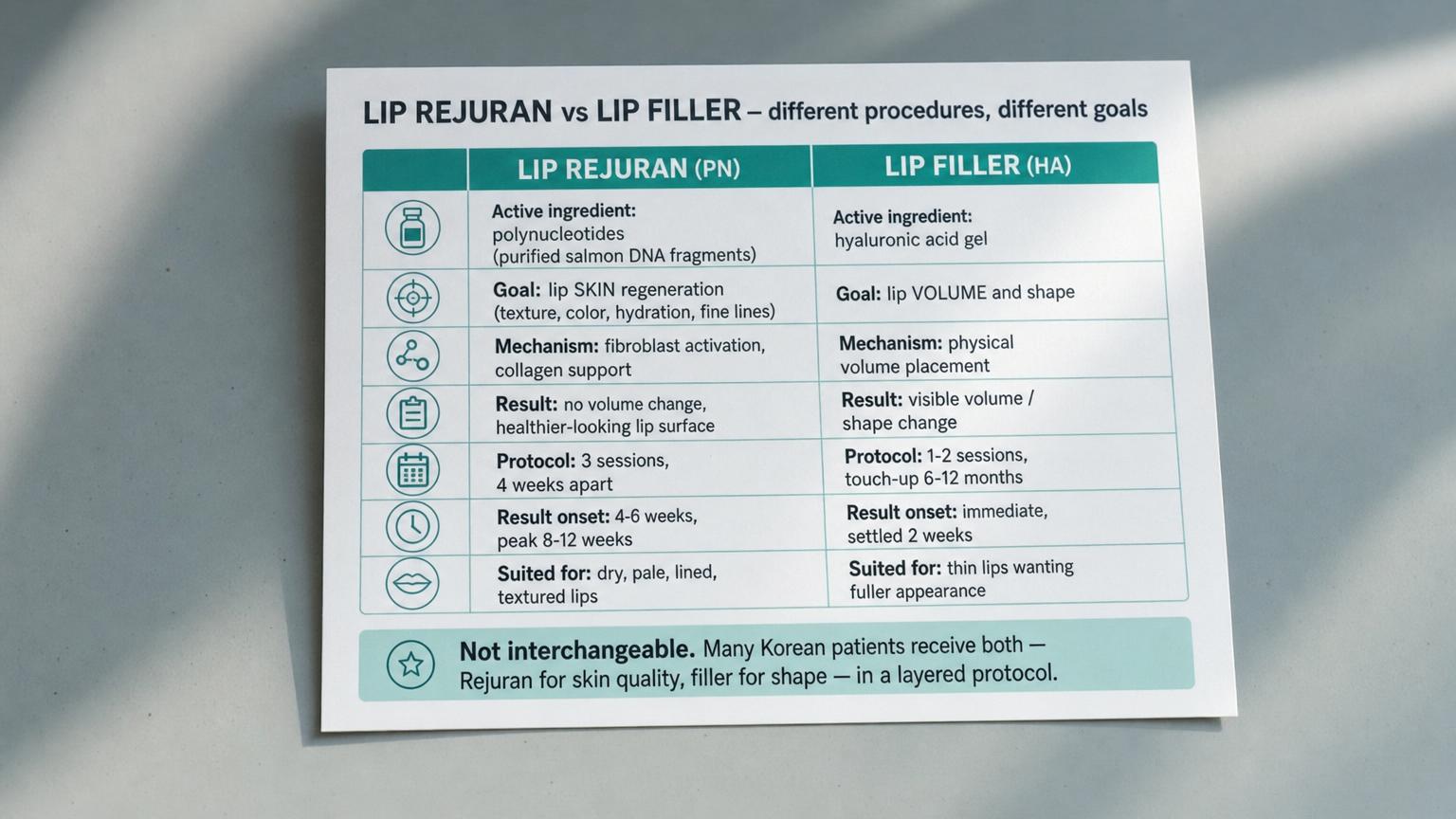
Active ingredient. Lip Rejuran uses polynucleotides — fragmented DNA chains derived from salmon, purified for clinical injection. Lip filler uses cross-linked hyaluronic acid, a gel that occupies physical space. The two molecules behave nothing alike in tissue.
Goal. Lip Rejuran targets skin quality — texture, hydration, color, fine lines, vermilion definition. Lip filler targets size and shape — fuller upper lip, more projected cusp, defined philtral columns, balanced upper-to-lower ratio.
Mechanism. PN activates fibroblasts and supports the dermal collagen scaffold. HA filler sits in tissue as a soft volumizing layer until it slowly degrades.
Result onset. Lip Rejuran results build over 4 to 12 weeks, with the most visible improvement settling between weeks 8 and 12 after the 3-session protocol is complete. Lip filler results are visible immediately, with final settled appearance at 2 weeks once initial swelling resolves.
Protocol. Korean Lip Rejuran protocols at Link PS follows a 3-session standard, spaced 4 weeks apart. Lip filler is typically 1 session, sometimes with a small touch-up at 2 to 4 weeks if the initial result needs refinement.
Maintenance. After the initial Lip Rejuran protocol completes, a single maintenance session every 6 to 12 months is typical. Lip filler maintenance varies by product but generally requires refill every 6 to 18 months depending on lip movement, individual metabolism, and the specific HA product used.
Layered protocol. In many Korean clinics, the two procedures are used together rather than as alternatives. A patient may receive Korean lip filler with Restylane Kysse for shape and balance, and Lip Rejuran for ongoing skin quality. The layered approach reflects the Korean preference for treating lip aesthetics as a combination of geometry and skin health rather than picking one or the other.
The Korean 3-Session Lip Rejuran Protocol
The standard Korean Lip Rejuran protocol is three sessions delivered 4 weeks apart. Session 1 establishes a baseline response — patients often notice subtle softening of fine lines and improved hydration within 1 to 3 weeks. Session 2 stacks on the cumulative collagen support, with vermilion color evening out and surface texture continuing to refine. Session 3 completes the protocol, after which the result settles between weeks 8 and 12. Patients evaluating their result at week 6 are looking at an unfinished protocol; patients evaluating at week 12 are looking at the final settled outcome.
Recommended for Your Recovery
Products commonly used before and after Korean lip rejuran pn lip regeneration — same items routinely recommended in the recovery instructions Seoul clinics hand out at discharge.
- COSRX Advanced Snail 96 Mucin Power Essence — Korean barrier essence to support skin between injection sessions and reduce post-procedure dryness. Check price on Amazon
- Beauty of Joseon Relief Sun SPF 50+ — lightweight Korean SPF 50+ — UV protection is critical after any injectable to prevent pigment irregularities. Check price on Amazon
- Gel Eye Mask (Cold Compress) — cold compress for periorbital or perioral micro-swelling in the 24 hours after a session. Check price on Amazon
- Arnica Montana Tablets — optional 1 to 2 day course around injection day to minimize bruising at injection points. Check price on Amazon
As an Amazon Associate, GlobalBeautySpot earns from qualifying purchases at no extra cost to you.
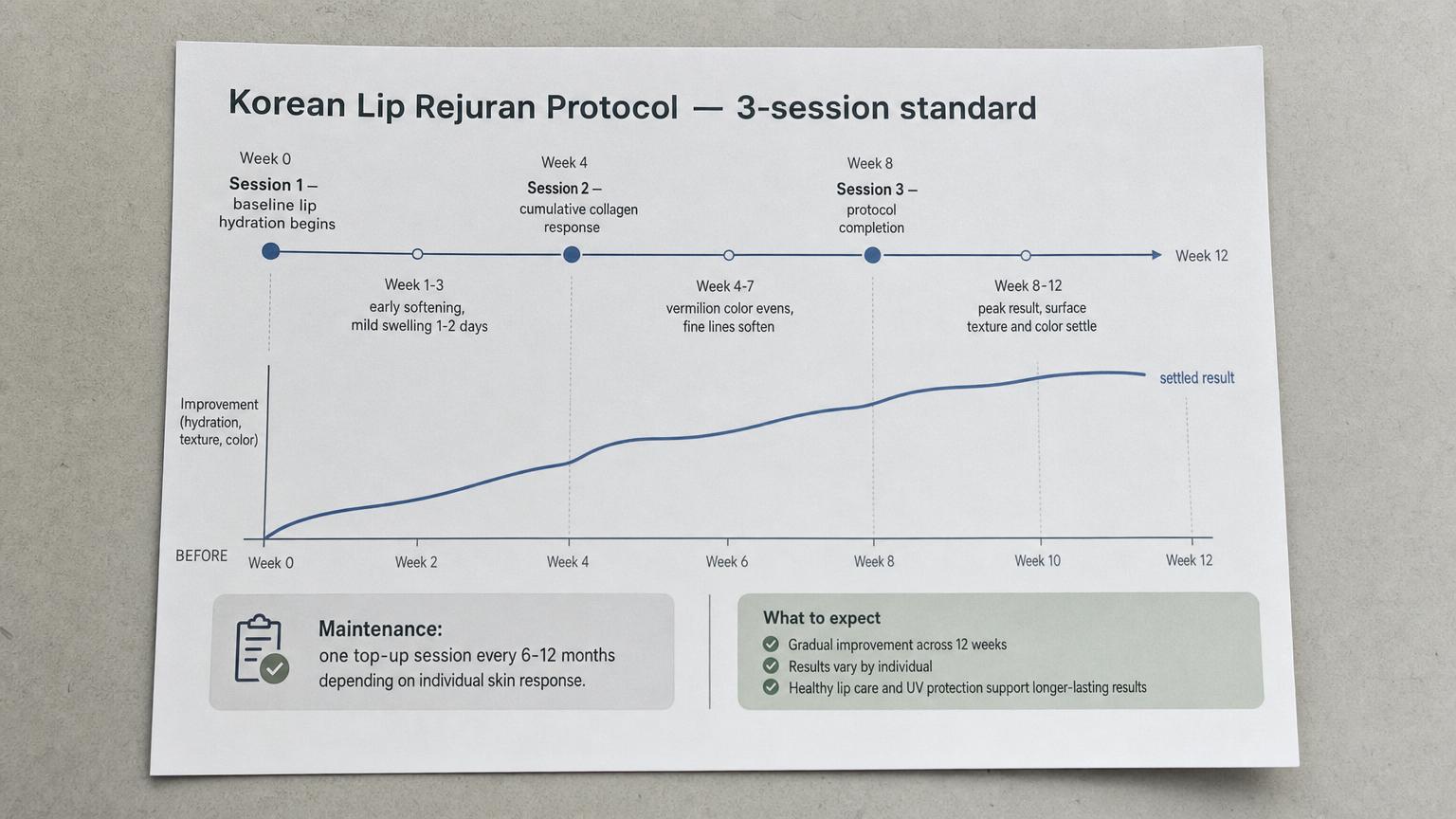
This is the second misconception that lands foreign patients in disappointment: assuming Lip Rejuran is a single-session result. It is not. The visible improvement is the cumulative response to three sessions delivered over 8 weeks, with the final 4 weeks dedicated to letting the response settle. Foreign medical tourists who book a single session expecting a finished outcome are evaluating a protocol that has barely begun.
Why 3 sessions and not 1
The biological response to PN is gradual. A single session delivers some immediate hydration benefit and begins fibroblast activation, but the cumulative collagen scaffold support that produces visible texture and color change requires the layered stimulus of repeated sessions spaced to match the dermal response cycle. Spacing them 4 weeks apart matches typical collagen turnover and avoids the inflammatory plateau that can occur when sessions are stacked too closely. Three sessions is the standard because it is the point at which most patients reach the visible inflection in their skin quality.
What each session feels like
Each session lasts approximately 15 to 25 minutes. Topical anesthetic cream is applied for 20 to 30 minutes beforehand to numb the lip and perioral area. The clinician then performs micro-injections across the lip body and the immediate perioral skin using a fine needle or microcannula depending on the technique preference. Patients typically describe the sensation as mild stinging during injection, comparable to a small pinch, followed by tenderness that resolves within hours.
Recovery Timeline and What to Expect After Each Session
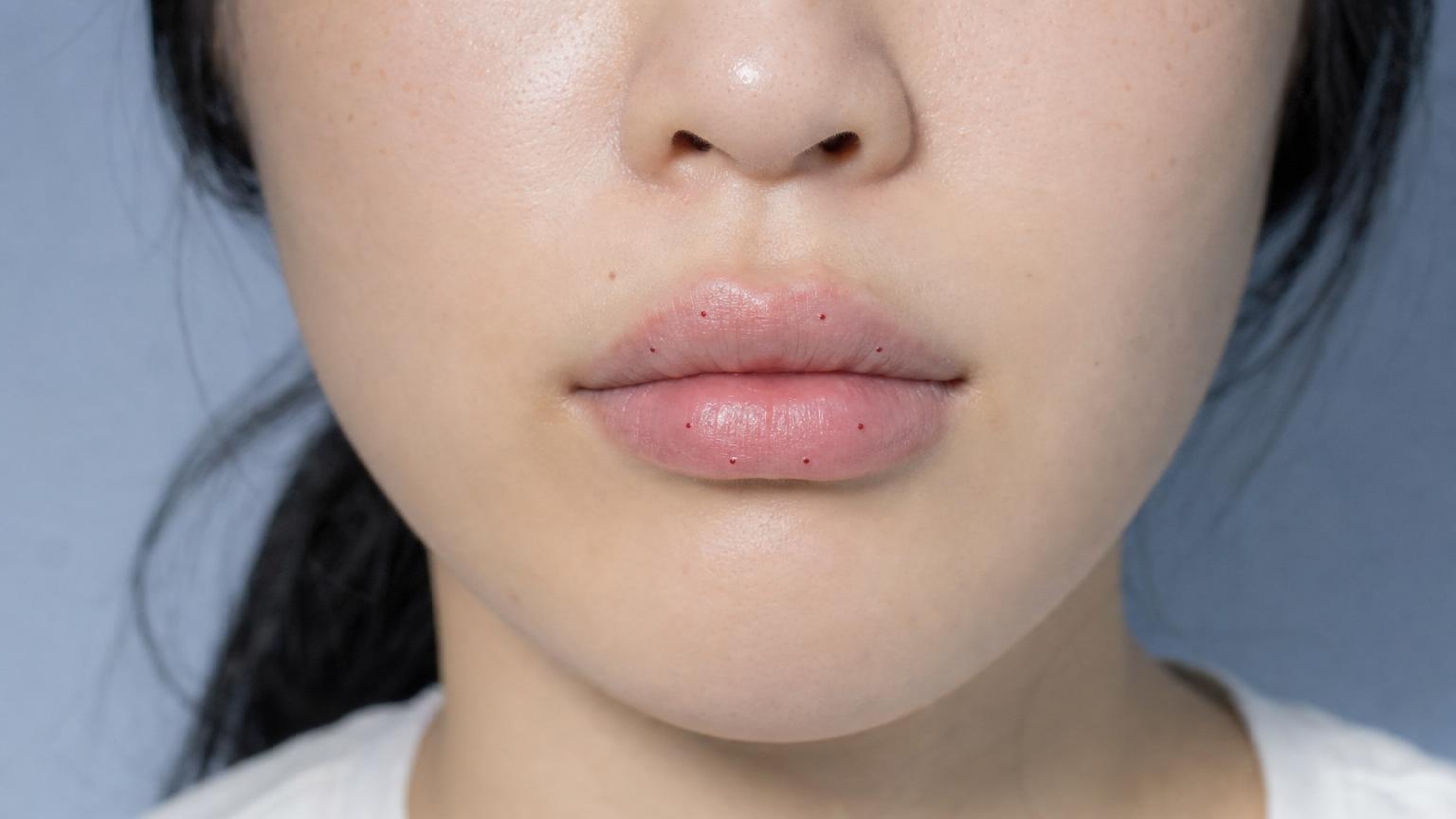
The recovery profile of Lip Rejuran is relatively gentle compared to most injectable lip treatments. Most patients experience the following.
First 24 hours. Mild swelling that gives the lips a slightly fuller appearance, six to eight visible injection point marks distributed evenly across the upper and lower lips, occasional tenderness when speaking or eating. Bruising is uncommon when the procedure is performed by an experienced injector but possible.
Days 2 to 4. Swelling resolves. Injection points fade and become invisible. Lips return to baseline appearance with very early hints of improved hydration.
Weeks 1 to 3. The fibroblast response begins to register. Lips often feel different to touch before they look different — softer, more pliable, less prone to chapping. Visible change at this stage is still subtle.
Weeks 4 to 7 (after Session 2). The cumulative collagen response begins to produce visible effects. Vermilion color appears slightly more even. Vertical lip lines start to soften. Texture improves. This is often the point at which patients first say their lips look different in photos.
Weeks 8 to 12 (after Session 3 and settling). The full result. Hydrated lip surface, defined vermilion border, even natural color, softened fine lip lines, and subtle natural plumpness from improved skin quality rather than injected volume.

Aftercare
- Avoid pressing or massaging the lips for the first 24 hours
- Skip lip products containing exfoliating acids for 48 hours
- Avoid hot, spicy, or extremely acidic foods for the first 24 hours to minimize tenderness
- Avoid alcohol for 24 hours after injection — it can prolong mild swelling
- Apply SPF lip balm during the day after the first 24 hours; the skin is more responsive to UV during the regeneration phase
- Avoid saunas, hot yoga, and prolonged sun exposure for 3 days after each session
Cost, Combinations, and the Korean Layered Approach
In Korean Seoul clinics, Lip Rejuran cost typically ranges from KRW 200,000 to 450,000 per session depending on the clinic, the injector, and whether the perioral skin is included in the same treatment. The full 3-session protocol therefore runs from approximately KRW 600,000 to 1,350,000 (USD 450 to 1,000 at current exchange rates) before any maintenance sessions. For comparison, a single Lip Rejuran-equivalent session in the United States, where the product is less widely available, typically prices between USD 400 and 800 per session — meaning the cumulative Korean 3-session protocol costs roughly what a single Western session would.
Korean clinics often combine Lip Rejuran with other procedures rather than treating it as a standalone option.
Lip Rejuran + Lip Filler. The most common combination. Filler establishes shape and proportion; Rejuran maintains skin quality. Patients receive both procedures across a layered timeline rather than alternating between them.
Lip Rejuran + face Rejuran. Korean Rejuran skin booster therapy for the broader face is often scheduled in coordination with the lip protocol, addressing perioral skin quality alongside the lips themselves.
Lip Rejuran + Exosome. Some clinics layer Korean Exosome therapy after Lip Rejuran sessions for accelerated tissue response, particularly in patients with more pronounced perioral skin aging.
Lip Rejuran + post-laser. When patients receive perioral laser treatment, Lip Rejuran is sometimes scheduled afterward to support skin regeneration in the treated area.
The layered protocol reflects a broader pattern in Korean petit aesthetics — treating regions of the face as systems rather than individual procedures. Foreign patients who arrive expecting a single procedure to solve a single problem often leave with a layered plan that addresses skin quality, shape, and surrounding tissue together. Patients can find an overview of the full Korean petit aesthetic procedure category from clinic resources before consultation.
Frequently Asked Questions
How is Lip Rejuran different from regular Rejuran?
The molecule is the same (polynucleotides). The formulation viscosity, particle distribution, and injection technique are adapted for the thin, mobile tissue of the lips. The protocol is also slightly different from facial Rejuran, with sessions calibrated to the faster turnover of perioral tissue.
Will my lips look bigger after Lip Rejuran?
They may appear subtly plumper because healthier, more hydrated skin reflects light differently and the vermilion border looks more defined. This is not the same as the visible volume change that lip filler produces. If you want measurable size or shape change, filler is the appropriate procedure.
Can I have Lip Rejuran and lip filler at the same appointment?
In most Korean clinics, the two are scheduled separately even when used in a layered protocol — typically filler first to establish shape, then Rejuran beginning 2 to 4 weeks later. Some clinics will schedule them on the same day depending on the patient’s anatomy and the clinician’s preference.
How long does the Lip Rejuran result last?
After the initial 3-session protocol, the visible improvement in skin quality typically lasts 6 to 12 months. Maintenance is generally a single session every 6 to 12 months depending on individual skin response and lifestyle factors like sun exposure and smoking.
Does Lip Rejuran hurt?
Topical anesthetic cream applied for 20 to 30 minutes beforehand makes the injection sensation manageable for most patients. Patients typically describe it as mild stinging during injection followed by tenderness for a few hours.
What’s the recovery downtime?
Most patients return to normal activities the same day. Mild swelling lasts under 24 hours, injection points fade within 2 to 4 days. There is no extended downtime in the way that resurfacing laser treatments require.
Is Lip Rejuran safe for sensitive lips?
PN-based treatments are generally well tolerated, but patients with active herpes simplex outbreaks, pregnancy, breastfeeding, or autoimmune conditions affecting the skin should disclose those during consultation as some clinics defer treatment until those conditions are clear or stable.
Can men get Lip Rejuran?
Yes. Lip Rejuran is used by male patients in Korean clinics, often combined with perioral skin protocols. The result is the same skin quality improvement without volume change, which suits most male aesthetic preferences.
How do I know if my clinic is using real Rejuran?
Ask to see the sealed ampoule before the injection. Authentic Rejuran ampoules carry the Korean MFDS regulatory marking and are typically distributed in single-use sealed packages. A clinic that opens an unmarked vial is delivering an unspecified product.
What if I’m only in Seoul for a short trip?
The 3-session protocol cannot be compressed without compromising the cumulative collagen response. Patients on shorter trips can begin Session 1 in Seoul and complete the remaining sessions with a local clinician using the same product family, or return to Korea for follow-up sessions if the cost calculation justifies the travel.
For patients planning their Lip Rejuran treatment in Seoul, Link Plastic Surgery’s official website lists the device authorization documentation, the 3-session protocol options, and English-language consultation booking details.