Why Your Under-Eye Skin Looks ‘Bumpy’ After 40 — And What Korean Clinics Actually Do About It
I remember the exact moment I noticed it. Not wrinkles — I’d made peace with those years ago. It was this weird, almost granular texture right under my eyes. Like the skin had quietly turned into crepe paper while I wasn’t paying attention. Foundation made it worse. Concealer? Forget it. Every product I layered on just highlighted what I was trying to hide.
Sound familiar?
Most English-language skincare advice will tell you to slap on some retinol and call it a day. But spend any time around Korean dermatology clinics — actual clinics, not Instagram ads — and you’ll hear a completely different conversation. The under-eye area isn’t just “aging skin.” It’s a specific zone with specific problems that need specific solutions. Korean doctors have been obsessing over this for years, and their approach is nothing like what you’ll find at your local med spa.
I’ve sat in on enough consultations in Gangnam to know that under-eye texture is one of the top complaints from international patients over 40. And the fixes aren’t what most people expect. No, it’s not just filler. It’s not just laser. It’s a layered strategy that treats the actual cause — collagen degradation, thinning dermis, and micro-circulation issues — rather than just smoothing the surface.
Key Takeaways
- That “bumpy” texture isn’t just dryness — it’s structural. The under-eye dermis thins dramatically after 40, and topical creams can’t rebuild what’s lost underneath.
- Korean clinics treat under-eye aging as a multi-layer problem, combining skin boosters like Rejuran Healer with tightening protocols rather than relying on a single treatment.
- Rejuran Healer is the go-to for under-eye texture in Korea — it uses polynucleotides (salmon DNA) to stimulate your own collagen, not just fill space.
- Filler under the eyes is falling out of favor in top Korean clinics. Too many complications, too much migration. Skin boosters are replacing it for texture issues.
- Results aren’t instant. Real under-eye texture improvement takes 2–3 sessions spaced 2–4 weeks apart. Anyone promising overnight transformation is selling you something.
- The wrong laser on under-eye skin can make things worse. Korean dermatologists are extremely selective about which devices they use in this delicate zone.
- Aftercare matters more than the procedure itself — and Korean clinics have post-treatment protocols that most Western providers skip entirely.
What surprised me most — and I’ve been writing about Korean beauty treatments for a while now — is how differently Korean dermatologists think about aging skin texture compared to their Western counterparts. In the U.S. or U.K., you’ll typically get one recommendation. One device. One product. Korean clinics layer treatments the way Korean skincare layers products. There’s a reason for each step, and skipping one undermines the rest.
So if you’ve been staring at your under-eye area in a magnifying mirror (we’ve all been there), wondering why it suddenly looks like it belongs to someone ten years older — this is what’s actually going on beneath the surface. And more importantly, what clinics in Seoul are doing about it that the rest of the world hasn’t caught up to yet.
That Weird Texture Under Your Eyes? It’s Not Just “Aging”
Nobody warns you about this part. You expect wrinkles. Fine lines, sure. But that strange, bumpy, almost crepe-like texture that shows up under your eyes sometime after 40? That catches people off guard.
I remember sitting in a consultation room in Sinsa-dong, watching a dermatologist zoom into a patient’s under-eye area with a VISIA skin scanner. The screen showed what looked like tiny hills and valleys — micro-irregularities invisible to the naked eye but very much there. “This is collagen fragmentation,” she said, pointing at the uneven terrain. “Not wrinkles. Not fat loss. The structure itself is breaking apart.”
And that’s the distinction most people miss.
What’s Actually Happening Under the Surface
The under-eye area has the thinnest skin on your entire body — roughly 0.5mm thick, compared to about 2mm on your cheeks. After 40, three things happen simultaneously in this delicate zone:
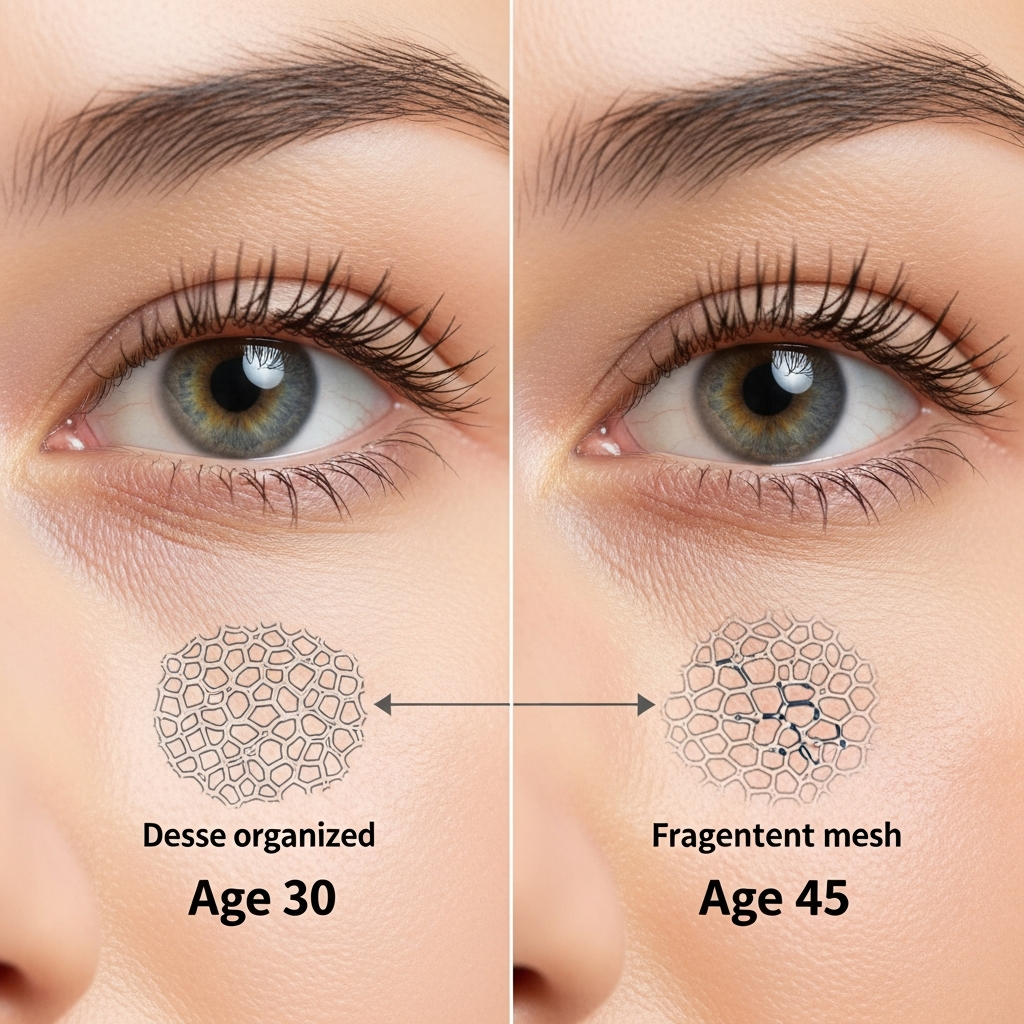
Collagen mesh deterioration. Your collagen fibers aren’t just decreasing in volume. They’re losing their organized lattice structure. Think of it like a woven basket slowly unraveling — the surface gets lumpy because the framework underneath is no longer uniform.
Dermal thinning with uneven fat pad descent. The SOOF (sub-orbicularis oculi fat) pad shifts downward unevenly. Some areas lose volume faster than others. The result? That bumpy, textured look that concealer somehow makes worse.
Microcirculation decline. Blood flow to the periorbital area drops. Less circulation means slower cell turnover, which means dead skin cells accumulate in patchy, irregular patterns.
Western dermatology tends to throw retinol and eye creams at this problem. Korean clinics take a fundamentally different approach — they go under the skin.
The Korean Clinic Playbook for Under-Eye Texture
So what do Korean clinics actually do? Having visited multiple practices in Gangnam and Cheongdam, I can tell you the protocol is surprisingly consistent across top clinics — but wildly different from what you’d get in New York or London.
Rejuran Healer: The Gold Standard for Under-Eye Texture
Rejuran (also called PN — polynucleotide) is everywhere in Korea. Everywhere. It’s derived from salmon DNA, which sounds bizarre until you understand the science: polynucleotides stimulate your fibroblasts to produce new collagen and repair damaged skin structure from within.
For under-eye texture specifically, clinics use Rejuran I — a thinner, less viscous formulation designed for the delicate periorbital area. The injection technique matters enormously here. Most Korean practitioners use a nappage technique with a 32-gauge needle, placing micro-droplets at precise depths in the papillary dermis.
A friend of mine — 44, had that classic bumpy texture she’d been trying to fix with expensive serums for two years — got her first Rejuran I session at a clinic near Apgujeong Rodeo station. Three weeks later, the texture wasn’t gone, but it was noticeably smoother. After the third session, she said her concealer “actually sat flat” for the first time in years.
That tracks with what most practitioners report: visible improvement starts around session 2-3, with optimal results after 4 sessions.
| Rejuran I Details | Specifics |
|---|---|
| Procedure time | 15–20 minutes (under-eye only) |
| Sessions needed | 3–4 sessions, spaced 2–4 weeks apart |
| Downtime | Tiny bumps for 1–3 days, mild bruising possible |
| Results onset | Gradual, peak at 4–8 weeks post-session |
| Maintenance | Every 6–12 months |
Skin Boosters: The Companion Treatment
Rejuran repairs structure. Skin boosters handle hydration and plumpness. Korean clinics almost always combine them.
The most common under-eye skin booster protocol I’ve seen in Korean clinics uses either Juvelook (a PDLLA + HA hybrid) or Skinbooster HA (like Restylane Skinboosters or Teosyal Redensity I). Juvelook is particularly popular right now because it stimulates collagen while hydrating — two birds, one needle.
But here’s what surprised me. Several clinics I visited layer these treatments across multiple sessions rather than doing everything at once. One dermatologist in Gangnam explained it simply: “The under-eye skin can only absorb so much stimulation. Push too hard, and you get prolonged swelling or Tyndall effect. We go slow.”
Smart.
Price Comparison: Korea vs. Western Clinics
This is where the numbers get interesting — and where you start understanding why medical tourism to Seoul keeps growing.
| Treatment | Korea (USD) | USA (USD) | UK (USD) |
|---|---|---|---|
| Rejuran I (per session, under-eye) | $150–$300 | $500–$800 | $400–$700 |
| Skin Booster — Juvelook (per session) | $200–$350 | $600–$1,000 | $500–$900 |
| Skin Booster — Restylane (per session) | $180–$300 | $500–$900 | $450–$800 |
| Full protocol (3–4 sessions combined) | $800–$1,500 | $2,500–$5,000+ | $2,000–$4,500 |
Even factoring in flights and a few nights in a hotel near Gangnam, most people come out ahead getting treated in Korea. And the concentration of experienced injectors per square kilometer in Gangnam is just — there’s nothing comparable anywhere else.

Which Clinics Are Actually Good for This?
Not every clinic in Gangnam is equal. Some are factory-line operations optimized for volume. For delicate under-eye work, you want a practice where the doctor — not a nurse, not an assistant — does the actual injections.
A few clinics that consistently come up in expat communities and Korean beauty forums for under-eye texture treatments:
- Oracle Dermatology — Multiple branches, strong reputation for skin booster protocols. Known for their layered approach to periorbital rejuvenation.
- Cheongdam Oracle — Their Rejuran specialists have been doing this since before it was trendy overseas.
- Link Plastic Surgery — Handles both surgical and non-surgical under-eye concerns. Good option if you want a comprehensive consultation that covers filler, fat repositioning, and skin texture in one visit.
- Banobagi Clinic — Popular with international patients, English-speaking staff, transparent pricing.
- Shimmian Clinic — Smaller practice, but their under-eye Rejuran work gets mentioned a lot on Korean skincare forums.
Do your own research. Read recent reviews — emphasis on recent, because clinic quality shifts fast in Seoul. A place that was great two years ago might have their best doctor at a different branch now.
The Technique Gap Most People Don’t Know About
Something I’ve noticed after visiting clinics in both Korea and the US: Korean practitioners inject differently. It’s not just about the product — it’s about needle depth, angle, spacing, and volume per injection point.
For Rejuran I under the eyes, the standard Korean technique involves approximately 0.01–0.02cc per injection point, spaced 2–3mm apart, at a depth of roughly 1–1.5mm. Too deep and you risk vascular complications. Too shallow and you get visible bumps that take days to resolve.
Most Korean dermatologists doing this procedure have performed hundreds — sometimes thousands — of under-eye Rejuran sessions. That repetition matters. The under-eye area has minimal margin for error, and the difference between a skilled injector and an average one shows up fast.
One clinic director told me bluntly: “Under-eye injection is not a beginner procedure. I don’t let my junior doctors touch this area until they’ve done at least 200 supervised sessions on other facial zones.” That kind of training rigor isn’t universal, but it’s more common in Korean practices than I’ve seen elsewhere.
What Actually Happens During an Under-Eye Skin Booster Session in Korea
So you’ve decided to do something about the texture. Good. But before you book a flight to Incheon, you need to know exactly what you’re walking into — the good parts and the uncomfortable ones nobody posts about on Instagram.
The Consultation (Don’t Skip This)
Korean clinics operate differently than what most Westerners expect. You won’t just walk in and get jabbed. Most reputable places — whether it’s Oracle Dermatology in Gangnam, Link Plastic Surgery, Banobagi, or any of the well-known spots along the medical tourism corridor — will start with a skin analysis. Some use VISIA imaging. Others just use their eyes and a decade of doing this eight hours a day.
The doctor will pinch your under-eye skin. Literally pinch it. They’re checking elasticity and thickness. This takes about two seconds and tells them more than any machine.
A friend of mine went in expecting Rejuran and left with a completely different treatment plan. The doctor told her the skin was too thin for what she wanted, and that fillers — which she’d been getting in LA for years — were actually making her texture worse. That conversation alone was worth the trip.
The Treatment Menu (And What Actually Works for Texture)
Here’s what Korean clinics typically reach for when the issue is bumpy, uneven under-eye skin rather than volume loss:
Rejuran Healer (aka PN injections) — This is the go-to for texture. Salmon-derived polynucleotides that stimulate your skin to repair itself at the cellular level. For under-eyes specifically, clinics use Rejuran-I, a thinner formulation designed for delicate skin. It doesn’t add volume. It rebuilds the structure from within.
Skin boosters (Juvelook, Lenisna, Nucleofill) — These sit between Rejuran and traditional fillers. Juvelook in particular has become wildly popular in Korean clinics for under-eye work because it combines polynucleotides with a tiny amount of PDLLA, which creates a mild scaffolding effect. Not dramatic. Just… smoother.
Combination protocols — And this is where Korean dermatology really separates itself. Most clinics won’t just do one thing. A typical under-eye texture treatment might combine micro-focused Rejuran with a light laser pass (like a gentle Pico toning) done two weeks apart. Layering treatments that work on different depths of the skin.
Pain Level: Let’s Be Honest
It hurts.
I’m not going to sugarcoat this. The under-eye area is one of the most sensitive spots on your face, and someone is putting a needle into it — repeatedly. Most Korean clinics apply a numbing cream for 20-30 minutes beforehand, and some use a cannula instead of a needle to reduce trauma. But you’ll still feel pressure, occasional sharp stings, and a weird crunchy sensation that’s more unsettling than painful.
The whole injection process takes maybe 10-15 minutes per side. It’s not long. But those minutes feel long.
One thing that surprised me — the pain level varies dramatically between clinics. Not because of the product, but because of technique. Doctors who do hundreds of under-eye cases per month have a rhythm. They’re faster, their angles are better, and they know exactly where the sensitive spots cluster. This is a genuine argument for going to a high-volume Korean clinic over getting the same product injected by someone who does it twice a month.
Recovery: Days 1 Through 14
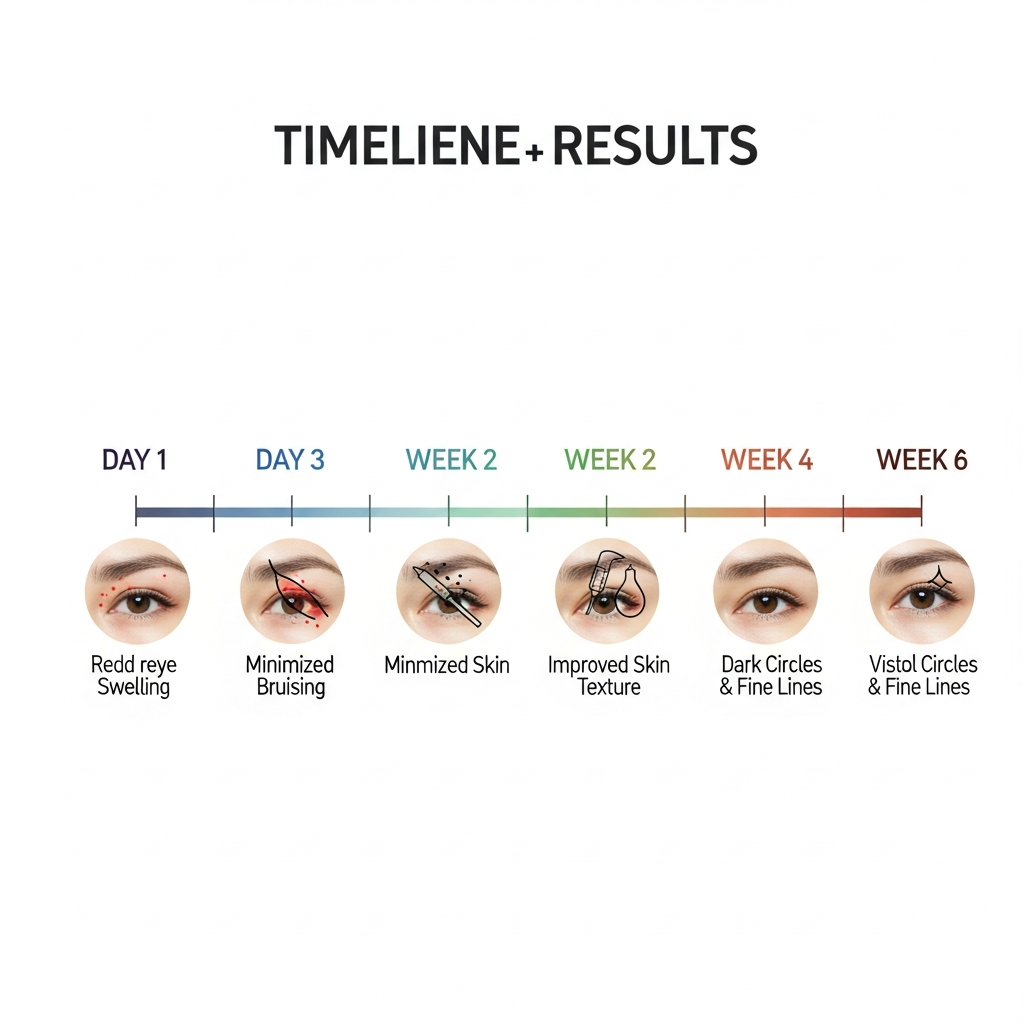
Day 1: You’ll look like you cried for six hours. Swelling, tiny bump marks from needle entry points, possible mild bruising. Don’t plan anything social.
Days 2-3: The little bumps from the injection sites are still visible. Some people get small whiteheads. This is normal and temporary but nobody warns you about it. You’ll stare in the mirror and wonder if you made a terrible mistake.
You didn’t.
Days 4-7: Swelling resolves. Bumps flatten. You start looking like yourself again, but don’t expect to see the texture improvement yet. Rejuran and skin boosters work by triggering your body’s own collagen and repair processes — that takes weeks, not days.
Days 7-14: This is when it starts. The skin under your eyes begins to feel different before it looks different. Smoother to the touch. A bit more resilient. Less crepey when you smile.
Full results: 4-6 weeks after treatment, with optimal results after 2-3 sessions spaced about a month apart.
What Nobody Tells You
What most patients don’t expect isn’t the pain or the swelling. It’s the in-between phase.
Around days 2-4 after Rejuran, your under-eye skin can actually look worse than before you started. The tiny deposits of product sit just under extremely thin skin, creating visible small bumps — almost like the texture problem you came to fix got amplified. I’ve seen people in online forums absolutely panicking at this stage, convinced something went wrong.
It didn’t. This resolves. But nobody prepares you for it, and when you’re alone in your hotel room in Gangnam staring at your puffy, bumpy under-eyes at 2 AM, that’s hard to believe.
Also — and this part is important — one session won’t transform your under-eye texture if you’re over 40. Most Korean clinics recommend a series of 2-3 treatments. Some patients need 4. The doctors who are honest with you upfront about this are the ones you want. If someone promises dramatic results from a single session, that’s a red flag. Skin that took decades to lose its structure doesn’t rebuild in one afternoon.
Risks That Actually Happen
Serious complications from Rejuran and skin boosters under the eyes are rare. But “rare” doesn’t mean “never,” and you should know what’s possible:
- Prolonged bumps — If injected too superficially, small nodules can persist for weeks. More common with less experienced injectors.
- Tyndall effect — A bluish discoloration under the skin if hyaluronic acid-based boosters are placed too shallow. Less of a risk with Rejuran (no HA), but possible with some combination protocols.
- Bruising that lasts — The under-eye area is vascular. Some people bruise badly and it sticks around for 10-14 days. If you bruise easily in general, plan accordingly.
- Asymmetry during healing — One side almost always swells more than the other. This evens out but can be alarming on day 2.
Vascular occlusion — the scary one you read about with fillers — is extremely rare with Rejuran and skin boosters because they’re not volumizing agents. But it’s not zero-risk. This is another reason technique and doctor experience matter more than which product you pick.
Practical Tips From People Who’ve Actually Done This
Arnica supplements starting three days before your appointment. They genuinely help with bruising — not a miracle, but a noticeable difference.
Book your treatment for a Monday or Tuesday if possible. By weekend, you’ll be presentable. Barely.
Bring sunglasses. Big ones. You’ll want them for the cab ride back to your hotel and for the next two days minimum.
Don’t apply makeup to the under-eye area for at least 48 hours. Yes, even mineral makeup. The needle entry points are essentially tiny open wounds and introducing anything into them is asking for problems.
And skip the wine the night before. Alcohol thins your blood, and thin blood around the under-eye area means bruising that looks like you lost a fight. I watched someone ignore this advice once. She looked rough for almost two weeks.
One more thing — if you’re combining this with other procedures during a Korea trip (and most medical tourists do), schedule the under-eye work last. You want your body’s healing resources focused here, not split between this and a laser resurfacing session you did the day before.
FAQ — Real Questions From Real People Freaking Out About Their Under-Eyes
“Is the bumpy texture under my eyes actually aging, or is it something else?”
Usually aging. After 40, collagen production tanks and the skin under your eyes — already the thinnest on your face — starts showing every little imperfection. Tiny milia, broken-down elastin fibers, sun damage you accumulated in your 20s. It all surfaces at once. Sometimes it’s a product reaction or mild eczema, sure. But nine times out of ten? It’s your skin finally showing its receipts.
“I keep hearing about Rejuran for under-eyes. Is it actually different from regular fillers?”
Completely different animal. Fillers add volume. Rejuran (specifically Rejuran I, the under-eye formulation) works at the cellular level — it’s polynucleotide derived from salmon DNA that kicks your skin’s repair mechanisms into gear. No puffiness, no Tyndall effect, no looking like you got stung by a bee. Korean clinics have been using this for years before it became trendy on TikTok. I was skeptical when I first heard “salmon DNA” — sounded like marketing nonsense. But the texture improvements I’ve seen on people who’ve done a full course? Genuinely impressive.
“How many sessions of skin boosters do I actually need to see results under my eyes?”
Most Korean clinics recommend 3 to 4 sessions, spaced 2 to 4 weeks apart. You’ll notice something after the first one — a bit more bounce, slightly smoother surface. But real texture change? That takes the full course. And honestly, the practitioners I’ve talked to in Seoul say the patients who get the best results are the ones who commit to maintenance every 6 months or so after the initial round.
“Can I just use retinol and skip the clinic stuff?”
You can try. Retinol does help with texture over time. But the under-eye area is tricky — too strong and you’ll get flaking, redness, irritation that makes things look worse. Most dermatologists recommend a very low concentration (0.025% max) for that zone. Will it fix established bumpy texture in your 40s? Probably not on its own. Think of retinol as maintenance. Skin boosters and Rejuran are the reset button.
“Why do Korean clinics seem so much better at this than clinics where I live?”
Volume. Pure and simple. A dermatologist in Seoul might do 15 to 20 under-eye treatments in a single day. Your local derm might do that many in a month. Repetition breeds precision. And Korean clinics tend to layer treatments — they won’t just do one thing. They’ll combine Rejuran with a mild laser, maybe some microneedling, customize the protocol per patient. It’s not magic. It’s practice and a culture that takes skin seriously at a medical level.
“I’m 43 and my under-eye area looks crepe-y AND bumpy. Is it too late?”
No. Stop that. 43 is not “too late” for anything skin-related. A friend of mine went to a clinic in Gangnam at 47, convinced nothing would help. Three sessions of Rejuran plus a round of fractional laser and her under-eye texture completely transformed. Took about two months total. The bumps flattened. The crepe-y look softened dramatically. She cried in the mirror — and I’m not being dramatic, she literally texted me a crying selfie. So no. Not too late.
“What’s the downtime like? I can’t take a week off work.”
Minimal. Most skin booster treatments for under-eyes involve tiny needle pricks — you’ll have some redness, maybe small bumps at injection sites for a day or two. Makeup-coverable by day 2 in most cases. Rejuran specifically has less downtime than filler because there’s barely any swelling. Some people fly to Seoul on a Thursday, get treated Friday morning, and are sightseeing by Saturday afternoon. Not everyone heals that fast, but it’s realistic for most.
Recommended for Your Recovery
Products that patients commonly use before and after surgery in Korea.
- Arnica Montana Tablets — start 3 days before surgery to reduce bruising and swelling. Check price on Amazon
- COSRX Advanced Snail 96 Mucin Essence — gentle hydration for healing skin post-surgery. Check price on Amazon
- Silicone Scar Sheets — apply 2 weeks post-op to minimize incision scarring. Check price on Amazon
- Beauty of Joseon Relief Sun SPF 50+ — lightweight Korean sunscreen, essential for post-surgical skin protection. Check price on Amazon
As an Amazon Associate, GlobalBeautySpot earns from qualifying purchases.
Final Verdict
If your under-eye texture has gone bumpy and uneven past 40 — and you’ve already tried every serum on the market — skin boosters like Rejuran are genuinely worth considering. Personally, I’d pick a Korean clinic for this specific treatment. Not because they have some secret formula nobody else has, but because the sheer volume of patients means they’ve refined their technique to an absurd degree. The combination approach Korean practitioners use — Rejuran plus complementary treatments tailored to your specific skin — tends to deliver better results than any single treatment done in isolation.
Budget around 3 to 4 sessions for real results. Don’t expect miracles after one visit. And go in understanding that maintenance matters — this isn’t a one-and-done fix. But for smoothing out that stubborn bumpy texture that no amount of eye cream has touched? This is currently one of the most effective options available. Period.
Wrapping Up
Bumpy under-eye skin after 40 isn’t a character flaw. It’s collagen doing what collagen does — giving up on you slightly earlier than you’d like. The good news is Korean dermatology has been quietly perfecting solutions for this exact problem for over a decade. Whether you fly to Seoul or find a skilled practitioner closer to home who offers similar protocols, the texture can absolutely improve. Your under-eyes don’t have to be something you avoid looking at in the bathroom mirror anymore.
Considering a procedure in Korea?
Get a free consultation with top-rated clinics in Seoul. We help you find the right surgeon for your goals.