Under-eye bags, dark hollows, and a perpetually tired appearance can make you look years older than you feel. If you have been researching solutions, you have likely come across lower blepharoplasty fat repositioning as one of the most effective surgical options available today. And if you have dug deeper, you have probably noticed that Korea keeps appearing as the global epicenter for this procedure.

South Korea performs more cosmetic surgeries per capita than any other country, and its oculoplastic surgeons have refined lower eyelid techniques across an exceptionally high volume of cases. The combination of world-class expertise, advanced technology, and significantly lower costs makes Korea an extremely compelling destination for under eye fat repositioning.
This comprehensive guide covers what the procedure involves, how it compares to other techniques, what it costs in Korea versus other countries, which clinics specialize in it, and what recovery genuinely looks like. We also explore the latest trends in Korean plastic surgery lower eyelid techniques for 2026 — and the honest risks that most clinic websites leave out.
In Korean won, the procedure ranges from approximately 3,000,000 to 5,500,000 KRW. Factors influencing price include technique complexity, surgeon experience, clinic location (Gangnam tends toward higher pricing), anesthesia type, and whether you combine procedures such as a SOOF lift, canthopexy, or laser resurfacing. Always confirm what is included in the quoted price: anesthesia, medications, and follow-up visits should ideally be bundled rather than billed separately.
Even with flights, 7 to 10 nights of accommodation in Seoul, and other travel expenses, most international patients find the total is significantly less than the procedure alone would cost in Western countries.

Top Clinics for Lower Blepharoplasty Fat Repositioning in Seoul
Seoul’s Gangnam district is home to a remarkable concentration of clinics specializing in lower eyelid procedures. Choosing the right one can feel overwhelming. Below is a comparison of several well-regarded clinics known for performing lower blepharoplasty fat repositioning in Korea.
Best Clinics for Lower Blepharoplasty in Korea
| Clinic | Notable Strengths | International Support |
|---|---|---|
| Banobagi Plastic Surgery | One of Korea’s largest plastic surgery hospitals; dedicated oculoplastic department; extensive before/after archive | English, Chinese, Japanese coordinators; airport pickup |
| JW Plastic Surgery | Known for non-incision transconjunctival technique; strong revision case track record; published research | Multilingual staff; medical tourism packages |
| THE PLUS Plastic Surgery | Primarily known for rhinoplasty and facial contouring; also offers anti-aging facial procedures including lower blepharoplasty with emphasis on natural results | English-speaking coordinators; online consultation |
| Noonopi Clinic | Eye-specialist clinic focused exclusively on oculoplastic surgery; emphasis on scarless transconjunctival lower eyelid techniques with ligament release | English support; detailed educational content |
| Link Plastic Surgery | Experienced oculoplastic surgeons specializing in facial procedures; performs both fat repositioning and combined lower eyelid techniques | English-speaking staff; international consultations |
| AB Plastic Surgery | Age-stratified approach (different protocols for 20s-30s vs 40s-50s); orbital septum restoration technique; safety certifications | Multilingual coordinators; online consultation |
This is not an exhaustive list, and the “best” clinic depends on your specific concerns, budget, and rapport with the surgeon. Some patients prefer large hospital-style clinics like Banobagi for the breadth of resources and multiple surgeon options, while others feel more comfortable at smaller specialized practices where the lead surgeon handles every case personally.
Many international patients also find it valuable to join online communities such as RealSelf forums, Reddit’s plastic surgery communities, or Korean medical tourism Facebook groups where past patients share detailed accounts of their experiences at specific clinics.
How to Verify Your Surgeon’s Credentials
Before committing to any clinic, verify your surgeon’s qualifications:
- Check board certification through the Korean Society of Plastic and Reconstructive Surgeons (KSPRS), the legitimate certifying body
- Look for oculoplastic specialization or fellowship training focused on periorbital surgery
- Review before-and-after photos of patients with similar age, ethnicity, and anatomy to yours; look for consistency across multiple cases
- Verify through official channels such as the KSPRS searchable database or the Korean Association of Plastic Surgeons
- Watch for red flags: clinics that refuse to name the surgeon in advance, quote dramatically lower prices, or pressure you to book immediately
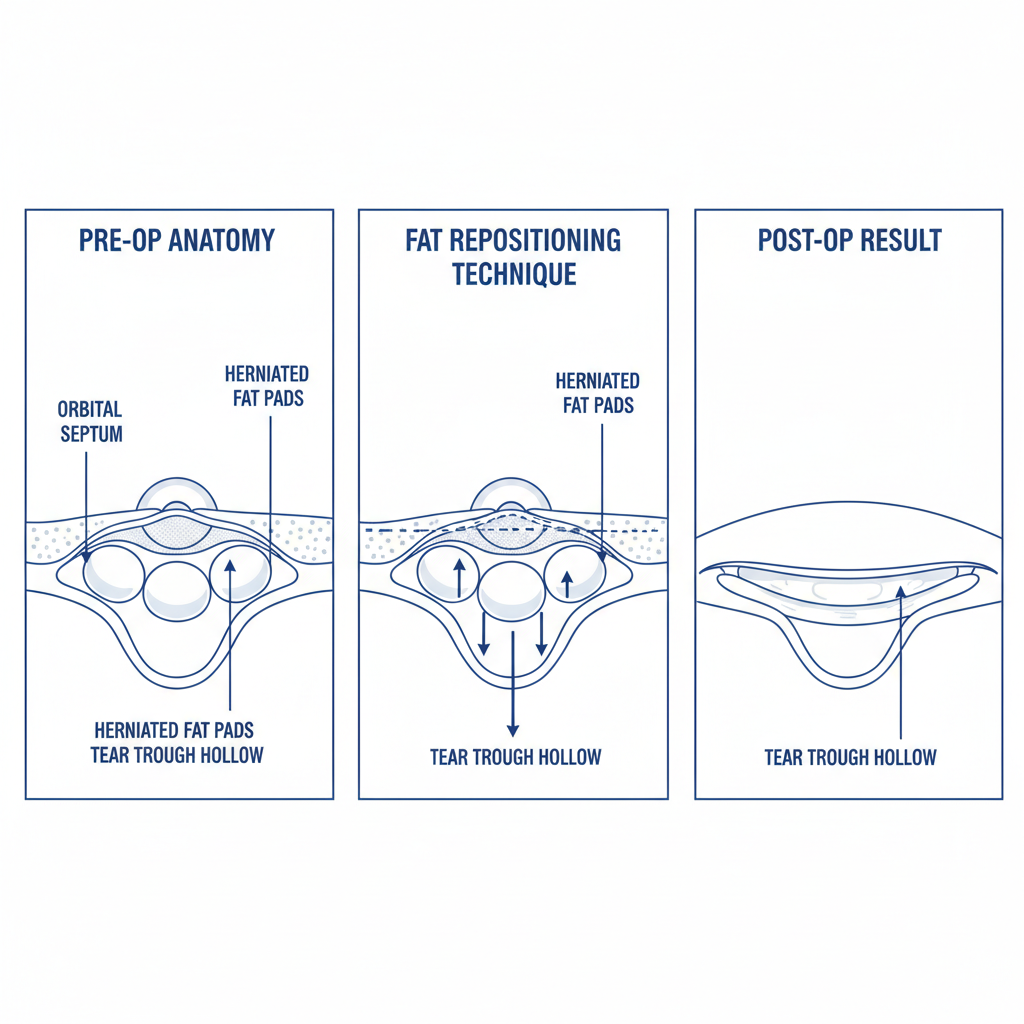
What to Expect: Procedure, Recovery, and Results
Understanding the full patient journey is essential for managing expectations and planning your trip. Here is a detailed breakdown of the typical timeline for international patients.
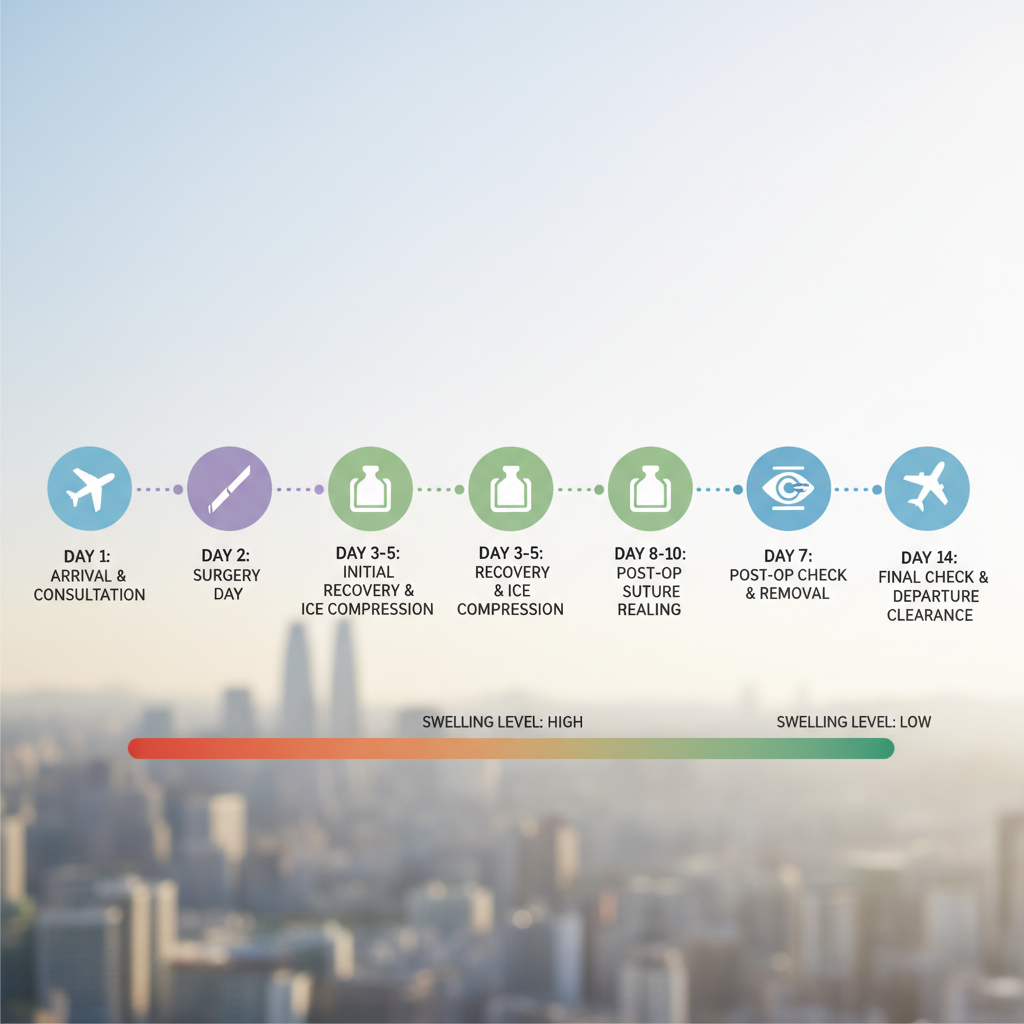
Day-by-Day Medical Tourism Timeline
- Day 1: Arrive in Seoul, check into accommodation, rest
- Day 2: In-person consultation, pre-op assessment, blood tests, confirm surgical plan
- Day 3 (Surgery): Procedure takes 45 to 90 minutes under local anesthesia with sedation; return to accommodation same day
- Days 4-5: Significant swelling and bruising; keep head elevated, apply cold compresses, minimal activity
- Days 6-7: First post-op check; possible suture removal; swelling noticeably decreasing
- Days 8-10: Bruising fades significantly; comfortable going out with sunglasses
- Days 10-14: Most surgeons clear patients for flying; get final follow-up clearance before departure
Recovery: What It Honestly Looks Like
The first 48 to 72 hours are the most uncomfortable, with swelling, bruising, and a tight sensation under the eyes. Pain is usually mild, more of a dull ache than sharp pain, and is well-controlled with prescribed medication. Most patients rate their discomfort at 2 to 3 out of 10 during the recovery period.
By the end of the first week, the worst of the swelling subsides, though you will not yet see your final result. There is often residual puffiness and subtle asymmetry during healing that resolves over the following weeks. Most patients feel presentable enough to return to normal social activities within 10 to 14 days, though some residual swelling can persist for 4 to 6 weeks.
The final result typically becomes apparent at the 3-month mark, with continued subtle refinement up to 6 months as the repositioned fat settles into its new position and any residual swelling fully resolves. It is important to note that the under-eye area may look worse before it looks better during the first week, which is completely normal and not a sign of a problem.
Post-Operative Care Essentials
- Sleep with head elevated on two or more pillows for the first week
- Cold compresses (not direct ice) for 10 to 15 minutes hourly during the first 2 to 3 days
- Avoid heavy lifting and strenuous exercise for at least 2 weeks
- No contact lenses for 2 weeks post-surgery
- No makeup near lower eyelids for at least 10 days
- SPF 50+ sun protection once cleared by your surgeon; for guidance on selecting and layering sunscreen into your daily routine, see our guide to building a proper skincare routine
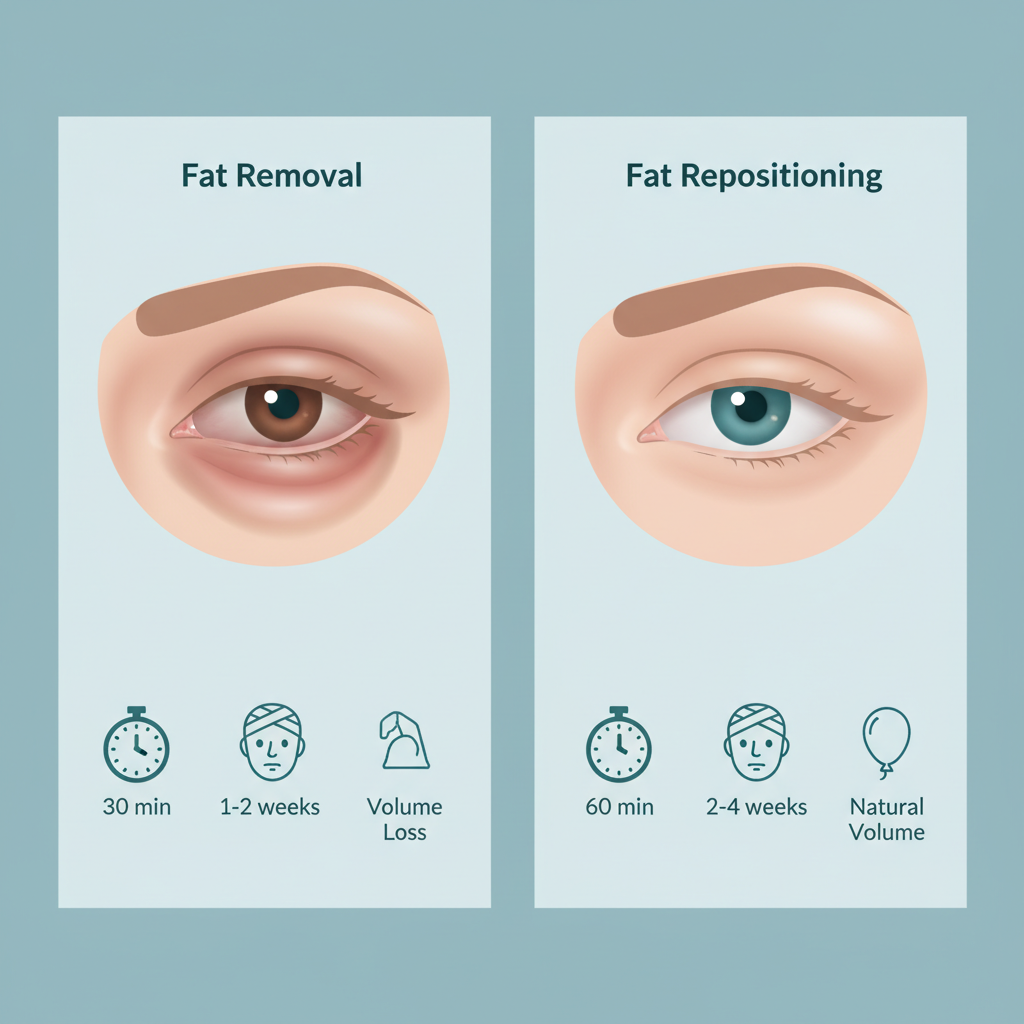
Pros and Cons of Getting Lower Blepharoplasty in Korea
Making the decision to travel abroad for surgery requires weighing genuine advantages against real challenges. Here is an honest assessment to help you decide.
Advantages
- Exceptional expertise: Korea’s high procedural volume means surgeons have refined transconjunctival blepharoplasty techniques extensively
- Significant cost savings: Even including travel, total costs are typically 30 to 50 percent less than the surgery alone in the US or UK
- Advanced technology: Korean clinics rapidly adopt cutting-edge surgical tools and imaging
- Natural aesthetic philosophy: Korean surgeons favor subtle, natural results, which aligns with what most under-eye surgery patients want
- Medical tourism infrastructure: Dedicated coordinators, multilingual staff, and streamlined processes
Disadvantages
- Distance and logistics: Long-haul flights and jet lag add complexity, particularly for patients from North America or Europe
- Limited local follow-up: Once home, in-person follow-up with your Korean surgeon is not practical
- Language barriers: Despite coordinators, nuanced aesthetic preferences can be harder to convey through an interpreter
- Revision logistics: If revision is needed, you face returning to Korea or finding a local surgeon willing to revise another doctor’s work
- Cultural beauty standard differences: Ensure your surgeon understands your specific goals, especially regarding features like the aegyo-sal
Honest Risk Profile: Complications You Should Know About
While lower blepharoplasty fat repositioning is considered safe overall, it carries risks that you should understand before proceeding. Most clinic websites minimize or omit these details.
Known Complications
- Asymmetry: Some degree is normal during healing; persistent asymmetry may require minor revision
- Under-correction or over-correction: Too little fat repositioned leaves the tear trough visible; too much creates an unnatural ridge
- Temporary chemosis: Conjunctival swelling causing a watery appearance; resolves within 1 to 2 weeks
- Dry eye: Temporary, usually managed with lubricating drops
- Fat necrosis: Compromised blood supply can cause some repositioned fat to not survive, affecting contour smoothness
- Transient granulomas: Inflammatory nodules around repositioned fat; published literature suggests these occur in a notable percentage of cases but typically resolve with conservative treatment
- Rare but serious: Retrobulbar hemorrhage, infection, and vision changes are extremely rare but possible
What If Results Disappoint?
It is important to have a plan in case the results are not what you expected. Most surgeons recommend waiting at least 3 to 6 months before considering any revision, as the final result takes time to fully manifest. What may look like an under-correction at 6 weeks could resolve into an excellent result by month three as residual swelling dissipates and the repositioned fat settles.
If a revision is ultimately needed, options include additional fat repositioning, fat grafting to fill remaining hollows, or in some cases injectable fillers as a less invasive touch-up. Before your initial surgery, ask your clinic about their revision policy in writing.
Some Korean clinics include complimentary minor revisions within the first year, while others charge a reduced fee. If you cannot return to Korea, consult with a board-certified oculoplastic surgeon in your home country who has experience with revision blepharoplasty.
Latest Trends in Korean Lower Eyelid Surgery (2026)
Korean plastic surgery evolves rapidly. Here are the notable developments shaping lower blepharoplasty fat repositioning in Korea this year.
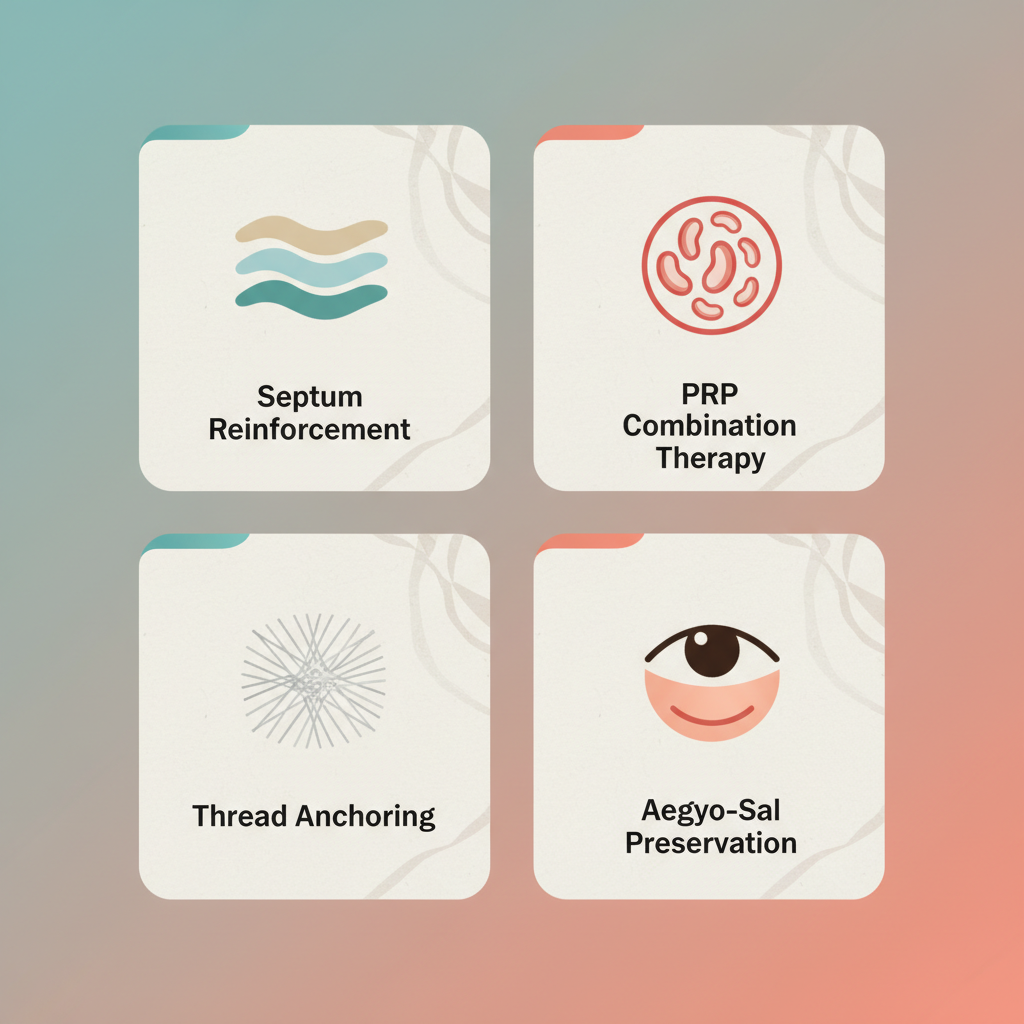
Septum Reinforcement Techniques
Many Korean surgeons now reinforce the weakened orbital septum after repositioning the fat. This “septum reset” approach, involving tightening and layering the septal tissue, aims to reduce fat re-herniation over time. Early clinical results suggest lower recurrence rates compared to traditional techniques.
PRP Combination Therapy
An increasing number of Seoul clinics combine fat repositioning with platelet-rich plasma (PRP) injections at the surgical site. PRP’s growth factors may promote faster healing and improve fat viability. While clinical evidence for this specific application is still emerging and systematic evaluation remains limited, patient satisfaction reports have been positive.
Thread Anchoring for Fat Stabilization
Some oculoplastic surgeons now use absorbable micro-threads to secure repositioned fat during healing. Adapted from thread-lift technology, this provides temporary structural support while fat integrates with surrounding tissue. This technique is particularly useful for larger fat volumes.
Preserving the Aegyo-Sal
Top Korean surgeons take particular care to preserve the aegyo-sal, the small youthful roll of fat below the lash line prominent when smiling. They distinguish between deeper orbital fat causing eye bags and superficial pretarsal fat responsible for the aegyo-sal. This nuanced approach is a hallmark of Korean surgical philosophy worth discussing with your surgeon.
Preparing for Your Trip: Practical Checklists
Thorough preparation makes the experience smoother and helps ensure better outcomes. If you are new to cosmetic surgery abroad, our essential checklist before cosmetic surgery covers universal pre-surgery planning steps that apply to any procedure. Here is what to do specifically before and during your lower blepharoplasty trip.
Before You Book
- Research 3 to 5 clinics and schedule online consultations with top choices
- Verify surgeon credentials through the Korean Society of Plastic and Reconstructive Surgeons
- Request itemized quotes including all fees (surgery, anesthesia, follow-ups, medications)
- Ask about revision and refund policies in writing
- Check visa requirements (many countries have visa-free entry for stays under 90 days)
- Confirm travel insurance covers medical tourism and potential complications
Key Questions for Your Consultation
- How many fat repositioning procedures do you perform monthly?
- Will you personally perform the entire surgery?
- What is your approach to orbitomalar ligament release and septum reinforcement?
- What is your revision rate and policy?
- Can I see before-and-after photos of patients with similar anatomy?
- How do you handle follow-up for international patients after they return home?
Recommended for Your Recovery
Products that patients commonly use before and after surgery in Korea.
- Arnica Montana Tablets — start 3 days before surgery to reduce bruising and swelling. Check price on Amazon
- COSRX Advanced Snail 96 Mucin Essence — gentle hydration for healing skin post-surgery. Check price on Amazon
- Silicone Scar Sheets — apply 2 weeks post-op to minimize incision scarring. Check price on Amazon
- Beauty of Joseon Relief Sun SPF 50+ — lightweight Korean sunscreen, essential for post-surgical skin protection. Check price on Amazon
As an Amazon Associate, GlobalBeautySpot earns from qualifying purchases.
Frequently Asked Questions About Lower Blepharoplasty in Korea
Is lower blepharoplasty fat repositioning permanent?
Results are long-lasting, with most patients enjoying them for 10 to 15 years or longer. However, aging continues, and gradual changes may eventually lead to some recurrence. Fat repositioning results tend to age more gracefully than fat removal since volume is preserved rather than eliminated.
Can I combine fat repositioning with other procedures?
Yes, and this is one of the advantages of traveling to Korea for surgery. Common combinations include upper blepharoplasty, canthopexy or canthoplasty to address lower eyelid laxity, mid-face or SOOF lift for additional volume restoration, fat grafting to other facial areas, and laser resurfacing for skin texture improvement.
Combining procedures can be more cost-effective than staging them separately, and it means a single recovery period rather than multiple. Discuss combination options and their additional costs during your consultation.
How soon can I fly after surgery?
Most surgeons recommend waiting 7 to 10 days, though some prefer a full two-week wait due to cabin pressure concerns. Plan your trip to allow adequate recovery time in Seoul before departure.
Will there be visible scars?
With the transconjunctival approach (most common for fat repositioning), there are no visible external scars. If a transcutaneous approach is needed for excess skin, the scar sits below the lash line and typically becomes virtually invisible within months.
What is the difference between dark circles and eye bags?
Eye bags are caused by protruding orbital fat beneath the eyes, while dark circles can have multiple causes: thin skin revealing underlying blood vessels, hyperpigmentation, volume loss in the tear trough, or shadowing from the bags themselves.
Dark circles surgery in Korea through fat repositioning directly addresses bags and the shadows caused by tear trough hollowing. However, it will not resolve dark circles caused by pigmentation or thin skin alone, which may require additional treatments such as laser therapy, chemical peels, or specialized under-eye creams.
Does insurance cover lower blepharoplasty in Korea?
Cosmetic lower blepharoplasty is generally not covered by insurance in Korea or in most other countries, as it is classified as an elective cosmetic procedure. However, if the eye bags are causing functional issues such as visual field obstruction, some insurance plans may cover a portion.
For international patients, the procedure is almost always an out-of-pocket expense. Most Korean clinics accept credit cards, wire transfers, and sometimes cash payments in Korean won. Deposits are typically required to secure your surgery date, and policies on cancellation refunds vary by clinic, so clarify these details before committing.
Making Your Decision With Confidence
Lower blepharoplasty fat repositioning in Korea offers a compelling combination of surgical expertise, advanced technique, and value that is difficult to match elsewhere. The procedure addresses under-eye bags and tear trough hollows in a single solution, and Korea’s surgeons have performed it at a scale and refinement level that few countries can rival.
That said, traveling abroad for surgery should not be taken casually. Research thoroughly, consult with multiple clinics, verify credentials, and understand the risks alongside the benefits. Give yourself enough time in Seoul for proper recovery before heading home.
With realistic expectations, careful planning, and a well-chosen surgeon, you are placing yourself in an excellent position for a safe, successful outcome. The combination of Korea’s world-class lower blepharoplasty fat repositioning expertise and significant cost savings makes it an outstanding choice for patients seeking brighter, more youthful-looking eyes in 2026 and beyond.