Recovery After Plastic Surgery in Seoul: The Complete Foreign Patient Survival Guide (2026)
The woman across from me in the Sinchon recovery center was trying to eat ramyeon through a jaw compression bandage. Not going well. She’d flown in from Vancouver four days earlier for V-line surgery and had packed exactly one hoodie, her passport, and what she described as “blind optimism.” No recovery plan. No aftercare supplies. Her return flight was in 48 hours.
I watched her struggle with the chopsticks for a minute before handing her a straw and a protein shake from the convenience store downstairs. She almost cried.
That scene — some version of it — plays out constantly in Seoul’s medical tourism district. Patients research their surgeon for months. They compare before-and-afters obsessively. They negotiate quotes across three or four clinics. And then they book a return flight for five days post-op because they “read online that recovery is fast.”
Recovery is not fast.
Or rather — the surgery itself might be quick. Korean surgeons are efficient, often remarkably so. But your face doesn’t care how skilled the surgeon was when it’s swollen to twice its normal size at 3 AM in a hotel room where nobody speaks your language. The clinical part is maybe 20% of this whole experience. The other 80% is logistics, patience, and knowing what to expect when your body does things that Google image results didn’t prepare you for.
I’ve coordinated recovery plans for patients from over thirty countries . The ones who have a smooth experience aren’t the ones who picked the most expensive clinic — they’re the ones who planned their recovery as carefully as they planned the procedure itself.
Key Takeaways
- Most procedures require 7–14 days in Seoul minimum before you’re cleared to fly — book accordingly, not optimistically.
- Recovery housing matters more than your hotel’s star rating; proximity to your clinic and access to a pharmacy should drive that decision.
- Post-op appointments are non-negotiable, not optional check-ins you can skip if you “feel fine.”
- Swelling peaks around day 3–4 for most facial procedures, which is exactly when panic tends to set in.
- A Korean SIM card with data and a translation app will save you more stress than any amount of pre-surgery research.
Seoul has built an entire infrastructure around surgical recovery for international patients — dedicated recovery centers, bilingual pharmacies in Gangnam, clinics with 24-hour coordinator hotlines. But that infrastructure only works if you know it exists and plan to use it. Most of what goes wrong during recovery isn’t medical. It’s logistical. Wrong food, wrong expectations, a flight booked too early, or just the loneliness of healing alone in a foreign city when you can’t open your jaw wide enough to ask for help.
The gap between “surgery went perfectly” and “I had a great experience” is almost entirely about what happens in the days and weeks after you leave the operating room.
What Recovery in Seoul Actually Looks Like — Week by Week
Most people plan their surgery down to the minute. Flight times, consultation slots, hotel check-in. But recovery? That part gets maybe ten minutes of thought. And it’s the part that determines whether you go home looking refreshed or looking like you made a terrible decision at a Gangnam clinic.
Recovery in Korea is structured differently than what you’d experience in the US, Australia, or Europe. Korean clinics operate on volume. That’s not a criticism — it’s how they’ve gotten so technically proficient. But it also means post-op care follows a system. You show up for your scheduled check-ups, you follow the protocol, and the clinic moves on to the next patient. If you need extra hand-holding between appointments, you’ll need to arrange that yourself.
The First 72 Hours
This is where most patients underestimate what they’re in for.
Swelling peaks around day 2-3 for most facial procedures. Rhinoplasty patients look like they lost a boxing match. Double eyelid patients can barely see. And jaw surgery patients — they’re on a liquid diet wondering why they did this.
Korean clinics typically schedule your first post-op visit within 24-48 hours. They’ll check for bleeding, change dressings, and sometimes do LED therapy or ultrasound treatment to accelerate healing. These post-op treatments are often included in your surgical package. In the US, you’d pay $150-300 per session for the same thing.
I sat in a recovery waiting room in Sinsa-dong once, surrounded by patients from six different countries, all in various states of swelling. The nurse was cycling through English, Mandarin, and Japanese like it was nothing. That level of multilingual post-op care is genuinely hard to find outside Korea.

Minimum Stay Requirements by Procedure
This is where planning gets real. You can’t just fly out two days after a facelift.
| Procedure | Surgery Time | Minimum Seoul Stay | Stitch Removal | Return to Normal Appearance |
|---|---|---|---|---|
| Double Eyelid (Incisional) | 40-60 min | 5-7 days | Day 5-7 | 2-3 weeks |
| Rhinoplasty | 1.5-3 hrs | 7-10 days | Day 7 | 3-6 weeks |
| V-Line / Jaw Reduction | 1.5-2.5 hrs | 10-14 days | Day 10-14 | 4-8 weeks |
| Fat Grafting (Face) | 1-2 hrs | 5-7 days | N/A | 2-3 weeks |
| Facelift | 3-5 hrs | 10-14 days | Day 7-10 | 4-8 weeks |
| Under-Eye Fat Repositioning | 1-1.5 hrs | 5-7 days | Day 5-7 | 2-4 weeks |
| Breast Augmentation | 1-2 hrs | 7-10 days | Day 7-10 | 4-6 weeks |
Those “minimum stay” numbers aren’t suggestions. They’re the bare minimum before a surgeon will clear you to fly. Cabin pressure changes at altitude can worsen swelling and increase bleeding risk. Most surgeons I’ve worked with strongly prefer patients stay an extra 2-3 days beyond the minimum.
What Recovery Costs Beyond the Surgery
Surgery price is one number. Recovery is a separate budget entirely. And this is where Korea becomes dramatically more affordable than Western countries — not just for the procedure itself, but for everything around it.
| Recovery Expense | Seoul (USD) | Los Angeles (USD) | Sydney (USD) |
|---|---|---|---|
| Recovery hotel/officetel (per night) | $50-120 | $180-350 | $150-300 |
| Post-op LED/ultrasound session | Often included | $150-300 | $120-250 |
| Prescription medication (7 days) | $15-40 | $50-200+ | $30-80 |
| Compression garments | $20-50 | $40-100 | $40-90 |
| Follow-up consultations (3 visits) | Usually included | $100-250 each | $80-200 each |
| Scar treatment (if needed) | $30-80/session | $150-400/session | $100-300/session |
The medication thing surprises people. Korean pharmacies fill prescriptions for a fraction of US prices. Antibiotics, anti-swelling medication, pain relief — you’re looking at maybe $30 total for a week’s supply. A friend paid $380 for the same antibiotics course at a CVS in New York after a rhinoplasty revision back home.
Recovery Accommodation — Your Options
Hotels work. But they’re not ideal.
Standard hotel rooms aren’t designed for surgical recovery. You need a space where you can elevate your head properly, store medications, prepare soft foods (jaw surgery patients, pay attention), and ideally have a washing machine because you will go through towels and pillowcases faster than you expect.
Three realistic options:
Recovery-specific guesthouses. These cater specifically to medical tourists. They’re usually near Gangnam or Sinsa stations, close to the major clinic clusters. Expect $60-100/night, with staff who understand post-op needs. Some provide meal delivery, pharmacy runs, and ride coordination to follow-up appointments. The rooms aren’t luxurious. But they’re functional.
Officetels (short-term apartment rentals). A studio apartment in Gangnam runs $70-120/night through platforms like Airbnb or local booking sites. You get a kitchen, laundry, and privacy. The downside — you’re on your own if something feels wrong at 2 AM.
Clinic-affiliated recovery centers. Some larger clinics operate their own recovery facilities with on-site nurses. These cost more ($120-200/night) but provide medical monitoring. For major procedures like jaw surgery or combined facial surgeries, this is worth considering.

The Part About Food Nobody Plans For
Eating after facial surgery in a country where you don’t speak the language — that’s a logistical problem people don’t think about until they’re standing in a 7-Eleven at midnight trying to figure out which porridge cups are plain and which ones are spicy.
Korean convenience stores are actually a recovery patient’s best resource. CU, GS25, and Emart24 all carry juk (rice porridge), soft tofu soups, protein drinks, and drinkable yogurts. You can survive the first 3-4 days almost entirely on convenience store food if needed. Budget roughly $15-25/day for meals during peak recovery.
Delivery apps like Coupang Eats and Baemin have English interfaces now, though they’re imperfect. Order juk or soft soups. Avoid anything that requires aggressive chewing for at least a week after any facial procedure — not just jaw surgery. Even rhinoplasty patients should be careful. Excessive jaw movement can transmit pressure upward.
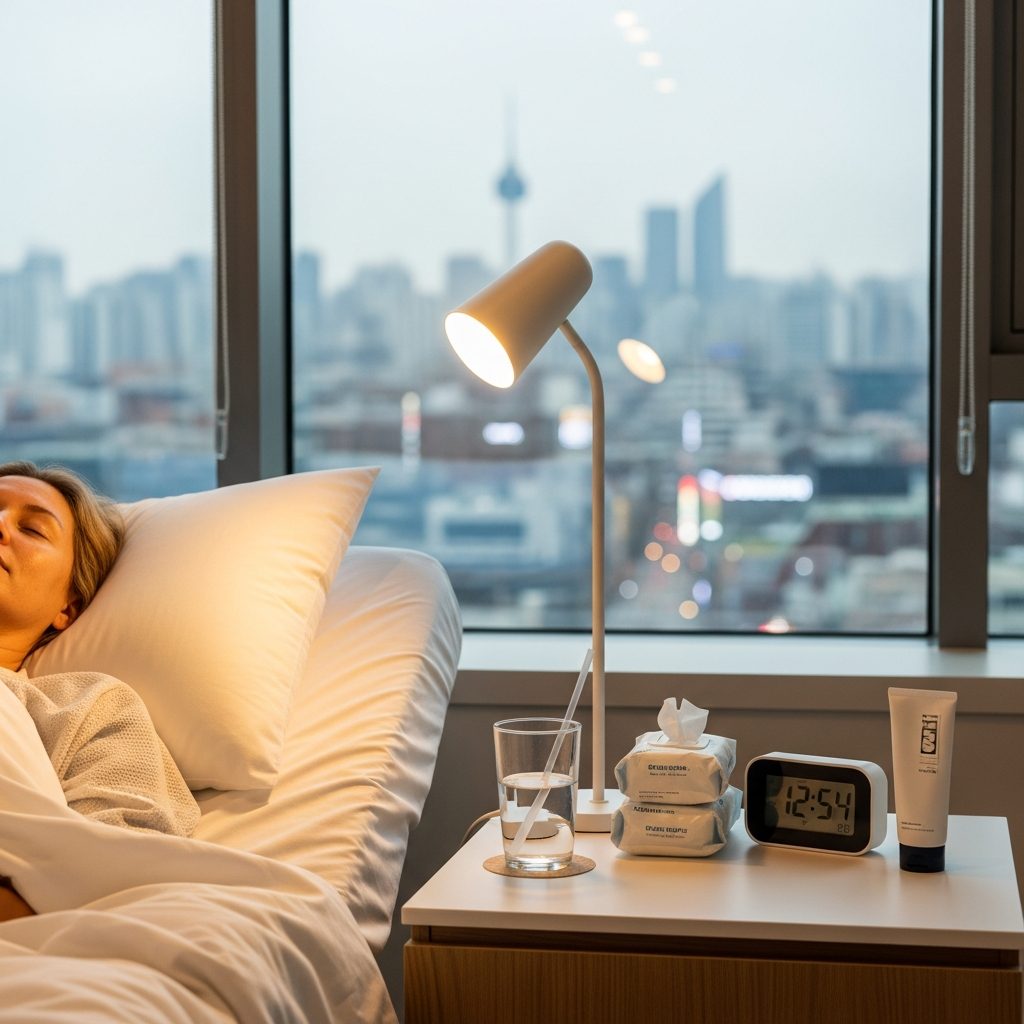
And stock up before surgery. Day-of, go to the nearest mart and buy water bottles, porridge packets, straws (essential after lip or nose work), and wet wipes. You won’t feel like shopping after.
One Thing Most Guides Won’t Tell You
The loneliest part of recovery abroad isn’t the pain. It’s the waiting.
Days 3 through 7 are psychologically the hardest. The initial adrenaline has worn off. You look worse than expected — swelling always looks worse before it looks better. And you’re sitting in a foreign city, probably alone, refreshing surgery forums at 3 AM trying to figure out if what you’re experiencing is normal.
It almost always is. But that doesn’t make it feel less isolating. Build your recovery plan with this in mind. Download Korean dramas. Bring books. Have someone back home you can video call who won’t panic at your appearance. Or better — travel with someone. The cost of a companion’s flight and hotel is minor compared to the peace of mind.
Your First 72 Hours: A Timeline Nobody Prepares You For
Surgery day itself is the easy part. You’re sedated, you wake up, someone hands you ice packs. Fine. The real challenge starts when you’re alone in your recovery room at 11 PM, swollen beyond recognition, trying to figure out how to order soup through a Korean delivery app.
So here’s a rough timeline of what actually happens post-op — not the sanitized version clinics put on their websites.
Day 0–1: The Fog
Most patients don’t remember much. General anesthesia wears off slowly, and you’ll feel groggy for 6–12 hours depending on the procedure length. Nausea is common. Some clinics provide anti-nausea medication automatically; others wait until you ask. Ask early.
You won’t want to eat. Force yourself to drink water anyway. Dehydration after surgery slows everything down — healing, swelling reduction, your mood. I’ve watched patients refuse water for 8 hours post-op because swallowing felt uncomfortable, and their recovery stalled because of it.
Pain levels vary wildly by procedure. Rhinoplasty patients often say the discomfort is more “pressure” than sharp pain. Jaw surgery patients have a harder first night. Eyelid surgery? Surprisingly manageable for most people.
Day 2–3: The Swelling Peak
This is where foreign patients panic.
Your face — or whatever area was operated on — will look significantly worse before it looks better. Swelling typically peaks around 48–72 hours post-surgery. And I mean peaks. Bruising spreads. Your eyes might swell shut after facial procedures. Your jawline disappears under fluid retention after bone work.

A patient I worked with flew to Seoul for a lower blepharoplasty and double eyelid revision. Day 3, she sent me a photo from her recovery studio looking like she’d been in a car accident. Completely normal outcome. But she didn’t know that, because her clinic’s before-and-after gallery only showed 3-month results.
Expect the worst visually at this stage. Bring oversized sunglasses — the kind that cover half your face. And a hat. You’ll need both for the mandatory clinic visits.
Getting Around Seoul While Recovering
Seoul’s subway system is efficient, but using it 3 days after facial surgery is a specific kind of miserable. Stairs everywhere. Crowds during rush hour. People staring — and in Korea, they absolutely will stare, though usually out of curiosity rather than judgment.
Budget for taxis. Kakao Taxi works like Uber and accepts international cards. A ride from Gangnam to Myeongdong costs about ₩8,000–12,000 ($6–9 USD). Worth every won when you’re holding an ice pack to your face.
Recovery accommodations matter more than most patients realize. Regular hotels work fine for minor procedures, but if you’ve had jaw surgery or a full facelift, you want a recovery-focused stay. Several guesthouses near Gangnam station cater specifically to medical tourists — they stock compression garments, have adjustable beds, and the staff won’t blink at your post-surgical appearance. Prices range from $50–120/night, which is cheaper than most Seoul hotels anyway.
Don’t book a hostel. I shouldn’t have to say this, but people do it. Shared bathrooms, bunk beds, and post-surgical drainage do not mix.
Food and Medication: The Overlooked Logistics
Your clinic will prescribe antibiotics, anti-inflammatories, and painkillers. Take them on schedule. Set alarms. Missing doses — especially antibiotics — increases infection risk, and dealing with a post-surgical infection in a foreign country is a nightmare you want to avoid entirely.
Korean pharmacies (약국) are everywhere and pharmacists are knowledgeable, but communication can be difficult. Keep your prescription sheet from the clinic — it’ll be in Korean, and pharmacists can read it directly. If you need over-the-counter supplements like arnica or bromelain for swelling, bring them from home. They’re harder to find here.
Food-wise, you’ll want soft, low-sodium options for the first week. Juk (죽) — Korean rice porridge — is perfect. Every neighborhood has a juk restaurant, and many deliver through Baemin or Coupang Eats. Avoid anything spicy for at least 5 days. That means no kimchi jjigae, no tteokbokki, no matter how tempting. Spicy food increases blood flow and can worsen swelling.
And alcohol? Zero. Not a sip. For a minimum of two weeks post-op, though most surgeons recommend four. Alcohol thins your blood and interferes with medication absorption. I’ve seen patients “celebrate” their surgery with soju on day 5 and regret it immediately.
What Catches Foreign Patients Off Guard
The loneliness.
Nobody really talks about this part. You’re in a foreign city, your face is swollen, you can’t eat properly, and your friends back home are sending messages like “can’t wait to see the results!” while you’re wondering if something went wrong because one side looks different from the other.
Asymmetric swelling is normal. One side of your face will almost always swell more than the other. It does not mean the surgeon made a mistake. But at 3 AM in a dark recovery room, your brain will absolutely convince you otherwise.

My unpopular opinion: most patients should not travel alone for major procedures. I know the privacy appeal — nobody wants coworkers knowing they flew to Korea for surgery. But having someone with you for the first 3–4 days makes an enormous practical difference. Someone to pick up medication, help you eat, or just confirm that yes, your swelling is progressing normally.
If traveling solo isn’t negotiable, at minimum arrange a post-op care service. Several agencies in Seoul provide English-speaking recovery companions who check on you daily, drive you to appointments, and translate during follow-ups. Costs run $80–200/day depending on the service level. Not cheap, but compare that to your surgery cost and it’s a reasonable insurance policy.
The Follow-Up Schedule
Plan your trip length around your stitch removal date, not your surgery date. Most procedures require stitch removal 5–7 days post-op. Some — like rhinoplasty with a splint — need you there for 7–10 days minimum.
A common mistake: booking a 5-day trip for rhinoplasty. Your cast comes off around day 7. If you leave before that, you’ll need to find a surgeon at home willing to remove another doctor’s work. Some will. Many won’t. And removing a nasal splint incorrectly can affect your result.
Build in buffer days. Flights get delayed. Swelling doesn’t always cooperate with your timeline. An extra 2–3 days beyond your last scheduled follow-up gives you breathing room for any complications or additional check-ins your surgeon might want.
Most clinics offer a final clearance appointment where they photograph your progress, confirm healing is on track, and give you written aftercare instructions for the weeks ahead. Get these instructions in English — in writing, not just verbal. You’ll reference them constantly once you’re back home.
FAQ
I’m flying alone and getting rhinoplasty — what happens if something goes wrong at 2am in my Airbnb?
Most clinics give you an emergency contact number that works 24/7. Call it. The coordinator will walk you through whether you actually need to come in or just adjust your sleeping position. Genuine emergencies after rhinoplasty are rare — but nosebleeds and panic at 2am are not.
Can I just fly home 5 days after double eyelid surgery?
Technically, yes. But your eyes will still be swollen enough that airport staff might look at you twice, and the cabin pressure won’t help. Most surgeons recommend 7 days minimum before flying, and stitch removal usually falls right around that window. Leaving before stitch removal means finding a doctor back home willing to do it — not always easy.
Do I really need a recovery hotel or can I just book a normal hotel?
A normal hotel works fine for minor procedures. For anything involving general anesthesia or facial surgery, recovery rooms near Gangnam stations are worth it — they check on you, help with ice packs, and the staff won’t panic when they see your face. Price difference is honestly not that big.
How bad is the food situation? Can I eat normal meals right after jaw surgery?
You’re on liquids for weeks. Stock up on protein shakes, porridge from convenience stores, and soup from the 죽 (juk) restaurants that are everywhere in Seoul. Delivery apps like Coupang Eats have a “죽” category — that becomes your best friend.
My clinic says I need a check-up 2 weeks post-op but my flight is in 10 days. What do I do?
Talk to your coordinator before booking the flight. Some clinics will move the check-up earlier. Others will do a video call follow-up after you leave. But skipping it entirely is a bad idea — that 2-week mark is when they catch early complications.
Is it safe to take the subway back to my hotel right after surgery?
After local anesthesia procedures, usually fine. After general anesthesia — no. You’ll be groggy, possibly nauseous, and navigating Seoul’s subway system while medicated is asking for trouble. Clinics arrange taxis or the coordinator drives you. Use that service.
What if I need a revision and I’m already back in my home country?
This is the part most blogs skip. Revision policies vary wildly between clinics. Some cover it free within a year but you pay your own flights. Others won’t touch it unless you come back within 6 months. Get the revision policy in writing — in English — before your first surgery. Not after.
Recovery Essentials: What to Pack Before Your Surgery
Based on what we see patients actually use during recovery in Seoul. These are available on Amazon and worth ordering before your trip.
- Arnica Montana Tablets — reduces bruising and swelling post-op. Start 3 days before surgery. Check price on Amazon
- Bromelain Supplement (500mg) — natural anti-inflammatory enzyme, helps with post-surgical swelling. Check price on Amazon
- COSRX Advanced Snail Mucin Essence — Korean skincare staple for healing skin. Safe to use after suture removal. Check price on Amazon
- Travel Neck Pillow (Memory Foam) — essential for sleeping upright after facial surgery. Check price on Amazon
- Silicone Scar Sheets — start using 2 weeks post-op to minimize scarring. Check price on Amazon
- Bendable Straws (Reusable) — a lifesaver after jaw or rhinoplasty surgery when opening your mouth is limited. Check price on Amazon
As an Amazon Associate, GlobalBeautySpot earns from qualifying purchases. This does not affect our editorial recommendations.
Final Thought
Recovery in Seoul is more manageable than most people expect, but only if you plan the boring stuff — pharmacy runs, follow-up schedules, a place to sleep that isn’t a capsule hotel. Build in 3 extra days beyond what your clinic recommends. That buffer has saved more trips than any amount of research.
Considering a procedure in Korea?
Get a free consultation with top-rated clinics in Seoul. We help you find the right surgeon for your goals.