“Dark Circles” Is a Symptom, Not a Surgery
Half the patients who come to a Seoul consultation asking for “dark circle surgery” do not have a dark circle problem. They have a shadow problem. The shadow comes from a hollow groove, or from a protruding fat pad, or from genuine pigmentation in the skin. Three completely different conditions, three completely different surgeries.
The Korean clinic will sort it out in five minutes. The trouble is, by then you have already booked a flight and decided what you want — usually the wrong thing.
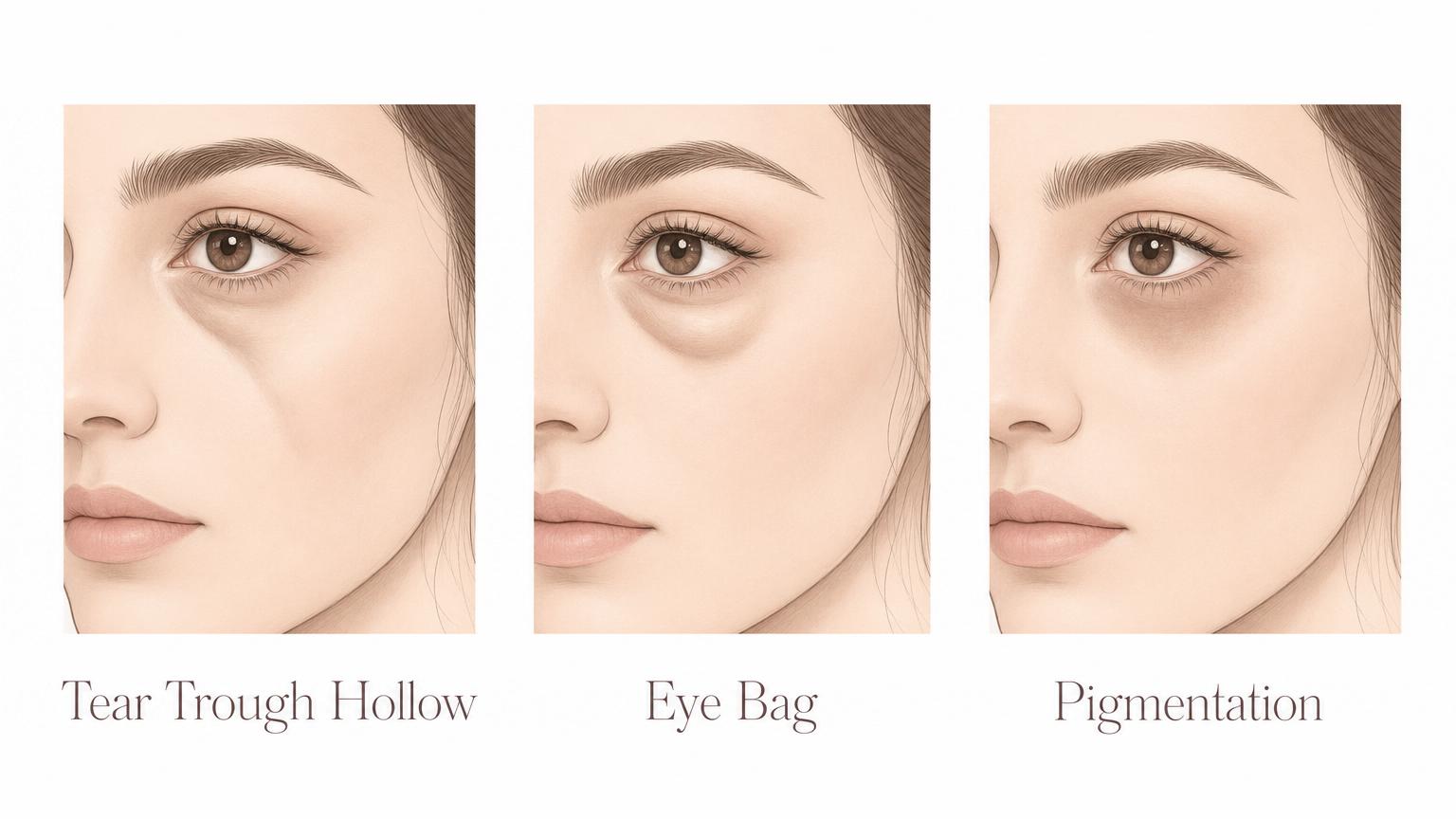
- Three different conditions cause “dark circles” under the eye — tear trough hollow, herniated eye bag, and skin pigmentation. Each needs a different fix.
- Tear trough hollow alone → fat repositioning (move existing fat into the hollow, no excision).
- Eye bag with no hollow → transconjunctival fat removal (excise herniated fat through the inner lid, no external scar).
- Eye bag plus loose skin → lower blepharoplasty (skin trimming, leaves a fine scar along the lash line).
- True pigmentation → laser, peels, or topical lightening. Surgery makes it worse, not better.
- Korean prices: fat repositioning KRW 2.5–3.5M (USD 1,800–2,600), fat removal KRW 1.8–2.5M (USD 1,300–1,800), lower blepharoplasty KRW 3.5–4.5M (USD 2,600–3,300).
- Most patients in their twenties have hollow without a real eye bag. Most in their forties and fifties have both.
The Three Conditions, and How a Korean Surgeon Tells Them Apart
Every consultation in Gangnam starts the same way. The surgeon tilts the chin up, then down, then asks you to look at the ceiling. Three angles, three light directions. That is how they read your under-eye.
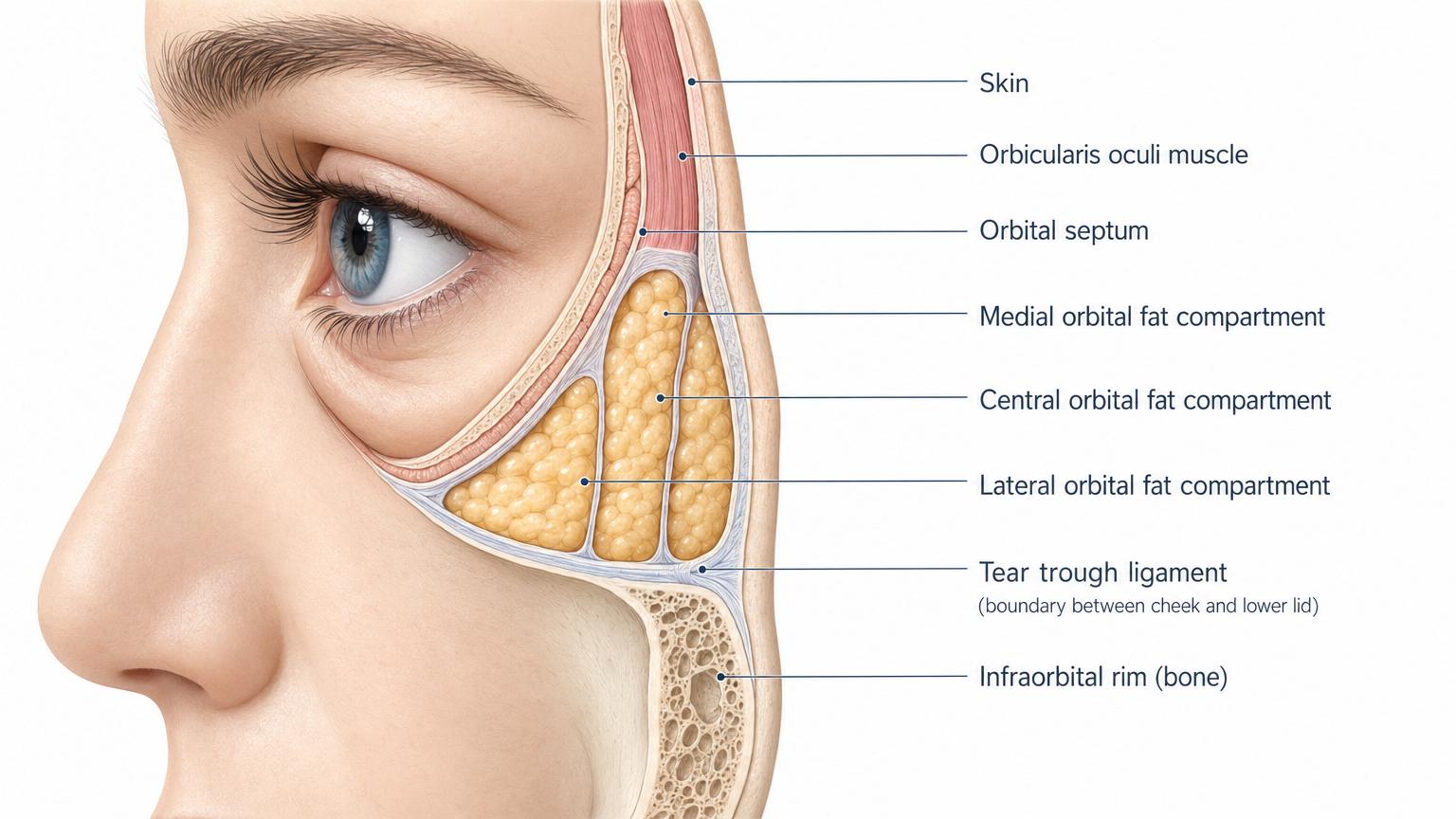
Condition 1 — Tear trough hollow
A groove that runs from the inner corner of the eye downward and outward, deepening when you smile or look up. The skin and fat are not protruding — they are missing. What you see as a dark circle is actually a shadow cast into the groove.
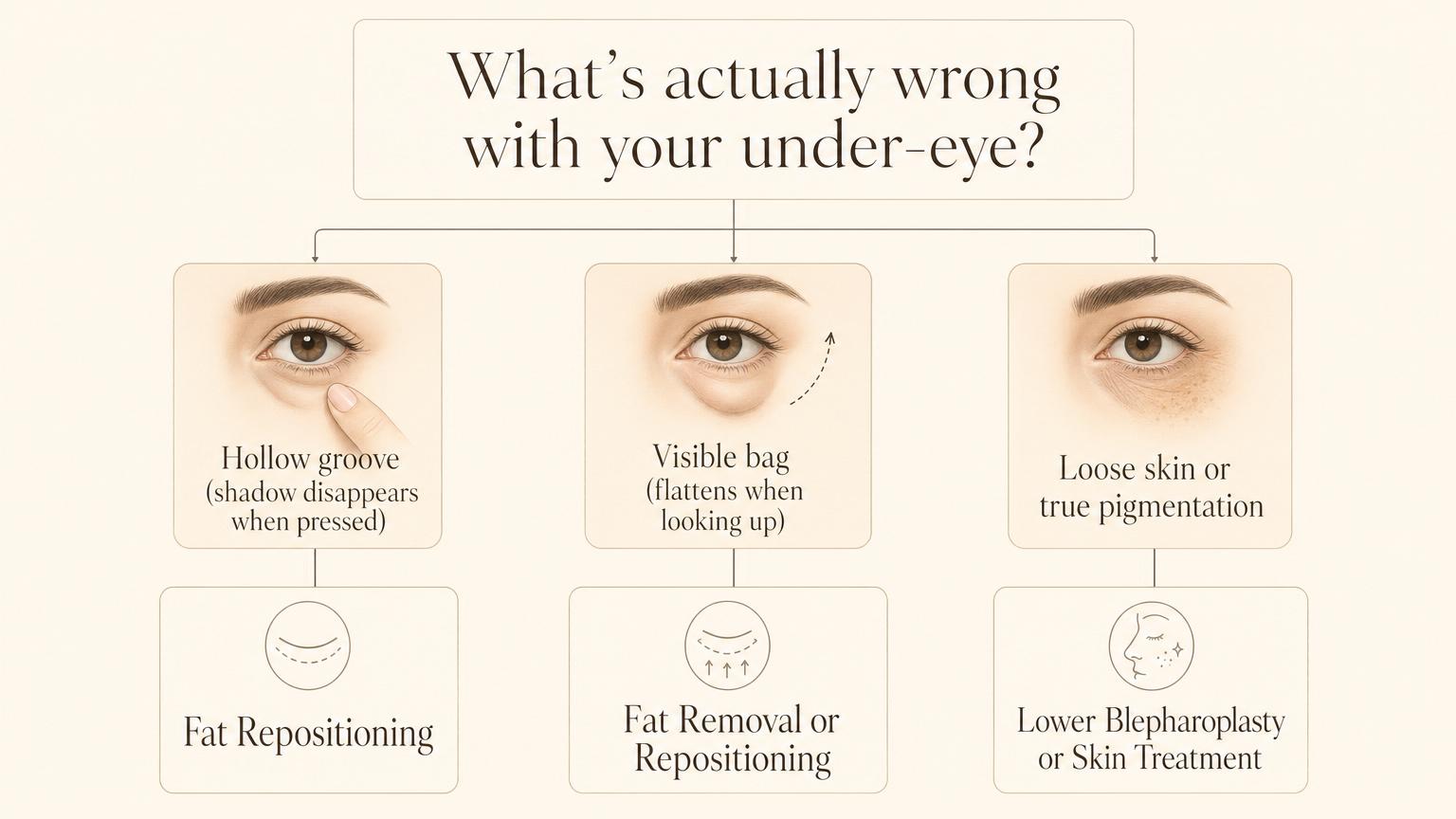
Press a finger into the hollow. If the darkness disappears, it is a tear trough. The shadow vanishes when you fill the depression.
This is the condition most patients in their twenties and early thirties have. It is genetic. It does not get worse from poor sleep, despite what every magazine article suggests.
Condition 2 — Herniated eye bag
Lower-eyelid fat that has pushed forward through a weakened orbital septum, creating a rounded bulge on the lower lid. The bulge throws its own shadow downward, especially under directional light.
Look up at the ceiling without moving your head. If the bag flattens or disappears, it is fat herniation — not skin loosening, not pigmentation. Direct sunlight makes it worse because the angled light deepens the shadow.
Most patients in their forties and beyond have some degree of this. A meaningful number of patients in their twenties have it too, especially if they have a family history.
Condition 3 — Loose skin and pigmentation
Two separate things often lumped together. Loose skin is what wrinkles when you smile and does not bounce back. Pigmentation is a flat brown or gray-purple discoloration in the skin itself, present whether you are tired or rested.
Pinch the skin gently. If it lifts and lingers, you have skin laxity. If you stretch the skin and the discoloration is still there, you have true pigmentation. These two cannot be solved with the same approach.
The combinations that confuse everyone
Here is what surprised me sitting in on Korean consultations as a coordinator. Almost no one walks in with one clean condition. Most patients have a mild tear trough plus an early eye bag plus a touch of pigmentation, and they need a strategy, not a single procedure.
One patient I worked with came in convinced she needed “the surgery that fixes dark circles.” After the three-angle exam, the surgeon told her the dark circles were 70% tear trough shadow, 20% pigmentation, and 10% a very mild eye bag. She left the room with a fat repositioning plan and a referral to dermatology for the pigmentation. Two procedures, not one. And the second one was non-surgical.
The Right Surgery for the Right Condition
This is where the diagnosis turns into a treatment plan. Foreign patients almost always confuse these three procedures, so let me draw the lines clearly.
Fat repositioning — for hollow without herniation
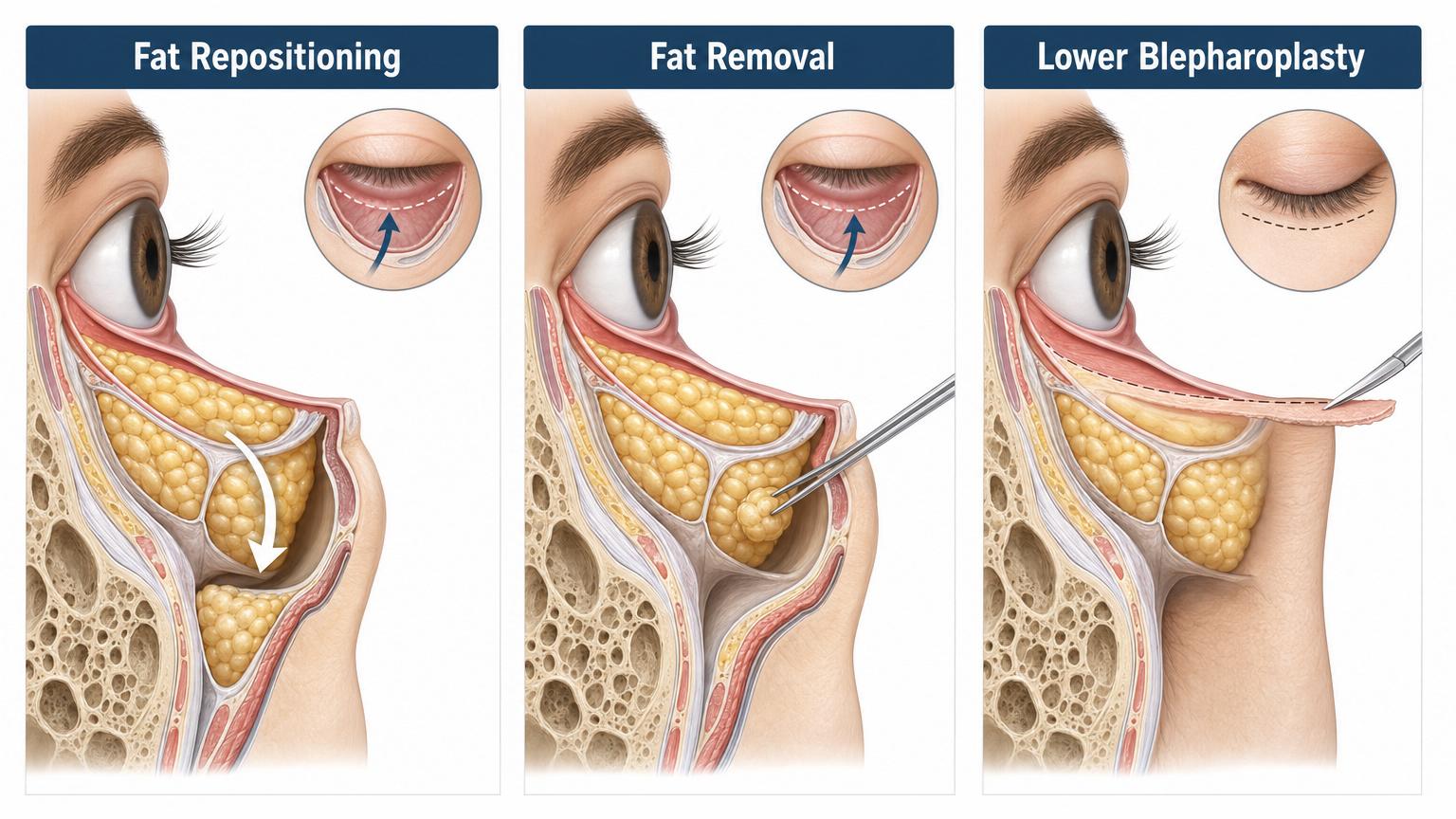
The surgeon enters through the inner conjunctiva (no external incision), releases the orbital fat from its compartment, and repositions it down into the tear trough hollow. The fat acts as a cushion, smoothing the transition between lid and cheek. Nothing is removed.
This is the procedure most twenty- and thirty-somethings actually need, even though they walk in asking for “fat removal.” Removing the fat would deepen the hollow, not solve it.
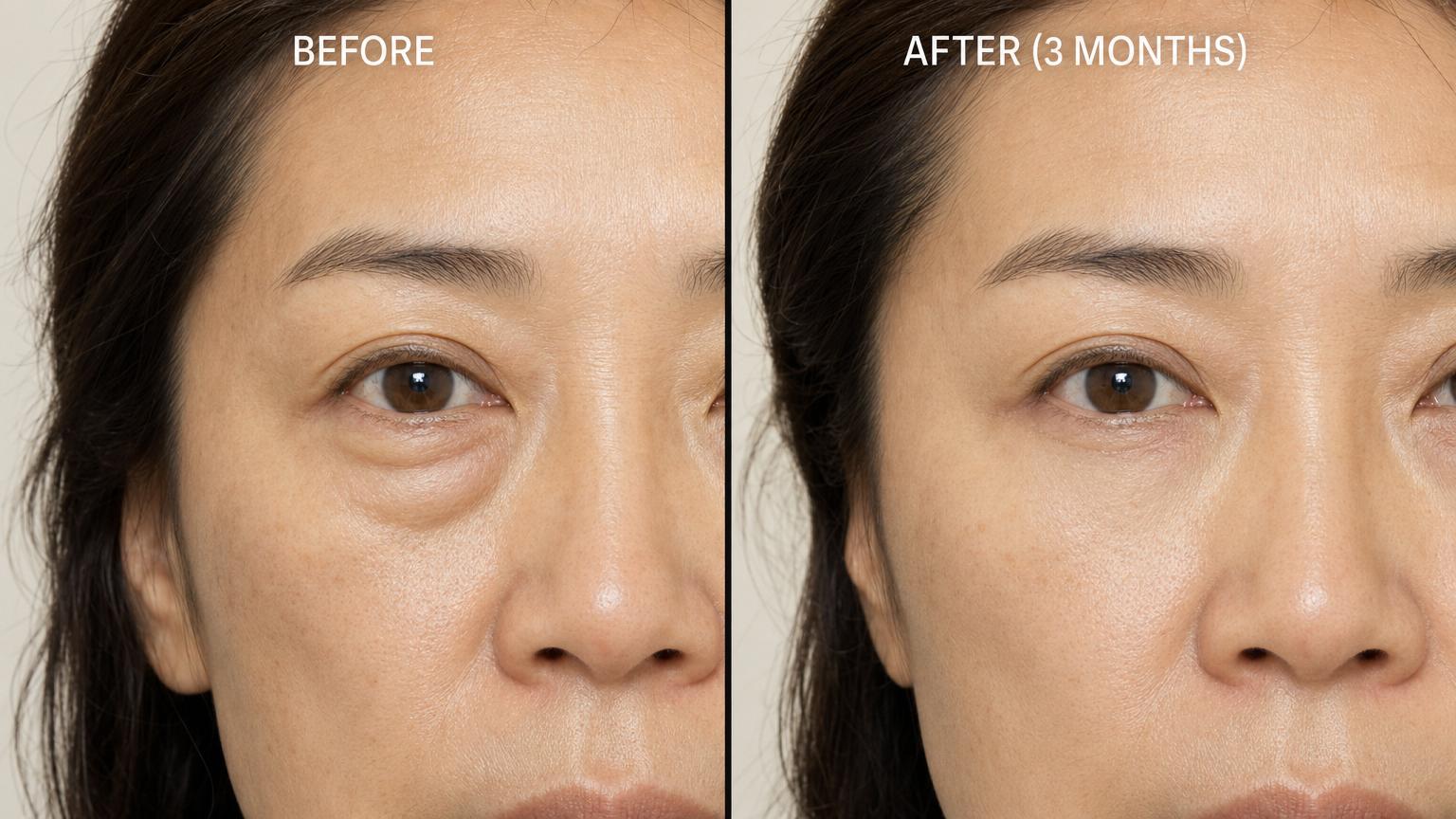
One day-seven review from a Korean clinic community described the result simply — “the depressions where the fat had been hollow were filled in beautifully” — which is exactly what good fat repositioning does. Volume back where it belongs.
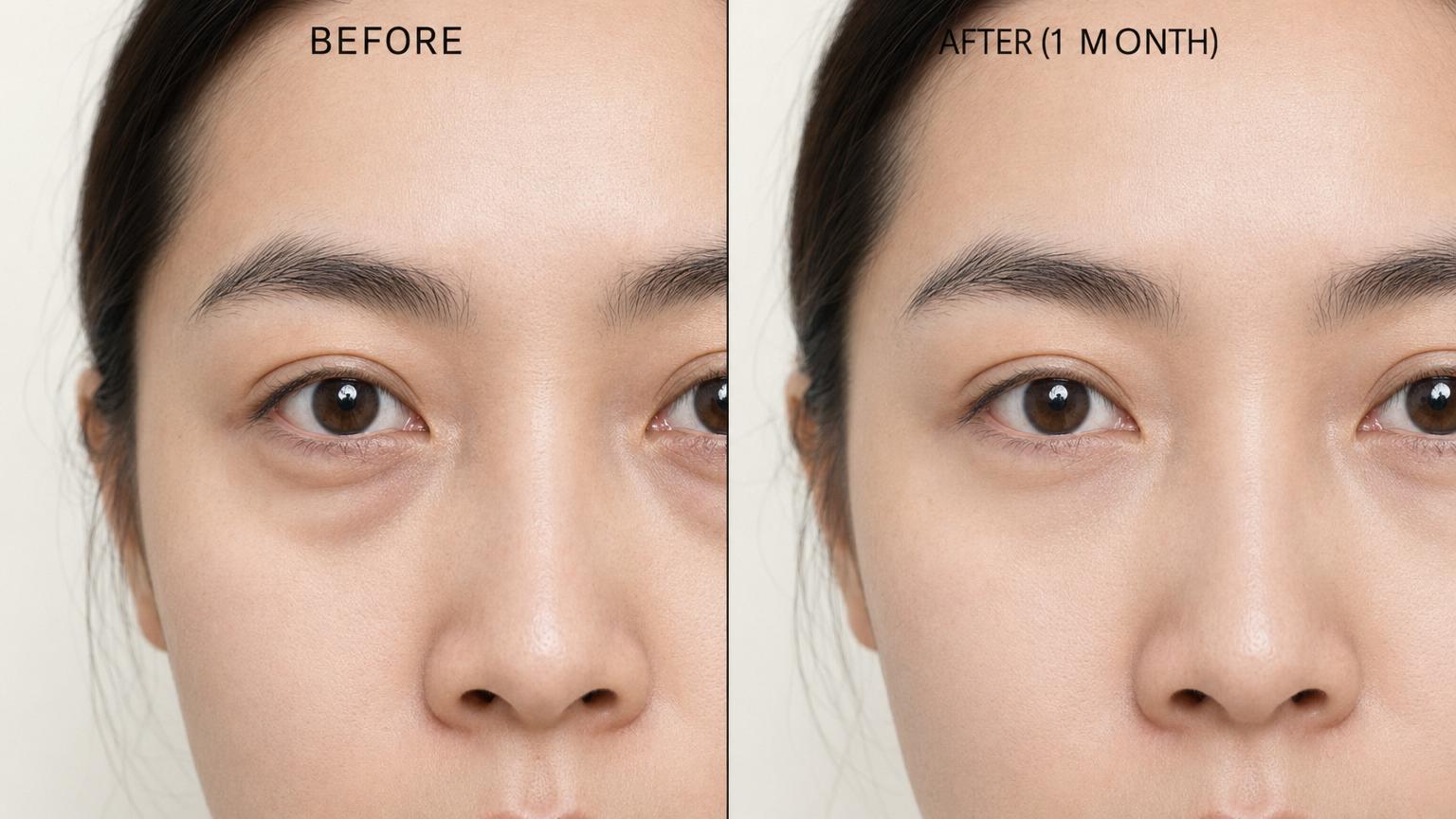
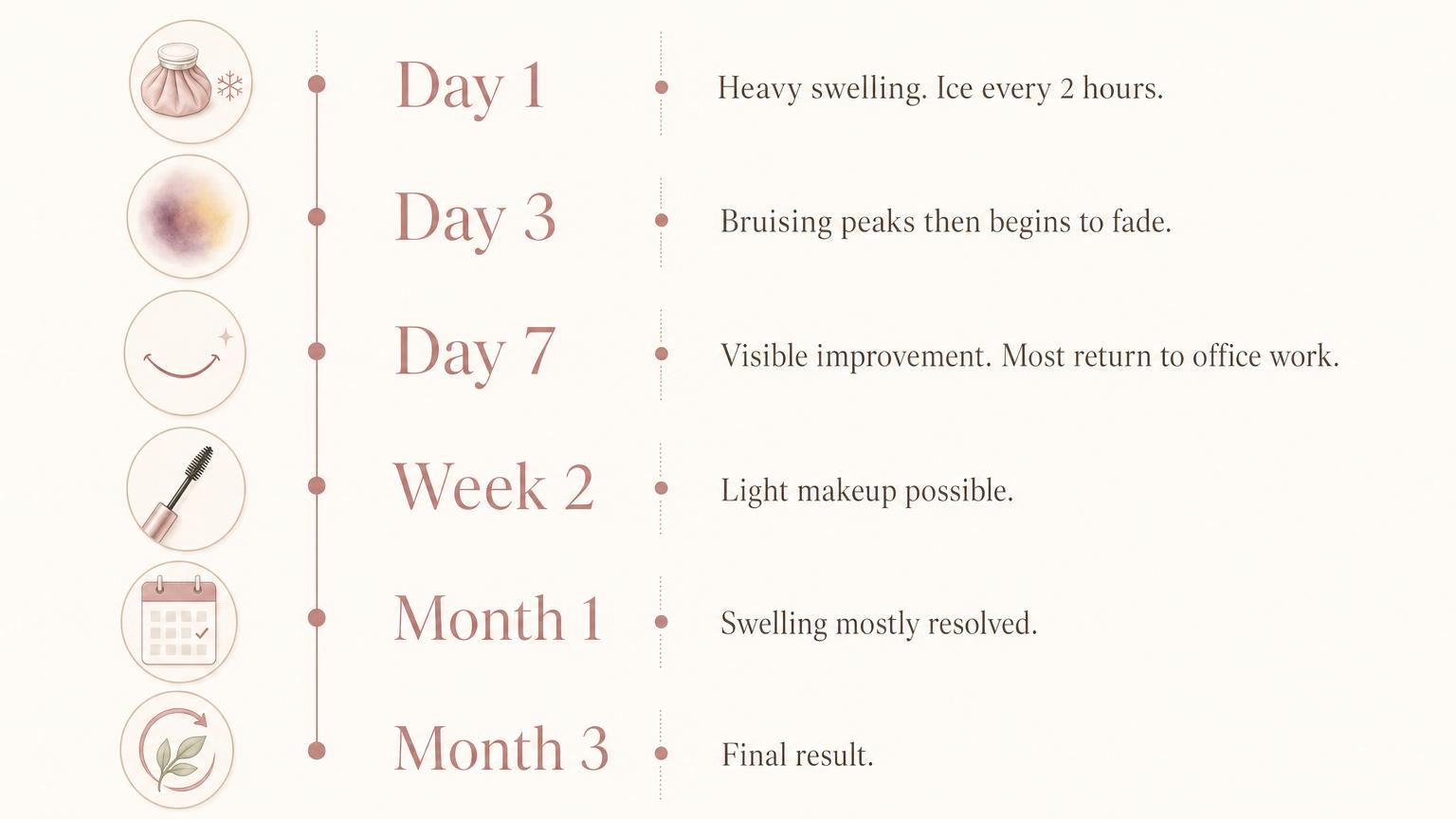
Recovery is genuinely fast. Most Korean patients return to office work within 7–10 days, with the worst swelling on days 2–3 and rapid improvement after that.
Fat removal — for protruding bag without major hollow
Same transconjunctival approach (no external scar), but here the surgeon excises the herniated fat instead of repositioning it. This works when there is a real bag and minimal hollow underneath. Removing protruding fat flattens the lower lid. Done.
The catch: pure fat removal is becoming less common in Seoul. Most patients with a herniated bag also have at least a mild tear trough, and removing all the fat in that situation creates a sunken, hollow look at age 50. The newer Korean approach is to remove only the excess and reposition the rest into the hollow — a hybrid that ages better.
If a clinic quotes you “fat removal only” without mentioning your tear trough, that is a yellow flag.
Lower blepharoplasty — for loose skin plus a bag
A horizontal incision is made directly beneath the lash line. The surgeon removes herniated fat, trims redundant skin, and tightens the muscle. There is a thin scar along the lash line that fades to invisible over 3–6 months.
This is the right procedure when skin laxity is the dominant issue — typically patients in their forties, fifties, and beyond. The transconjunctival approach cannot fix skin. If your lower lid wrinkles when you smile and stays wrinkled, no amount of internal fat work will smooth it. You need the skin trim.
The downside: a real scar (even if fine), longer recovery, and a higher technical bar. The complication you do not want is lower-lid retraction — the eyelid pulled slightly downward, exposing more white below the iris. Senior surgeons keep this rate very low. Junior ones do not.
Three procedures, side by side
| Procedure | Best for | Approach | Korea (KRW) | USD |
|---|---|---|---|---|
| Fat Repositioning | Hollow + mild bag | Transconjunctival | 2.5M – 3.5M | $1,800 – $2,600 |
| Fat Removal | Bag without hollow | Transconjunctival | 1.8M – 2.5M | $1,300 – $1,800 |
| Lower Blepharoplasty | Loose skin + bag | Subciliary (lash line) | 3.5M – 4.5M | $2,600 – $3,300 |
| Fat reposition + grafting | Severe hollow + global volume loss | Transconjunctival + harvest | 5M – 8M | $3,700 – $5,900 |
Established Gangnam clinics that publish prices openly — places like Link Plastic Surgery and the larger comprehensive clinics — sit in the middle of these ranges. Cheaper quotes from app-based platforms typically exclude the design consultation, follow-up visits, or assume a mid-tier surgeon rather than the senior one in the photos.
Recovery, Combinations, and What Goes Wrong When You Pick the Wrong One
Knowing the procedure is half the work. The other half is understanding what recovery looks like and which combinations Korean surgeons actually recommend.
The seven-day window
For fat repositioning specifically, the seven-day point is where most patients turn the corner. A cluster of recent Day-7 reviews from one Gangnam clinic’s patient community describe almost the same arc — bruising fading, swelling significantly down, the under-eye looking lighter and the face looking “brighter overall.” One review noted bruising and swelling came down faster than expected after following the post-op care instructions; another described feeling that the face looked younger even at day seven.
This is not because the result is fully visible at day seven. It is because the worst is behind you. Final settling takes three full months.
What if you have severe hollowing
For patients with deep tear trough plus generalized facial volume loss — the look you see in patients in their late forties and beyond, or in very thin patients — fat repositioning alone often is not enough. The compartmental fat is too small to fill the deficit.
The Korean answer is repositioning plus harvested fat grafting. The surgeon repositions what is in the lower lid, then takes additional fat from the abdomen or thigh, processes it, and grafts the deficit areas — typically the temples, midface, and the deeper part of the tear trough.
One patient I followed online had gone in for an under-eye consultation and left with a combined fat repositioning plus full-face grafting plan. Her stated reason — the surgeon walked through her before-photos with a marker and showed her where she had volume loss beyond the lower lid. A single under-eye procedure would have left her with a hollow temple and a flat midface that the lid fix could not solve on its own.
Another two-week post-op update from a similar case described the same logic — the patient presented with very thin under-eye fat and overall low facial volume, and the surgeon recommended the combined approach rather than under-eye work in isolation.
This is the kind of judgment call that separates an experienced Korean surgeon from a generalist. If your concerns are more than just the under-eye, ask about the combined approach during consultation.
The combinations Korean surgeons actually recommend
- Fat repositioning + epicanthoplasty. Common in patients in their twenties who want a brighter, more open eye look. The two procedures are done in one operation, one recovery.
- Fat repositioning + canthoplasty (lateral). For patients whose lower lid sits a bit low or has a mild downward tilt. Lifting the outer corner sharpens the entire lower-lid line.
- Fat repositioning + facial fat grafting. Described above — for severe hollow with global volume loss.
- Lower blepharoplasty + midface lift. For patients in their fifties with significant skin laxity plus midface descent. This is the procedure most foreign patients underestimate the recovery of.
What goes wrong if you pick the wrong procedure
Three patterns I see in patients who come back for revision.
The first is fat removal in a tear trough patient. The bag is gone, but the hollow underneath is now exposed and looks worse. This is the most common revision case at Korean clinics. Solution: secondary fat repositioning or fat grafting, harder than getting it right the first time.
The second is lower blepharoplasty too aggressive on skin. The lid is pulled down slightly. The white of the eye shows below the iris. Revision involves lid support procedures and is technically demanding. Avoid by choosing a senior surgeon with documented low retraction rates.
The third is surgery for what was actually pigmentation. The patient comes back at month three saying “the dark circles are still there.” Because they always were — the surgery removed shadow, not pigment. Lesson: insist on a clear pigmentation assessment before surgery, and accept that some of the discoloration may need a separate non-surgical track.
Recommended for Your Recovery
Products patients commonly use before and after Korean under-eye surgery — same items routinely included in the recovery kits Seoul clinics hand out at discharge.
- Arnica Montana Tablets — start 3 days before surgery to reduce bruising and post-op swelling around the periorbital area. Check price on Amazon
- Gel Eye Mask (Cold Compress) — reusable cold pack shaped to the eye area for the every-two-hour icing schedule on day 1 to day 3. Check price on Amazon
- COSRX Snail Mucin Essence — gentle hydration safe for the delicate skin around the eyes once cleared by your surgeon. Check price on Amazon
- Beauty of Joseon Relief Sun SPF 50+ — lightweight Korean sunscreen critical for the healing under-eye area to prevent post-inflammatory pigmentation. Check price on Amazon
As an Amazon Associate, GlobalBeautySpot earns from qualifying purchases at no extra cost to you.
Frequently Asked Questions
How do I know which condition I have without a Korean consultation?
Use the three at-home tests. Press into the dark area — if the shadow disappears, it is a tear trough hollow. Tilt your chin up and look at the ceiling — if the bag flattens, it is fat herniation. Stretch the skin gently — if the discoloration stays, it is pigmentation. Most patients have a mix, and a Korean surgeon will give you the percentages.
Is fat repositioning permanent?
The repositioned fat stays where it is placed. The aging process continues, so the under-eye area will continue to change with time, but the procedure itself does not “wear off” the way a filler does. Most Korean surgeons quote a 90%+ long-term hold rate.
Can I just get filler instead?
Hyaluronic acid filler in the tear trough is widely used and reversible, but it has real limitations — it can migrate, it can swell with hydration, and after several years of repeat injections the area often looks puffier than the original problem. For patients under 30 with a mild hollow, filler is a reasonable starting point. For everyone else, surgery generally ages better.
Will fat repositioning fix my dark circles?
It will fix the shadow component, which is most of what most patients are calling “dark circles.” It will not fix true pigmentation. Plan accordingly — if a careful mirror exam shows discoloration that does not depend on light angle, you will need a separate skin-lightening track.
What about under-eye filler done by a Korean dermatologist?
It is widely available, fast, and around KRW 400,000–700,000 per session. Good for patients who are not ready for surgery or who have very mild hollows. Not a substitute for surgery in patients with significant hollow plus a bag — the bag is still there afterward, just sitting on top of filler.
Do I need to fly home with a bandage?
Transconjunctival surgery has no external bandage because there is no external incision. You leave with cold compresses and antibiotic eye drops. Lower blepharoplasty leaves you with thin tape over the lash-line incision for the first few days. Either way, sunglasses are non-optional for the trip.
How do I find a Korean surgeon who actually does the diagnosis carefully?

Look for a board-certified plastic surgeon (성형외과 전문의) with a focus on eye surgery, ask to see their personal before-and-after gallery rather than the clinic’s general portfolio, and pay attention to whether the consultation includes the three-angle exam I described in section 2. Several Gangnam clinics — including Link Plastic Surgery — publish individual surgeon galleries online, which is a reasonable filter for finding someone who treats this as a diagnostic process rather than a checkout cart.
If a clinic shows you the price before they have looked at your eyes, that tells you what kind of clinic it is. Walk out.