The patient had a folder on her phone of fat-dissolving injection ads, fat-freezing before-and-afters, and a quote for liposuction, and she wanted to know which one was the real deal. She had been told by one clinic that injections would melt her stubborn lower-belly pocket, by another that fat-freezing was the no-surgery answer, and by a third that only liposuction would actually do anything. They could not all be right, and she was understandably confused. The Seoul surgeon looked at the area, pressed the tissue, and explained the one fact that the marketing on all three had carefully avoided saying out loud. Only one of these physically removes fat. The other two reduce it more modestly and gradually, and none of them is a weight-loss method. The consultation at Link Plastic Surgery starts with what the tissue actually needs, not with the treatment the ad sold you.
Fat reduction is one of the most heavily marketed categories in aesthetics, and that marketing has left foreign patients with a genuinely muddled picture. Liposuction, fat-dissolving injections, and cryolipolysis fat-freezing are presented as interchangeable ways to get rid of unwanted fat, when in fact they do different things to the fat cell, produce very different amounts of reduction, and suit very different situations. Picking the wrong one wastes money on a result that was never going to match the expectation. Understanding what each one actually does is the difference between a sensible plan and a series of disappointing sessions.
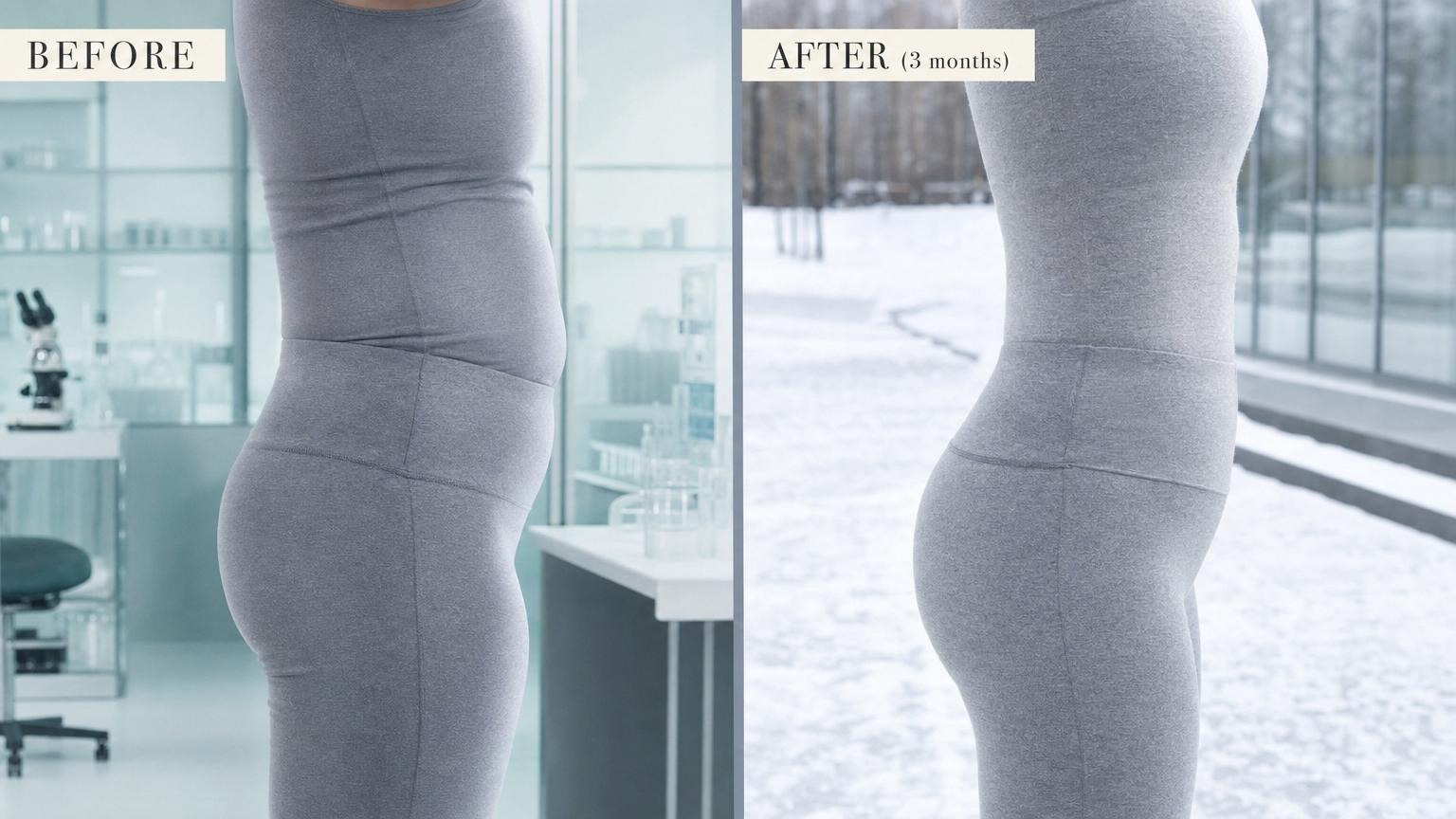
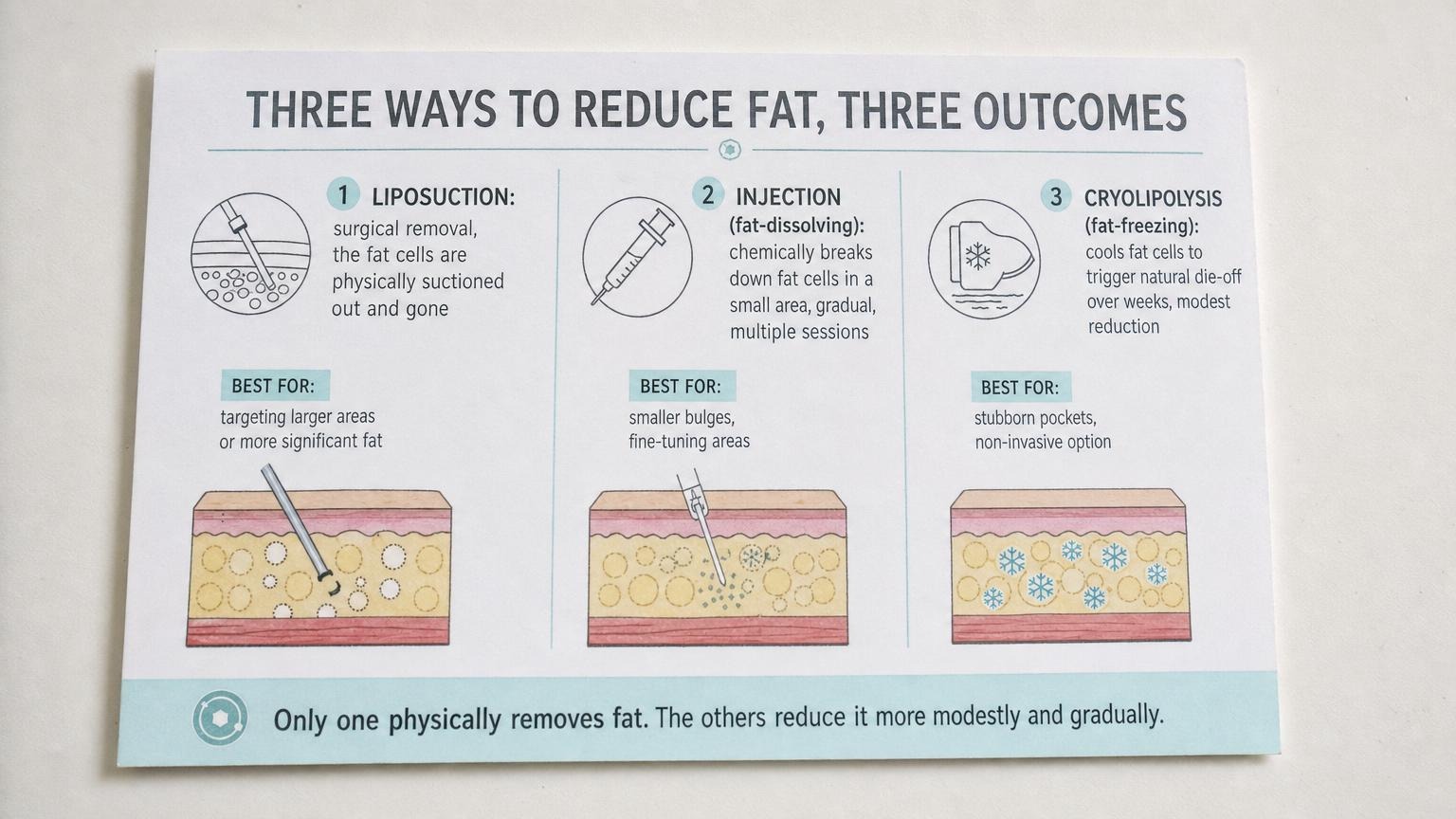
Three Methods, Three Different Things Done to the Fat Cell
Liposuction: Physical Removal
Liposuction is the only one of the three that physically removes fat cells from the body. A thin cannula is used to suction the fat out, and those cells are gone for good. Because it removes cells rather than shrinking them, it produces the largest and most definitive reduction of the three, and it is the right tool when there is a meaningful volume of fat to address in a defined area. The Korean approach uses fine micro-cannulas for precise contouring rather than aggressive bulk removal, which is covered in detail in our guide to Korean liposuction. The trade is that it is a surgical procedure with real recovery, compression garments, and weeks of swelling before the final contour settles. It is the most invasive and also the most effective of the three, and those two facts are linked.
Fat-Dissolving Injections: Chemical Breakdown
Fat-dissolving injections work chemically. A solution is injected into a small area of fat and it breaks down the fat cells over the following weeks, which the body then clears. It is non-surgical, it suits small stubborn pockets like a double chin or a small flank bulge, and it requires multiple sessions to produce a visible result. The reduction is modest and gradual, nowhere near what liposuction achieves, and it works best on small targeted areas rather than larger volumes. It is a reasonable tool for someone with a specific small pocket who wants to avoid surgery and is willing to do several sessions and wait. It is not a substitute for liposuction on a larger area, despite how the two are sometimes marketed side by side.
Cryolipolysis: Fat-Freezing
Cryolipolysis, the fat-freezing approach, cools the fat cells to a temperature that triggers them to die off gradually over the weeks that follow, after which the body clears them. It is non-surgical, has minimal downtime, and produces a modest reduction in a treated area. Like injections, it is best suited to small stubborn areas rather than large volumes, and it typically needs more than one session for a noticeable result. The reduction is real but gentle, and patients who expect a liposuction-level change from a fat-freezing session are usually disappointed. It occupies the same niche as injections: small areas, no surgery, gradual modest results, patience required.
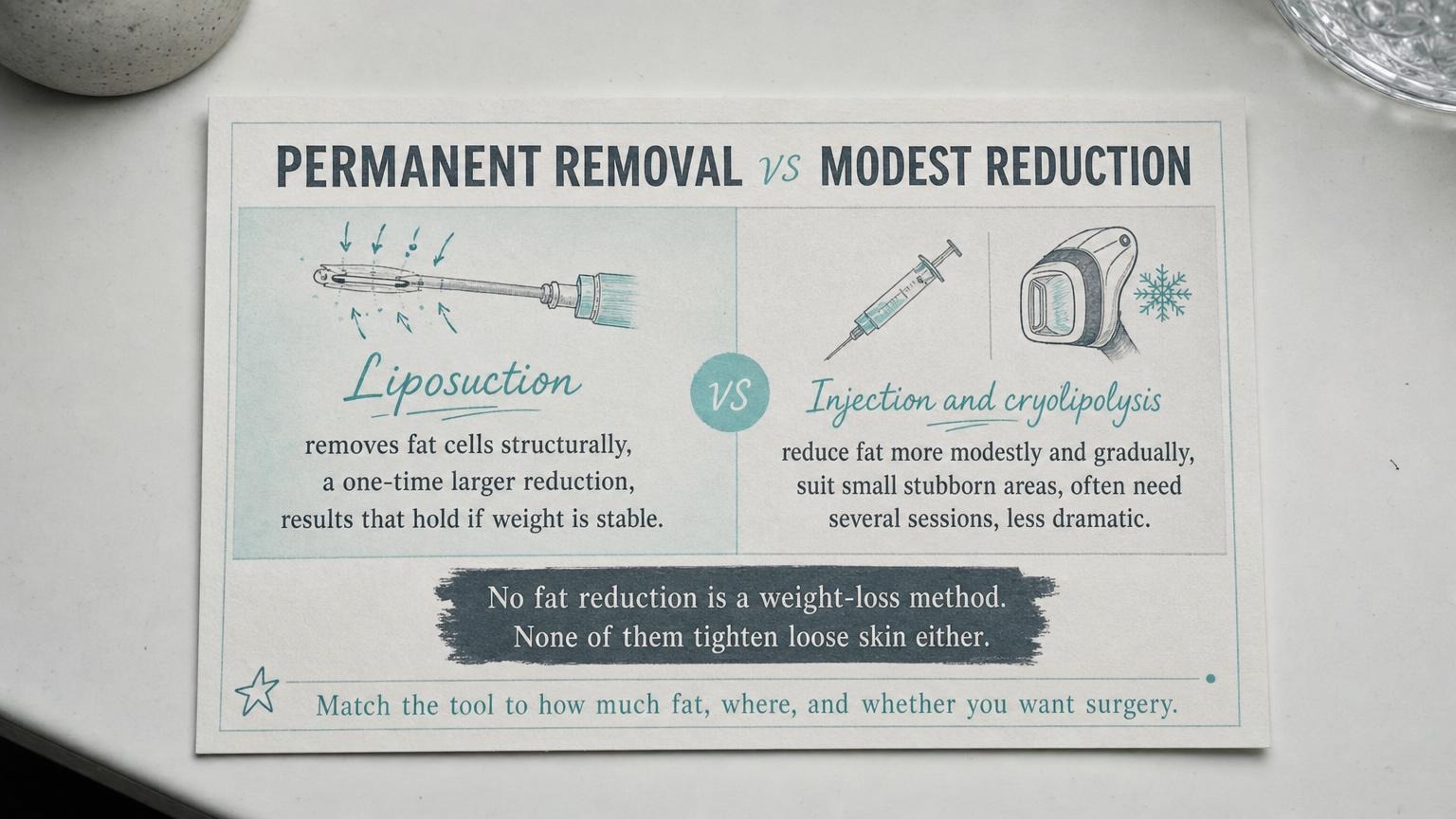
Permanent Removal Versus Modest Reduction
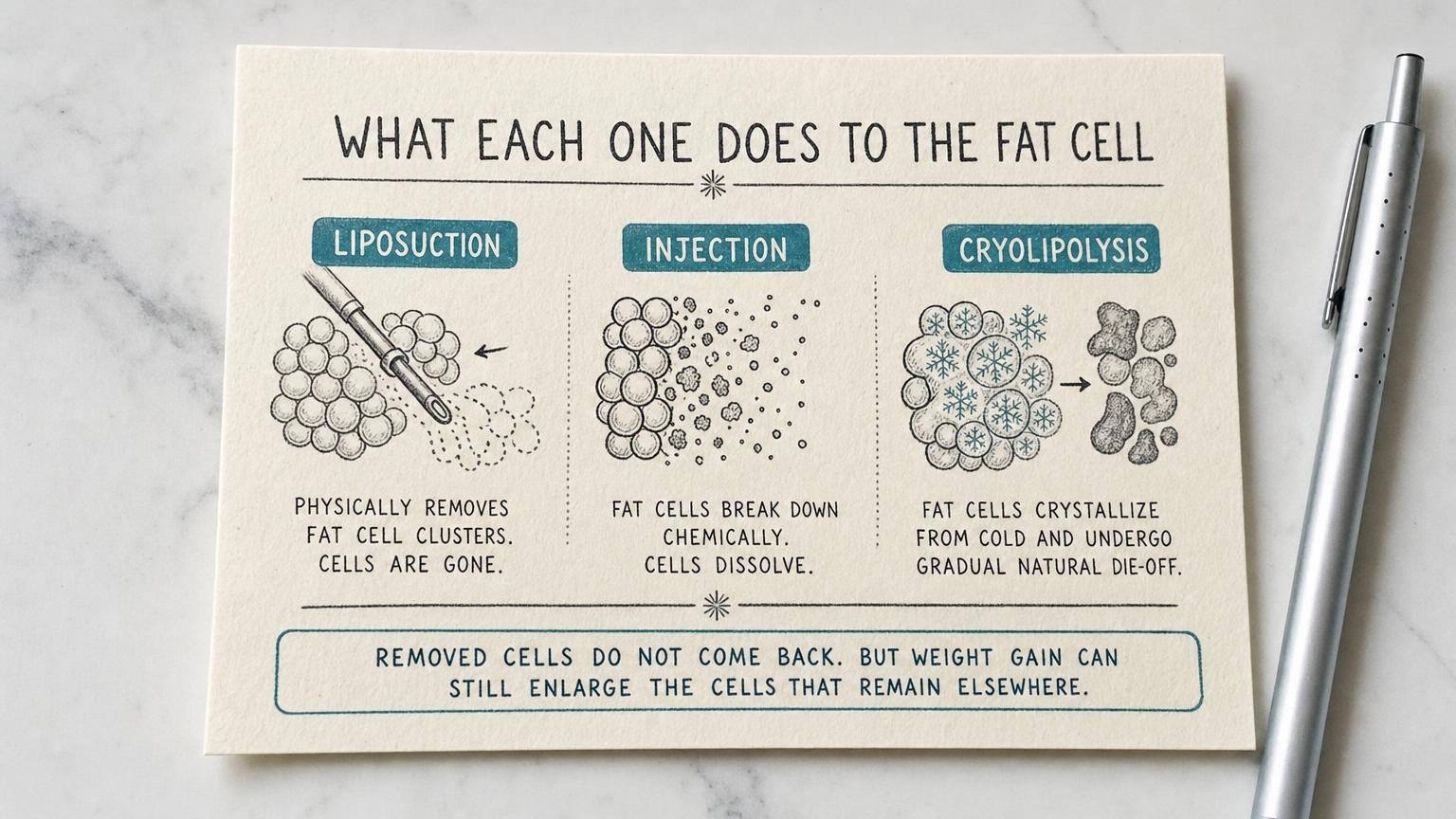
The single most important distinction, and the one the marketing tends to blur, is between physically removing fat cells and modestly reducing them. Liposuction removes cells, so the reduction is a one-time structural change that holds as long as your weight stays stable. Injections and fat-freezing reduce the fat more modestly and gradually, suit small areas, and often need several sessions to add up to a visible difference. Neither approach is wrong; they simply do different jobs. The mistake is expecting the modest, gradual methods to deliver the dramatic structural change that only removal produces.
There are two honest caveats that apply to all three and that no fat-reduction marketing wants to dwell on. First, none of these is a weight-loss method. They contour specific areas; they do not reduce your overall body weight, and gaining weight afterward can still enlarge the fat cells that remain elsewhere. Second, none of these tightens loose skin. If the skin in the area has already lost its elasticity, removing or reducing the fat underneath can actually leave the skin looking looser, which is why the skin question matters as much as the fat question and why a body procedure to address skin is sometimes needed alongside, as covered in our guide to the Korean tummy tuck and body contouring options.
Downtime, Sessions, and the Real Trade
The three methods sit at very different points on the trade between how much they achieve and how much they cost in recovery and sessions. Liposuction is a single surgical procedure with weeks of recovery and a compression garment, but one procedure delivers the full result. Fat-dissolving injections and fat-freezing each require multiple sessions spaced weeks apart, with little to no downtime per session, but the cumulative result is modest. So the choice is partly about how you weigh a single bigger recovery against several small no-downtime sessions for a smaller result.
Recommended for Your Recovery
Products commonly used before and after Korean fat reduction liposuction vs injection vs coolsculpting — same items routinely recommended in the recovery instructions Seoul clinics hand out at discharge.
- Arnica Montana Tablets — start 3 days before body surgery to reduce bruising in the treated zone. Check price on Amazon
- Silicone Scar Sheets — cut to size and apply over incision lines starting week 3 to flatten scar formation. Check price on Amazon
- Beauty of Joseon Relief Sun SPF 50+ — daily UV protection on healing scars — sun exposure during the first 6 months drives post-inflammatory pigmentation. Check price on Amazon
- COSRX Advanced Snail 96 Mucin Power Essence — gentle Korean skin essence to support overall skin barrier during the recovery window. Check price on Amazon
As an Amazon Associate, GlobalBeautySpot earns from qualifying purchases at no extra cost to you.
For a foreign patient planning a Seoul trip, this matters concretely. Liposuction needs the trip planned around surgical recovery, with the compression and swelling timeline in mind. Injections and fat-freezing fit a short trip in terms of the session itself, but because they need multiple sessions for a result, a single trip rarely completes the course, and the modest reduction develops over the weeks after you fly home. Anyone expecting a dramatic single-trip transformation from the non-surgical methods is misreading what they do.
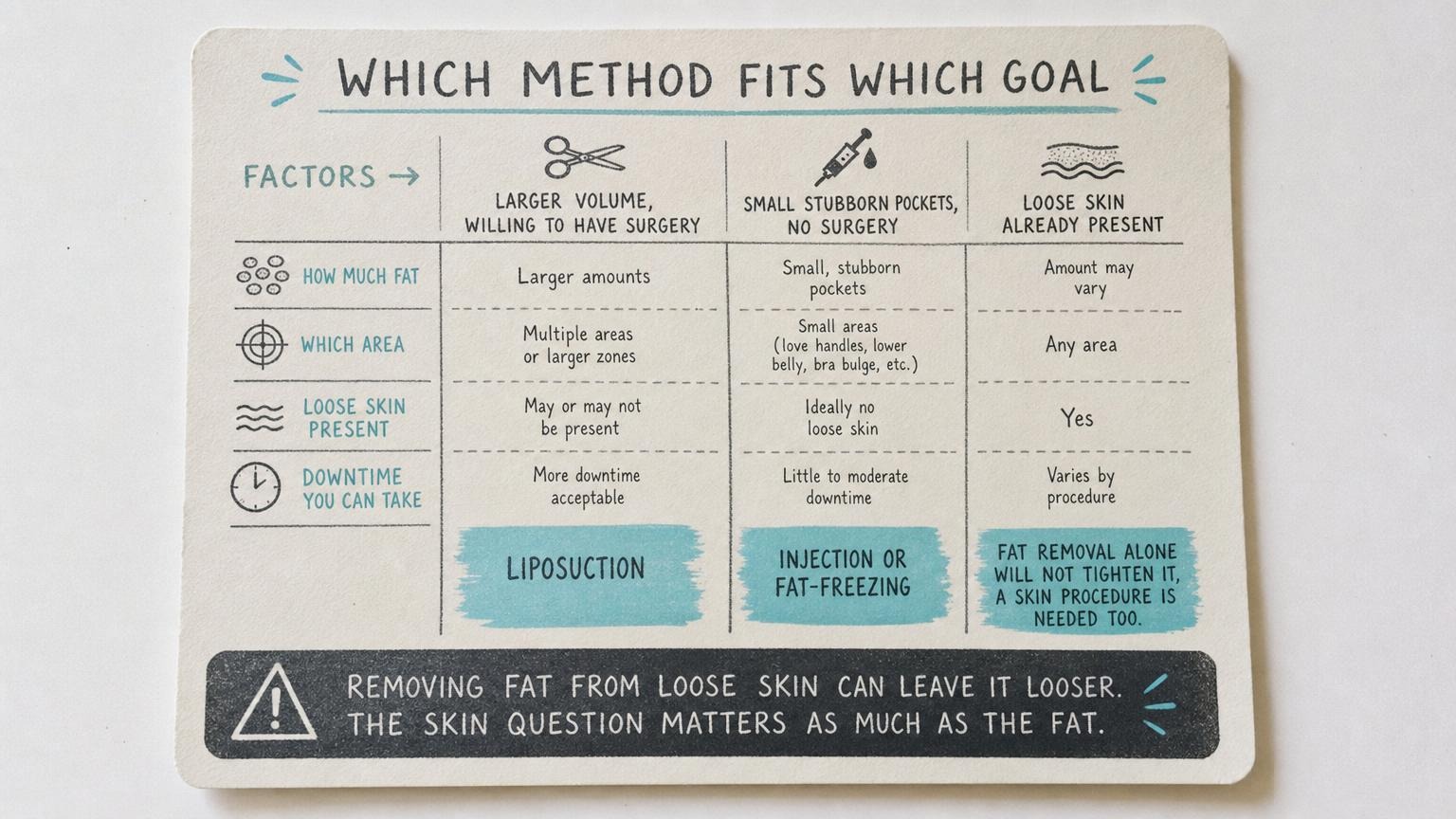
Which Method Fits Which Goal
The decision comes down to a few honest questions. How much fat are you actually trying to reduce, a larger defined volume or a small stubborn pocket? Which area is it? Is there loose skin already present? And how much downtime can you take? A larger volume in a patient willing to have surgery points clearly to liposuction, which is the only tool that removes a meaningful amount. A small stubborn pocket in someone who wants to avoid surgery and is patient points to injections or fat-freezing. And if there is already loose skin, the honest answer is that fat reduction alone will not tighten it and a skin procedure may be needed alongside, which is exactly the kind of combined plan that Korean body contouring is built around, often staged with related procedures like a belly button revision when the abdomen is being contoured.
The trap to avoid is being sold the no-surgery option for a problem that needs removal, or being sold removal for a small pocket that an injection would handle. A clinic that recommends the same method to everyone, whether that is always liposuction because it is lucrative or always the non-surgical option because it is easy to sell in a package, is not assessing your tissue. A good Seoul surgeon presses the area, judges the fat volume and the skin quality, and tells you honestly which method matches what you actually have, even when that means telling you the treatment you came in asking for is the wrong one.
Cost and How to Verify the Plan
Pricing scales with the method and the area. Fat-dissolving injection sessions in Seoul are the lowest per session but add up across the multiple sessions required, typically landing in the hundreds of thousands of won per session. Cryolipolysis is similar, priced per area per session with several sessions usually needed. Liposuction is a surgical procedure and costs considerably more as a one-time fee, varying widely by the number and size of areas treated. The fuller context for body contouring options is covered across our Korean body procedure guides.
Before committing, five questions tell you whether a clinic is assessing your body or selling a package. Did the surgeon physically assess the fat volume and the skin quality before naming a method? How much reduction is realistic with the recommended method, honestly? How many sessions will it take and over what timeline? Is loose skin a factor, and if so what addresses it? And what is the maintenance reality, given that none of these prevents future weight gain? A clinic that answers these clearly is matching the method to your body. A clinic that quotes a fat-freezing package or a liposuction fee before assessing the area is selling a treatment, not solving your problem.

Frequently Asked Questions
1. Do fat-dissolving injections really work?
They work for small stubborn pockets, breaking down fat cells chemically over several sessions. The reduction is modest and gradual, suited to areas like a double chin or a small bulge, not larger volumes. They genuinely reduce fat in the right situation, but they are not a substitute for liposuction on a larger area, and expecting a dramatic change from them leads to disappointment.
2. Is fat-freezing as good as liposuction?
No, and they are not trying to do the same thing. Fat-freezing modestly reduces fat in a treated area over weeks and suits small stubborn pockets with no surgery. Liposuction physically removes fat cells and produces a much larger, definitive reduction but is surgical. For a meaningful volume of fat, liposuction is the tool; for a small pocket with no downtime, fat-freezing is reasonable.
3. Will the fat come back?
The fat cells that are removed by liposuction or cleared after injection or freezing do not regenerate. However, none of these methods prevents future weight gain, and gaining weight can enlarge the fat cells that remain in untreated areas. Stable weight is what keeps any of these results looking good over time.
4. Can any of these tighten loose skin?
No. None of the three fat-reduction methods tightens skin. If the skin in the area has already lost elasticity, reducing the fat underneath can leave the skin looking looser. When loose skin is a factor, a skin-tightening or skin-removal procedure may be needed alongside the fat reduction, which is why the skin assessment matters as much as the fat.
5. How many sessions do the non-surgical methods need?
Both fat-dissolving injections and cryolipolysis typically need multiple sessions spaced several weeks apart to produce a visible result, because each session only reduces the fat modestly. The exact number depends on the area and the goal. Liposuction, by contrast, achieves its result in a single procedure.
6. Are these a way to lose weight?
No. None of these is a weight-loss method. They contour specific areas of stubborn fat; they do not reduce overall body weight. They are best thought of as shaping tools for localized fat in someone who is already at or near a stable weight, not as a route to weight loss.
7. Which has the most downtime?
Liposuction has the most, being surgical, with weeks of swelling and a compression garment. Fat-dissolving injections and fat-freezing have little to no downtime per session, though they require several sessions. The trade is a single larger recovery for a bigger result versus several no-downtime sessions for a modest one.
8. Can I combine these methods?
Sometimes. Liposuction might address a larger area while injections handle a small adjacent pocket that does not justify surgery, or a non-surgical method might maintain a result after liposuction. Liposuction is also frequently combined with other body work in a single plan, such as alongside a Korean breast procedure in a postpartum body plan. The combination is planned according to what each area needs, and a thoughtful surgeon sequences it rather than doing everything at once.
9. Is the result different for different body areas?
Yes. Some areas respond well to non-surgical methods because the fat pocket is small and discrete, while larger or denser areas realistically need liposuction. The abdomen, flanks, thighs, and arms each behave differently, and the right method depends partly on the area as well as the volume and the skin.
10. How should I plan a Seoul trip around fat reduction?
Liposuction needs the trip planned around surgical recovery and the compression timeline. The non-surgical methods fit a short trip per session but rarely complete the multi-session course in one visit, and the modest result develops after you return home, so plan remote follow-up. For current scheduling and trip-planning details, visit Link Plastic Surgery’s official website.