The patient had already spent the equivalent of three thousand dollars on energy treatments back home, all aimed at her softening jawline, and she was frustrated that none of it had held. She arrived in Seoul asking for the strongest HIFU machine available, convinced that the problem was the device. The surgeon examined her lower face, gently pinched the skin along her jaw, and told her something she had not heard from anyone before. Her skin was past the stage where HIFU does much. She did not need a stronger machine. She needed a different tool entirely, because the jawline is not one problem with one solution. It is a spectrum of laxity, and there is a right tool for each stage. The consultation at Link Plastic Surgery begins with where on that spectrum your skin actually sits, not with the device you walked in asking for.
Jawline tightening is one of the most requested treatments by foreign patients in Seoul, and it is also where the most money is wasted on the wrong approach. The three main tools, HIFU energy tightening, thread lifting, and surgical lifting, are not competitors offering the same result at different price points. They are an escalation ladder, matched to how loose the skin already is. HIFU is excellent for early softening and nearly useless for advanced sagging. Surgery is the definitive answer for significant laxity and complete overkill for a jaw that is only just starting to blur. Understanding where you sit on that ladder is the difference between a result that holds and a series of treatments that quietly disappoint.
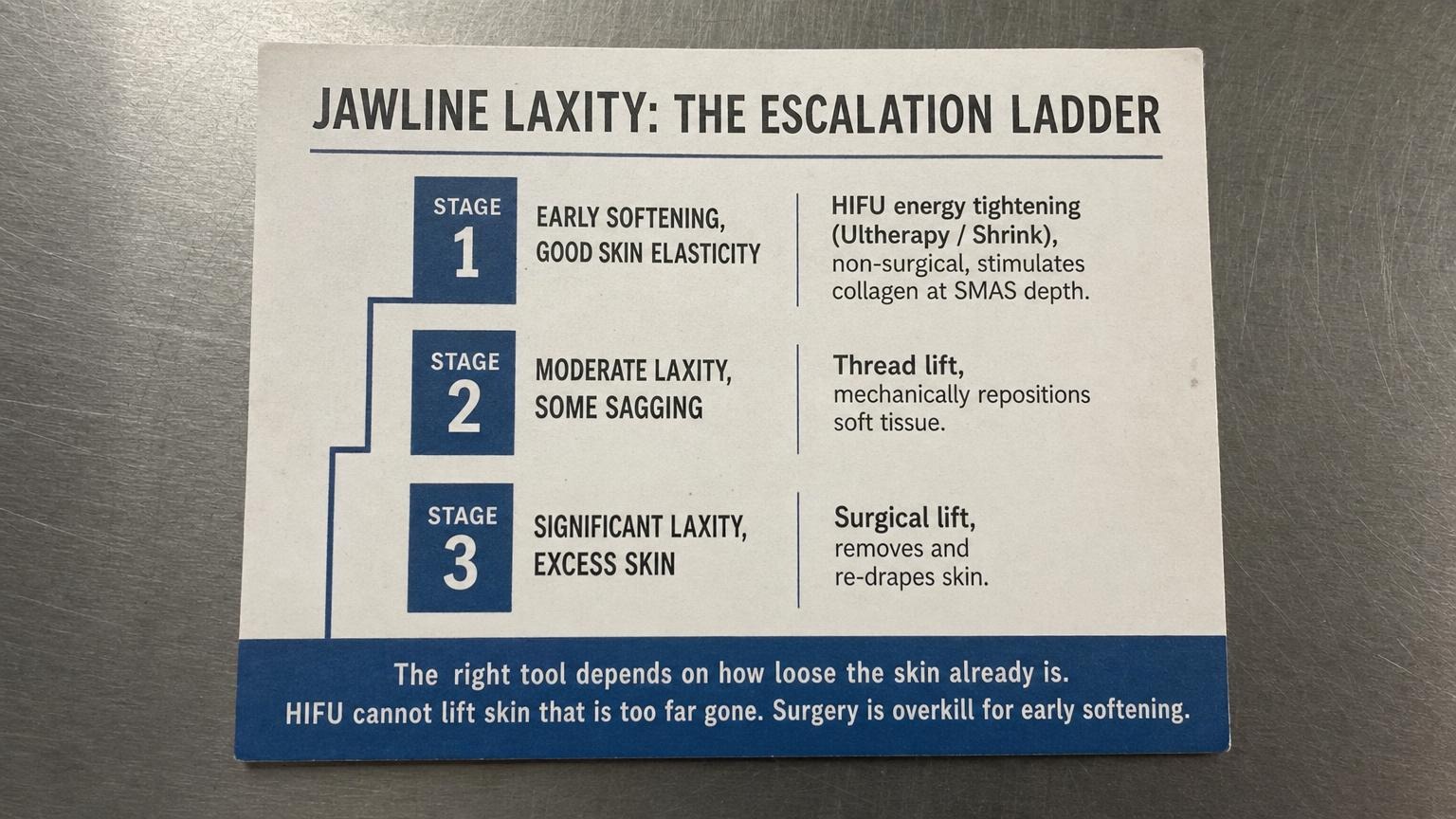
The Escalation Ladder: Matching the Tool to the Laxity Stage
Stage One: Early Softening, Good Elasticity
In the earliest stage of jawline change, the skin has only just begun to soften. The jaw-to-neck transition is starting to blur, the mandibular line is a little less crisp than it was, but the skin still has good elasticity and there is no real excess. This is the stage where HIFU energy tightening shines. Focused ultrasound reaches down to the SMAS layer, the deep structural layer of the face, and stimulates collagen production without any incision. The result builds gradually over two to three months as new collagen forms, and the jawline firms and lifts subtly. It is repeatable, it has essentially no downtime, and for the right candidate it is genuinely effective. The detailed mechanism is covered in our guide to Korean Ultherapy, including how the depth targeting actually works.
Stage Two: Moderate Laxity, Some Sagging
At the next stage, the softening has progressed into real sagging. There is visible jowl formation, the lower cheek has descended, and the skin no longer snaps back the way it used to. Energy tightening at this point produces some collagen response but cannot physically lift tissue that has already dropped. This is where thread lifting becomes the right tool. Barbed sutures are placed in the subcutaneous layer and mechanically reposition the sagging soft tissue upward, holding it in a higher position while also stimulating collagen along the thread path over the following weeks. It gives an immediate lift that energy cannot, with only a few days of mild swelling. The Korean approach to thread lifting is detailed in our guide to the Korean flower lift thread procedure.
Stage Three: Significant Laxity, Excess Skin
At the most advanced stage, there is genuine excess skin. The jowls are heavy, the neck has loosened, and no amount of energy or threading will produce a clean result because the fundamental problem is that there is simply too much skin and the deep structural layer itself has descended. This is where surgical lifting is the honest answer. The SMAS layer is tightened directly and the excess skin is removed and re-draped, producing the longest-lasting and most definitive result. It requires weeks of recovery and it is a real surgical procedure, but for a patient at this stage it is the only tool that actually solves the problem. A surgeon who offers HIFU to a patient who needs surgery is taking money for a treatment that cannot work.
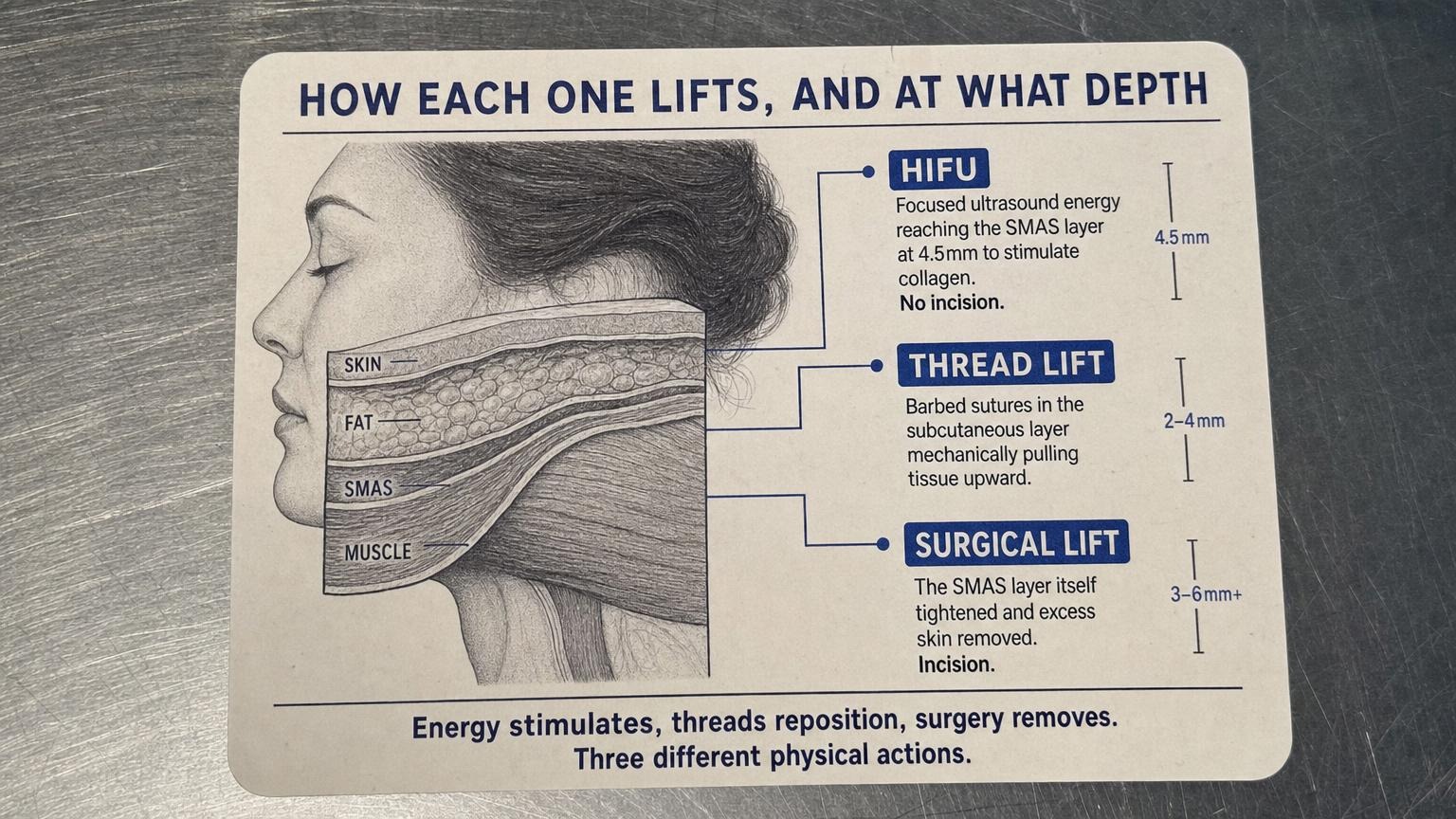
How Each One Actually Lifts, and at What Depth
The reason these three tools suit different stages comes down to three genuinely different physical actions, at three different depths. HIFU does not lift anything mechanically. It delivers focused ultrasound energy to the SMAS layer, around four and a half millimeters deep, and the heat stimulates the body to produce new collagen, which firms the tissue from within over the following months. It is a stimulation tool, not a lifting tool, which is exactly why it works on skin that still has elasticity and fails on skin that has already given way.
Thread lifting works in the subcutaneous layer, shallower than HIFU’s target. The barbed sutures grip the soft tissue and physically pull it upward into a higher position, where it is held mechanically while collagen forms along the thread track. It is a repositioning tool, which is why it can lift tissue that has already sagged in a way energy cannot. Surgical lifting works at the deepest level, tightening the SMAS layer itself and removing the excess skin envelope, which is why it is the only tool that addresses true excess. There is also a separate energy route worth knowing about: monopolar radiofrequency devices like Korean Volnewmer RF tightening heat the dermis rather than the SMAS, firming skin quality alongside HIFU at the early-laxity stage. The framework is the same one Korean surgeons apply across their energy-based lifting devices: match the depth and the action to what the tissue actually needs.
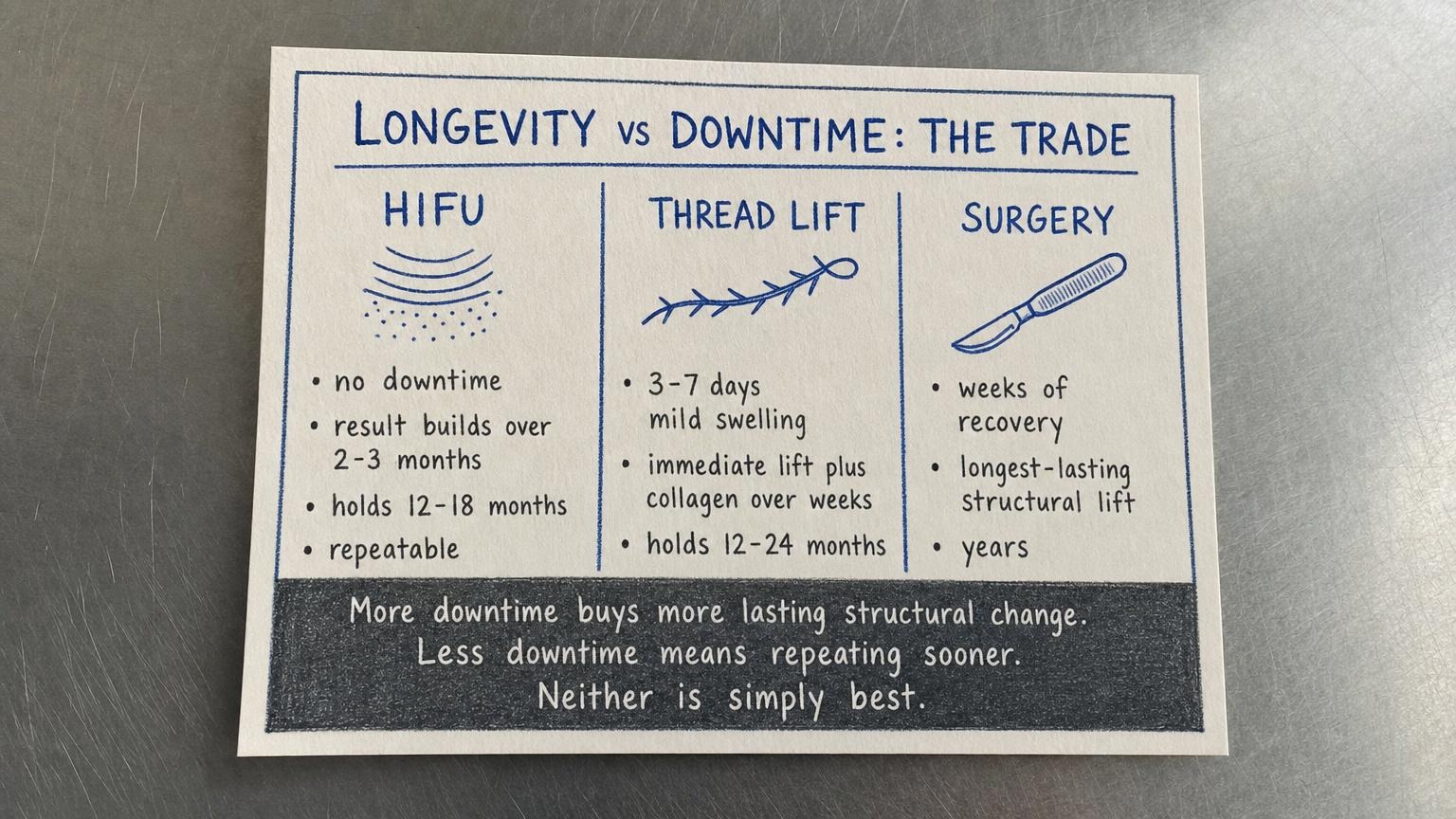
Longevity Versus Downtime: The Real Trade
Patients often try to choose by longevity alone, assuming the longest-lasting option is automatically the best, and that is a mistake. The three tools sit at very different points on the trade between how long the result lasts and how much recovery it costs. HIFU has essentially no downtime, the result builds over two to three months, and it holds for roughly twelve to eighteen months before a maintenance session is sensible. Thread lifting costs a few days of mild swelling, gives an immediate lift plus collagen over the following weeks, and holds for roughly twelve to twenty-four months. Surgical lifting costs weeks of recovery but delivers the longest-lasting structural result, measured in years.
Recommended for Your Recovery
Products commonly used before and after Korean jawline hifu vs thread vs surgery — same items routinely recommended in the recovery instructions Seoul clinics hand out at discharge.
- COSRX Advanced Snail 96 Mucin Power Essence — Korean barrier essence for the post-laser tissue regeneration window. Check price on Amazon
- Beauty of Joseon Relief Sun SPF 50+ — strict SPF 50+ daily for at least 3 months after any pigment or resurfacing laser — UV reverses results. Check price on Amazon
- Gel Eye Mask (Cold Compress) — cold compress for residual redness in the first 24 to 48 hours after a session. Check price on Amazon
- Silicone Scar Sheets — for ablative laser zones with crust formation, support scar maturation as new skin emerges. Check price on Amazon
As an Amazon Associate, GlobalBeautySpot earns from qualifying purchases at no extra cost to you.
The honest framing is that more downtime buys more lasting structural change, and less downtime means repeating the treatment sooner. For a patient with early laxity who wants to avoid recovery, repeating HIFU every year or so is perfectly reasonable. For a patient with significant excess skin, choosing HIFU to avoid downtime simply means paying repeatedly for a treatment that will never solve the problem, which is the most expensive option of all in the long run. The right answer depends on where you sit on the ladder and how you weigh recovery against longevity.
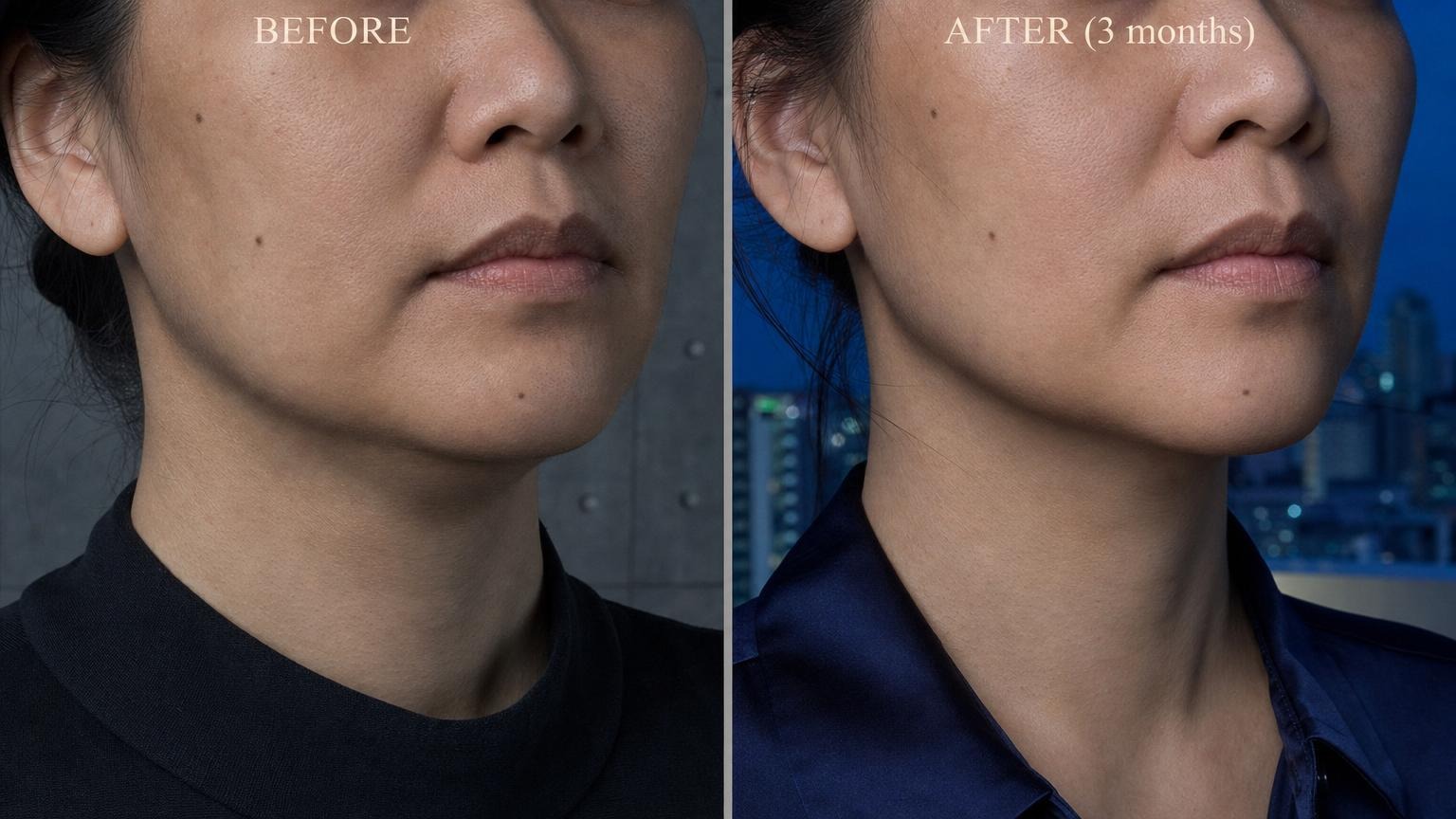
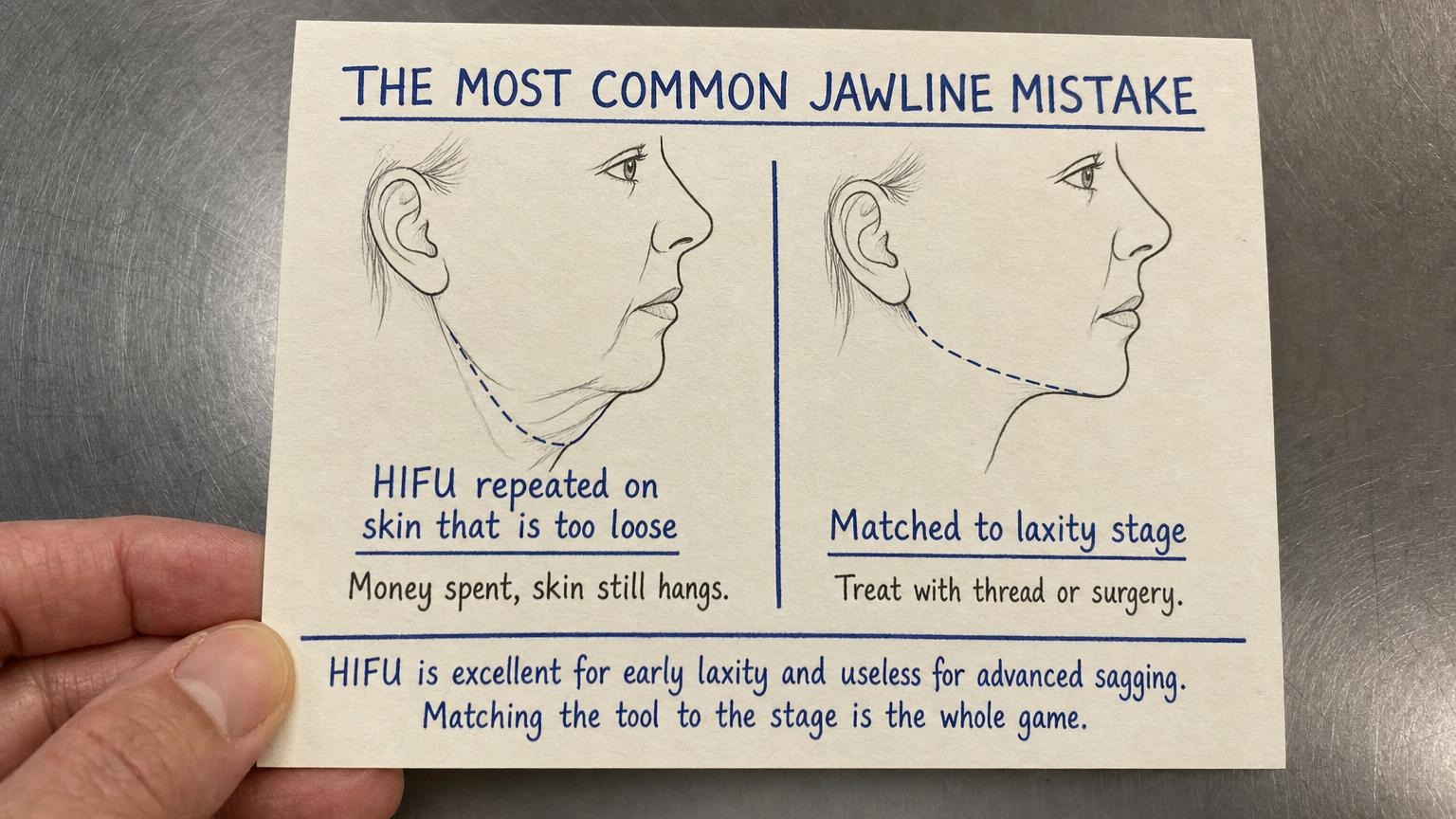
The Most Common Jawline Mistake
The single most common and most expensive mistake foreign patients make with their jawline is repeating HIFU on skin that is already too loose for it. It happens because HIFU is marketed as the no-downtime miracle, because it genuinely works for early laxity, and because patients judge it by the device rather than by their own skin stage. So they keep buying sessions, the skin keeps hanging, and they conclude that jawline tightening does not work. Jawline tightening works. The tool was wrong for the stage.
The opposite mistake also happens, though less often: a patient with only early softening being steered toward thread lifting or surgery when HIFU would have served perfectly well with no downtime. Matching the tool to the laxity stage is the entire game. A clinic that recommends the same tool to everyone, whether that is always HIFU because it is easy to sell or always surgery because it is lucrative, is not assessing your skin. A good Seoul surgeon pinches the skin, judges the elasticity and the excess, and tells you honestly which rung of the ladder you are on, even when that means telling you the treatment you asked for is not the one you need.
Cost and How to Verify the Plan
Pricing scales with the invasiveness of the tool. A HIFU jawline session in Seoul typically runs in the range of 300,000 to 800,000 Korean won depending on the device, the shot count, and the area. A jawline thread lift runs roughly 1,000,000 to 2,500,000 won depending on the number and type of threads. Surgical lower-face and neck lifting runs considerably more, into the several-million-won range, reflecting that it is a full surgical procedure. These are below the equivalent costs in the United States or Australia, which is part of why jawline work is built into so many Seoul trips. The broader context for energy and lifting options is covered across our Korean laser and energy guides.
Before committing, five questions tell you whether a clinic is assessing your skin or selling a device. Did the surgeon physically assess your skin laxity and elasticity before naming a tool? Which stage of the ladder are you on, and what is the reasoning? If HIFU is recommended, why is your skin still elastic enough to respond? If surgery is recommended, why is energy or threading not enough? And what is the realistic longevity and maintenance plan for the recommended option? A clinic that answers these clearly is matching the tool to your face. A clinic that quotes a HIFU package before touching your jaw is selling a machine.
Frequently Asked Questions
1. Why did my HIFU treatments stop working?
The most likely reason is that your skin laxity has progressed past the stage HIFU can address. HIFU stimulates collagen and firms skin that still has elasticity, but it cannot mechanically lift tissue that has already significantly sagged. If repeated HIFU is no longer producing change, it usually means the tool no longer matches your stage, and a thread lift or surgical option may be what is actually needed.
2. Is HIFU or thread lift better for the jawline?
Neither is better in the abstract. HIFU is better for early softening with good skin elasticity because it firms without downtime. Thread lift is better for moderate laxity with visible sagging because it physically repositions tissue that energy cannot lift. The right one depends on how loose your skin already is, which is why a physical assessment matters more than the device name.
3. How do I know which stage I am on?
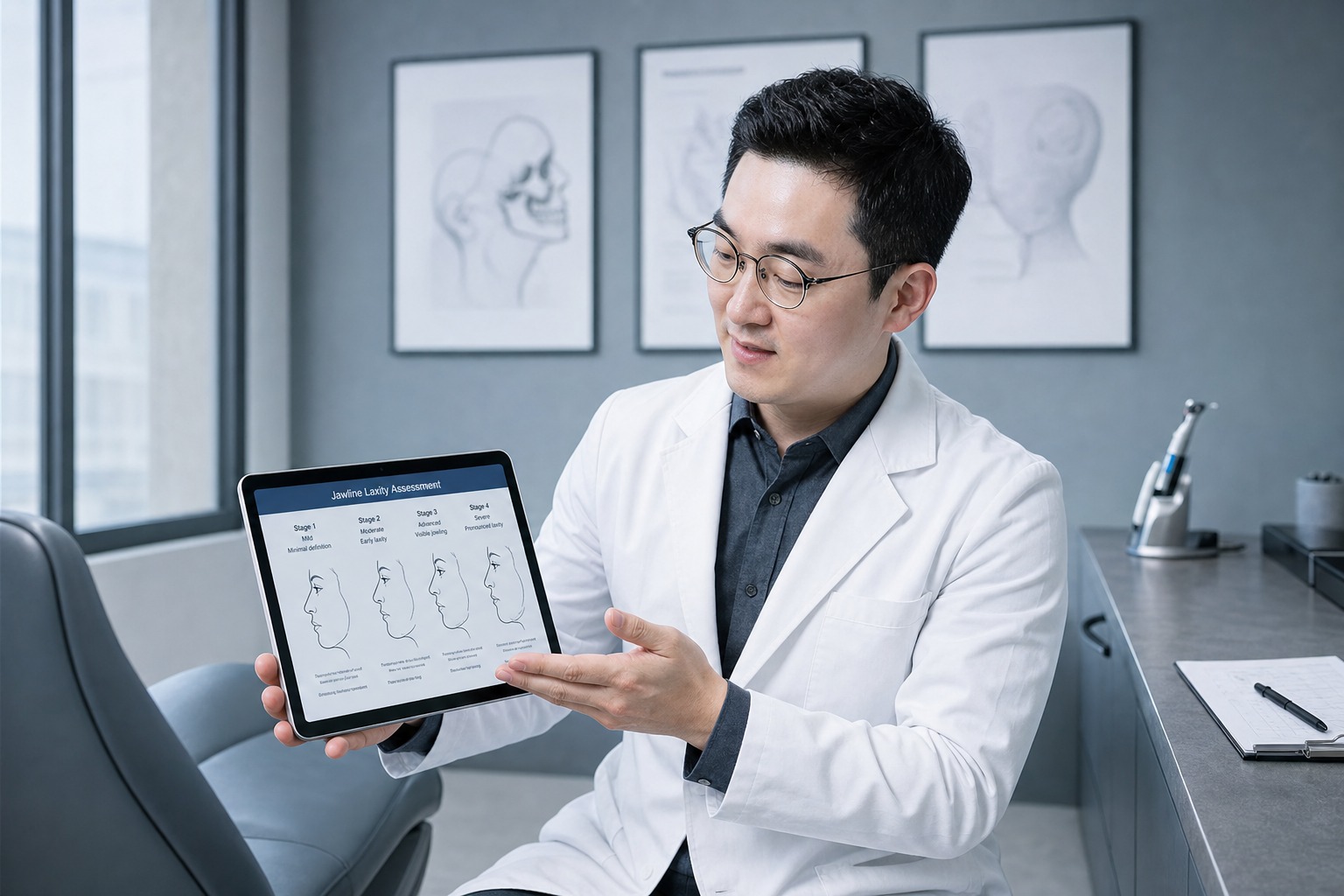
A surgeon assesses it by examining and gently pinching the skin along your jaw and neck, judging elasticity, the degree of jowl formation, and whether there is true excess skin. Early softening with good snap-back points to HIFU, visible sagging with reasonable skin points to threads, and significant excess skin points to surgery. It is a clinical judgment, not something you can reliably self-diagnose from photos.
4. Does HIFU have any downtime?
HIFU has essentially no downtime. There may be mild redness or tenderness for a day, but you can return to normal activity immediately. This no-downtime quality is its biggest advantage and also the reason it is over-recommended to patients whose skin is actually past the stage it can help.
5. How long does a thread lift last?
A jawline thread lift generally holds for roughly twelve to twenty-four months. It gives an immediate mechanical lift and then stimulates collagen along the thread path over the following weeks, which extends the result. The threads themselves dissolve over time, but the collagen and the repositioning effect persist beyond that.
6. Can I combine these tools?
Yes, and they are often combined. A common approach is threads to reposition the sagging tissue plus HIFU to firm the surrounding skin quality, or surgery for the structural lift with energy maintenance afterward. The combination is planned according to your stage, and a thoughtful surgeon sequences them rather than doing everything at once.
7. Will any of these look pulled or unnatural?
Done correctly and matched to the stage, no. The Korean standard is a firmer rested jawline, not a pulled-tight or obviously operated look. The unnatural result usually comes from over-treatment or from using a tool too aggressive for the stage. A jawline that looks done rather than rested is a sign the approach was wrong, not that the tools are inherently unnatural.
8. I am in my 30s. Is it too early for anything?
Not necessarily. Early softening in the 30s is exactly the stage HIFU is designed for, and treating early laxity while the skin still has good elasticity often gives a better and easier result than waiting until significant sagging requires more invasive tools. The point is to match the tool to the current stage, not to wait for a particular age.
9. Does jawline laxity differ for Asian and Western faces?
The escalation framework is the same. The specifics differ in that bone structure, skin thickness, and fat distribution vary, which changes how laxity presents and how much lift a given tool produces. A surgeon adjusts the assessment and the choice accordingly, but the principle of matching the tool to the laxity stage applies regardless of ethnicity.
10. How should I plan a Seoul trip around jawline work?
HIFU fits a short trip with no recovery needed, though the result builds over months so plan to judge it later. Thread lifting needs a few days for swelling to settle before you look fully normal. Surgical lifting needs a longer stay or a trip planned around weeks of recovery. For current scheduling and trip-planning details, visit Link Plastic Surgery’s official website.