He had spent two years and a lot of money on the same fractional laser, run again and again, and his acne scars had barely changed. He arrived in Seoul assuming he just needed a stronger laser. The dermatologist looked closely and explained the real problem: most of his scars were the rolling, tethered kind, held down by bands of scar tissue beneath the surface, and no amount of surface laser would lift them until those bands were released first. He had been treating the wrong layer with the wrong tool, repeatedly. The consultation at Link Plastic Surgery often starts by identifying which types of scar you actually have, because they are not all treated the same way.
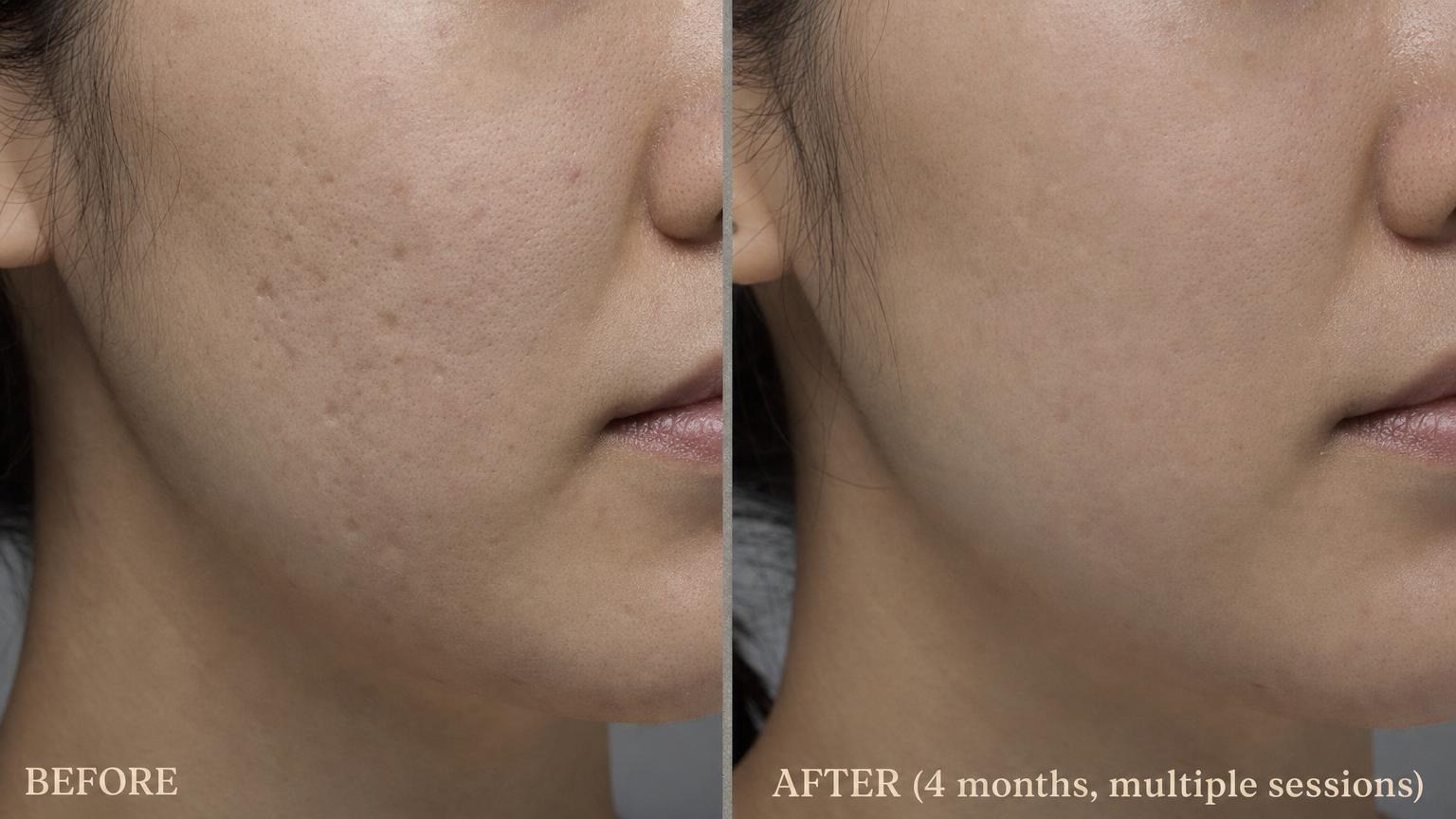
Acne scarring is one of the most common skin concerns foreign patients bring to Korean clinics, and it is wrapped in a costly misconception: that one laser, run enough times, will smooth everything out. In reality, acne scars come in several distinct types, each needing a different tool, and a single laser repeated on the wrong type of scar wastes time and money. Understanding that your scars are probably a mix, and that the plan must be matched to that mix, is what separates real improvement from frustrating stagnation.
Acne Scars Are Not One Thing
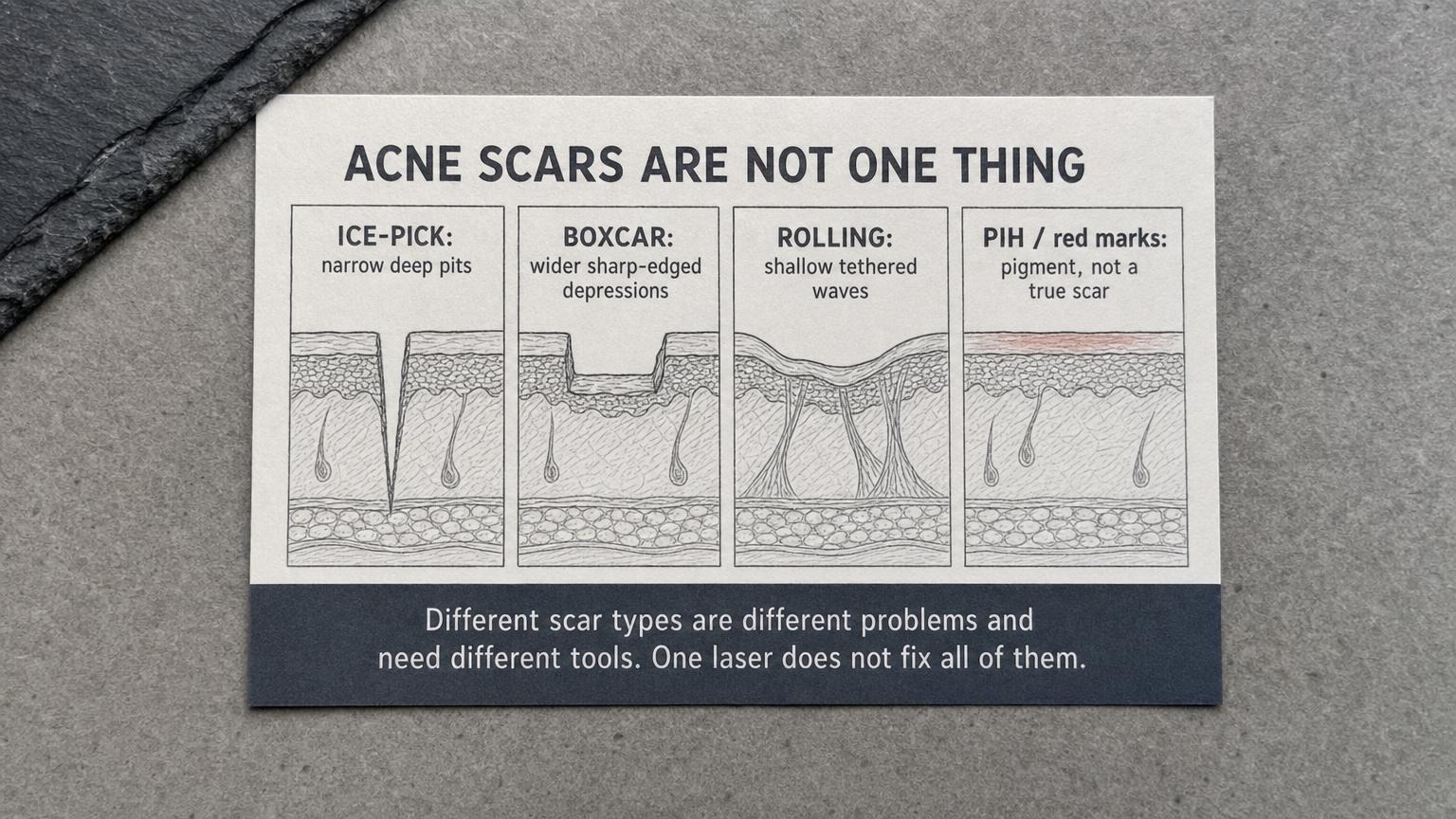
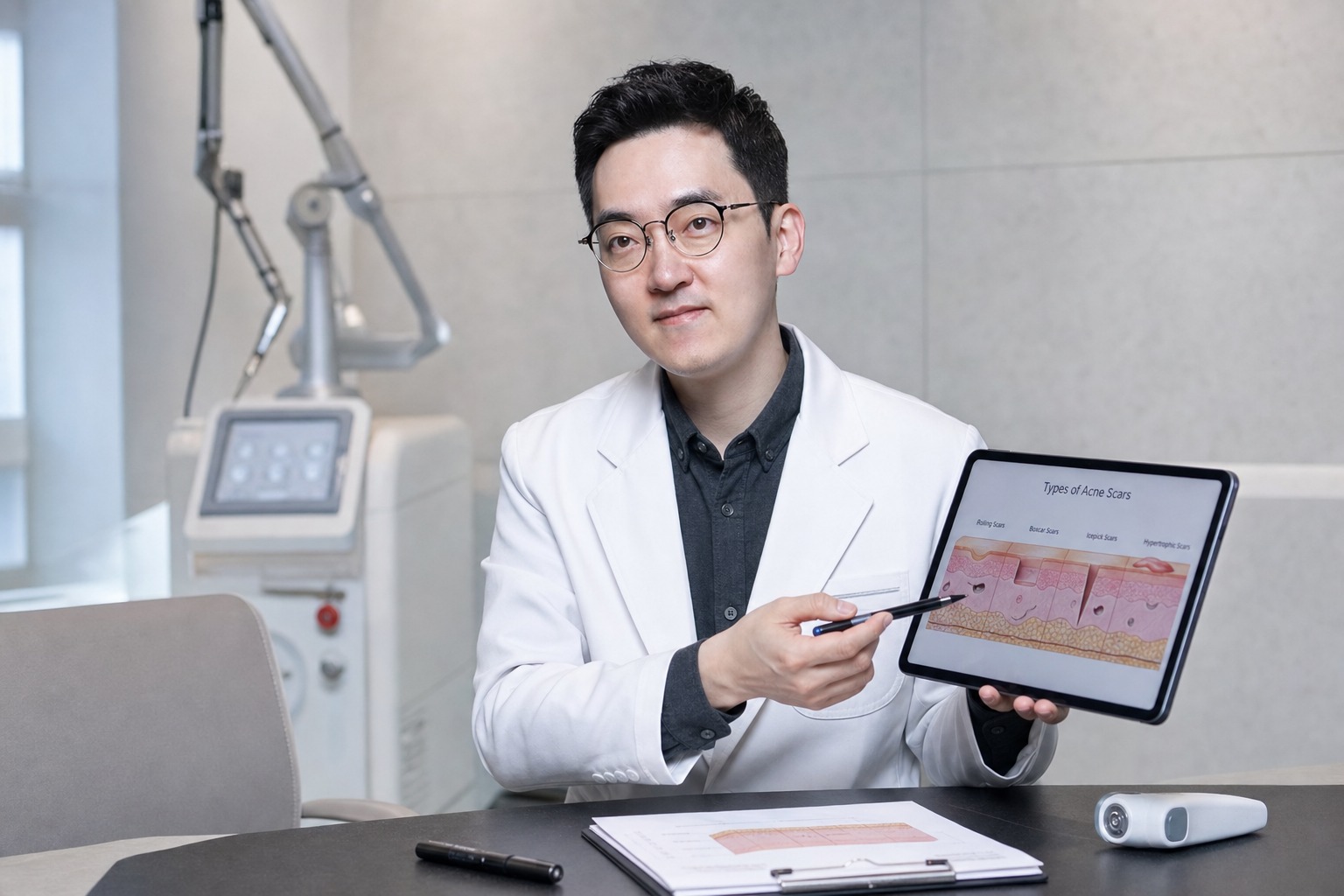
The first and most important realization is that acne scars are several different problems, not one. Telling them apart is what makes treatment work. Ice-pick scars are narrow, deep pits, like tiny puncture marks. Boxcar scars are wider depressions with sharp, defined edges. Rolling scars are shallow, wave-like depressions caused by the skin being tethered down from underneath. And post-inflammatory hyperpigmentation, the red or brown marks left after a breakout, is not a true scar at all but a pigment issue.
These are genuinely different problems at different depths, and they respond to different treatments; one laser does not fix all of them. The mistake of treating them as a single condition is exactly why so much acne-scar treatment underdelivers. The treatments involved draw on the same resurfacing technologies covered in our guides to fractional laser and CO2 laser resurfacing, but the tool has to match the scar.
Matching the Tool to the Scar
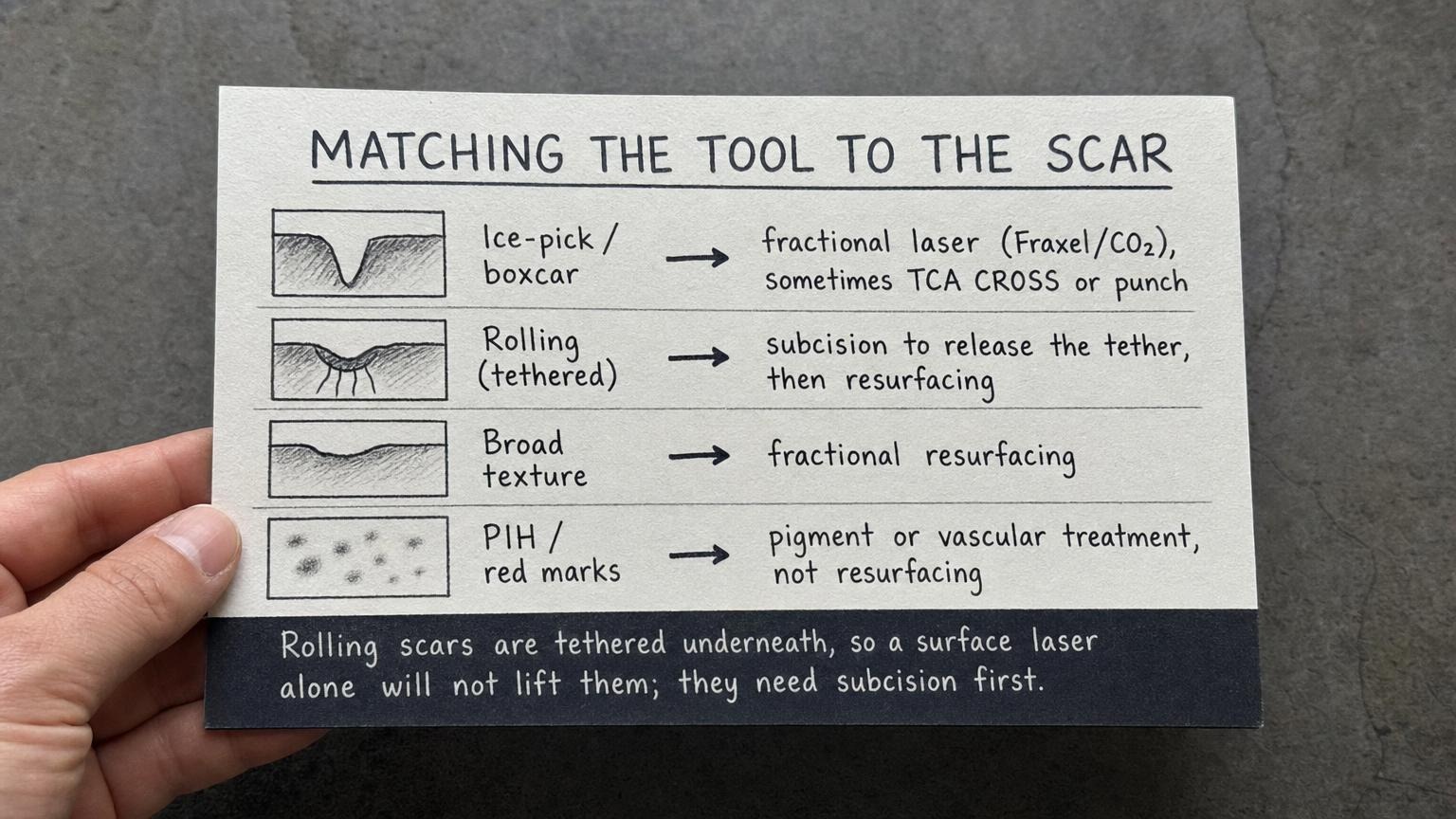
Once the scar types are identified, each is matched to the appropriate tool, and a real plan usually combines several. Ice-pick and boxcar scars often respond to fractional laser resurfacing, and the deepest may need focused techniques such as TCA CROSS or a small punch procedure. Rolling scars, because they are tethered from underneath, need subcision, a procedure that releases the binding bands, before resurfacing can help. Broad textural irregularity responds to fractional resurfacing. And pigment marks, the post-inflammatory red or brown, are treated with pigment or vascular treatments, not resurfacing at all.
The key insight is that rolling scars are tethered beneath the surface, so a surface laser alone will never lift them; they need to be released with subcision first. This is the single most common reason laser-only treatment stalls. A plan matched to your particular mix of scars, drawing on the full range of Korean laser and energy treatments plus subcision and focused techniques, is what produces results that a single repeated laser cannot.
Why One Laser Fails
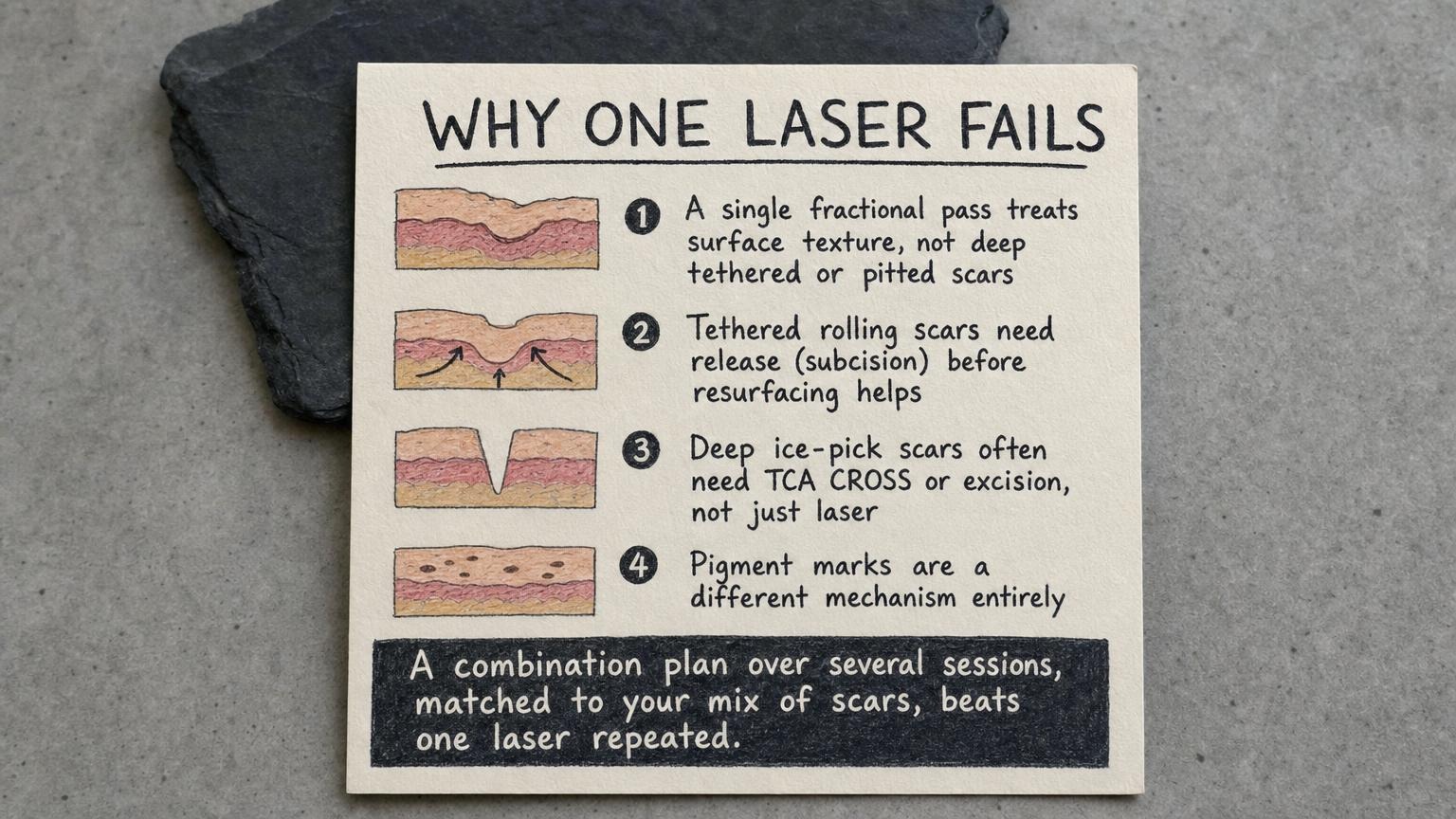
Understanding why the one-laser approach disappoints is what protects you from repeating it. A single fractional pass treats surface texture, which helps broad roughness and some shallow scarring, but it does not address deep, tethered, or pitted scars that sit beyond its reach. Tethered rolling scars need release before any resurfacing helps, because the surface cannot be smoothed while it is being pulled down from below. Deep ice-pick scars frequently need TCA CROSS or excision rather than laser. And pigment marks are a completely different mechanism that laser resurfacing does not target.
Recommended for Your Recovery
Products commonly used before and after Korean acne scar treatment options — same items routinely recommended in the recovery instructions Seoul clinics hand out at discharge.
- Arnica Montana Tablets — start 3 days before facial surgery to reduce bruising in the treated area. Check price on Amazon
- Silicone Scar Sheets — for procedures with visible incisions, apply from week 3 onward to support scar maturation. Check price on Amazon
- Beauty of Joseon Relief Sun SPF 50+ — daily Korean SPF 50+ to protect freshly treated facial skin. Check price on Amazon
- COSRX Advanced Snail 96 Mucin Power Essence — Korean snail mucin essence to support the post-procedure skin barrier. Check price on Amazon
As an Amazon Associate, GlobalBeautySpot earns from qualifying purchases at no extra cost to you.
So the reason a single laser repeated many times fails is not that it is too weak, but that it is the wrong or incomplete tool for most of the scarring. A combination plan, delivered over several sessions and matched to your specific mix of scar types, achieves what one laser cannot. A clinic that simply offers more passes of the same device, without distinguishing your scar types or addressing tethering, is repeating the very mistake that left you frustrated. The right approach is diagnostic first, then combination.
Realistic Expectations
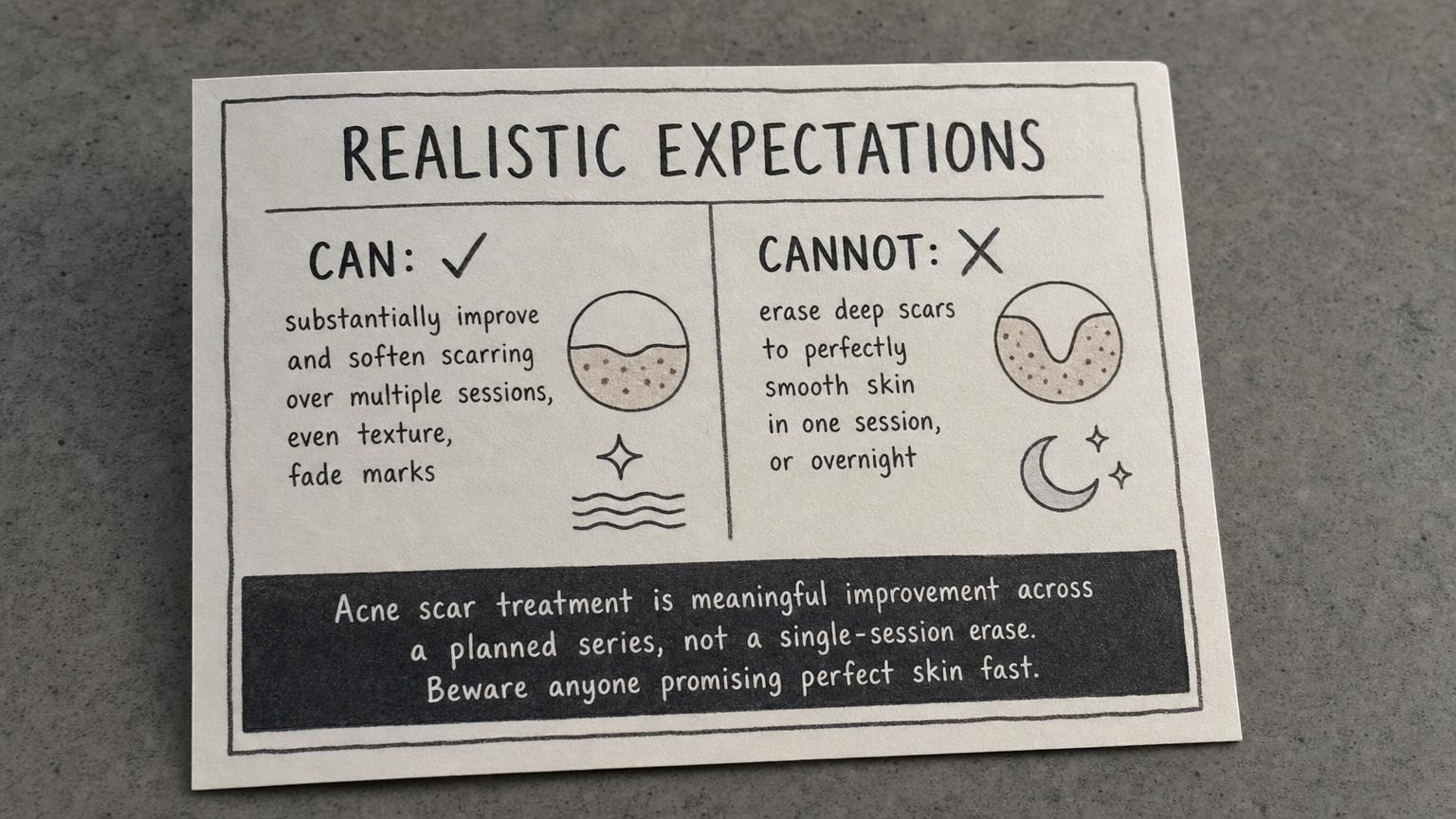
Setting honest expectations matters, because acne-scar treatment is powerful but not magic. A properly matched, multi-session plan can substantially improve and soften scarring, even out texture, and fade marks, often dramatically over time. What it cannot do is erase deep scarring to perfectly smooth skin in one session, or overnight. Acne scars that took years to form are improved across a planned series of treatments, not eliminated in a single visit.
This is why realistic framing is part of a trustworthy plan. Meaningful improvement across several sessions is the honest promise; perfect skin fast is a warning sign. Anyone guaranteeing complete erasure of deep scarring in one go, or promising flawless results quickly, is overselling. The goal is real, often substantial improvement that makes the scarring far less noticeable, achieved patiently with the right combination of tools, and a clinic that frames it this way is the one being straight with you.
Cost and How to Verify the Plan
Pricing reflects the combination and the number of sessions, since a matched plan involves several treatments over months rather than one. Subcision, fractional laser, TCA CROSS, and pigment treatments each carry their own cost, and the realistic figure is the planned series. These costs are generally below the equivalent abroad. Paying for a proper combination plan that works is more economical than years of a single repeated laser that does not.
Before committing, five questions tell you whether a clinic is diagnosing your scars or just selling laser passes. Did the clinic identify which types of scar you have, ice-pick, boxcar, rolling, or pigment? If you have rolling scars, is subcision part of the plan before resurfacing? Is the plan a combination over several sessions rather than one laser repeated? What realistic improvement, not perfection, is expected for your specific scars? And how many sessions, over what period, are anticipated? A clinic that distinguishes your scar types and proposes a matched combination is the one to trust. For trip-planning details, visit Link Plastic Surgery’s official website.
Frequently Asked Questions
1. Why hasn’t laser improved my acne scars?
Most likely because your scars include types a surface laser cannot fix on its own. Rolling scars are tethered from underneath and need subcision first; deep ice-pick scars often need TCA CROSS or excision; pigment marks need pigment treatment, not resurfacing. A single laser repeated on the wrong scar type stalls. A matched combination is what works.
2. What are the different types of acne scar?
Ice-pick (narrow deep pits), boxcar (wider sharp-edged depressions), and rolling (shallow tethered waves) are the true scar types, plus post-inflammatory hyperpigmentation, the red or brown marks that are pigment rather than a true scar. They sit at different depths and need different treatments, which is why identifying yours matters.
3. What is subcision and why is it important?
Subcision is a procedure that releases the fibrous bands tethering rolling scars from underneath. Because those scars are pulled down from below, a surface laser cannot lift them until the tether is released. Subcision is often the missing step that makes resurfacing finally work on rolling scars, which is why it is central to many plans.
4. Can one laser treat all my acne scars?
Rarely, because most people have a mix of scar types at different depths, and a single laser treats only surface texture. Deep, tethered, and pitted scars, and pigment marks, each need different tools. A combination plan matched to your particular mix, over several sessions, is what produces real improvement, not one laser repeated.
5. How many sessions will I need?
It depends on the type, depth, and extent of your scarring, but a proper plan typically involves several sessions over months, combining treatments such as subcision, fractional laser, and pigment treatment. Acne scars that formed over years improve across a planned series rather than in a single visit. The clinic should estimate this for your specific scars.
6. What treats deep ice-pick scars?
Deep, narrow ice-pick scars often need focused techniques such as TCA CROSS, where a small amount of acid is applied precisely to the scar, or a small punch procedure, rather than laser alone. Laser resurfacing helps surrounding texture but may not reach the depth of a narrow ice-pick scar, so these are usually combined.
7. Are red or brown marks the same as scars?
No. Post-inflammatory hyperpigmentation, the red or brown marks left after a breakout, is a pigment issue, not a true scar, and it is treated with pigment or vascular treatment rather than resurfacing. It often fades with time and the right treatment, and confusing it with true scarring leads to the wrong approach.
8. Can acne scars be completely erased?
Realistically, deep scars are substantially improved and softened rather than erased to perfectly smooth skin, especially in a single session. A matched, multi-session plan can make scarring far less noticeable, often dramatically, but anyone promising complete erasure or flawless skin quickly is overselling. Meaningful improvement over time is the honest expectation.
9. Is acne scar treatment painful or much downtime?
It depends on the treatments. Subcision and ablative resurfacing involve some downtime and discomfort managed with numbing, while gentler fractional and pigment treatments have less. A combination plan is staged so the recovery is manageable, and the clinic should explain the downtime for each step so you can plan, especially as an international patient.
10. How do I plan acne scar treatment as an international patient?
Have a consultation that identifies your scar types and proposes a matched combination over a realistic number of sessions, and discuss how to stage treatments around your trip since a full plan spans months. Some can be done in a visit with maintenance later. For scheduling details, visit Link Plastic Surgery’s official website.