For years, the conversation about breast implants ran in one direction: getting them. In 2026 the conversation has become two-way. More women, including public figures who have talked about it openly, are choosing to remove their implants, exchange them for a smaller size, or replace volume with their own fat, and Seoul clinics now treat these requests as a normal, established part of breast surgery rather than an unusual reversal. Part of this is simple honesty about the devices themselves: implants are not designed to last a lifetime, and a set placed in your twenties will almost certainly need attention at some point in your life. The rest is a genuine cultural shift toward lighter, more natural proportions. Whichever describes you, the surgery is only half the decision; the other half is planning the result you will live with afterward, which is exactly what a careful clinic like Link Plastic Surgery builds the consultation around.
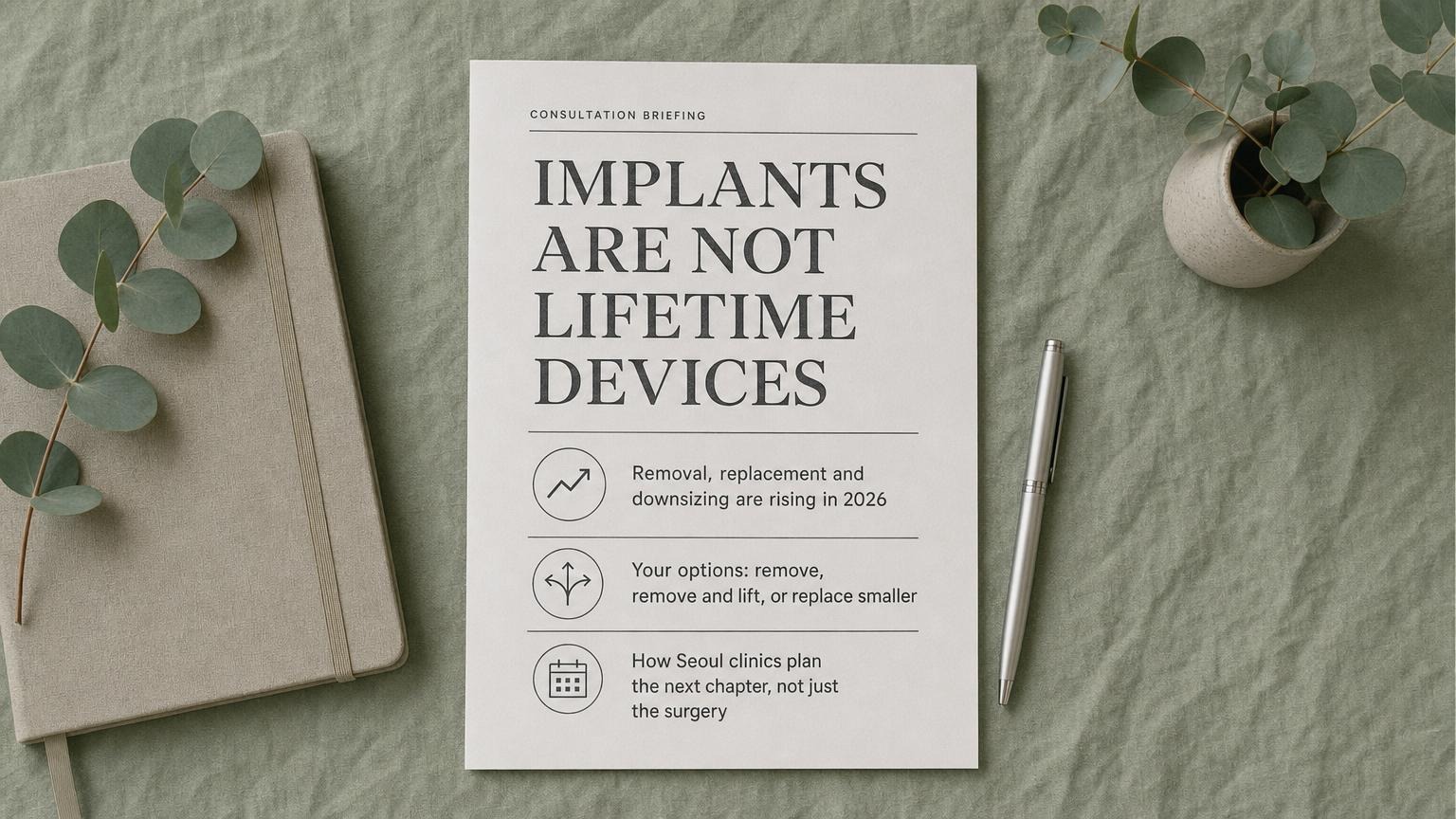
Breast implants are not lifetime devices, and removal, replacement, and downsizing are all rising in Korea in 2026. Your three main paths are removing the implants only, removing them with a lift to restore shape, or replacing them with a smaller implant or your own fat. The right choice depends on your skin, your tissue, and the look you want next, which is why the consultation matters as much as the surgery.
Why Patients Remove or Change Implants
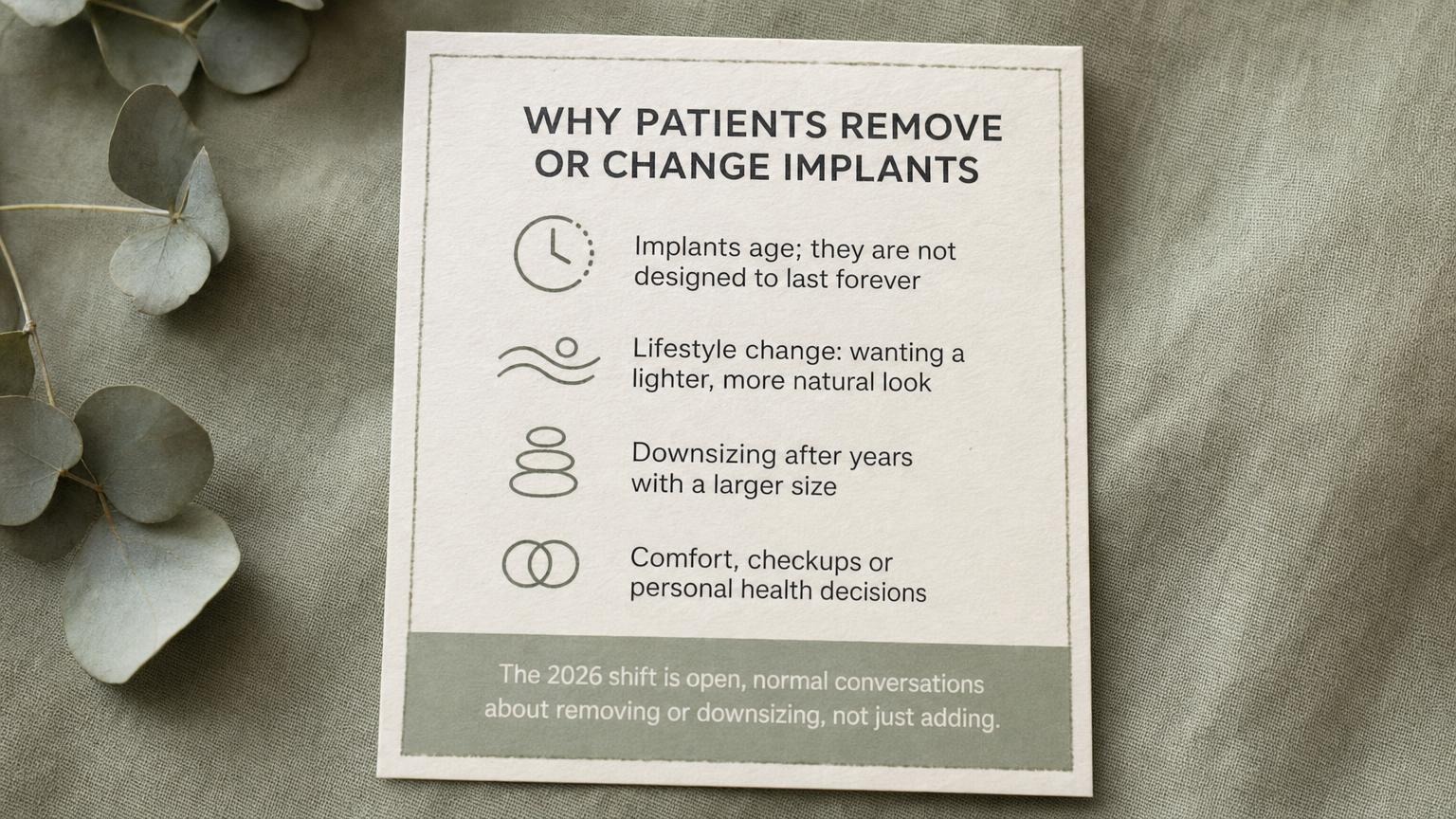
The most common reason is simply time. Implants are medical devices with a working lifespan, not permanent fixtures, and manufacturers and surgeons alike expect them to be reviewed, and often exchanged or removed, years down the line. Someone who had augmentation in their twenties or thirties may now be looking at implants that are one or two decades old, and a checkup that recommends attention is a completely routine trigger for this surgery rather than a sign that something went wrong.
The second driver is a change in what people want. Bodies, lifestyles, and taste all shift: a size that felt right at twenty-eight can feel heavy or conspicuous at forty-five, and many patients describe wanting to feel lighter, exercise more comfortably, or simply return to a more natural proportion. Some also make the decision around comfort or personal health considerations they have discussed with their doctors. What has changed in 2026 is not the reasons but the openness: downsizing and removal are now discussed as ordinary choices, and clinics that once mostly enlarged now spend real consultation time planning the opposite direction.
Your Three Main Options
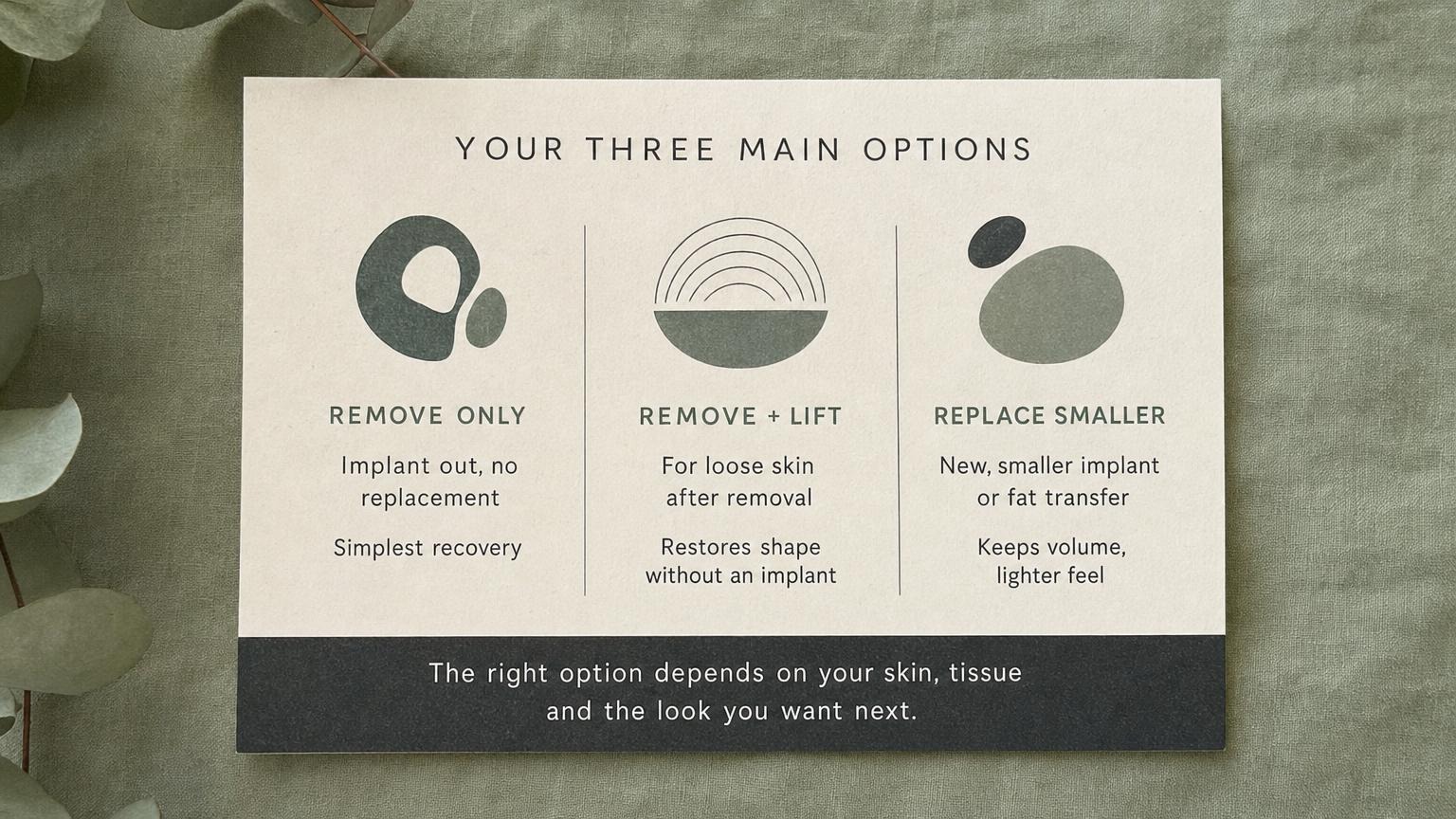
The first path is removal alone: the implants come out, usually along with the capsule of tissue around them where appropriate, and nothing is added. It is the simplest surgery with the most straightforward recovery, and it suits women whose natural breast tissue and skin are likely to settle well on their own. The honest caveat is that after years of carrying an implant, the skin does not always snap back, and how well removal alone will look depends heavily on your skin quality, your natural volume, and how large the implants were.
That is why the second and third paths exist. Removal with a lift addresses the loose skin directly: the implant comes out and the breast is reshaped and lifted in the same operation, restoring a natural, supported shape without any new device. Replacement, the third path, keeps some volume but changes it, either exchanging the old implants for a smaller, lighter pair or replacing implant volume with a transfer of your own fat for the softest, most natural feel. These are the same trade-offs we walk through in our comparison of augmentation, lift, and fat transfer, just approached from the other direction, and the right answer depends on your skin, your tissue, and the silhouette you actually want next.
What a Good Consultation Covers
A proper revision consultation starts with an assessment of what is already there: the age, type, and condition of your current implants, the capsule around them, and how your own tissue and skin have changed over the years. If you have your original surgical records, implant card, or recent imaging, bring them, because knowing exactly what is being removed makes the plan more precise. This assessment is also what separates a considered recommendation, remove only, lift, or replace, from a one-size answer given before anyone has examined you.
The second half of the consultation should be about the result you will live with. A good surgeon will talk honestly about how your skin is likely to settle after removal, whether a lift is genuinely needed or optional, and what a smaller implant or fat transfer would realistically look like on your frame, rather than promising that any option suits everyone. It is the same philosophy that applies to implants themselves, where device choice and placement are matched to your anatomy, as covered in our guide to how Korean clinics plan breast augmentation. A consultation for Link Plastic Surgery’s breast surgery program is designed to map exactly this: what is there now, what you want next, and the most conservative path between the two.

Recovery and How the Result Settles
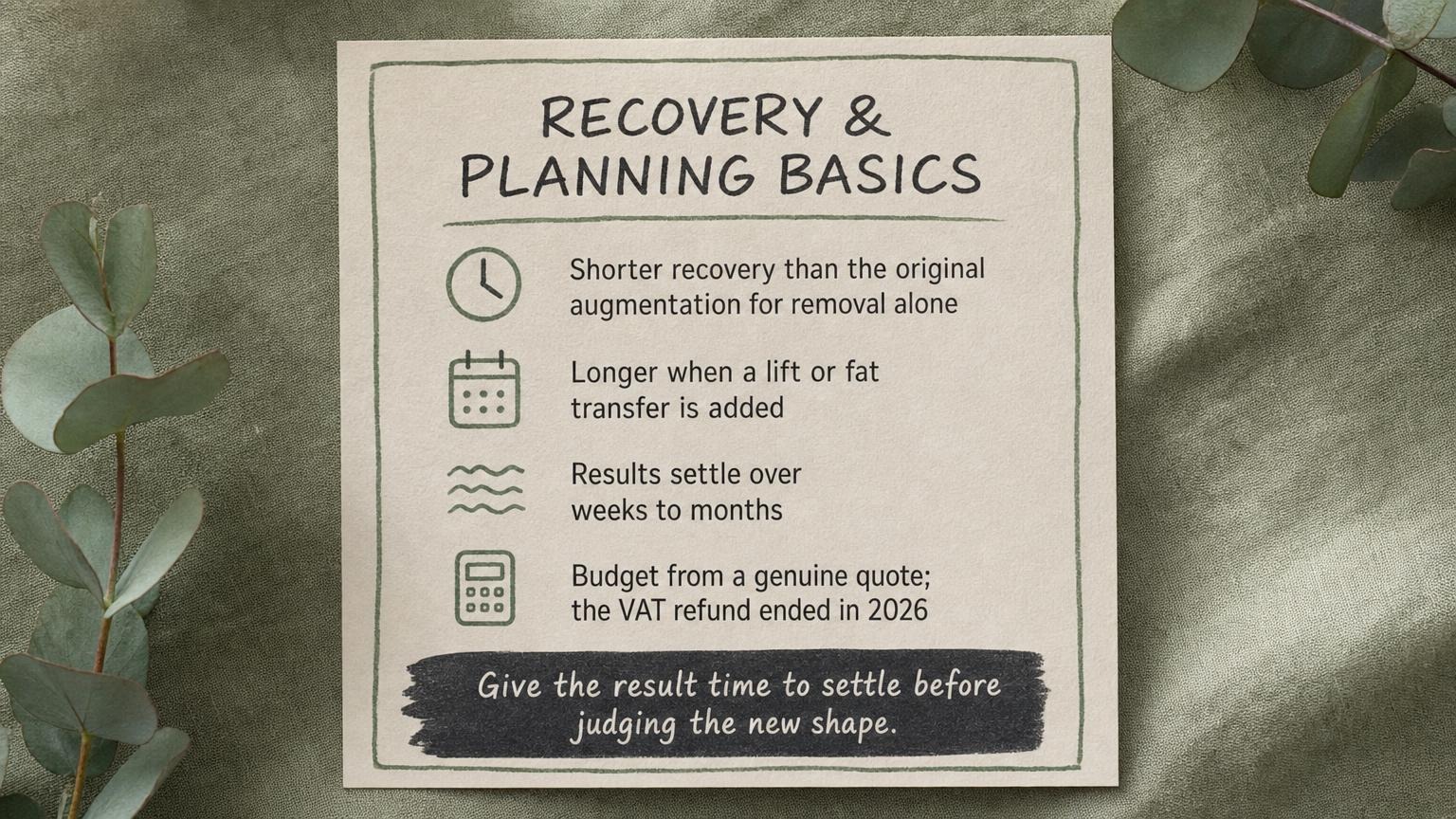
Recovery depends on which path you choose. Removal alone is generally easier than the original augmentation: most patients are back to desk work within days to a week, with a support garment worn for several weeks while the tissue settles. Adding a lift or fat transfer extends the recovery, since there is more reshaping involved, and brings it closer to the original surgery’s timeline. In every case, the early result is not the final one; the breast softens and settles over weeks to months, and the shape you see at day ten is not the shape you will have at month three.
That settling period matters emotionally as much as physically. Immediately after downsizing or removal, many patients go through a short adjustment as their eye recalibrates to the new proportion, and surgeons consistently advise judging the result only after the swelling has resolved and the tissue has relaxed into its new shape. Planning a calm recovery window, especially if you are travelling internationally for the surgery, and following the clinic’s garment and activity guidance, is what protects the result you and your surgeon planned.
Cost and Practical Planning in 2026
In Korea, implant removal is typically quoted in the range of roughly four to seven million won, with the total rising when a capsule removal, lift, or fat transfer is added, and Gangnam clinics generally pricing above regional ones. Those figures still compare well internationally, which is why foreign patients increasingly combine the surgery with a planned trip. Two practical notes for 2026: budget from a genuine, itemized clinic quote rather than a package headline, and remember that the foreigner VAT refund on cosmetic procedures has ended, so expect to pay roughly ten percent more than older guides suggest.

Before you book, five questions shape a good decision. Do I know the age and condition of my current implants, and do I have my records or recent imaging? Am I clear on which of the three paths, remove, remove and lift, or replace smaller, matches the look and feel I actually want? Has a surgeon examined my skin and tissue and told me honestly how removal alone would settle? Have I planned a realistic recovery window, including the weeks it takes the result to soften? And have I budgeted from a genuine itemized quote, with the VAT refund gone? If those answers are in place, this is one of the most predictable and satisfying revisions in breast surgery. To plan yours with an honest assessment, visit Link Plastic Surgery’s official website.
Frequently Asked Questions
1. Do breast implants really need to be removed or replaced?
Implants are not lifetime devices, and surgeons and manufacturers expect them to be reviewed over the years and often exchanged or removed at some point. That does not mean every implant must come out on a fixed schedule; many are monitored and left alone while they remain in good condition. But planning for the possibility is realistic, and a routine checkup recommending attention is a normal reason for this surgery, not a sign something went badly wrong.
2. Why are removal and downsizing trending in 2026?
Two forces. First, honesty about device lifespan: a large generation of implants placed in the 2000s and 2010s is now reaching the age where review, exchange, or removal is sensible. Second, taste: public conversations about explant and downsizing have normalized wanting a lighter, more natural proportion. Seoul clinics now treat removal and downsizing as ordinary, well-established requests rather than unusual reversals.
3. What are my options when removing implants?
Three main paths. Removal alone takes the implants out with nothing added, and suits women whose tissue and skin will settle well naturally. Removal with a lift reshapes and lifts the breast in the same operation, which addresses loose skin without a new device. Replacement keeps volume but changes it, exchanging for smaller implants or transferring your own fat. The right path depends on your skin quality, natural volume, and the look you want next.
4. Will my breasts look deflated after removal?
It depends on your skin and tissue, which is exactly what the consultation assesses. Younger, elastic skin with reasonable natural volume often settles surprisingly well after removal alone. Skin that has been stretched by larger implants for many years may not fully retract, which is when a lift, or replacing some volume with fat transfer, is recommended. An honest surgeon will examine you and tell you which group you are in before you decide.
5. What is a capsule, and does it need to be removed?
The capsule is the layer of natural scar tissue your body forms around any implant. Whether and how much of it is removed depends on its condition and your surgeon’s assessment; healthy, thin capsules are sometimes left, while thickened or problematic ones are removed with the implant. This is a case-by-case surgical decision, and it is one of the specific things a good consultation, ideally with your implant records and recent imaging, will address.
6. Can I downsize instead of removing completely?
Yes, and it is one of the most popular choices in 2026. Downsizing exchanges your current implants for a smaller, lighter pair, or replaces implant volume with a transfer of your own fat for the most natural feel. It suits women who still want some enhancement but a calmer proportion. Because the skin has been stretched by the larger size, downsizing is sometimes combined with a lift to keep the smaller result well-shaped.
7. How long is recovery after implant removal?
Removal alone is generally easier than the original augmentation: desk work within days to a week for most patients, a support garment for several weeks, and strenuous exercise paused per your clinic’s guidance. Adding a lift or fat transfer extends recovery closer to the original surgery’s timeline. In all cases the shape keeps settling for weeks to months, so the early result is not the final one.
8. How much does implant removal cost in Korea?
Removal is typically quoted around four to seven million won, roughly three to five and a half thousand US dollars, with the total rising when capsule work, a lift, or fat transfer is added. Gangnam clinics tend to price higher than regional ones. Budget from a genuine itemized quote after examination, and note that from 2026 the foreigner VAT refund on cosmetic procedures has ended, so expect roughly ten percent more than older guides suggest.
9. Is it worth travelling to Korea for explant or revision surgery?
Korean clinics perform a high volume of breast revision work, and pricing compares well internationally even before considering the quality of surgical planning. The practical requirement is time: build in enough days for the consultation, surgery, and early follow-up before flying, and follow your clinic’s garment and activity guidance afterward. Bringing your implant records or recent imaging from home makes the consultation significantly more precise.
10. How do I plan implant removal or downsizing safely?
Know what you have: gather your implant records and any recent imaging. Decide what you want next: fully natural, lifted without a device, or smaller. Have a surgeon examine your skin and tissue and give you an honest read on how removal alone would settle. Plan a realistic recovery window, and budget from a genuine quote with the VAT refund gone. For an honest assessment of your options, visit Link Plastic Surgery’s official website.
Information on breast implant removal, replacement, and downsizing trends, typical Korean price ranges (approximately KRW 4–7 million for removal), and the 2026 end of the foreigner VAT refund is based on industry and clinic reporting (Bookimed, Korea Clinic Guide and others), 2026. Figures are approximate and individual outcomes vary; consult a licensed surgeon for a personal assessment.