
Under-Eye Fat Repositioning in Korea: What Western Clinics Won’t Tell You
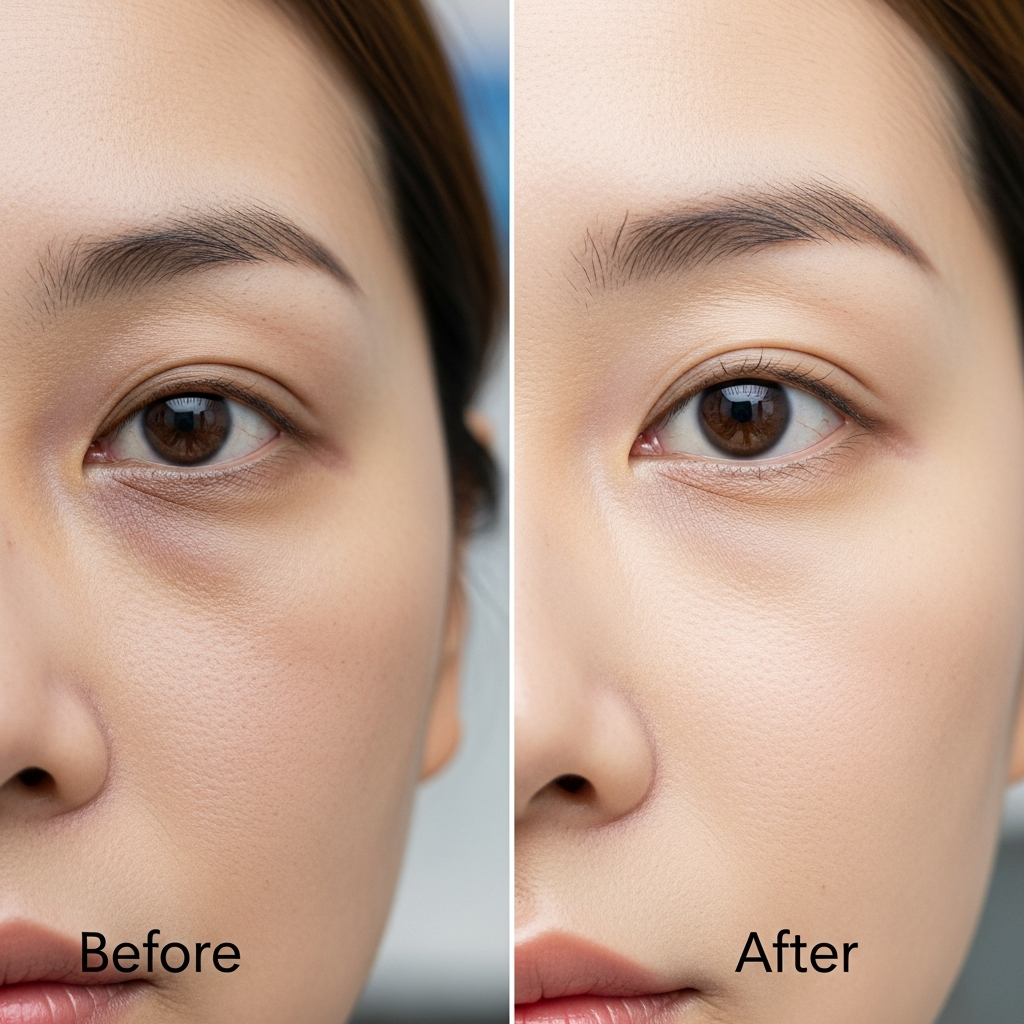
Western surgeons have been removing under-eye fat for decades. And most of them are doing it wrong.
That’s not clickbait. It’s what happens when an entire medical system treats orbital fat like garbage to be thrown away rather than raw material to sculpt with. In Korea, under-eye fat repositioning — 눈밑지방재배치 — has been the standard approach for over fifteen years. Meanwhile, clinics in LA and London are still scooping out fat pads and sending patients home with hollowed-out eye sockets that age them ten years by the time they hit forty.
I watched it happen to someone I know. She flew to a well-reviewed surgeon in Beverly Hills, paid $6,000 for lower blepharoplasty, looked amazing for about eight months. Then the hollowing started. Shadows deeper than what she walked in with. She ended up in Seoul eighteen months later getting fat grafting to fix what never should have been removed in the first place.
Key Takeaways
- Repositioning ≠ removal — Korean surgeons move the fat pad downward to fill the tear trough instead of cutting it out, which prevents long-term hollowing.
- Most Korean clinics perform transconjunctival fat repositioning (incision inside the eyelid), meaning zero visible scarring.
- Recovery is genuinely fast — multiple patients at Seoul clinics report major swelling gone within a week, with some returning to normal activities in five days.
- The price gap is real: $800–$2,000 in Korea versus $4,000–$8,000 in the US for the same (or arguably better) procedure.
- Not every surgeon repositions the same way — some anchor the fat with sutures, others use a septal reset technique, and the results differ significantly.
- Fat removal is not automatically bad, but if your surgeon doesn’t even mention repositioning as an option, that’s a red flag.
Korea didn’t stumble into this by accident. The sheer volume matters. Clinics in Gangnam perform more lower blepharoplasties in a month than most Western practices do in a year. A recent review on one clinic’s community board put it simply — the patient said their under-eye area looked brighter and their overall impression became softer after just seven days. That kind of fast, clean result comes from surgeons who do this procedure daily, not occasionally. — Link Plastic Surgery official community
And the technique keeps evolving. Five years ago, most Korean surgeons were doing basic fat transposition. Now the top clinics combine septal reset with fat repositioning and — in some cases — simultaneous micro fat grafting to the tear trough for patients with severe volume loss. Western literature is only starting to catch up to what’s been standard practice here.
Another patient shared that friends had recommended the procedure because the scarring was virtually invisible and results looked natural. After surgery, they compared before and after photos and were genuinely surprised at the difference. Seven days post-op. — Link Plastic Surgery’s patient forum
The gap between Korean and Western approaches isn’t about technology. It’s philosophy. Western training still leans toward subtraction — remove the bulge, problem solved. Korean training starts from a different question: where should this tissue actually be? That one shift in thinking changes everything about how the surgery plays out long-term.
Clinics like THE PLUS, Braun, Link Plastic Surgery, and Lamiche have built entire reputations around lower eyelid work. Some focus exclusively on eyes. That level of specialization doesn’t really exist in Western markets where your “oculoplastic surgeon” also does facelifts, rhinoplasty, and maybe some Botox between appointments.
Specialization breeds precision. And under-eye work demands precision more than almost any other facial procedure — we’re talking about millimeters of difference between looking refreshed and looking overdone. Or worse, looking like something was done at all.
Why Korean Surgeons Approach Under-Eye Fat Completely Differently
Most Western oculoplastic surgeons will remove your under-eye fat. Cut it out, stitch you up, send you home. Korean surgeons think that’s remarkable.
And honestly? After sitting through consultations at six different clinics in Gangnam over two trips, I get why.
The philosophy gap is massive. In the US, UK, and Australia, lower blepharoplasty typically means excision — the surgeon identifies the herniated orbital fat pads, removes them, and closes. Clean, simple, done. The problem is what happens two, three, five years later. That hollowed-out look. The sunken eyes that make you look older than before surgery. I’ve seen it in person on medical tourists who flew to Seoul specifically to fix botched Western lower bleph results.
Korean lower blepharoplasty — 눈밑지방재배치 — is fundamentally a repositioning procedure. Instead of throwing away perfectly good fat, surgeons relocate it into the tear trough depression below. You’re solving two problems at once: the bulging bags disappear, and the hollow dark circles fill in.
Sounds obvious when you say it out loud. But most clinics in North America still default to removal.
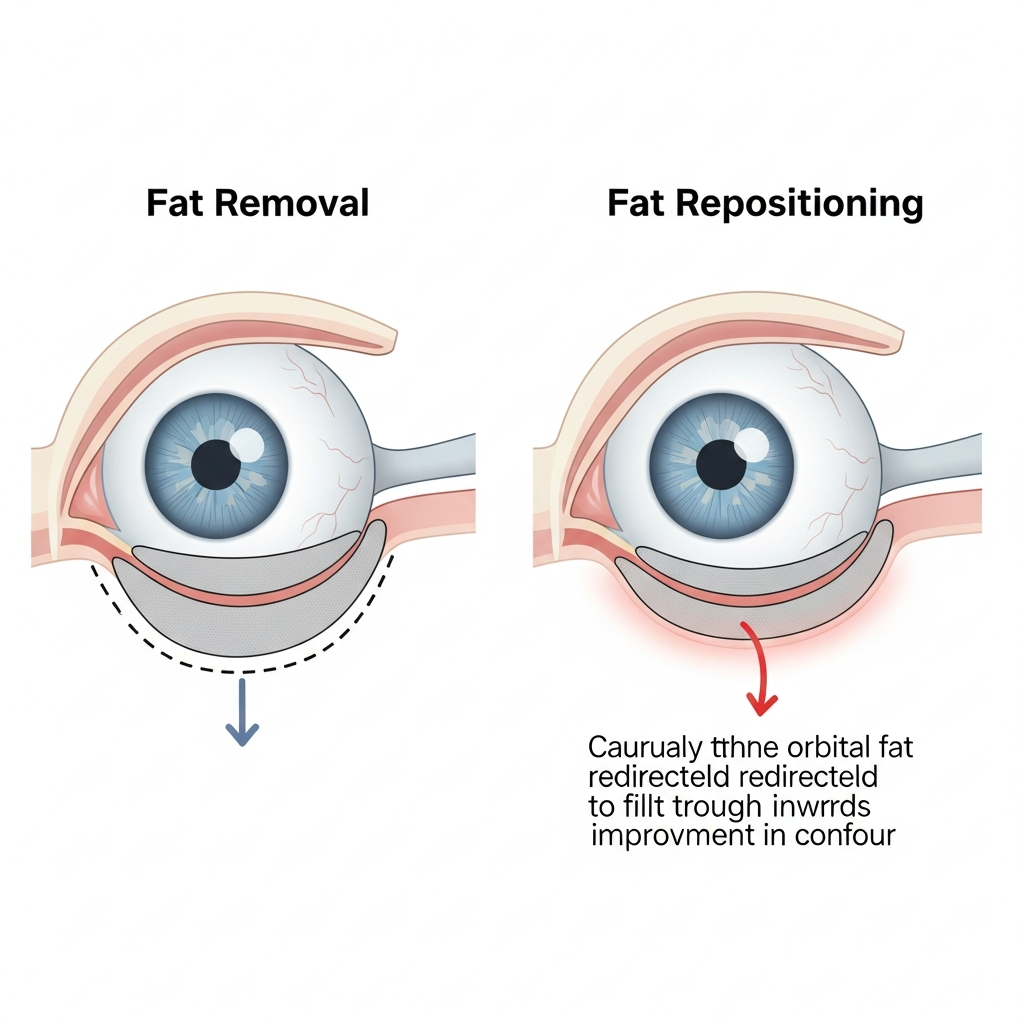
Transconjunctival vs. Transcutaneous — The Incision Nobody Sees
Korean surgeons overwhelmingly prefer the transconjunctival approach. The incision goes inside your lower eyelid. No external scar. Zero visible stitches. Western surgeons use this too, but a surprising number still default to transcutaneous (incision just below the lash line) — especially when combining with skin removal.
The Korean reasoning: younger patients with under-eye fat herniation usually don’t need skin excision. They need the fat moved, not the skin cut. And even for patients in their 40s and 50s, many Seoul surgeons will do the repositioning transconjunctivally and only add a tiny skin pinch if absolutely necessary.
One surgeon I consulted told me bluntly — “Western doctors overcorrect. They take skin, take fat, take muscle. Then the patient looks shocked.” He wasn’t wrong. I’ve seen the before-and-afters.
What Actually Happens During the Procedure
The surgery itself is shorter than most people expect.
| Detail | Korea (Typical) | US / UK / Australia |
|---|---|---|
| Technique | Transconjunctival fat repositioning | Fat removal (excision) or filler |
| Anesthesia | IV sedation + local (“sleep anesthesia”) | Local or general |
| Surgery time | 30–60 minutes | 45–90 minutes |
| Visible scarring | None (internal incision) | Possible lash-line scar |
| Initial downtime | 5–7 days (major swelling) | 7–14 days |
| Return to normal | 2–3 weeks | 2–4 weeks |
| Long-term hollowing risk | Low | Moderate to high (with excision) |
The IV sedation thing is worth mentioning. Koreans call it 수면마취 — literally “sleep anesthesia.” You’re not fully under general anesthesia, but you’re out. You feel nothing and remember nothing. A recent review on one clinic’s community board confirmed exactly this — the patient had fat repositioning under sleep anesthesia and said they felt zero pain during the procedure, with recovery easier than expected. Their face looked noticeably brighter and cleaner just seven days post-op.
That tracks with what I saw during my last visit. Patients walking out of clinics same-day, dark sunglasses on, heading to the recovery guesthouse across the street. Gangnam has an entire ecosystem built around this.
The Cost Gap Is Embarrassing
This is where it gets wild.
| Country | Under-Eye Fat Repositioning Cost (USD) |
|---|---|
| South Korea | $1,200 – $2,500 |
| United States | $4,000 – $8,000 |
| United Kingdom | $3,500 – $7,000 |
| Australia | $4,500 – $9,000 |
| Thailand | $1,500 – $3,000 |
| Turkey | $1,000 – $2,000 |
Korea isn’t the cheapest. Turkey and some Southeast Asian countries undercut on price. But the volume difference is staggering — Korean eye surgeons perform this specific procedure hundreds of times a year. Some clinics do nothing but eyes. That level of specialization just doesn’t exist in most Western cities where your oculoplastic surgeon also does ptosis repair, strabismus correction, orbital fractures, and maybe some cosmetic work on the side.
And Korean pricing often includes aftercare visits, medication, and sometimes even the recovery kit. In the US, those are all separate charges that inflate the final bill by another $500–$1,000.
The Clinics Running This Assembly Line
Seoul has a ridiculous density of eye-specialist clinics. Some of the well-known names for lower blepharoplasty and fat repositioning:
- Ilumi Eye Clinic — eye-only practice, very high volume
- Bright Eye Clinic (브라이트안과) — popular among domestic Korean patients
- Link Plastic Surgery — multiple surgeons performing fat repositioning; their patient community has a steady stream of 7-day post-op reviews
- Dream Medical Group — large multi-specialty with a dedicated eye surgery team
- Wannabe Plastic Surgery — known for combined eye procedures
I’ve looked through dozens of post-op reviews from the clinic’s patient forum — one thing that stood out was how consistently patients mentioned the fat being relocated to fill in the hollow area. One patient wrote that the sunken area under their eyes was significantly reinforced after surgery, and they were recommending the procedure to others just seven days in. Another reviewer — who’d been referred by friends — said the before-and-after difference made their overall expression softer and their under-eye area visibly brighter.
That consistency across multiple surgeons at the same clinic is somewhat rare. Most places have one star doctor and everyone else is hit-or-miss.
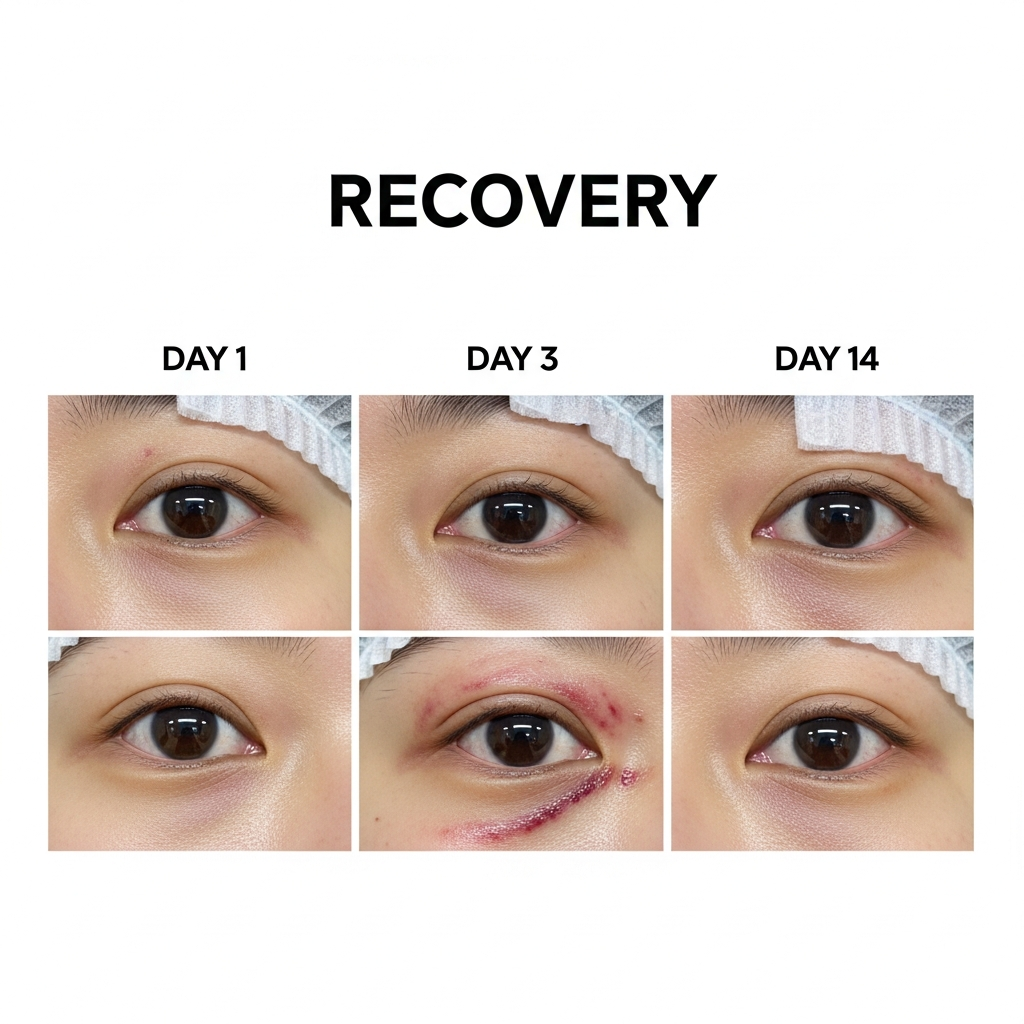
Why “Just Get Filler” Is a Trap
I know someone’s reading this thinking — why not just get tear trough filler? Cheaper, no surgery, five-minute appointment.
Sure. And you’ll be back every 8–12 months for a top-up. At $600–$800 per session in the US. Do that math over five years. You’ve spent more than the surgery would have cost, and you’re dealing with potential filler migration, Tyndall effect (that bluish tint under thin eye skin), and the risk of vascular occlusion — which, under the eye, can mean vision loss.
Hyaluronidase can dissolve filler if something goes wrong. But the under-eye area is unforgiving. Most experienced Korean surgeons I spoke with were surprisingly anti-filler for the tear trough. One coordinator at a Gangnam clinic looked at me like I’d lost it when I asked about combining filler with repositioning. “Why would you put something artificial when you have your own fat right there?” That’s a reasonable concern.
Fat repositioning is a one-time fix. The relocated fat is your own tissue — it integrates, it stays, it ages with you. Filler is a subscription service for your face.
Who’s Actually a Good Candidate
Not everyone with dark circles needs surgery. Important distinction.
Fat repositioning works best for people with visible fat herniation — those puffy bags that create a shadow underneath. If your dark circles are purely pigmentation or thin skin showing the underlying muscle, surgery won’t fix that. A good surgeon will tell you this during consultation. A questionable one will book you for surgery anyway.
The ideal candidate has moderate to significant fat prolapse with a defined tear trough. Age range is broad — I’ve seen Korean clinics operating on patients as young as their mid-20s (genetic fat herniation is real and doesn’t care about your age) up through their 60s. But the approach might differ. Younger patients usually get pure transconjunctival repositioning. Older patients might need a small external incision for skin tightening too.
And if you’ve already had fat removed elsewhere and now look hollow? Korean surgeons can sometimes do a secondary repositioning using remaining fat, or combine with micro fat grafting. It’s fixable. Usually.
Your Week-by-Week Reality Check (And the Stuff Clinics Gloss Over)
So you’ve decided to do it. You’ve picked Korea, maybe even narrowed down a few clinics. Now what?
The consultation process in Seoul is unlike anything you’ll experience back home. Most clinics offer same-day or next-day consultations, and many have English-speaking coordinators. But — and This is important — the quality of those coordinators varies wildly. Some are basically translators. Others actually understand the surgery and can relay your concerns accurately to the surgeon. Ask to speak with the surgeon directly, even if it’s through a translator. Don’t settle for coordinator-only consultations.
During the consult, a good surgeon will do more than just look at your under-eye area. They’ll assess your midface volume, cheek bone structure, skin thickness, and tear trough depth. If a surgeon spends less than 10 minutes with you and just says “yes, fat repositioning, no problem” — walk out.
What Actually Happens During Surgery
Most Korean clinics perform transconjunctival lower blepharoplasty, meaning the incision is made inside your lower eyelid. No visible scar. The procedure takes roughly 40–60 minutes under sedation (what Koreans call 수면마취 — you’re asleep but not under general anesthesia). One recent patient at the clinic described it well: the sedation meant zero pain during surgery, and recovery felt surprisingly manageable. They were back to normal life within a week.
The surgeon redistributes orbital fat from where it’s bulging into the hollow tear trough area below. Some surgeons also release the orbitomalar ligament to get a smoother transition. This part matters a lot — if they skip it, you can end up with a visible step-off between the repositioned fat and your cheek.
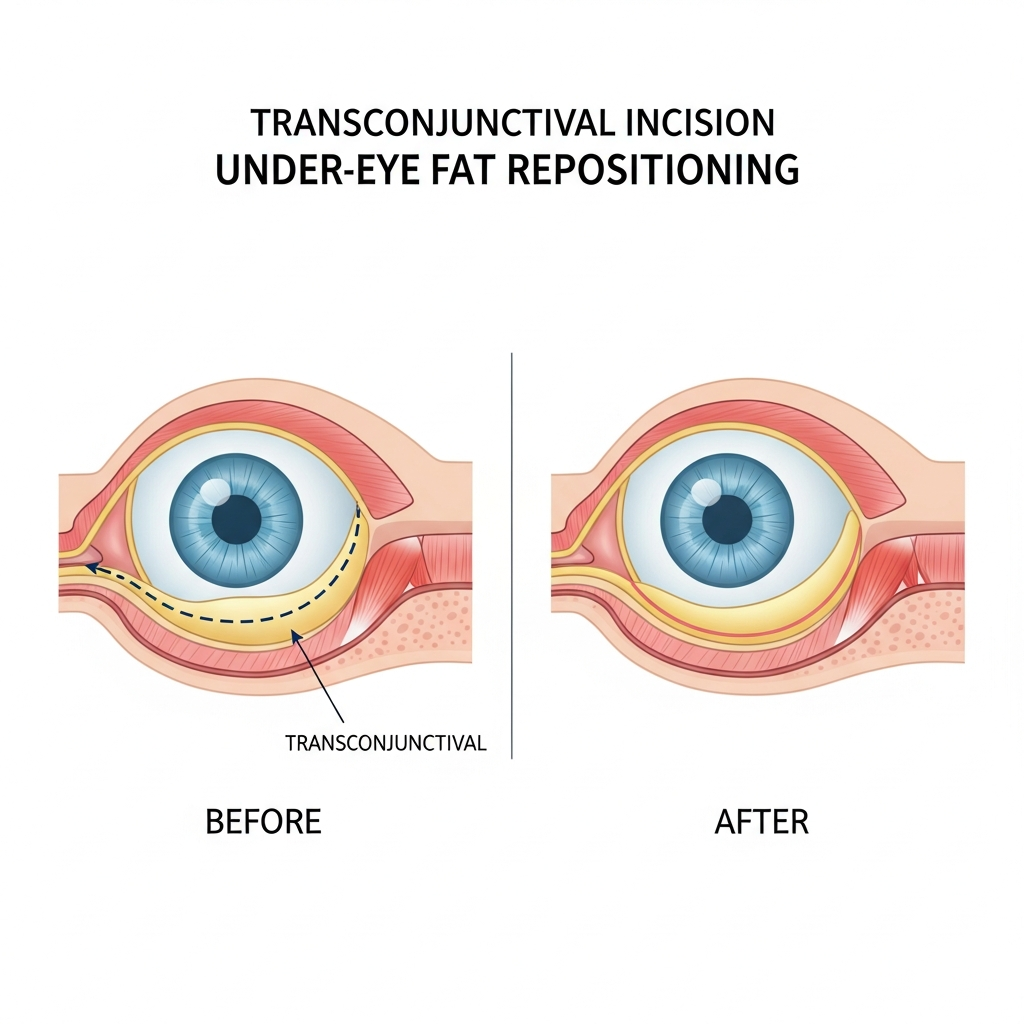
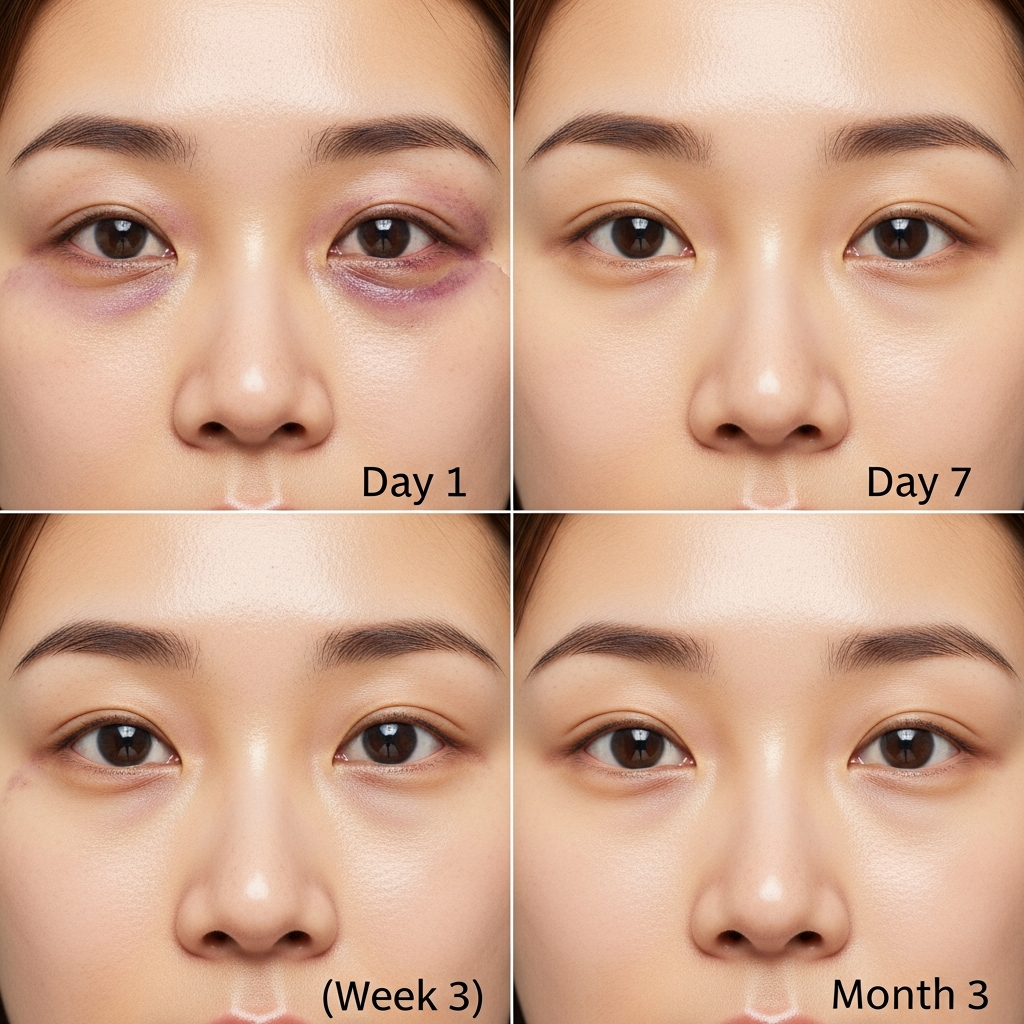
Days 1–3: The Ugly Phase
Nobody looks cute after this surgery. Your under-eyes will be swollen, bruised, and you’ll look like you lost a boxing match. Sleeping elevated on two pillows is non-negotiable. Cold compresses every 20 minutes while you’re awake.
Pain? Honestly, less than you’d expect. Most patients rate it a 3 out of 10. The discomfort is more of a tightness, like someone’s gently pressing on your lower lids. Your eyes might water constantly. Reading your phone will be annoying — not painful, just blurry and uncomfortable.
Here’s something nobody mentions: your vision might feel slightly off for the first 48 hours. Not blurry exactly, but like your lower field of view is swollen shut (because it somewhat is). It freaked me out the first time I heard about it from someone post-op. Totally normal. Goes away.
Days 4–7: The “Is This Normal?” Phase
Bruising turns yellow-green. Swelling shifts downward into your cheeks — this is gravity doing its thing and does NOT mean something went wrong. You’ll google “under eye fat repositioning swelling day 5” approximately 47 times. Everyone does.
A patient who had the procedure done by Dr. Sung at the clinic shared that by day 7, following post-op care instructions closely made a real difference — their swelling and bruising resolved faster than expected, and the hollow areas were noticeably filled in. Another patient of Dr. Jung at the same clinic posted similar results: by day 7, their under-eye area looked brighter and their overall expression appeared softer.
— the clinic’s patient forum
Most Korean clinics will see you for a check-up around day 5–7. They’ll remove any dissolvable stitches if used (many don’t even use stitches with the transconjunctival approach) and assess your healing.
Weeks 2–4: The Awkward In-Between
You’ll look “fine” to strangers. Friends might think you look rested. But you’ll obsess over asymmetry. One side always heals faster. Always. And the swelling can make things look uneven for weeks. Surgeons in Gangnam will tell you to wait three months before judging results. They’re right, even though waiting three months feels impossible.
Some firmness or lumpiness under the skin is normal during this period. It’s scar tissue forming around the repositioned fat. Gentle massage (only if your surgeon okays it) helps. Don’t poke at it constantly — I know the temptation.
Clinics Worth Consulting
Korea has dozens of clinics specializing in lower blepharoplasty. A few names that come up consistently in medical tourism communities: Banobagi, Link Plastic Surgery, JW Plastic Surgery, and ID Hospital all have dedicated eye surgery departments. Smaller boutique clinics like View and Lovely Eye Clinic also have strong reputations specifically for eye procedures. Get at least 2–3 consultations. Prices typically range from 1.5 to 4 million KRW (roughly $1,100–$3,000 USD), depending on complexity and whether you need additional procedures like fat grafting.
What Can Go Wrong — For Real
I’m not going to sugarcoat this.
Under-correction is the most common issue. The surgeon doesn’t redistribute enough fat, and your hollows still show. Fixable with a revision, but annoying. Over-correction is rarer but harder to fix — too much fat pushed down creates a puffy, unnatural look under the eye.
Lower lid retraction. This is the scary one. If too much tissue is disturbed or if there’s excessive scarring, your lower eyelid can pull downward, showing too much white below the iris. It’s uncommon with the transconjunctival approach (more of a risk with external incisions), but it happens. Choosing an experienced surgeon — someone who does this procedure multiple times a week, not multiple times a year — drastically reduces this risk.
Persistent chemosis (swelling of the conjunctiva) can stick around for weeks and make your eyes look watery and red. Eye drops help. Time fixes it. But it’s unsettling when you’re 3 weeks post-op and one eye still looks irritated.
The Thing Nobody Warns You About
Results keep changing for months. At 2 weeks you’ll think it didn’t work. At 6 weeks you’ll think it’s perfect. At 3 months some swelling finally resolves and you see the actual result. And here’s my slightly controversial take: fat repositioning alone doesn’t always fix dark circles. If your darkness is primarily from thin skin showing the muscle underneath (a purplish tone), moving fat around won’t fully address that. Some patients need PRP or a tiny amount of filler on top of the surgery. Korean surgeons tend to be more upfront about this than Western ones — another reason the consultations in Seoul feel different.
But fat repositioning fixes the shadow component of dark circles. That hollowed-out look where light hits your under-eye and creates a visible groove? Gone. And for most people, that shadow is 70–80% of what makes them look tired.
Practical Tips From People Who’ve Done It
- Book your flight home no earlier than day 7. Day 10 is better. You want that post-op check-up before you leave the country.
- Bring wraparound sunglasses. Not for sun protection — for hiding bruising at the airport. And honestly? In Seoul, nobody will look twice. Half the people in Gangnam station are wearing post-surgery masks.
- Stock up on preservative-free eye drops before surgery. You’ll go through dozens of vials.
- Avoid salty food for 2 weeks post-op. Korean food is delicious but high-sodium — and sodium makes swelling significantly worse. Stick to bland stuff. Yes, it’s tragic.
- Don’t compare your day 5 to someone else’s day 5. Healing is wildly individual. Skin thickness, age, how much fat was moved — all of it affects your timeline.
- Screenshot your surgeon’s post-op instructions. You will forget them in the post-anesthesia haze. Every single person does.
FAQ — The Stuff You’re Actually Googling at 2 AM
Is under-eye fat repositioning permanent or will my bags come back?
Permanent. The fat gets moved, not dissolved. It’s repositioned into the hollow tear trough area and stays there once it settles. Your body doesn’t “regrow” the bags — that fat pad is just relocated, not regenerated.
Transconjunctival vs. external incision — which one do Korean surgeons usually do?
Transconjunctival. Almost always. The incision goes inside the lower eyelid so there’s zero visible scarring. External incisions are more of an older Western approach — most Seoul clinics moved past that years ago.
I’m 28, is that too young? My under-eye bags aren’t THAT bad yet
Younger patients actually tend to get better results because their skin still has elasticity. A recent review on the clinic’s community put it well — one patient in their late twenties said the difference was subtle but their whole face looked “brighter” and the impression became softer. If the bags bother you now, age isn’t a reason to wait.
How bad is the recovery? Can I go sightseeing in Seoul after like 3 days?
You’ll look rough for about 5 days. Bruising, swelling, the whole thing. But honestly? Multiple patients at the clinic reported that swelling went down faster than expected when they followed aftercare instructions properly — one was posting 7-day progress photos looking totally fine. Sightseeing at day 3 is ambitious though. Day 5-6, sunglasses on, you’re probably okay for a café crawl. Skip the jjimjilbang for two weeks.
What’s the difference between fat repositioning and fat REMOVAL? My clinic back home only offered removal
Big difference. Removal just takes the fat out — which can leave you looking hollowed out and older within a few years. Repositioning moves that same fat downward to fill the tear trough. One patient shared on the clinic’s the clinic’s patient forum that their sunken areas got significantly filled in, and they were satisfied with how natural it looked. Western clinics push removal because it’s simpler and faster. Not because it’s better.
Will this fix my dark circles too?
Depends on why you have them. If it’s shadowing from the bag itself — yes, dramatically. If it’s pigmentation or thin skin showing blood vessels underneath, repositioning alone won’t fully fix that. Some Korean clinics combo the surgery with rejuran or fat grafting for the pigment issue. Ask specifically during consultation.
How do I pick between the 900 clinics in Gangnam that all claim to be “the best”?
Look at one thing: does the surgeon specialize in lower eyelid work, or do they do everything from nose to jaw to boobs? Specialists matter here — the orbital area is delicate and somewhat unforgiving if someone gets sloppy. Check their community boards for real patient reviews with photos, not the polished before-and-afters on the main website. And if a clinic won’t let you meet the actual surgeon before booking — walk out.
Recommended for Your Recovery
Products that patients commonly use before and after surgery in Korea.
- Arnica Montana Tablets — start 3 days before surgery to reduce bruising and swelling. Check price on Amazon
- COSRX Advanced Snail 96 Mucin Essence — gentle hydration for healing skin post-surgery. Check price on Amazon
- Silicone Scar Sheets — apply 2 weeks post-op to minimize incision scarring. Check price on Amazon
- Beauty of Joseon Relief Sun SPF 50+ — lightweight Korean sunscreen, essential for post-surgical skin protection. Check price on Amazon
As an Amazon Associate, GlobalBeautySpot earns from qualifying purchases.
Final Thought
Under-eye fat repositioning is one of those procedures where Korea is genuinely 10 years ahead, and the price gap makes it almost silly not to fly out. Do your homework on the specific surgeon — not the clinic brand, the actual person holding the scalpel — and you’ll probably wonder why you waited so long.
Considering a procedure in Korea?
Get a free consultation with top-rated clinics in Seoul. We help you find the right surgeon for your goals.