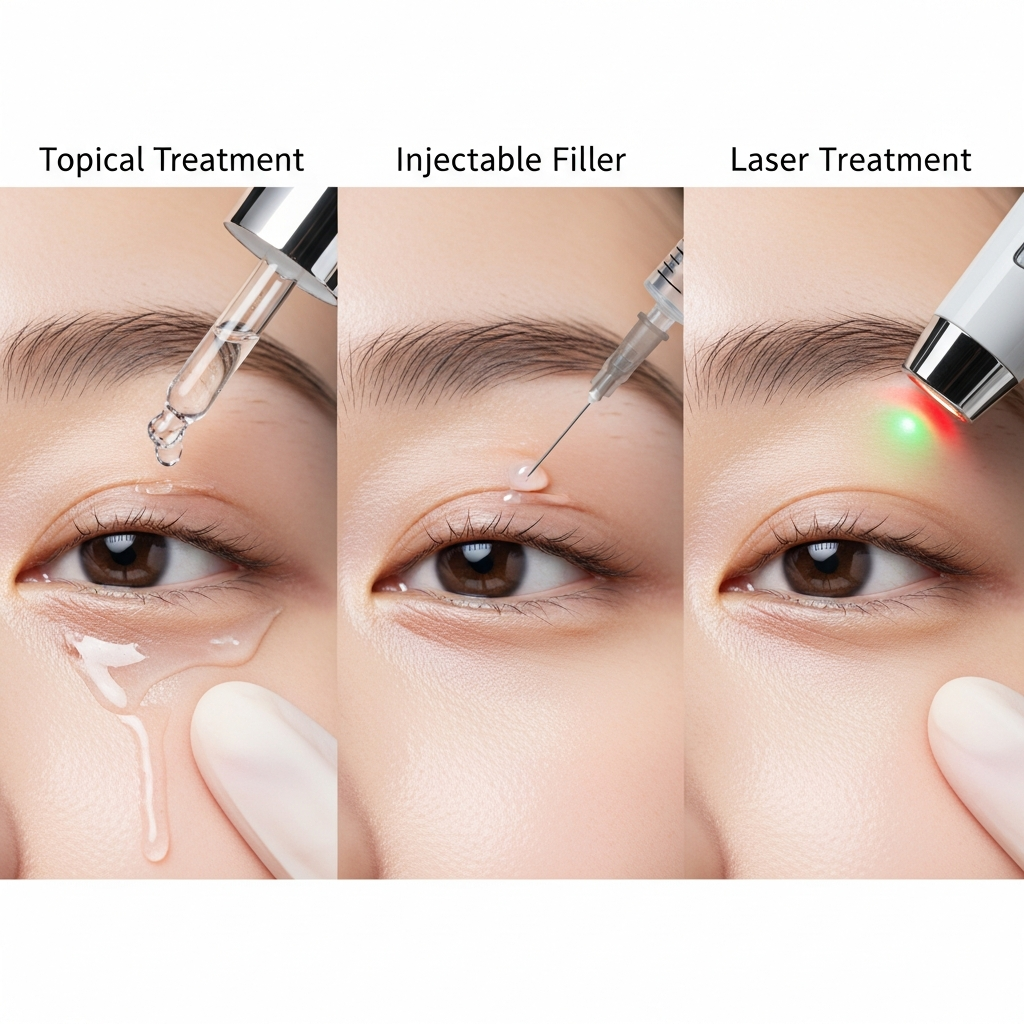
Fat Repositioning vs. Fat Grafting vs. Filler: Which Korean Under-Eye Treatment Actually Fits Your Face?
Last month I sat across from a 34-year-old Australian woman in a Gangnam consultation room. She’d flown 10 hours to fix her dark circles and had already decided she wanted fat repositioning. She’d read every blog post about it. Watched the YouTube videos. Had a clinic shortlist.
The surgeon looked at her for about 30 seconds and said: “You don’t need repositioning.”
She blinked. I could see the confusion.
“Your fat pads are flat,” he continued. “Your problem is skin pigmentation and volume loss in the tear trough. Repositioning moves fat you already have. You don’t have fat to move. You need grafting — maybe laser on top.”
She’d spent three months researching the wrong procedure.
This happens constantly. The internet has made everyone an expert on under-eye fat repositioning specifically, but dark circles have at least four distinct causes — and each one calls for a different treatment. Korea happens to offer all of them, often under one roof. The trick is matching the right fix to your actual anatomy, not to whatever procedure is trending on social media this month.
The Four Types of Under-Eye Problems (And Why They Need Different Fixes)
Not all dark circles are created equal. I coordinate patients through Korean clinics on a regular basis, and the single biggest misconception I encounter is people treating “dark circles” as one condition. It’s not. It’s an umbrella term covering at least four separate issues — sometimes overlapping.
Type 1: Fat Herniation (The Bags)
The orbital fat pads behind your lower eyelid push forward. Gravity, aging, genetics — sometimes all three. You get visible puffiness that creates a shadow below. This is what fat repositioning fixes. The fat gets moved downward into the hollow instead of removed.
Type 2: Tear Trough Hollowing (The Groove)
A depression runs from the inner corner of your eye diagonally across the cheek. No puffiness above it — just a visible dip. Volume loss is the culprit. Fat grafting or filler addresses this, not repositioning. There’s nothing bulging that needs to be moved.
Type 3: Skin Pigmentation (The Stain)
Brown or purple-ish discoloration that doesn’t change with lighting angles. It’s melanin deposits or thin skin showing the orbicularis muscle underneath. Surgery won’t fix this. Laser, chemical peels, Rejuran, or topical treatments target pigmentation.
Type 4: Combined (The Mess)
Bags plus hollowing plus pigmentation. This is the majority of patients I see over age 35. And it’s where Korean clinics have a genuine edge — they’ll combine procedures in a single surgical plan rather than sending you to three separate specialists.
One patient shared on a Gangnam clinic’s community board that their surgeon identified all three issues during the initial consult and proposed a combined repositioning-plus-skin treatment plan — something their dermatologist back home had never even mentioned as an option. The patient said their face looked noticeably brighter with a softer overall impression within a week of the first procedure. — Link Plastic Surgery official community
The Head-to-Head Comparison: Every Under-Eye Treatment Available in Korea
Here’s what I wish someone had handed me when I first started coordinating medical tourism patients. A single table that lays out the options honestly.
| Factor | Fat Repositioning | Fat Grafting | Tear Trough Filler | Laser / Skin Tx |
|---|---|---|---|---|
| Best for | Bags + hollow (Type 1 & 4) | Hollowing only (Type 2) | Mild hollowing (Type 2, early) | Pigmentation (Type 3) |
| How it works | Moves existing orbital fat into tear trough | Harvests fat from body, injects under eye | HA filler injected into tear trough | Targets melanin or stimulates collagen |
| Anesthesia | IV sedation | IV sedation + local at donor site | Topical numbing cream | Topical numbing or none |
| Procedure time | 40-90 min | 60-120 min | 15-30 min | 20-45 min per session |
| Downtime | 7-10 days | 10-14 days | 1-3 days | 3-7 days |
| Visible scarring | None (transconjunctival) | Tiny at donor site | None | None |
| Longevity | Permanent | Mostly permanent (50-80% survival) | 8-18 months | 1-2 years per session |
| Korea cost (USD) | $1,200-$3,200 | $1,500-$3,500 | $300-$800 | $200-$1,000/session |
| US cost (USD) | $4,000-$8,500 | $4,500-$9,000 | $600-$1,200 | $500-$2,000/session |
| Biggest risk | Under-correction | Uneven fat survival, lumpiness | Migration, Tyndall effect | Hyperpigmentation rebound |
Fat Repositioning: When You Have Too Much in the Wrong Place
Fat repositioning is the procedure the internet won’t shut up about. And for good reason: when it’s the right call, the results are striking. The surgeon takes orbital fat that’s bulging forward (creating the “bag”) and shifts it downward into the tear trough depression. Two problems, one surgery.
The key word is “when it’s the right call.”
You’re a candidate if you have visible fat herniation — puffy bags under the eyes that cast a shadow below them. Look in a mirror with overhead lighting. If pressing the puffy area flat makes the dark circle disappear, repositioning is probably your answer.
Korean surgeons almost universally perform this transconjunctivally — the incision goes inside the lower eyelid. No external scar. Recovery runs about 7 days before you look presentable with sunglasses off.
Where people go wrong: assuming repositioning also fixes pigmentation or thin-skin darkness. It doesn’t. It fixes the shadow component created by the bag. If your darkness is primarily melanin or vascular show-through, the bags might disappear but the circles won’t.
Clinics that handle high volume of repositioning cases in Seoul include Banobagi, Link Plastic Surgery, THE PLUS, and JW Plastic Surgery. One consistent pattern across patient reviews on Link’s community board: patients note that their sunken areas become visibly reinforced and the overall facial impression turns softer within the first week. Another patient mentioned that friends had recommended the procedure because the scarring was virtually invisible — and the before-and-after comparison surprised even the patient themselves.
Fat Grafting: When the Hollow Is the Whole Problem
Fat grafting to the tear trough is a completely separate procedure from fat repositioning, and confusing the two is one of the most common mistakes I see patients make.
Repositioning moves fat that’s already in your lower eyelid. Grafting harvests fat from somewhere else on your body — usually the abdomen, inner thigh, or love handles — purifies it, and injects it beneath the under-eye skin to fill the hollow.
You need grafting, not repositioning, if:
- You have a visible tear trough groove but no puffy bags above it
- Your under-eye area looks sunken or hollowed — especially after previous fat-removal surgery abroad
- You’ve lost significant facial volume from weight loss or aging
The catch with grafting: fat survival rates are unpredictable. Korean clinics quote 50-80% survival, meaning some of the transferred fat gets reabsorbed by your body. Most surgeons slightly overcorrect to compensate. You might look “overfilled” for 4-6 weeks before it settles to the intended volume. Some patients need a touch-up session 6 months later.
The procedure also adds a donor site to the equation. Liposuction from the abdomen is minor, but it means soreness in two areas instead of one, and the total recovery is slightly longer than repositioning alone.
Korean pricing for tear trough fat grafting ranges from $1,500 to $3,500 — about half what you’d pay in the US for the same technique. Some surgeons combine grafting with repositioning for patients who have both fat herniation and hollowing. This combined approach costs more ($2,500-$4,000) but addresses the full picture.
Tear Trough Filler: The Quick Fix That Might Become a Long Problem
I need to be honest about this one.
Tear trough filler is the most popular under-eye treatment globally. Fast. Cheap compared to surgery. Zero downtime. And a growing number of Korean surgeons I’ve spoken with actively advise against it.
“Why put something artificial when you have your own tissue right there?” — that’s an actual quote from a coordinator at a Gangnam eye clinic, and it stuck with me.
The issue isn’t that filler never works. It does, temporarily, for mild tear trough hollowing. The issues are:
Migration. Hyaluronic acid filler placed under the eye can shift over time. It spreads laterally, creating puffiness or unevenness that looks worse than what you started with. I’ve personally coordinated three patients in the past year who flew to Seoul specifically to dissolve migrated under-eye filler before getting surgical correction.
Tyndall effect. Thin under-eye skin can show filler as a bluish discoloration. It’s visible in daylight and extremely difficult to correct without full dissolution.
The subscription trap. Filler lasts 8-18 months. At $300-$800 per session in Korea ($600-$1,200 in the US), the 5-year math starts looking ugly compared to a one-time surgical fix. A patient who gets filler twice a year for five years spends $3,000-$8,000 — roughly what repositioning or grafting costs once.
That said, filler has its place. If you’re 26 with a mild hollow and not ready for surgery, one conservative round of HA filler placed by an experienced injector can buy you time. The key word is conservative. Under-correcting is always safer than overcorrecting in the tear trough.
Korean clinics that still offer tear trough filler tend to use cannulas rather than needles, which reduces the risk of vascular complications. Ask specifically about technique during your consultation.
Laser and Skin Treatments: When the Problem Is the Skin Itself
Here’s the part nobody talks about because it’s less dramatic than surgery.
A significant percentage of people with “dark circles” don’t need any surgical intervention at all. Their darkness comes from melanin deposits, thin skin, or both. No amount of fat repositioning or grafting fixes skin pigmentation. It’s a different problem requiring a different category of solution.
Korean clinics offer several non-surgical options for under-eye skin:
- Rejuran i — Polynucleotide injections that thicken thin under-eye skin and improve texture. Korean clinics have been using this for years; it’s just now gaining traction in Western markets. Multiple sessions needed. $200-$400 per session in Korea.
- Pico laser / Q-switched laser — Targets melanin deposits causing brown discoloration. Works best on pigment-type dark circles. 3-5 sessions typical. $150-$350 per session.
- Fractional CO2 or Erbium laser — Stimulates collagen production, tightening and thickening the under-eye skin. More aggressive, more downtime (5-7 days of redness), but better results for crepey skin. $300-$600 per session.
- PRP (Platelet-Rich Plasma) — Your own blood is drawn, processed, and injected under the eyes. Stimulates skin renewal. Results are subtle but cumulative over 3-4 sessions. $300-$500 per session.
The advantage of doing these in Korea: the pricing is 40-60% lower than equivalent treatments in the US or Australia, and Korean dermatologists have seen thousands more under-eye cases than most Western practitioners. The disadvantage: skin treatments require multiple sessions, so a single trip to Seoul may not be enough unless you’re staying 3-4 weeks.
The Combination Play: What Korean Clinics Do That Western Ones Don’t
This is where Korea’s medical system genuinely outperforms.
In the US or UK, if you walk into a plastic surgeon’s office with under-eye bags, you’ll get a surgical recommendation. Walk into a dermatologist’s office with the same face, you’ll get a filler or laser recommendation. Neither specialist sees the full picture.
Korean clinics — especially the larger ones with both surgical and dermatological departments — will assess all four under-eye issues in a single consultation. A surgeon at one Seoul clinic spent 25 minutes with a patient I coordinated, mapping out which quadrant of the under-eye area needed volume correction (repositioning), which area needed skin treatment (Rejuran), and which areas to leave alone entirely.
That kind of precision-targeted approach is rare outside Korea. Not because Western doctors are less skilled — because the system doesn’t encourage cross-specialty consultation the same way.
Common Korean combination protocols I’ve seen:
- Fat repositioning + Rejuran — The standard combo for patients with bags plus thin/dark skin. Repositioning first, Rejuran 3-4 weeks later once healed.
- Fat grafting + laser — For patients with hollowing plus pigmentation. Grafting addresses volume; laser targets melanin.
- Repositioning + micro fat grafting — For patients with bags and severe hollowing where the repositioned fat alone won’t fill the entire tear trough.
- Filler dissolution + repositioning — For patients who had filler placed abroad that migrated or caused Tyndall effect. Dissolve first, wait 2-4 weeks, then surgical correction.
A patient on Link Plastic Surgery‘s community board described exactly this combined approach — the surgeon assessed their fat pad position, skin quality, and tear trough depth separately, then recommended a staged plan. The patient said following the surgeon’s aftercare protocol closely led to faster-than-expected swelling resolution, with noticeable improvement in both the bags and the overall skin quality by the two-week mark.
How to Self-Diagnose Before Your Consultation (The Mirror Test)
You can narrow down your likely treatment before ever stepping into a clinic. This won’t replace a surgical consult, but it’ll help you ask smarter questions and avoid wasting consultations on procedures you don’t need.
Step 1: Overhead lighting test. Stand under a bright ceiling light. Look straight into a mirror. If you see visible puffiness creating a shadow below, you likely have fat herniation — fat repositioning territory.
Step 2: Press test. Gently press the puffy area with your finger. If the dark shadow disappears when the puff is flattened, your darkness is shadow-based (volume problem). If the darkness stays even when skin is smooth, it’s pigmentation or thin skin.
Step 3: Pull test. Gently pull the skin of your lower eyelid downward. If the color underneath is brownish — melanin pigmentation. If it’s purple-blue — blood vessels showing through thin skin.
Step 4: Age and history check. Had filler before? It might have migrated. Had fat removal abroad? You might need grafting to replace what was taken. Under 30 with no bags but visible grooves? That’s structural hollowing, not aging.
Bring your findings to the consultation. Korean surgeons appreciate patients who’ve done basic self-assessment — it speeds up the conversation and shows you’re informed.
Cost Breakdown: Planning Your Budget for a Korea Trip
Real numbers. No ranges so wide they’re meaningless.
| Treatment | Korea Price (USD) | Sessions Needed | Total Korea Cost | Equivalent US Cost |
|---|---|---|---|---|
| Fat repositioning only | $1,200-$3,200 | 1 | $1,200-$3,200 | $4,000-$8,500 |
| Fat grafting (tear trough) | $1,500-$3,500 | 1 (maybe touch-up) | $1,500-$4,500 | $4,500-$9,000 |
| Repositioning + grafting combo | $2,500-$4,000 | 1 | $2,500-$4,000 | $6,000-$12,000 |
| Tear trough filler | $300-$800 | Every 8-18 months | $300-$800/session | $600-$1,200/session |
| Rejuran i | $200-$400 | 3-4 sessions | $600-$1,600 | $400-$800/session |
| Pico / Q-switched laser | $150-$350 | 3-5 sessions | $450-$1,750 | $300-$700/session |
Factor in flights ($800-$1,500 roundtrip from the US/Australia), accommodation ($50-$120/night in Gangnam for 10 nights), and meals. Even with travel, surgical options in Korea typically come in at 40-60% less than the procedure alone would cost at home.
For non-surgical treatments requiring multiple sessions: if you can’t stay 3-4 weeks, some patients split it into two trips — one for the initial sessions, another 2-3 months later for follow-ups. Not ideal, but workable.
Choosing the Right Clinic: Different Clinics Excel at Different Things
This is where people mess up. They find a “best clinic in Korea” list and book whatever’s on top. But a clinic that’s outstanding at fat repositioning might be mediocre at laser treatments. Specialization matters.
General guidance based on what I’ve seen across dozens of patient experiences:
- For fat repositioning or combined lower eyelid surgery — Look for clinics with dedicated eye surgery departments and surgeons who perform this procedure multiple times per week. Link Plastic Surgery, Banobagi, THE PLUS, and JW all have eye surgery specialists with high case volumes.
- For fat grafting (tear trough) — Some clinics specialize in fat grafting across the entire face, not just eyes. Dream Medical Group and BIO Plastic Surgery have strong fat grafting programs.
- For laser and skin treatments — Dermatology clinics in Gangnam often outperform plastic surgery clinics for non-surgical work. Oracle Dermatology, Hus-hu Dermatology, and CNP Skin Clinic handle enormous volumes of laser and injectable treatments.
- For combination approaches — Larger clinics with both plastic surgery and dermatology departments can coordinate the full plan. This saves you from bouncing between a surgeon and a separate derm clinic.
Book at least 2-3 consultations. Most are free in Korea. Ask each surgeon specifically what they recommend and why. If two out of three surgeons tell you the same thing, that’s probably the right call.
FAQ — The Questions People Actually DM Me About
Can I combine fat repositioning with filler or laser in the same trip to Korea?
Yes, and Korean clinics do this routinely. Typical approach: repositioning first, then skin treatments 2-4 weeks later once initial healing is complete. If you’re planning a single trip, budget 3-4 weeks in Seoul for the combined approach. Some patients split it into two shorter trips.
I had under-eye filler abroad and it migrated. Can Korean clinics fix it?
This is more common than you’d think. Korean clinics regularly dissolve migrated filler with hyaluronidase first — that’s a 15-minute appointment. Then you wait 2-4 weeks for the area to settle before proceeding with surgical correction. Many international patients plan this as a two-phase trip.
Which under-eye treatment lasts the longest?
Fat repositioning is permanent — the fat stays where it’s moved. Grafting is mostly permanent but 20-50% of transferred fat gets reabsorbed. Filler lasts 8-18 months. Laser results last 1-2 years per session. For a one-and-done fix, surgical options win every time.
How do I know if my dark circles need surgery or just skin treatment?
The mirror test above covers this in detail. Quick version: press the puffy area flat. Shadow disappears? Volume problem, surgical territory. Darkness stays? Pigmentation or thin skin, non-surgical treatments. If both — and that’s most people over 35 — you’ll likely need a combination approach.
Is tear trough filler safe? I keep reading horror stories.
The tear trough is one of the highest-risk areas for filler injection because of thin skin and proximity to blood vessels. Tyndall effect and migration are real. Korean clinics that still offer it tend to use cannulas rather than needles and inject conservatively. But honestly? If three different surgeons in Seoul tell you to skip filler and go surgical, listen to them.
Recommended for Your Recovery
Products that patients commonly use before and after surgery in Korea.
- Arnica Montana Tablets — start 3 days before surgery to reduce bruising and swelling. Check price on Amazon
- COSRX Advanced Snail 96 Mucin Essence — gentle hydration for healing skin post-surgery. Check price on Amazon
- Silicone Scar Sheets — apply 2 weeks post-op to minimize incision scarring. Check price on Amazon
- Beauty of Joseon Relief Sun SPF 50+ — lightweight Korean sunscreen, essential for post-surgical skin protection. Check price on Amazon
As an Amazon Associate, GlobalBeautySpot earns from qualifying purchases.
Final Thought
The under-eye area is maybe two centimeters of real estate, but it has an outsized effect on how tired, old, or stressed your entire face looks. Getting the right treatment matters more than getting the trendiest one. Fat repositioning is excellent — when fat herniation is your actual problem. It’s a waste of money and recovery time if your issue is pigmentation or structural hollowing that needs a completely different approach.
Korea’s edge isn’t that any single treatment here is radically different from what exists elsewhere. It’s that Korean clinics assess, diagnose, and treat the under-eye area with a granularity that most Western practices don’t match. Use that. Get the full assessment. Then make the call.
Considering a procedure in Korea?
Get a free consultation with top-rated clinics in Seoul. We help you find the right surgeon for your goals.