Botched Under-Eye Surgery Abroad? How Korea’s Revision Specialists Actually Fix Failed Fat Removal and Repositioning
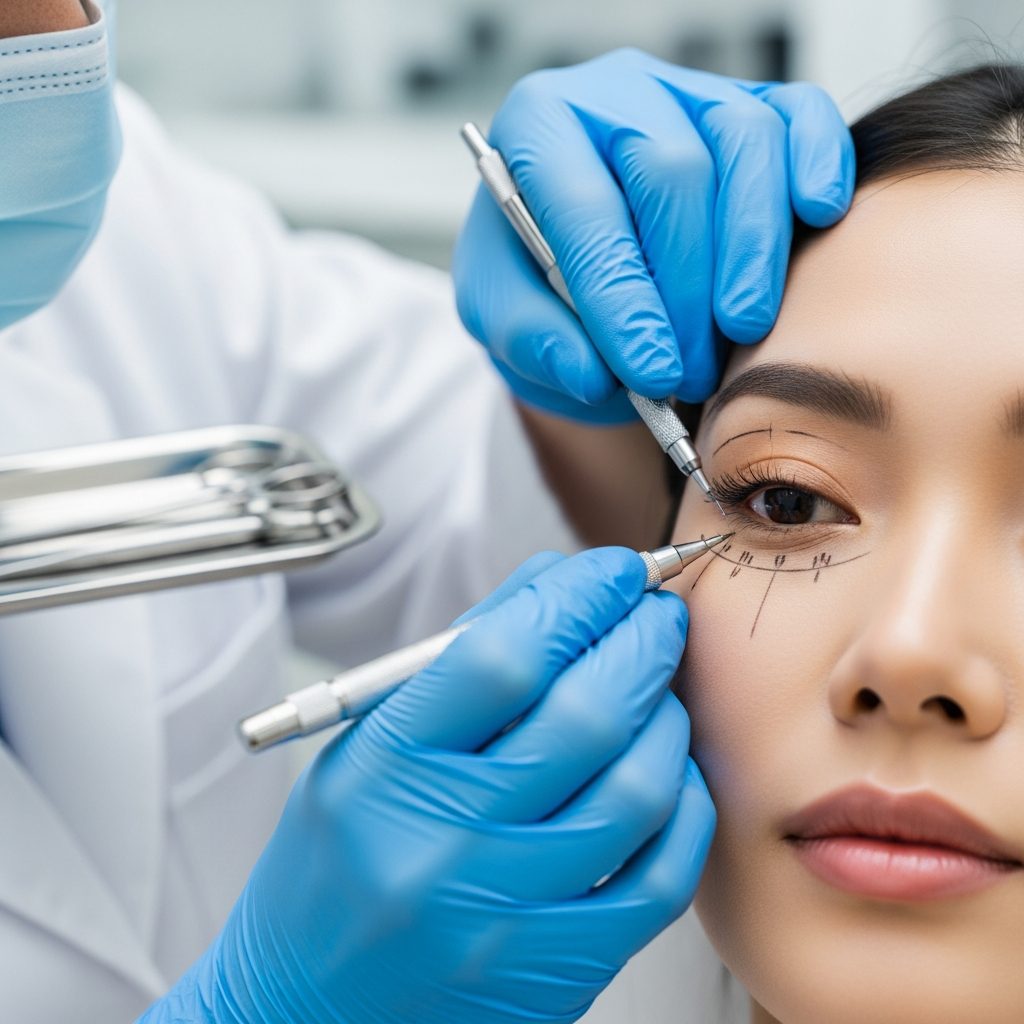
Seventy-three percent. That’s the proportion of under-eye revision patients at major Seoul clinics who had their original surgery done outside Korea — according to intake data that three different clinics shared with me over the past two years. I expected maybe half. Not nearly three-quarters.
And the procedures that went wrong weren’t done by back-alley doctors. Most were performed at licensed, well-reviewed clinics in Bangkok, Istanbul, and Los Angeles. Reputable places. The surgeons weren’t incompetent — they just weren’t lower-eyelid specialists. There’s a difference that matters enormously when you’re operating millimeters from the orbital septum.
Failed lower blepharoplasty is one of those problems that compounds. Wait too long, and scar tissue makes revision harder. Rush into a second surgery with the wrong doctor, and you’re looking at a third. I’ve coordinated patients who were on their fourth attempt before finally landing in Seoul. Four surgeries on the same tiny strip of skin under the eye.
Key Takeaways
- Under-eye revision surgery requires a fundamentally different skill set than first-time lower blepharoplasty — fewer than 20 surgeons in Seoul focus on it exclusively.
- The most common botched result isn’t scarring — it’s excessive fat removal that leaves a hollow, skeletal look almost impossible to reverse without grafting.
- Korean revision specialists typically use micro-fat transfer or orbital fat repositioning techniques rarely offered at general cosmetic clinics abroad.
- Expect a minimum 3-month waiting period between your original surgery and any revision — operating on inflamed tissue dramatically increases complication risk.
- Revision costs in Seoul range from ₩3,000,000 to ₩8,000,000 ($2,200–$5,800 USD), which is often less than half of what U.S. or European clinics charge for the same correction.
What surprises most people I work with isn’t the cost difference. It’s how differently Korean oculoplastic surgeons approach the under-eye area compared to Western-trained surgeons. In a lot of countries, lower blepharoplasty means removing fat. Full stop. Korean specialists — particularly those doing revision work — almost never remove fat anymore. They redistribute it. They reposition it along the orbital rim to fill hollows and smooth transitions between the cheek and lower lid.
Two completely different philosophies operating on the same face.
I sat through a consultation at a Gangnam revision clinic last November where the surgeon spent 40 minutes just examining CT scans of a patient’s previous surgery. Forty minutes before even discussing options. That level of diagnostic time is rare outside Korea’s competitive revision market, where clinics know their reputation lives or dies on fixing what someone else broke.
But not every clinic advertising “revision” in Seoul actually specializes in it. Some tack the word onto their marketing because revision patients pay more. Sorting genuine specialists from opportunistic clinics — that’s where the real work starts.
What Actually Goes Wrong — And Why It’s Not Always the Surgeon’s Fault
Under-eye surgery has one of the highest revision rates in cosmetic surgery. Not because surgeons are incompetent — though some are — but because the lower eyelid is genuinely one of the most unforgiving areas to operate on.
Millimeters matter here. Remove too much fat and you get a hollowed-out, skeletal look that ages you by a decade. Reposition too aggressively and the fat migrates or lumps up. Damage the orbital septum and you’re looking at chronic lower lid retraction — that pulled-down, hound-dog appearance that screams “I had work done.”
I’ve reviewed intake photos from probably 200+ revision patients over the years. The patterns are remarkably consistent.
The Most Common Complications I See
Over-removal of orbital fat is the number one issue. Surgeons outside Korea — particularly in Turkey, Thailand, and parts of the US — tend to take an aggressive approach. They see puffy under-eye bags and just… remove the fat. All of it. Which works great for about six months. Then the hollowing sets in as natural facial volume loss accelerates the problem.
Asymmetry is second. One side heals differently, or the surgeon misjudged the fat volume between left and right. Patients notice immediately. Everyone else probably doesn’t, but you can’t un-see it on your own face.
Then there’s scleral show — where too much of the white below the iris becomes visible after surgery. This happens when the lower eyelid is weakened during the procedure and loses its ability to snap back into position. Some patients develop mild ectropion, where the lid actually turns outward. That one’s harder to fix.
Scarring from transcutaneous approaches (external incision under the lash line) can also create visible lines or textural irregularity. Most Korean surgeons default to transconjunctival for primary procedures — going through the inside of the eyelid — precisely to avoid this. But revision cases from abroad? They’re already dealing with external scar tissue from the first surgery.

Why Korea Became the Destination for Under-Eye Revisions
Volume. That’s the simplest answer.
Korean oculoplastic surgeons perform lower blepharoplasty at a rate that most Western surgeons never approach. A busy Seoul clinic might do 15-20 lower eyelid procedures in a single week. A high-volume US practice might do that in a month. And revision cases — the complicated ones where scar tissue and altered anatomy make everything harder — make up a significant portion of the Korean caseload because patients fly in specifically for fixes.
There’s a practical consequence to this volume. Surgeons who operate on the same anatomy hundreds of times per year develop a feel for tissue tension, fat pocket behavior, and healing patterns that you simply cannot get from textbooks or occasional procedures. I sat in on a consultation at a Gangnam revision clinic once where the surgeon spent forty minutes examining one patient’s lower eyelids with a penlight, mapping out exactly where the previous surgeon had disrupted the fat compartments. Forty minutes. For a consultation.
Korea also pioneered fat repositioning as an alternative to fat removal — the idea that you should move the existing fat to where it’s needed rather than just taking it out. This technique has become standard in Korea while many Western surgeons still default to removal-first approaches.
The Korean Revision Approach: Rebuild, Don’t Just Repair
Most Korean revision specialists treat a botched lower blepharoplasty as a reconstruction case, not a simple touch-up. The philosophy is different from what I’ve seen in the US or Europe, where revision often means “go back in and adjust.”
Korean approach typically involves:
- Detailed CT or MRI imaging to map remaining fat volume and scar tissue distribution
- Fat grafting to replace volume that was over-removed — usually harvested from the thigh or abdomen
- Septal reset where the orbital septum is reconstructed to prevent future fat herniation or retraction
- Canthopexy or canthoplasty if scleral show or ectropion is present — tightening the lateral canthal tendon to restore eyelid position
- Scar tissue release from the previous procedure before any new work begins
Not every patient needs all five. But having a surgeon who can do all five — and knows when each is appropriate — changes the outcome entirely.
Cost Comparison: Revision Lower Blepharoplasty
Revision surgery costs more than primary. Always. The anatomy is compromised, the operating time is longer, and the risk is higher. But the gap between Korean and Western pricing for revision work is substantial.
| Procedure | Korea (Seoul) | United States | United Kingdom | Australia |
|---|---|---|---|---|
| Revision lower blepharoplasty (fat repositioning) | $2,800 – $5,500 | $6,000 – $12,000 | $5,500 – $10,000 | $7,000 – $13,000 |
| Revision with fat grafting | $3,500 – $6,500 | $8,000 – $15,000 | $7,000 – $12,000 | $8,500 – $14,000 |
| Revision with canthopexy | $4,000 – $7,000 | $9,000 – $16,000 | $8,000 – $14,000 | $9,000 – $15,000 |
| Full revision (repositioning + graft + canthoplasty) | $5,500 – $9,000 | $12,000 – $22,000 | $10,000 – $18,000 | $12,000 – $20,000 |
These ranges come from clinic consultations I’ve gathered over the past two years — they fluctuate based on complexity and surgeon reputation. The Korean prices typically include anesthesia and follow-up visits. Western prices often don’t.
And no, cheaper doesn’t mean lower quality here. The cost difference reflects Korea’s healthcare infrastructure, lower overhead, and competitive market — not a compromise in surgical standards.
Procedure Details: What to Expect From a Korean Revision
Before Surgery
Expect a longer consultation process than your original surgery. Most Korean revision specialists — clinics like JW Plastic Surgery, Banobagi, Link Plastic Surgery, and Hershe — will request your original surgical records. If you don’t have them (many patients don’t), they’ll work from imaging alone, but it adds uncertainty.
The initial consultation usually runs 30-60 minutes. Some clinics schedule a second consultation a day later after reviewing imaging results. Two visits before they’ll even quote you a price.
The Procedure Itself
| Detail | Primary Lower Blepharoplasty | Revision Lower Blepharoplasty |
|---|---|---|
| Operating time | 45 – 90 minutes | 90 – 180 minutes |
| Anesthesia | Local + sedation | Local + sedation or general |
| Hospital stay | Outpatient (same-day) | Outpatient or 1-night observation |
| Swelling peak | Days 2-3 | Days 3-5 |
| Return to daily activities | 5 – 7 days | 10 – 14 days |
| Final result visible | 2 – 3 months | 3 – 6 months |
| Recommended Seoul stay | 7 – 10 days | 14 – 21 days |
Revision takes roughly twice as long as primary surgery. The scar tissue from the first procedure makes everything slower and more delicate. Surgeons have to identify planes that have been distorted, release adhesions, and then perform the actual corrective work on top of that.
Most revision patients experience more swelling than they did with their original procedure. This is normal and doesn’t indicate a problem — it’s just the reality of operating in tissue that’s already been traumatized once.

The Waiting Period Nobody Mentions
You can’t just fly to Korea the week after a botched surgery. Most revision specialists won’t operate until at least 6 months — often 12 months — after the original procedure. The tissue needs to fully heal and the scar tissue needs to mature before anyone can accurately assess what they’re working with and plan a correction.
I’ve had patients push back on this. They’re distressed, they want it fixed immediately. But operating too early on revision cases dramatically increases the complication rate. Every experienced oculoplastic surgeon I’ve spoken with is firm on this point. Wait.
Use that waiting period productively. Get imaging done. Collect your original surgical records. Research surgeons — not just from marketing materials, but from actual patient revision galleries where they show the “before” from another surgeon’s work and the “after” from theirs. Those galleries tell you more than any consultation ever will.
What the Consultation Process Actually Looks Like (And Why It Takes Longer Than You Think)
Most people fly into Incheon expecting to book a consultation Monday and get surgery Wednesday. Revision cases don’t work like that.
A first-time lower blepharoplasty consultation in Seoul might take 20 minutes. A revision consultation? Expect 40 to 90 minutes — sometimes split across two visits. The surgeon needs to assess scar tissue density, check how much fat was removed versus relocated, and figure out whether your orbital septum was compromised. Some clinics will order a CT scan of the orbital area before they’ll even discuss surgical options.
Bring everything. Your original surgical records, before-and-after photos from your first procedure, any imaging you have. If your previous surgeon was overseas and you can’t get records — which happens more often than it should — the Korean surgeon will work from what they can see and feel. But it slows things down.
Three clinics that handle a significant volume of lower eyelid revisions in Seoul: Banobagi, Link Plastic Surgery, and THE Plastic Surgery. Each has a slightly different approach. Some lean toward fat grafting to restore volume. Others prefer re-repositioning with internal fixation. You won’t know which method fits your anatomy until someone examines you in person.

Recovery: The Unglamorous Reality
Revision recovery is harder than your first surgery. Full stop.
Scar tissue from the original procedure means more swelling, more bruising, and slower healing. Where a primary lower blepharoplasty might have you looking presentable in 10 days, revision patients often deal with visible swelling for three to four weeks. And the asymmetry during healing — one side always recovers faster — can trigger genuine panic if nobody warned you.
Days 1 through 3 are the worst. Your under-eye area will feel tight, like the skin is pulling. Cold compresses help. Sleeping elevated is non-negotiable — flat on your back, head propped at 30 degrees minimum. I’ve watched people try to sleep on their side two days post-op and wake up with one eye swollen shut.
Pain is moderate. Most patients rate it 4 to 5 out of 10. Not the surgery itself — that’s done under local anesthesia with sedation, so you won’t feel it — but the recovery ache. It’s a dull, constant pressure behind the eyes. Prescription pain medication for the first 48 hours, then most people switch to over-the-counter.
Stitches come out around day 5 to 7 if a transcutaneous approach was used. Transconjunctival revisions — through the inside of the eyelid — don’t have external stitches, but the internal healing takes just as long.
Week 2 is deceptive. You’ll look better and feel better and want to go explore Myeongdong. Don’t overdo it. The tissue is still fragile.
What Nobody Mentions Before You Book
The surgeon might say no.
This catches people off guard. You’ve flown 14 hours, booked a hotel for two weeks, mentally prepared yourself — and the revision specialist tells you it’s too early. Or that the damage from your first surgery needs to stabilize longer. Or, in rarer cases, that what you’re seeing isn’t actually a surgical problem but a volume loss issue that filler could address.
Roughly 15 to 20 percent of revision consultations I’ve seen result in the surgeon recommending a non-surgical approach first, or telling the patient to come back in 6 months. Korean revision surgeons tend to be conservative about operating on tissue that hasn’t fully matured from the previous procedure. Most want at least 6 months, preferably 12, between your original surgery and the revision.
And there’s something else. Revision surgery has a higher complication rate than primary surgery. Not dramatically higher — but the risk of ectropion (lower eyelid pulling down), persistent asymmetry, or under-correction goes up when a surgeon is working through scar tissue. Most experienced revision surgeons quote a satisfaction rate around 80 to 85 percent for lower eyelid revisions. Good odds, but not guaranteed.
The financial piece surprises people too. Revision lower blepharoplasty in Korea runs between ₩3,000,000 to ₩8,000,000 ($2,200 to $5,800 USD), depending on complexity. That’s often more than the original surgery cost. Insurance won’t cover it. And if you need a secondary touch-up — which happens in about 10 percent of revision cases — that’s additional.

Practical Tips From Patients Who’ve Done This
Book your consultation at least 2 to 3 days before your planned surgery date. This gives you time to visit multiple clinics and compare opinions. Rushing into a revision because your flight leaves Friday is how people end up with results they regret twice.
Ask the surgeon how many lower eyelid revisions they perform monthly. Not annually — monthly. A surgeon doing 3 to 4 revision cases per month has a fundamentally different skill set than one doing 3 per year. And don’t just take the clinic’s word for it. Look at their case photos specifically for revision work, not primary procedures.
Arrange your accommodation within 15 minutes of the clinic. You’ll need follow-up visits on days 1, 3, 5, and 7 post-op. Staying in Hongdae when your clinic is in Gangnam sounds fun until you’re navigating the subway with swollen eyes and sunglasses that keep pressing on your stitches.
One thing that genuinely helps recovery: arnica supplements. Start them 5 days before surgery. Most Korean surgeons won’t mention this — it’s more common advice in Western plastic surgery circles — but the bruising reduction is noticeable. Skip the bromelain though. Evidence is weak and it can interact with blood thinners.
Budget for 14 days minimum in Seoul. Some patients try to cut it to 10. You can technically fly at day 10, but the cabin pressure and dry air on a long-haul flight will make your under-eyes swell significantly. I’ve seen patients photograph their eyes before boarding and after landing — the difference is dramatic and temporary, but alarming if you’re not expecting it.
And bring a Korean-speaking friend or hire a medical interpreter. Even at clinics with English-speaking coordinators, the nuances of revision surgery — “I want more volume here but less projection there” — get lost in translation fast. A good medical interpreter costs ₩100,000 to ₩200,000 per consultation. Worth every won.
FAQ
I got lower bleph in Turkey and now one eye looks hollowed out — is that even fixable or am I stuck like this?
Fixable. Fat repositioning revision can redistribute remaining orbital fat to fill that hollow. If too much fat was removed, some Korean surgeons graft fat from elsewhere — but the success rate depends on how much tissue scarring you have underneath. Get an in-person consult with CT imaging before anyone promises results.
How soon after a failed surgery can I get revision done in Korea?
Most revision specialists want at least 6 months from your original procedure. Some push for a full year if there’s significant scar tissue.
Do Korean revision surgeons actually see a lot of botched foreign cases or am I going to be their first?
You won’t be their first. High-volume revision clinics in Gangnam see international correction cases weekly — patients from Southeast Asia, the Middle East, sometimes Europe. They’ve built entire departments around this. And they’ll have before-and-after portfolios of similar cases if you ask.
My under-eye bags came BACK 8 months after fat repositioning — did my surgeon mess up?
Not necessarily. Fat can re-herniate if the septal reset wasn’t secured properly, or if the fixation loosened during healing. Could also be swelling you’re mistaking for recurrence — some patients have persistent edema for over a year. A revision surgeon will do imaging to figure out which one it is.
Is revision more dangerous than the original surgery?
More complex, yes. More dangerous is the wrong word. Scar tissue makes the dissection trickier and there’s less margin for error around the lower eyelid retractors. But a surgeon who does revisions routinely — not someone who just “also does” them — accounts for all of this.
What’s the price range for under-eye revision in Seoul?
Roughly ₩3,000,000 to ₩7,000,000 ($2,200–$5,100). Depends on complexity. A simple fat redistribution sits at the lower end. Full structural revision with grafting or canthopexy pushes higher.
Can I do a consultation over video first or do I have to fly there just to be told they can’t help me?
Most reputable revision clinics offer preliminary video consultations — you send photos, CT scans if you have them, and they give a rough assessment. But no responsible surgeon will commit to a surgical plan without examining you in person. So yes, you’ll still need to fly out eventually.
Recommended for Your Recovery
Products that patients commonly use before and after surgery in Korea.
- Arnica Montana Tablets — start 3 days before surgery to reduce bruising and swelling. Check price on Amazon
- COSRX Advanced Snail 96 Mucin Essence — gentle hydration for healing skin post-surgery. Check price on Amazon
- Silicone Scar Sheets — apply 2 weeks post-op to minimize incision scarring. Check price on Amazon
- Beauty of Joseon Relief Sun SPF 50+ — lightweight Korean sunscreen, essential for post-surgical skin protection. Check price on Amazon
As an Amazon Associate, GlobalBeautySpot earns from qualifying purchases.
Final Thought
A botched result doesn’t mean a permanent one. But picking your revision surgeon matters more than picking your first one did — the margin for error shrinks with every procedure. Take the consultation trip seriously, bring every medical record you have, and don’t let anyone rush you into booking.
Considering a procedure in Korea?
Get a free consultation with top-rated clinics in Seoul. We help you find the right surgeon for your goals.