You are lying back in the chair, the coordinator is smiling, and a syringe appears from a drawer, already filled, no box in sight. It feels rude to ask questions. It is exactly the moment you should. Counterfeit dermal fillers are a real problem in Korea’s budget aesthetic market, and the single most effective way to protect yourself costs nothing: insist on seeing the sealed, MFDS-labeled box before anything goes into your face. In 2026, Korean regulators and agencies have publicly moved to combat counterfeit cosmetics, which tells you the problem is real enough to legislate against. The good news is that a genuine, MFDS-approved filler is easy to verify if you know the two or three things to look for, and a consultation at a transparent clinic like Link Plastic Surgery should welcome, not resist, those questions.
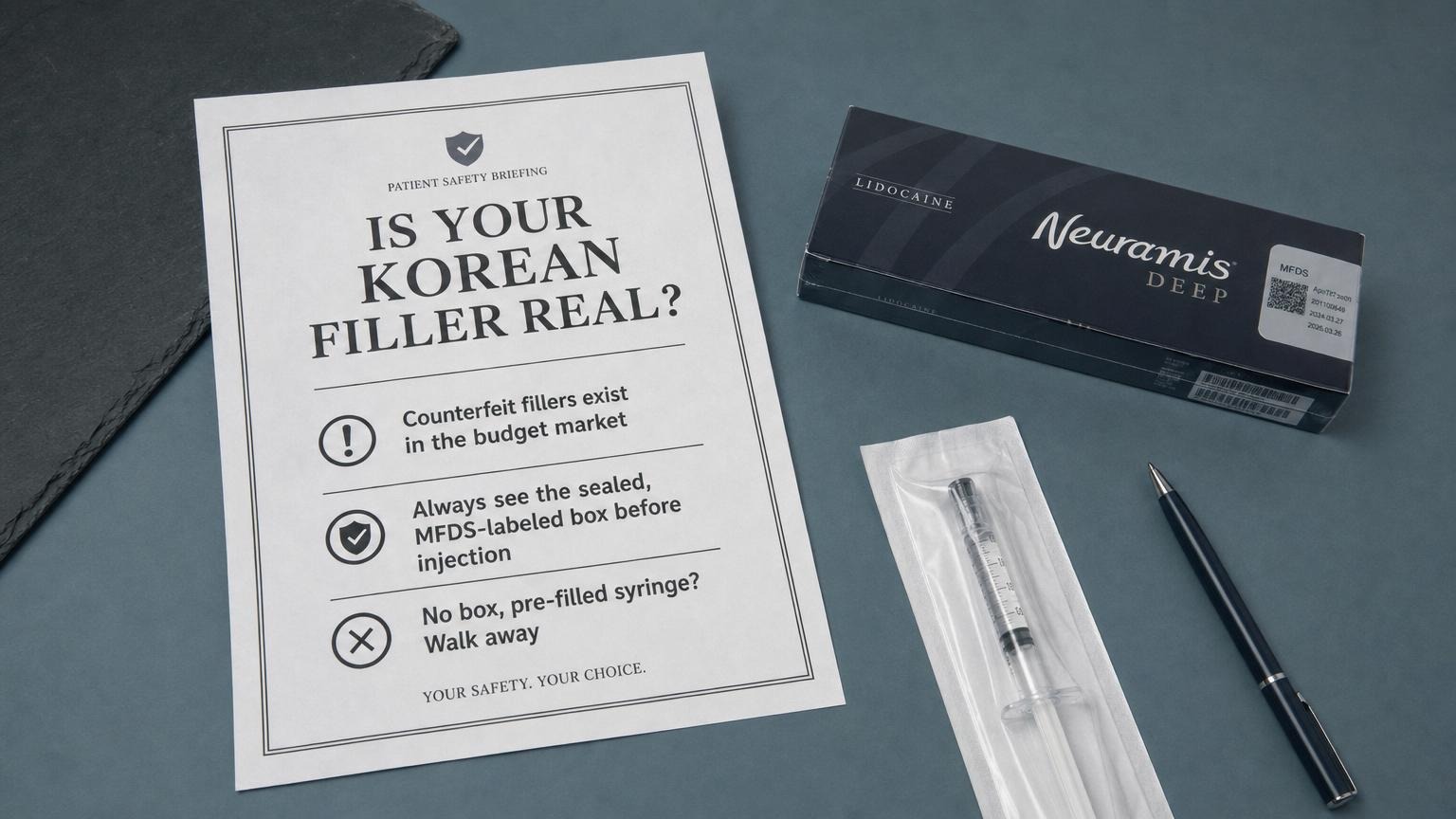
Counterfeit fillers, fake or non-medical products sold at suspiciously low prices, are a genuine risk in Korea’s cheapest clinics, and the harm can be serious. The reassuring part is that verifying a real filler is simple: see the sealed, MFDS-labeled box, confirm the brand is MFDS-approved, and watch it drawn from a fresh, labeled product. Understanding what counterfeit fillers are, how to verify yours, when to walk away, and why safety beats price is what protects you.
What Counterfeit Fillers Are
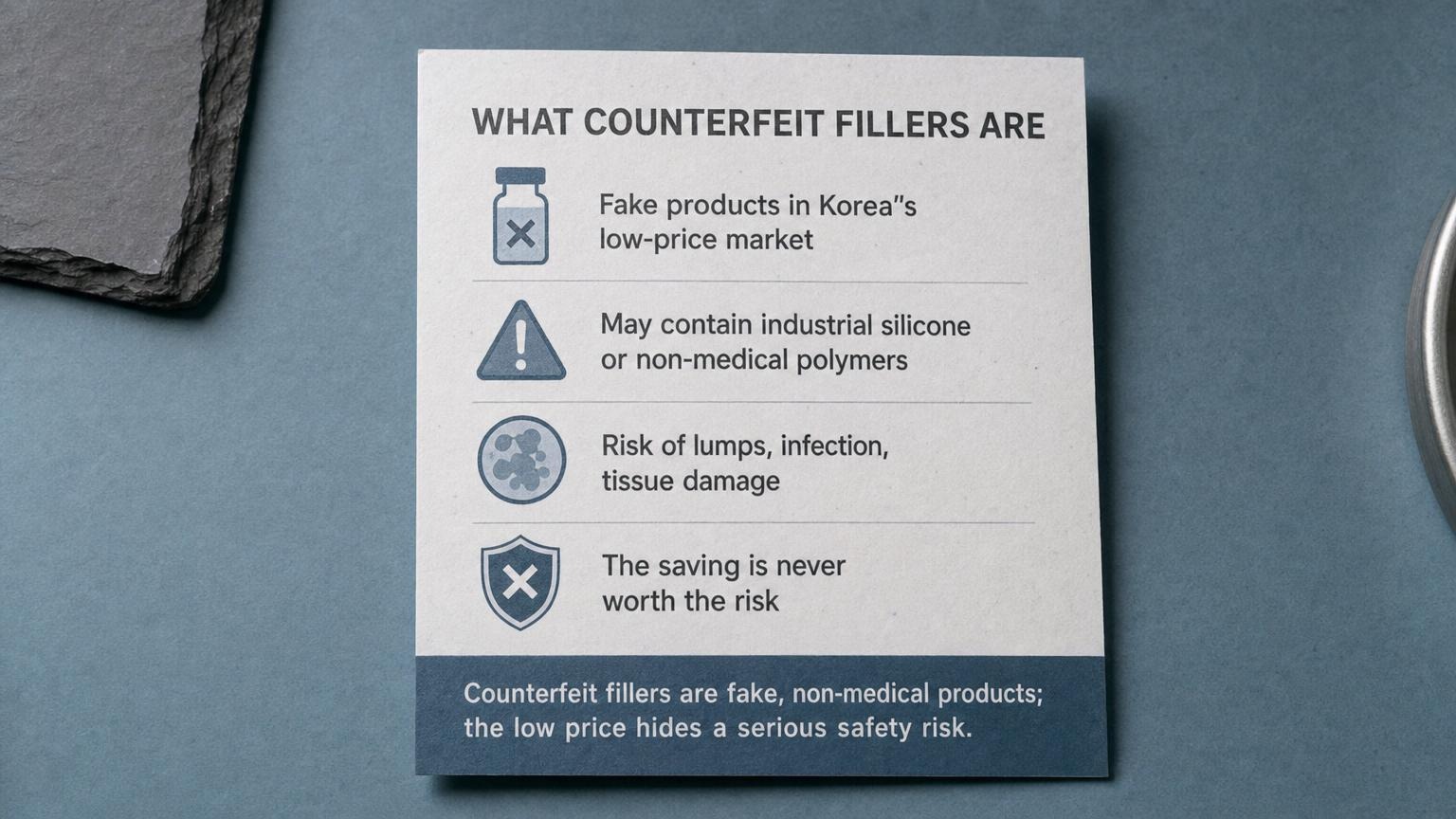
The problem sits at the bottom of Korea’s price range. Counterfeit fillers are fake products sold in the low-price market, and they may contain industrial-grade silicone, non-medical polymers, or improperly manufactured hyaluronic acid rather than a genuine, regulated filler. The risk is not cosmetic disappointment; it is medical harm, including permanent lumps, infection, and tissue damage that can require surgical removal. The low price is the bait, and the missing safety is the hidden cost.
The honest framing is that counterfeit fillers are fake, non-medical products whose low price hides a serious safety risk. In Korea, genuine dermal fillers are tightly regulated, generally classified as high-class medical devices requiring full pre-market review and certified manufacturing before they can legally reach the market. A counterfeit product bypasses all of that. This is why the same careful verification that applies to any injectable, covered across our clinic verification guide, matters so much for fillers specifically.
How to Verify Your Filler
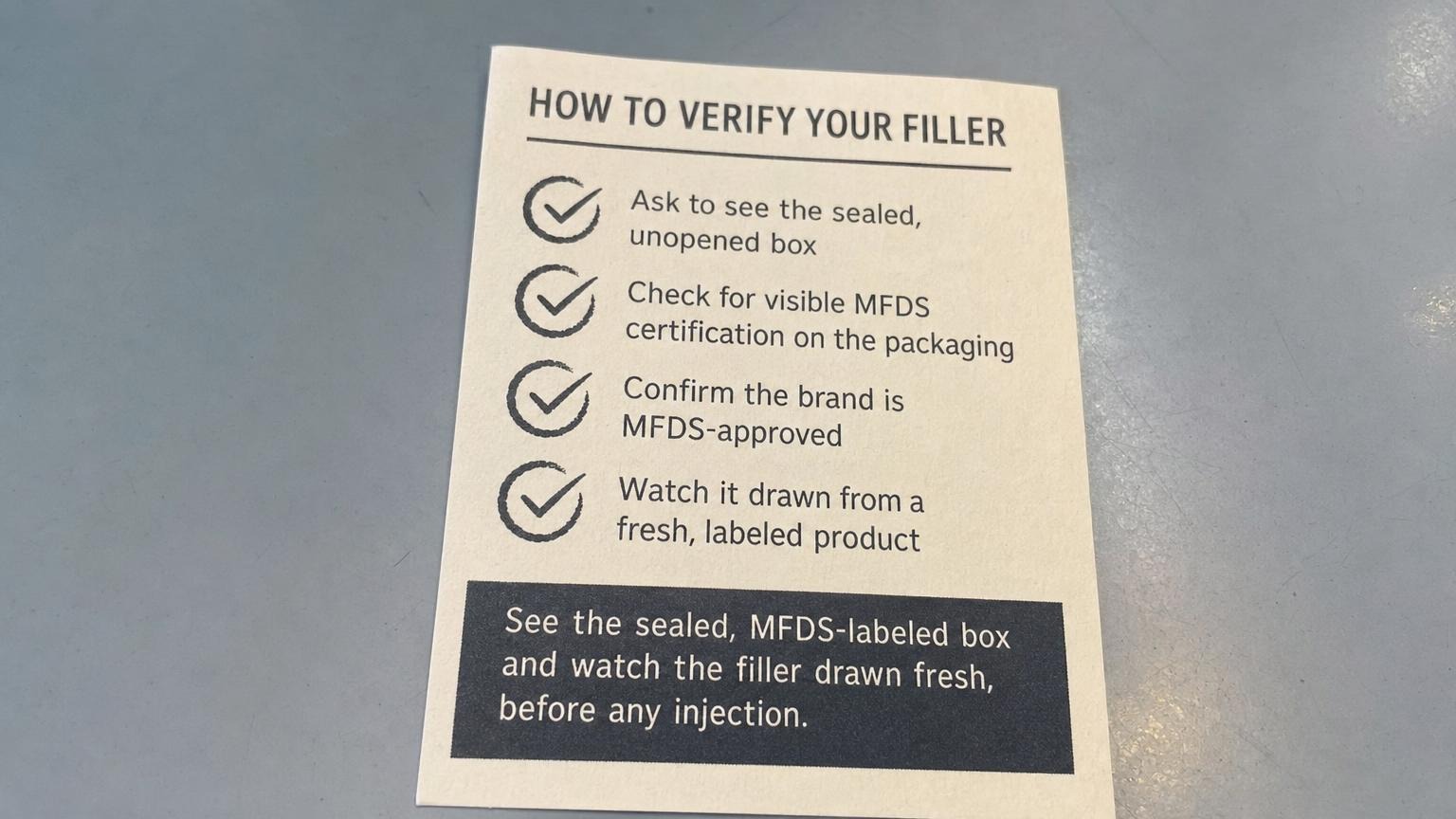
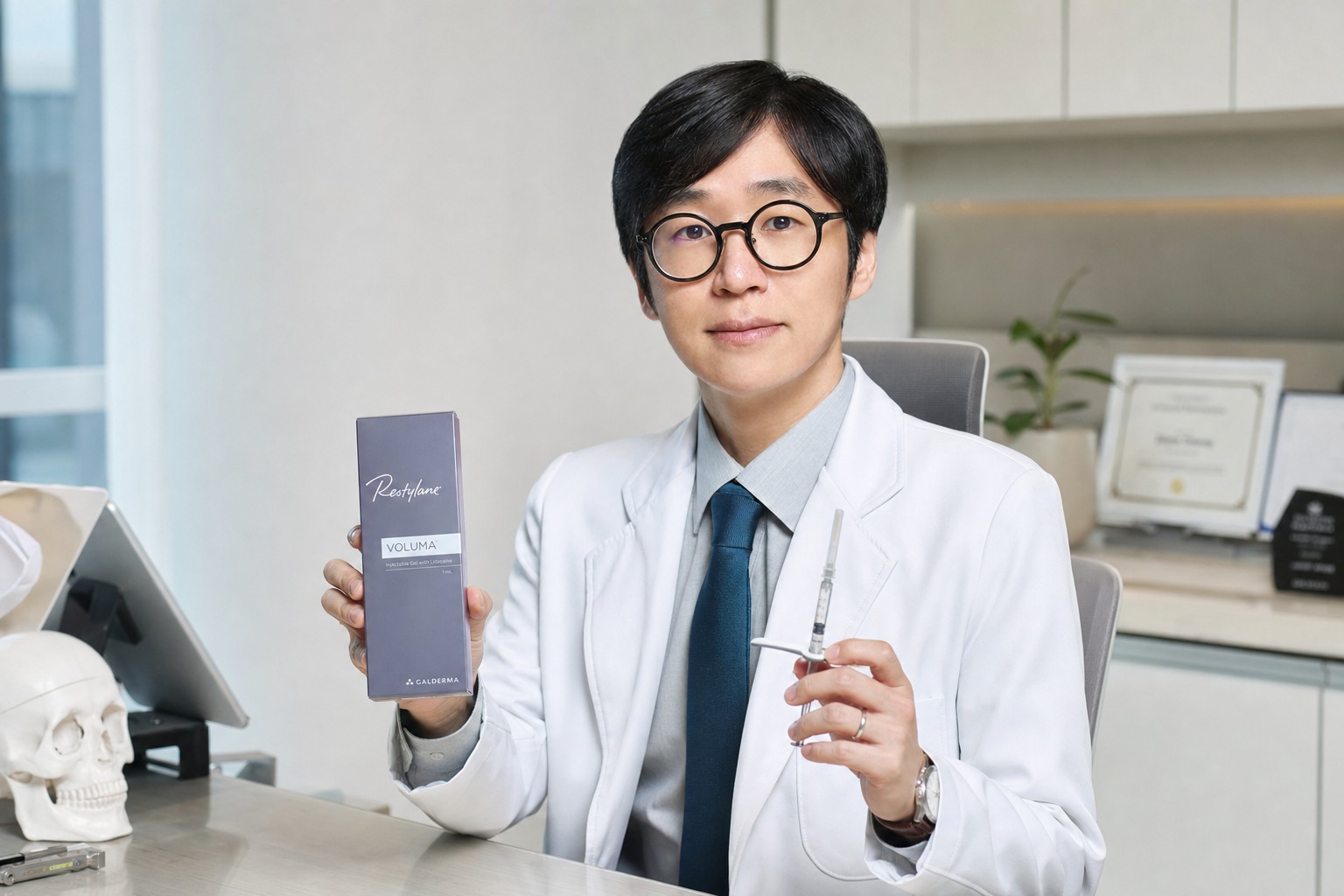
Verification is a short, reasonable checklist you carry out in the chair. Ask to see the sealed, unopened box before treatment. Check that the packaging shows visible MFDS certification. Confirm the brand is one of the MFDS-approved fillers a legitimate clinic uses. And watch the filler being drawn from a fresh, labeled product rather than accepting a syringe that is already filled. None of this is confrontational; it is simply confirming that what goes into your face is genuine.
The core rule is to see the sealed, MFDS-labeled box and watch the filler drawn fresh, before any injection. A reputable clinic does this without being asked, or is happy to when you do ask, because traceability protects them as much as you. Genuine Korean clinics use MFDS-approved products and can show you the packaging; that transparency is exactly what you are checking for. The same standard applies to the range of injectables and skin treatments offered at a proper non-surgical (petit) clinic, where each product is genuine and physician-administered.
When to Walk Away
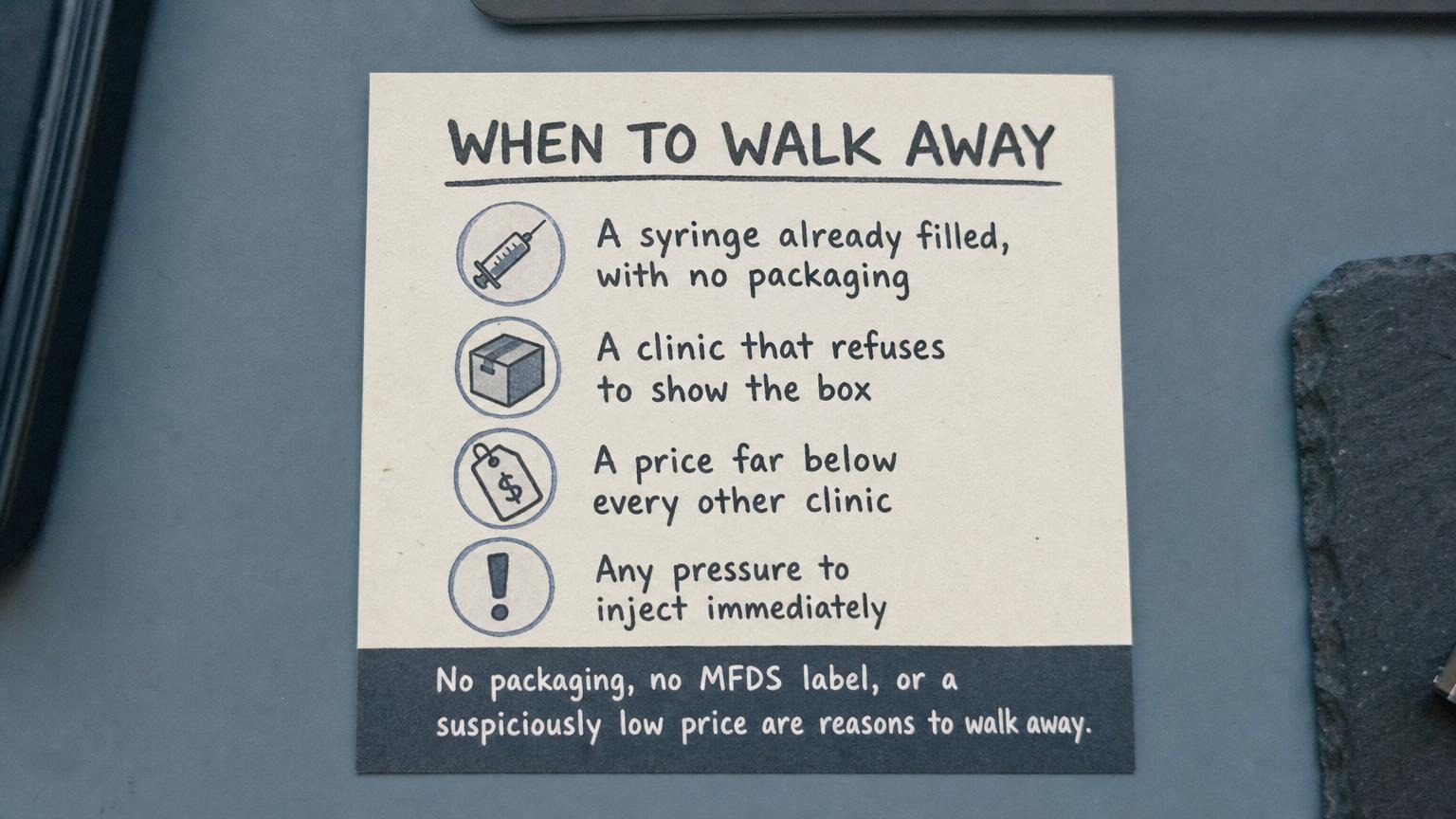
Some signs are clear enough that the right response is simply to leave. A syringe that is already filled, with no packaging to show. A clinic that refuses or deflects when you ask to see the box. A price that is far below every other clinic you have checked. And any pressure to inject immediately, before you have seen what is being used. Each of these, on its own, is a reason to pause; together, they are a reason to walk out.
The honest bottom line is that no packaging, no MFDS label, or a suspiciously low price are reasons to walk away. It can feel awkward to leave a clinic after arriving, but a filler injection is not reversible in the way a bad meal is, and the consequences of a counterfeit product are far worse than the inconvenience of rebooking. A clinic that cannot or will not show you a sealed, labeled, MFDS-approved product has told you everything you need to know. Trust that, not the discount.
Choose on Safety, Not Price
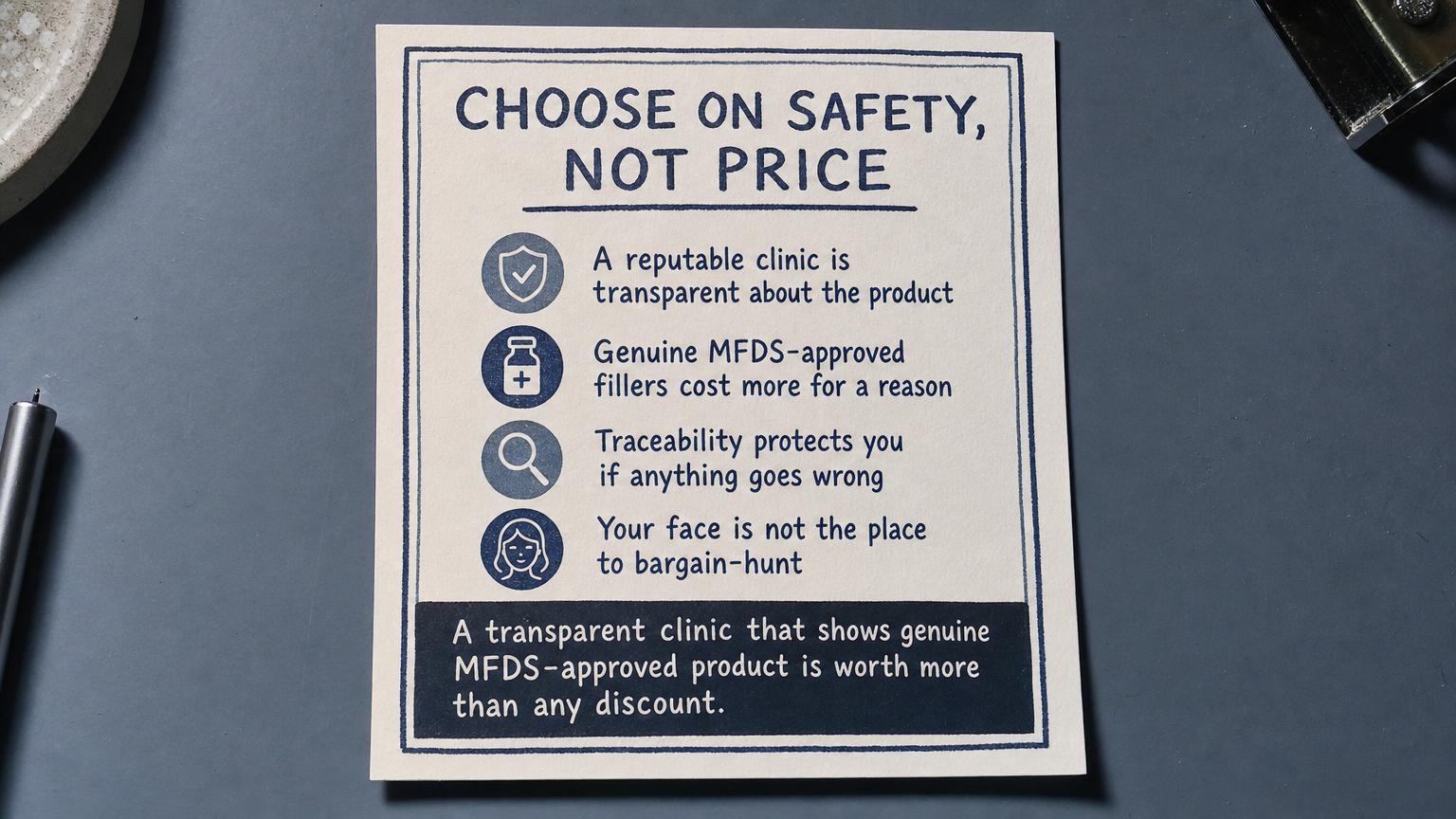
The whole issue comes down to one principle: your face is not the place to bargain-hunt. A reputable clinic is transparent about exactly which product it uses and shows you the packaging. Genuine MFDS-approved fillers cost more than counterfeits for a reason, because they are properly manufactured, regulated, and traceable. That traceability protects you if anything ever goes wrong, since a genuine product can be identified and addressed, while a fake one cannot. The saving from a counterfeit is never worth what you risk.
The honest framing is that a transparent clinic showing genuine MFDS-approved product is worth more than any discount. Filler prices in Korea vary widely, and the temptation to choose the lowest quote is understandable, especially for a visitor comparing options. But the difference between a real and a fake filler is not a matter of a better or worse result; it is a matter of safety. Choosing a clinic that verifies its products, and refusing anyone who cannot, is the single most important decision you make about a filler in Korea.
Cost and How to Plan It
Genuine, MFDS-approved fillers sit in a normal price band at reputable Korean clinics, and while that is generally still below Western prices, it is meaningfully above the counterfeit end of the market. The sensible way to plan is to get quotes from a few reputable clinics, understand the normal range, and treat any quote far below that range as a warning rather than a bargain. Budget for a genuine product from a transparent clinic, not the cheapest number you can find, because the cost of correcting the damage from a counterfeit filler dwarfs any saving.
Before any filler in Korea, five questions keep you safe. Have I seen the sealed, unopened box before treatment? Does the packaging show visible MFDS certification? Is the brand one this clinic can confirm is MFDS-approved? Is the price within the normal range rather than suspiciously low? And is the clinic transparent and unpressured when I ask these questions? A clinic that answers all five openly is the one to trust. For a consultation with a clinic that verifies its products, visit Link Plastic Surgery’s official website.
Frequently Asked Questions
1. Are counterfeit fillers really a problem in Korea?
Yes, at the low-price end of the market. Counterfeit dermal fillers, fake or non-medical products, are a real risk in Korea’s cheapest clinics, serious enough that regulators and agencies have publicly moved to combat counterfeit cosmetics in 2026. Genuine fillers are tightly regulated; counterfeits bypass that entirely. The good news is that verifying a real product is simple if you know what to check.
2. How do I know if a filler is genuine?
Ask to see the sealed, unopened box before treatment, check that it shows visible MFDS certification, confirm the brand is MFDS-approved, and watch the filler drawn from a fresh, labeled product. A reputable clinic does this readily. If you cannot see genuine, labeled packaging, you cannot confirm the product is real, and that is reason enough to stop.
3. What is MFDS certification?
MFDS is Korea’s Ministry of Food and Drug Safety, which regulates dermal fillers as high-class medical devices requiring pre-market review and certified manufacturing. Genuine fillers carry visible MFDS approval on their packaging. Seeing that certification on a sealed box is the simplest way to confirm a filler is a legitimate, regulated product rather than a counterfeit.
4. What are the risks of a counterfeit filler?
Counterfeit fillers may contain industrial-grade silicone, non-medical polymers, or improperly made hyaluronic acid, and can cause permanent lumps, infection, and tissue damage that may require surgical removal. The harm is medical, not just cosmetic. This is precisely why verifying the product before injection matters so much more than saving money on the price.
5. Why is a very cheap filler a red flag?
Because genuine, MFDS-approved fillers cost more to manufacture, regulate, and trace, a price far below every other clinic often signals a counterfeit or uncertified product. A low price is the bait; the missing safety is the hidden cost. Treat any quote well below the normal range as a warning to verify carefully or walk away, not as a bargain to grab.
6. Is it rude to ask to see the packaging?
No. Asking to see the sealed, MFDS-labeled box is a completely reasonable safety check, and a reputable clinic welcomes it because traceability protects them too. How a clinic responds is informative: openness confirms a genuine product, while deflection or reluctance is a warning. Never let the fear of seeming rude stop you from confirming what goes into your face.
7. What if the syringe is already filled when I arrive?
Be cautious. A syringe already filled with no packaging to show means you cannot verify the product, which is exactly the situation to avoid. Ask to see the sealed, labeled box the filler came from. If the clinic cannot produce it, or pressures you to proceed anyway, that is a strong reason to walk away rather than accept an unverifiable injection.
8. Which filler brands are MFDS-approved?
Korean clinics use a range of MFDS-approved fillers, both domestic and well-known international brands. Rather than memorizing names, the practical approach is to ask the clinic to confirm the specific product is MFDS-approved and to show you its labeled packaging. A legitimate clinic can do both; the verification matters more than any single brand name.
9. Does a higher price guarantee a genuine filler?
No, price alone is not proof; a high price with no verifiable packaging is still a risk. The reliable check is the sealed, MFDS-labeled box and confirmation that the brand is approved, not the number on the quote. That said, a suspiciously low price is a warning sign, so use both: verify the packaging and be wary of prices far below the normal range.
10. How do I plan a safe filler treatment in Korea?
Get quotes from a few reputable clinics to learn the normal range, then choose on transparency: a clinic that shows you the sealed, MFDS-labeled box, confirms the brand is approved, draws the product fresh, and answers your questions without pressure. Treat any suspiciously low price as a warning. For a consultation with a clinic that verifies its products, visit Link Plastic Surgery’s official website.
Information on counterfeit filler risks and Korea’s MFDS regulation is based on public guidance from Korea’s Ministry of Food and Drug Safety and industry reporting (Seoul Economic Daily and others), 2026. Always confirm product authenticity directly with your clinic.