Korean Liposuction for Foreign Patients: Why Seoul Surgeons Refuse the “BBL Mindset” (And Why That Saves Your Skin)
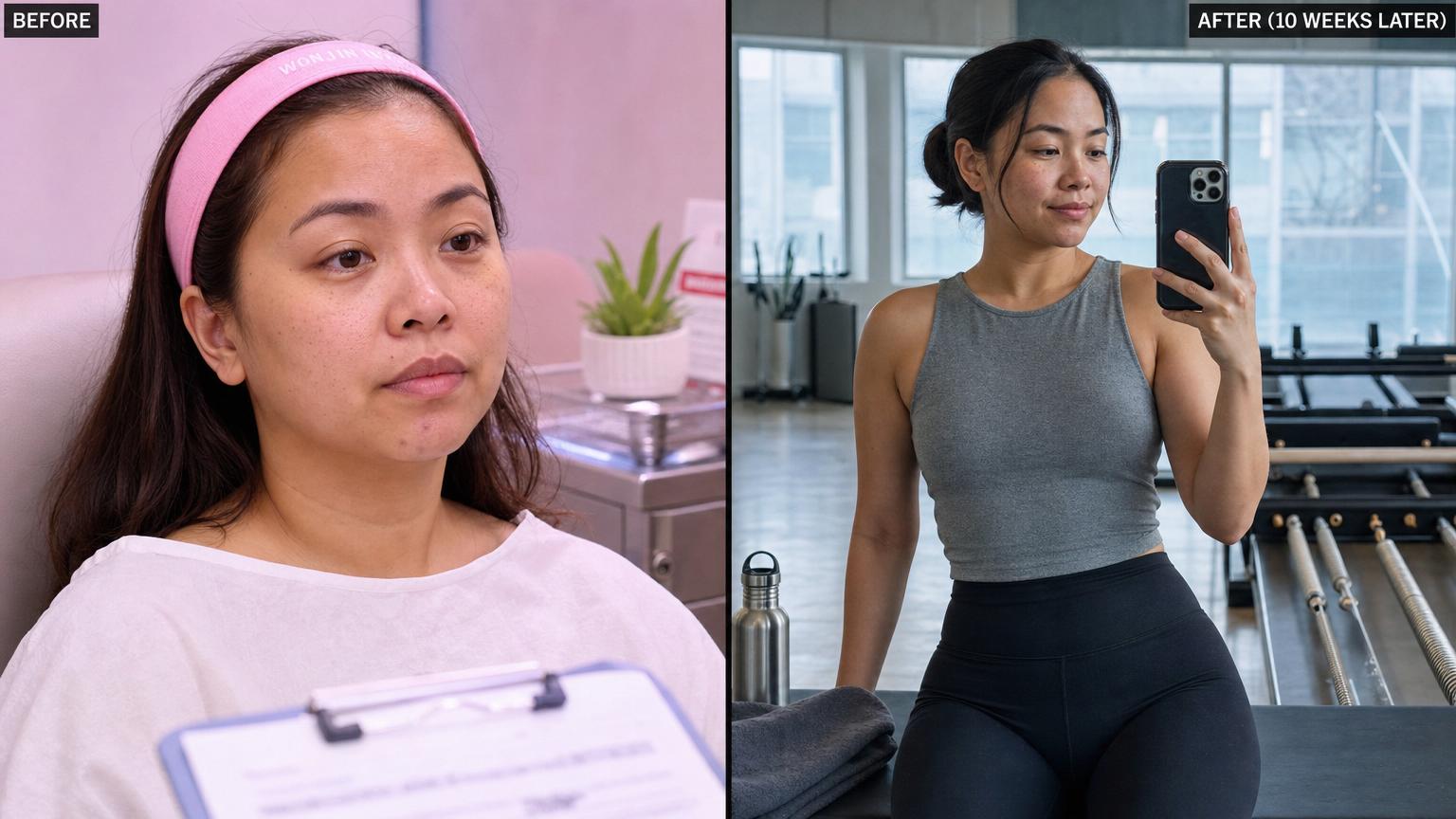
Foreign patients fly into Seoul with a specific request — remove as much fat as possible in a single session, the more the better. Korean surgeons say no, and that “no” is the entire point of why Korean liposuction has the reputation it does. The Korean approach is a preservation protocol, not a volume-maximization protocol. The cannula is small (2–3 mm, sometimes called micro-cannula), the technique is multi-layer rather than single-pass, and a deliberate 5 mm layer of subdermal fat is left intact to support skin retraction. The aggressive Brazilian and US “BBL mindset” — large-bore cannulas, single-overshoot sessions of 500 ml or more per zone, lipo-360 packages — produces the skin rippling, contour irregularity, and “shelf” deformities that haunt liposuction patient forums. Korean protocol stays at 180–300 ml per zone per session, accepts that two sessions may be needed for some patients, and treats the skin envelope as an asset to protect rather than a wrapper to thin. The result is slower in execution but kinder to the long-term silhouette. Note also that Korean clinics generally do not market “lipo-360” — that is a US and Latin American marketing term, not a Korean protocol.
This guide is for the foreign patient who has read US or Brazilian liposuction marketing, has seen aggressive single-session before-and-afters on social media, and is trying to figure out why the Seoul surgeons they consulted with are recommending a more conservative plan. It explains what Korean liposuction actually is at the technique level, why the Korean philosophy diverges from BBL-mindset volume maximization, which zones Korean clinics will and will not treat, the realistic week-by-week recovery, and how to verify a clinic. It draws on the protocol Korean clinics — including Link Plastic Surgery‘s body menu — apply across patients flying in for body contouring rather than weight loss.
Section 1 — What Korean Liposuction Actually Is
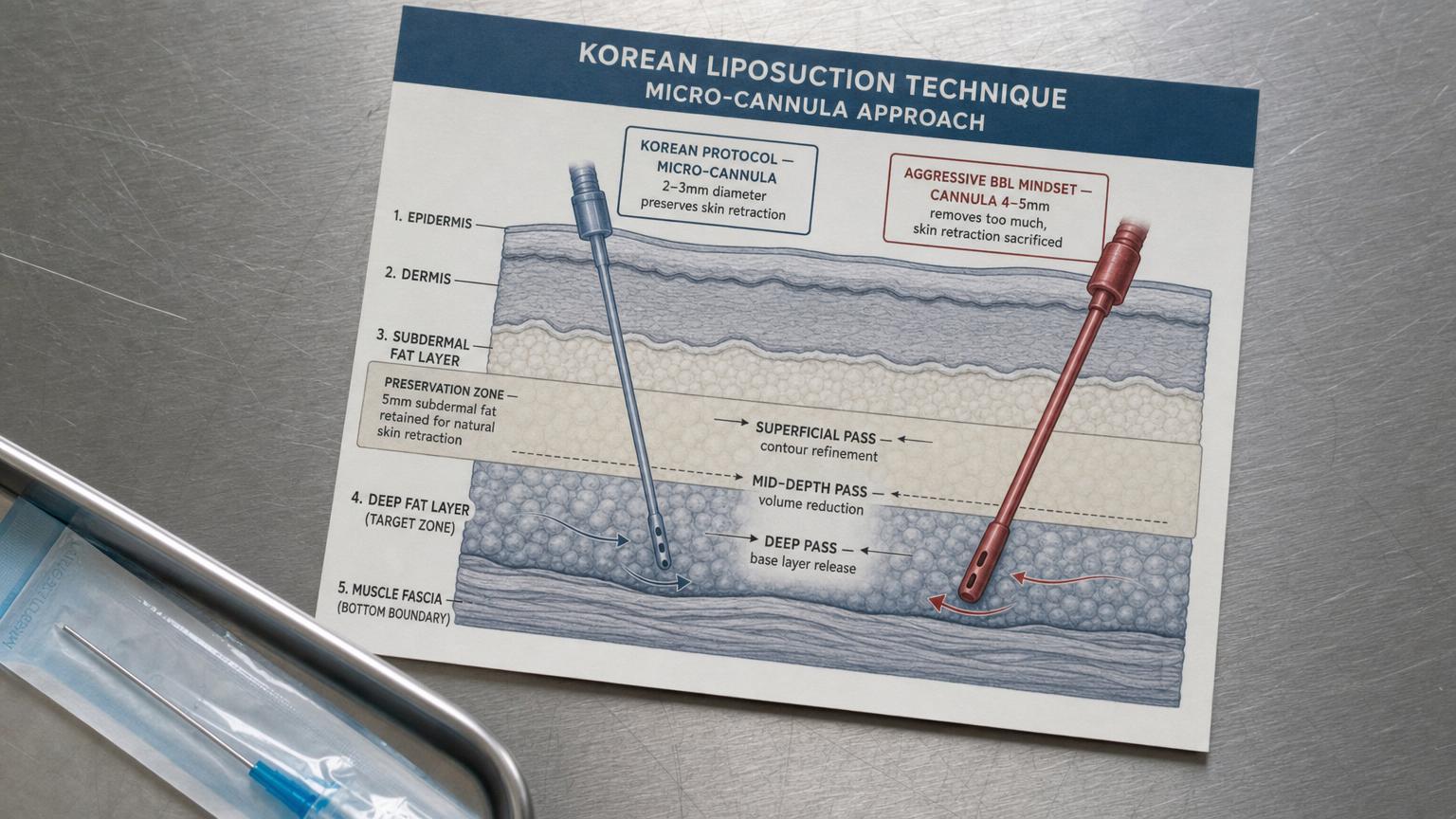
Korean liposuction is built around three technical commitments that, taken together, look unusual to a Western patient who has read BBL-mindset marketing. The cannula diameter is smaller than Western standards. The aspiration is performed in multiple anatomical layers rather than a single deep pass. And a deliberate residual subdermal fat layer is preserved to support skin contraction. Each of these is a deliberate choice with a specific reason behind it.
The 2–3 mm Micro-Cannula
Western liposuction often uses 4–5 mm cannulas, sometimes larger, because larger-bore cannulas aspirate faster and reduce operative time. Korean liposuction defaults to 2–3 mm micro-cannulas. The trade-off is real — micro-cannulas remove fat more slowly, so the procedure takes longer for the same volume of aspirate. The reason Korean clinics accept that trade-off is precision. A 2–3 mm cannula tunnels through fat in smaller pathways, which means the surgeon can sculpt contour more granularly, avoid the deep “channel” tracks that larger cannulas leave behind, and stay further away from the dermis and the perforating vessels that supply it. The smaller cannula is the technical foundation of why Korean liposuction tends to leave a smoother contour even when the volume removed is modest.
Multi-Layer Aspiration
Western single-pass liposuction typically removes fat from the deep layer first and stops there. Korean multi-layer technique aspirates the deep layer, then the intermediate layer, then carefully feathers the superficial layer above it, with the surgeon switching cannula angles to avoid overlapping passes. The reason for multi-layer technique is contour control. Single-layer removal can leave the superficial fat intact and create a “shelf” where the treated zone meets untreated tissue. Multi-layer feathering blends the transition, which is why Korean post-operative contours often look continuous rather than carved.
The Preserved 5 mm Subdermal Layer
This is the single most important divergence from BBL mindset. Korean surgeons deliberately leave a 5 mm layer of subdermal fat intact under the skin — they do not aspirate down to the dermis. The reason is skin retraction. After fat is removed, the overlying skin needs to contract to the new underlying volume. Skin contraction depends on the subdermal vascular plexus (the small vessels just under the skin that supply blood to the dermis) and on the connective tissue septa that anchor skin to deeper structures. Aspirating too close to the dermis disrupts both. The skin then either fails to retract (producing loose, hanging skin) or retracts unevenly (producing the rippling, “orange peel” texture, or contour irregularity that liposuction patient forums document extensively). Korean protocol treats the 5 mm subdermal layer as untouchable. The result is fewer cases of post-liposuction skin ripple and a better final silhouette even when the volume removed is more conservative.
Volume Per Session — 180 to 300 ml Per Zone
Korean clinics generally remove 180–300 ml of fat per zone per session. A bilateral flank treatment, for example, might total 400–600 ml across both sides. An abdomen treatment might total 500–800 ml across upper and lower abdominal zones. The aggressive Brazilian or US single-session liposuction patient may have 3,000–5,000 ml of aspirate from a combined lipo-360 package — the Korean approach is dramatically more conservative per visit. Patients who need more contouring than a conservative session can deliver are scheduled for a second session 3–6 months later, after the first round has fully healed and the surgeon can re-evaluate which residual contour issues remain. This is the right answer for two reasons: it limits the per-session physiologic load (less anesthesia exposure, less swelling, less risk of seroma and fluid shift) and it gives the surgeon a chance to fine-tune contour with full information about how the patient’s tissue responded to the first round.
Section 2 — Korean Protocol vs the BBL Mindset
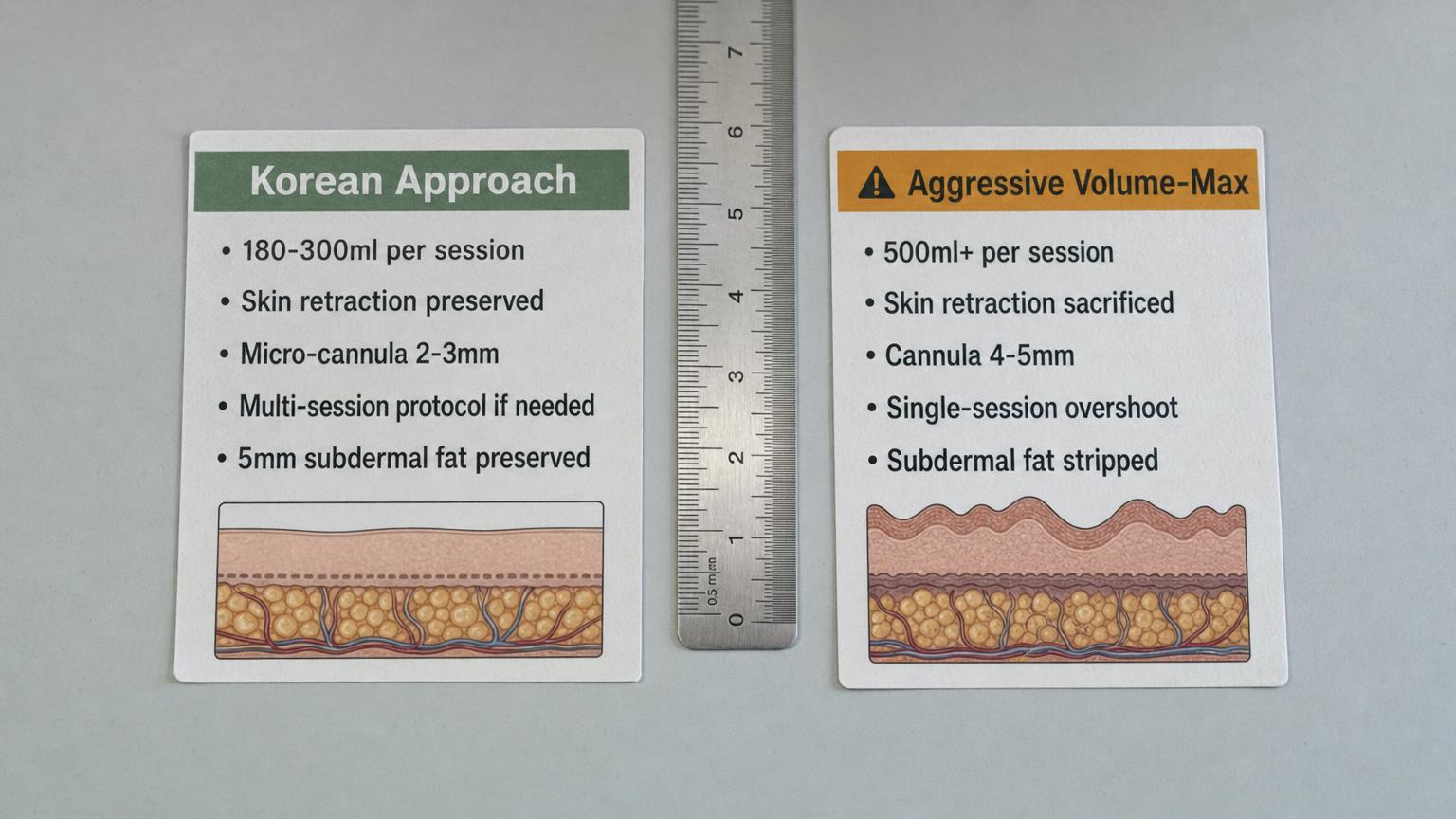
The “BBL mindset” is shorthand for a particular philosophy of liposuction that became dominant in Brazilian and US aesthetic surgery over the last two decades — high-volume aspiration in a single session, often coupled with fat transfer to the buttocks (the actual Brazilian Butt Lift), aggressive cannula sizes, and the marketing concept of “lipo-360” as a complete circumferential contouring package. Korean liposuction practice rejects the volume-maximization framing at almost every step, for reasons that are visible in the side-by-side comparison.
Side-by-Side: What Diverges
- Volume per session. BBL-mindset clinics aspirate 500 ml or more per zone (commonly 1,000 ml from the abdomen alone) and may exceed 4,000–5,000 ml total in a single visit. Korean clinics stay at 180–300 ml per zone, totaling 800–1,500 ml across a multi-zone session. The Korean ceiling is dictated by what the patient’s tissue and skin can safely accommodate without compromising retraction; the BBL ceiling is dictated by what the patient asked for.
- Cannula diameter. BBL-mindset technique uses 4–5 mm cannulas, sometimes 6 mm for the deepest zones, for faster aspiration. Korean technique uses 2–3 mm micro-cannulas for precision. The Western argument is that time on the table is itself a risk factor; the Korean counter-argument is that contour quality and skin survival are also risk factors, and they accept the longer operative time.
- Strategy across visits. BBL mindset treats the procedure as a single-overshoot event — remove all the targeted fat at once, accept whatever skin issues develop, and revise if needed. Korean strategy treats the procedure as iterative — conservative removal first, full healing for 3–6 months, then a second session if residual contour issues remain. The iterative approach front-loads less risk but takes longer to reach the final result.
- Skin envelope. BBL mindset accepts skin issues (rippling, looseness, contour irregularity) as a known cost of high-volume aspiration and often addresses them with secondary treatments (radiofrequency tightening, fat transfer to mask irregularities, surgical excision). Korean philosophy treats skin retraction as a primary outcome and accepts smaller per-session volume as the price of better skin behavior.
- Lipo-360 framing. Korean clinics generally do not use the term “lipo-360” in marketing or consultation. The phrase is US and Latin American — it refers to a packaged circumferential trunk liposuction often combined with fat transfer. Korean clinics will treat the same anatomical zones individually (flanks, abdomen, back), but they will rarely commit to all of them in a single session and they will not market the package under that name. Patients who walk in asking specifically for “lipo-360” are gently redirected toward a multi-zone, multi-session Korean plan.
Why Korean Patients (and Surgeons) Accept the Slower Plan
The trade-off is clear and it is honestly explained during Korean consultations: more visits, more total time, slower path to the final result, but better skin behavior and lower revision rates. Korean patients accept this because the cultural expectation is for natural-looking results that age well, not dramatic single-session transformations. Foreign patients who arrive with the BBL-mindset framing — single session, maximum aspiration, fast result — find the conservative plan frustrating until they understand the trade-off. The patients who do best are the ones who reframe the trip: this is the start of a 6–12 month contouring process, not a one-and-done event.
What Korean Surgeons Will Say “No” To
Korean clinics routinely decline requests that the patient considers reasonable. The most common refusals: aspirating more than 300 ml per zone in a single session, treating more than 4 zones in a single session, treating BMI patients above approximately 28–30, performing simultaneous fat transfer to the buttocks at high volumes (the BBL component itself is high-mortality elsewhere and Korean clinics will not run it aggressively), and treating patients seeking weight loss rather than contour. A clinic that agrees to all of these requests is a clinic that has dropped the Korean protocol. A clinic that pushes back is a clinic still running it.
Section 3 — Which Zones Korean Clinics Will Treat
Korean liposuction is contour-driven, not weight-loss-driven, so the zones that get treated are the zones where contour matters — places where stubborn fat persists despite diet and exercise and where removing it changes the overall body line. A diet-resistant zone with otherwise good skin tone is an excellent candidate. A zone where the underlying issue is weight, skin redundancy, or muscle definition is not.
Recommended for Your Recovery
Products commonly used before and after Korean liposuction micro cannula — same items routinely recommended in the recovery instructions Seoul clinics hand out at discharge.
- Arnica Montana Tablets — start 3 days before body surgery to reduce bruising in the treated zone. Check price on Amazon
- Silicone Scar Sheets — cut to size and apply over incision lines starting week 3 to flatten scar formation. Check price on Amazon
- Beauty of Joseon Relief Sun SPF 50+ — daily UV protection on healing scars — sun exposure during the first 6 months drives post-inflammatory pigmentation. Check price on Amazon
- COSRX Advanced Snail 96 Mucin Power Essence — gentle Korean skin essence to support overall skin barrier during the recovery window. Check price on Amazon
As an Amazon Associate, GlobalBeautySpot earns from qualifying purchases at no extra cost to you.
Standard Zones Korean Clinics Approve
- Flanks (love handles). The lateral waist between the rib cage and the iliac crest. One of the highest-satisfaction Korean liposuction zones because the fat is typically diet-resistant and the skin in the area retracts well. Treatment is usually bilateral in a single session, 200–300 ml per side, with multi-layer technique to blend the transition into the upper back and lower abdomen.
- Outer thigh (saddlebag). The lateral upper thigh below the iliac crest. Another high-satisfaction zone because the fat sits in a discrete subdermal pocket. Treatment is typically bilateral, 200–300 ml per side, with feathering into the buttock crease to avoid creating a “shelf.”
- Inner thigh. A more selective zone — the skin here is thinner and retraction is less predictable, so Korean clinics are conservative with volume (often 150–200 ml per side) and prioritize feathering over volume removal. Patients with mild laxity in the inner thigh are warned that skin tightening may need to be added later.
- Upper arm (bingo wing). Conservative volumes here, 150–250 ml per side, with deliberate preservation of the subdermal layer to avoid post-operative skin laxity. Korean clinics often discourage liposuction in upper arm patients who have significant skin redundancy already — surgical brachioplasty is the more honest answer in those cases.
- Submental (under the chin). Korean liposuction is well-suited to submental contour because the area is small, the volume needed is modest (typically 30–80 ml total), and the result is visible from day one with minimal recovery. Often combined with masseter botox or thread lifting for jawline definition.
- Abdomen. Korean clinics treat upper and lower abdominal fat as separate zones, often in separate sessions, following the multi-zone framework documented on Link Plastic Surgery’s liposuction page. Total session volume across both abdominal zones rarely exceeds 800 ml. Patients with diastasis recti or significant skin redundancy from pregnancy are redirected to abdominoplasty or combined procedures rather than liposuction alone.
What Korean Clinics Decline
- General weight loss. Liposuction is not a weight-loss procedure in Korean practice. Patients seeking 5–10 kg of weight reduction are redirected to nutrition and exercise programs. A patient who arrives 10 kg overweight and asks for liposuction will be told to lose the weight first and return for contour work after.
- BMI above 28–30. Korean clinics typically enforce a BMI cutoff around 28, with some clinics extending to 30 for selected patients with good skin tone. Above that range, the risks of high-volume aspiration outweigh the contour benefit, and patients are referred to bariatric or dermatological alternatives.
- Aggressive BBL (high-volume fat transfer to buttocks). The Brazilian-style large-volume BBL has a documented mortality risk from fat embolism. Korean clinics either decline BBL or perform it at small volumes (under 300 ml per side) with subcutaneous placement only — never intramuscular.
- Single-session lipo-360 packages. Korean clinics will treat the constituent zones but will not commit to circumferential trunk liposuction in one visit at the volumes typical of US lipo-360 protocols. The same zones can be treated across two visits with better skin behavior.
- Patients with significant skin redundancy. If the underlying issue is loose skin (post-pregnancy abdomen, post-major-weight-loss arms, aging neck), liposuction alone will not fix it. Korean clinics are honest about this and redirect to combined liposuction + skin excision procedures or to surgical lift alternatives.
Section 4 — Recovery Timeline Week by Week

Foreign patients planning a Korea trip for liposuction need realistic expectations about the recovery window, because compression-garment compliance is a major predictor of the final contour and most foreign patients underestimate the duration. The Korean protocol asks for 4–6 weeks of consistent compression garment wear (23 hours a day for the first 2 weeks, then 12–16 hours for weeks 3–6), with full activity resumption at 6 weeks. Patients who plan a Korea trip of 1 week and expect to leave fully recovered are reading the wrong timeline.
Day 0 — Surgery Day
Anesthesia is typically intravenous sedation with local infiltration (tumescent solution) at the treatment zones. General anesthesia is reserved for very large multi-zone cases. The procedure for a typical 2–3 zone case takes 1.5–2.5 hours. Immediately after, the patient is dressed in a compression garment in the operating room — it goes on before the patient is fully awake and stays on continuously. Most patients spend 1–2 hours in recovery and go home the same day. Patients who flew in are typically staying at a nearby hotel for 5–7 days minimum.
Days 1 to 3 — Peak Swelling and Drainage
The first three days are the most uncomfortable. Tumescent solution that was infiltrated into the treatment zones drains slowly through the small entry incisions — this is normal and expected, and patients are told to expect pink-tinged drainage on the compression garment and bed linens for 24–72 hours. Swelling peaks at days 2–3 and can make the treated zones look paradoxically larger than they did before surgery. This is the most common moment when foreign patients panic. The clinic reassurance is that swelling has not yet started to resolve and the final contour cannot be evaluated for at least 6 weeks. Pain is moderate and managed with oral analgesics; most patients do not need opioids beyond the first 24 hours.
Day 7 — Suture Removal
The small entry incisions (typically 3–4 mm) have a single suture each. These are removed at the day-7 clinic visit. Most foreign patients schedule their flight home for day 8 or later so they can have the suture removal done by the operating clinic rather than at home. The clinic also reviews the compression garment fit at this visit — if swelling has shifted the garment fit, an adjustment or replacement garment is provided.
Day 14 — First Real Shower and Garment Wash
For the first 14 days the compression garment stays on continuously except for very brief wipe-downs. At day 14 the patient can shower normally and the garment can be removed for washing (clinics recommend having two garments to alternate). This is also the moment patients first see themselves without compression, and the contour is still distorted by swelling — patients are warned in advance not to evaluate the result at this stage.
Weeks 3 to 6 — Compression Compliance Window
Weeks 3 through 6 are when most foreign patients fail compliance and end up with worse final contour than they could have had. The garment requirement at this stage is 12–16 hours per day, which is annoying but manageable. The patients who wear it consistently see smoother contour at week 6 than the patients who decided after week 2 that they had “healed enough” to skip it. This is the single most important behavior that distinguishes good outcomes from mediocre ones, and Korean clinics emphasize it heavily during pre-operative consent. The compression garment is not a comfort item — it is shaping the final result by encouraging the skin envelope to retract evenly onto the new underlying contour.
Week 6 — Garment Removal and Activity Resumption
At the 6-week mark the compression garment can be discontinued for most patients (some clinics extend it to 8 weeks for larger-volume cases). Full activity, including unrestricted exercise, weight lifting, and inverted positions, resumes. The contour at week 6 is approximately 70% of final — there is still residual swelling that will resolve over the following 2–3 months.
Month 3 — Settled Contour

By the 3-month mark the contour has fully settled. This is the photograph the Korean clinic will reference when evaluating the result. Patients describe themselves as “looking like a slimmer version of myself” rather than “looking different.” The change is visible to people who knew the patient before but is not dramatic in the way BBL-mindset transformations are. Patients who wanted a more dramatic change are evaluated at this point for a second-round session; the surgeon can now see exactly which residual contour issues remain and target them with a much smaller second procedure (often 60–90 minutes, single zone, with 2 weeks of compression).
Months 6 to 12 — Final Result and Skin Retraction
Final skin retraction is not complete until 6–12 months after the procedure. Patients with excellent skin tone (typically under 35 years old) reach full retraction by month 6. Patients with moderate skin tone (35–50 years old) reach full retraction by month 9–12. Patients older than 50, or patients who lost significant weight before the procedure, may have residual mild skin laxity that does not resolve with additional time — these patients are sometimes scheduled for radiofrequency skin tightening or, in more substantial cases, surgical excision to address the residual laxity.
Section 5 — Cost, Verification, and Coordinating With Other Korean Procedures
Korean liposuction is competitively priced relative to US, Australian, and UK liposuction, primarily because Korean clinics have settled into specific zone-based protocols and the volume of patients per clinic keeps per-zone costs predictable. The Korean price advantage is most pronounced for multi-zone cases.
| Region | Liposuction Cost | Notes |
|---|---|---|
| Korea (Seoul) — Single zone (e.g. flanks) | KRW 2,500,000–4,500,000 (USD 1,850–3,330) | Includes anesthesia, compression garment, follow-up visits |
| Korea (Seoul) — Multi-zone (3–4 zones) | KRW 6,000,000–11,000,000 (USD 4,440–8,150) | Most common foreign patient package, single-day procedure |
| Korea (Seoul) — Submental only | KRW 1,500,000–3,000,000 (USD 1,110–2,220) | Short procedure, 30–80 ml total, minimal compression |
| USA — Single zone | USD 3,500–7,500 | Wide variation by region and surgeon experience |
| USA — Multi-zone | USD 8,000–18,000 | Often packaged as “lipo-360,” frequently higher-volume protocols |
| Australia — Multi-zone | AUD 10,000–22,000 | Conservative volume protocols closer to Korean practice |
| UK / EU — Multi-zone | GBP 6,000–14,000 | Available in cosmetic surgery and dermatology clinics |
The Korean pricing typically includes anesthesia, the first compression garment, and follow-up visits through the 6-week mark. Patients who need a second garment (often the case at the day-14 to week-3 wash schedule) pay separately. International patients should also budget for hotel accommodation for 7–10 days minimum and additional follow-up consultations if combining with other procedures.
Coordinating With Other Korean Body and Contour Procedures
Liposuction is rarely the only thing a foreign patient is doing on a Korea trip, and the Korean clinic protocol is helpful at coordinating multiple procedures to keep recovery overlapping cleanly.
- Postpartum patients combining liposuction and abdominoplasty. Patients with both diastasis recti and stubborn fat after pregnancy are often candidates for combined liposuction and abdominoplasty. Korean surgeons typically perform these in a single operative session — the liposuction is conservative (preserves the abdominoplasty skin flap blood supply) and the tummy tuck is performed through the same incision plan. Recovery is dominated by the abdominoplasty timeline (4–6 weeks) rather than the liposuction timeline. This combination is one of the most common foreign-patient bookings in the body category.
- Breast augmentation combined with liposuction. Patients having breast augmentation sometimes add flank or upper-abdomen liposuction in the same operative day. Korean clinics will agree to this if total operative time stays under approximately 4 hours and total aspirate stays under 1,500 ml — beyond that, the procedures are split across two days for safety. The compression schedule overlaps but is manageable.
- Fat harvesting for facial fat grafting. Patients booking facial fat grafting need fat harvested from a donor site — typically the lower abdomen or inner thigh. Korean clinics treat this as a courtesy aspiration rather than full liposuction (only 50–100 ml needed, vs 300+ ml for body contouring), so it does not count as a separate liposuction zone. Patients who want both body contouring liposuction and facial fat grafting are scheduled with the body contouring first and the facial grafting at a later visit, since the fat survival rate is higher when harvested at modest volume from a non-contoured donor site.
- Submental liposuction alongside jawline procedures. Submental liposuction is commonly combined with masseter botox and PDO thread lifting for comprehensive jawline definition. The three procedures address different layers — submental fat (volume), masseter (muscle bulk), and threads (skin and SMAS lift) — and together produce the V-line silhouette that submental liposuction alone cannot deliver.
Five Questions to Ask Any Liposuction Clinic in Korea
- What cannula size do you use, and why? The right answer is 2–3 mm micro-cannula for body zones, with a specific reason tied to contour precision and skin envelope preservation. A clinic that uses 4 mm or larger cannulas as default is running a more aggressive protocol than the Korean standard and the patient should understand the trade-off.
- How much volume do you typically remove per zone per session? The right answer is 180–300 ml per zone, with the rationale that higher volumes compromise skin retraction. A clinic that volunteers it can aspirate 500 ml or more per zone is selling a BBL-mindset protocol, not a Korean one.
- How thick is the subdermal layer you leave intact? The right answer is approximately 5 mm, with the rationale that this preserves the subdermal vascular plexus and supports skin contraction. A clinic that has not thought about this question is either inexperienced or running aggressive technique.
- What is your protocol if I need a second session for residual contour issues? The right answer is a 3–6 month wait, then re-evaluation, then a smaller targeted second procedure. A clinic that promises a “guaranteed final result in one session” is overselling. A clinic that talks honestly about staged contouring is running the Korean protocol.
- What BMI cutoff do you enforce, and what do you tell patients above it? An honest clinic enforces approximately 28–30 BMI and redirects patients above that to weight loss before contouring. A clinic that agrees to operate on a patient at BMI 33 is taking on more physiologic risk than the Korean standard supports.
Frequently Asked Questions
Is liposuction a weight-loss procedure?
No. Korean liposuction is a contour-shaping procedure, not a weight-loss tool. Patients typically lose 1–3 kg of total weight from a multi-zone session, which is a function of the fat volume removed plus residual swelling resolution. Patients seeking 5–10 kg of weight reduction are redirected to diet and exercise programs. The most satisfied liposuction patients are within 10% of their goal weight and have diet-resistant pockets of fat in specific zones.
Why do Korean clinics enforce a BMI cutoff?
BMI above approximately 28–30 increases the risks associated with high-volume aspiration (fluid shifts, anesthesia load, post-operative seroma and infection) and reduces the predictability of skin retraction. Korean clinics typically enforce a BMI cutoff around 28, with some clinics extending to 30 for selected patients with good skin tone. Above that range, the risks outweigh the contour benefit. Patients with higher BMI are advised to lose weight first and return for contour work after.
How many sessions will I need?
Most patients (around 70–80%) need only one session for their primary contour goals. Patients with more substantial volume to remove, with multiple body zones, or with asymmetric fat distribution may need a second session 3–6 months after the first. The Korean approach is to do the first session conservatively, let the result fully settle, and only then decide whether a second targeted session is needed — this produces better final contour than a single overshoot session aiming to “do everything at once.”
Why does Korean liposuction use such small cannulas instead of the larger ones I have read about?
The 2–3 mm micro-cannula is slower to aspirate but produces more precise contour and stays further from the dermis and the perforating vessels that supply it. Larger cannulas (4–5 mm and above) aspirate faster but leave deeper tunnel tracks and increase the risk of skin envelope compromise. Korean technique accepts the longer operative time as the price of better contour and lower revision rates.
What happens if I do not wear the compression garment consistently?
Compression garment compliance is one of the strongest predictors of the final contour. Patients who skip the garment after the first 2 weeks tend to have residual swelling that persists longer, less even skin retraction, and a higher rate of contour irregularity at the 3-month mark. The garment is not a comfort item — it is shaping the final result by encouraging the skin envelope to retract evenly onto the new underlying contour. Korean clinics emphasize this heavily during pre-operative consent, and the patients who do best are the ones who treat the garment as part of the procedure rather than as an optional accessory.
Will there be visible scars from liposuction?
The entry incisions are small (3–4 mm each) and are placed in inconspicuous locations — within natural skin folds, at the lateral hip, behind the ear for submental, or at the umbilicus for abdominal cases. Each zone typically requires 2–3 entry points. By 6–12 months the scars mature to fine pale lines that are difficult to see in normal lighting and are usually hidden by underwear or swimwear. Patients with darker skin tones may experience temporary post-inflammatory hyperpigmentation at the entry sites that resolves over 6–9 months.
Can men get liposuction in Korea?
Yes, and male patients are a substantial portion of Korean liposuction practice. Common zones for men are the flanks (love handles), upper abdomen, submental, and gynecomastia (chest tissue). The technique is identical to the female protocol, but volumes and contour goals are different — male patients typically want muscle definition emphasized rather than overall softness, so the surgeon shapes around the underlying musculature (rectus abdominis edges, oblique borders, pectoral edges) to produce a more athletic line. Compression garment requirements are the same as for female patients.
I had a baby last year and still have stubborn belly fat plus loose skin. Is liposuction the answer?
If the dominant issue is loose skin and diastasis recti (the abdominal muscle separation that often follows pregnancy), liposuction alone will make the loose skin worse, not better. Removing fat from under loose skin produces more hanging skin. The honest Korean answer in this case is combined liposuction plus abdominoplasty (tummy tuck), or abdominoplasty alone if the fat component is modest. A self-assessment: lie on your back, lift your head and shoulders slightly, and feel the gap between the two sides of the abdominal wall with your fingers — a gap wider than 2 finger-widths suggests diastasis recti and means liposuction alone is not the right answer.
Can foreign patients realistically do liposuction in a single Korea trip?
Yes, for single-zone or modest multi-zone cases. The minimum trip length is 7–10 days — day 0 procedure, day 7 suture removal, day 8+ flight home. For patients combining liposuction with abdominoplasty or breast augmentation, the trip length extends to 14–21 days because the larger procedures have longer immediate recovery and require more clinic follow-up before flying. Patients who anticipate needing a second session schedule it 3–6 months later as a separate Korea trip.
How does Korean liposuction compare to non-surgical options like Sculptra, CoolSculpting, or fat-dissolving injections?
Different tools for different situations. CoolSculpting (cryolipolysis) removes a modest fraction of fat from treated zones over 2–3 months and is best for small, well-localized fat pockets in patients who want no downtime. Fat-dissolving injections (deoxycholic acid, brand names Kybella in the US and various in Korea) work similarly for very small zones like submental. Sculptra is a volumizer, not a fat-reducer — it is the wrong category to compare. Korean surgical liposuction removes substantially more fat in a single session than any of these non-surgical options, with more predictable contour control, but at the cost of a 6-week recovery. The patient who has 200 ml of stubborn flank fat and 6 weeks to recover is a better candidate for liposuction. The patient who has 50 ml of submental fullness and cannot take time off is a better candidate for CoolSculpting or fat-dissolving injection.
Closing
Korean liposuction is competitive globally not because it removes more fat per session than other countries’ protocols — it does not — but because it removes fat in a way that respects the skin envelope and the long-term silhouette. The 2–3 mm micro-cannula, the multi-layer aspiration technique, the deliberate 5 mm subdermal fat preservation, and the conservative 180–300 ml per-zone ceiling are not arbitrary numbers. Each is a deliberate choice that reduces the rate of the post-liposuction problems that haunt patient forums elsewhere — skin rippling, contour irregularity, “shelf” deformities, residual loose skin. The trade-off is a slower path to the final result, sometimes requiring a second session, and a 4–6 week compression-garment recovery that demands patient compliance.
Foreign patients who arrive in Seoul with the BBL mindset — single overshoot, maximum aspiration, fast result — find the Korean conservative plan frustrating until they understand the trade-off. The patients who do best are the ones who reframe the trip: this is the start of a 6–12 month contouring process, not a one-and-done event. They wear the compression garment consistently, they accept that the contour at week 2 looks worse than baseline because of swelling, they trust the week-12 result rather than the week-2 panic, and they understand that a second session, if needed, is not a sign of failure but a normal part of staged Korean contouring. Clinics built around the Korean protocol — including Link Plastic Surgery‘s body menu — will set those expectations honestly during the consultation rather than after the procedure. That honesty, combined with the protocol fluency that comes from years of Korean clinical experience with micro-cannula multi-layer technique, is what makes Seoul the practical destination for body contouring that ages well.