Korean Ultherapy in Seoul: How Foreign Patients Verify Real Merz MFU-V Before the Discount Tempts Them
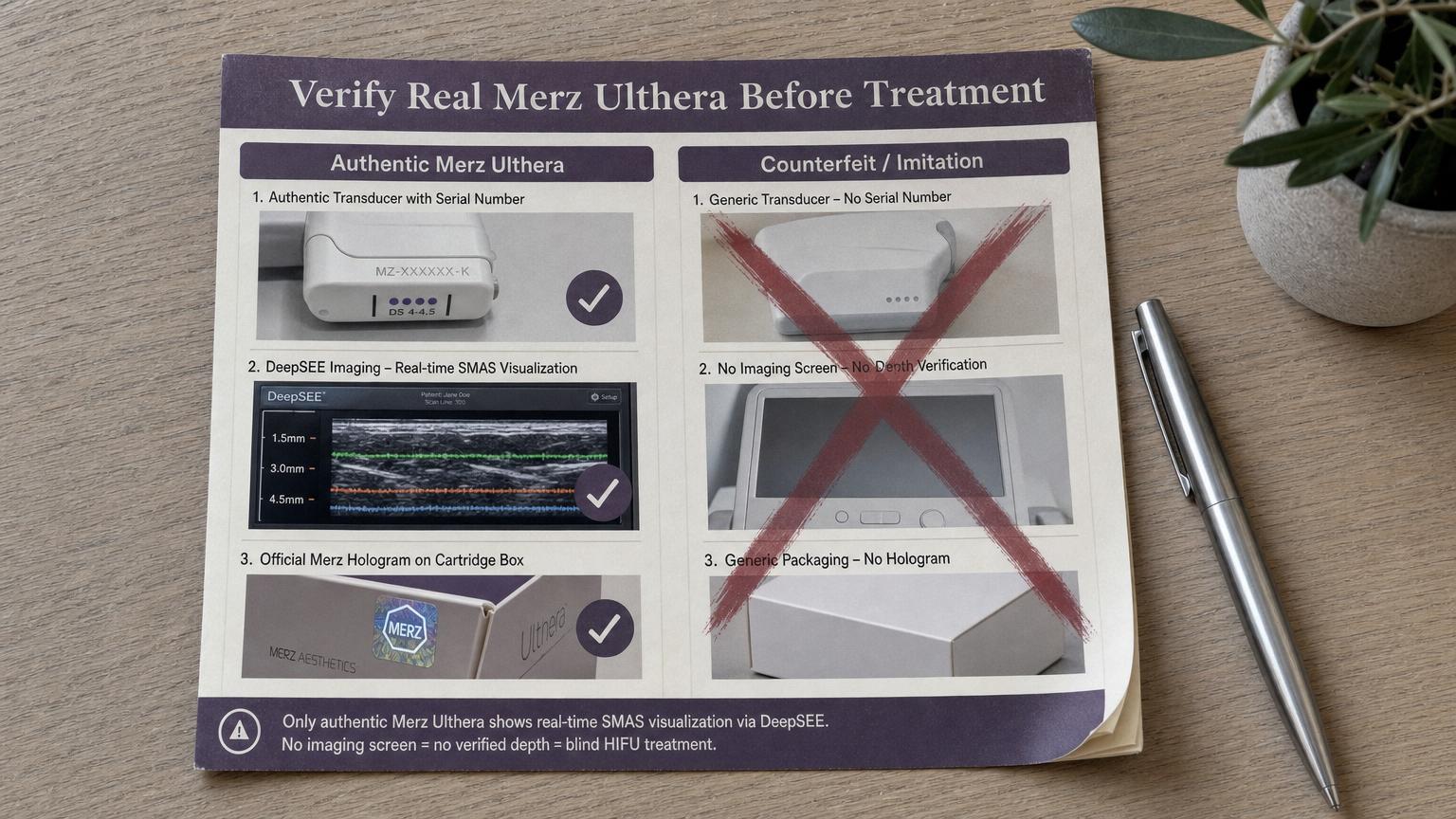
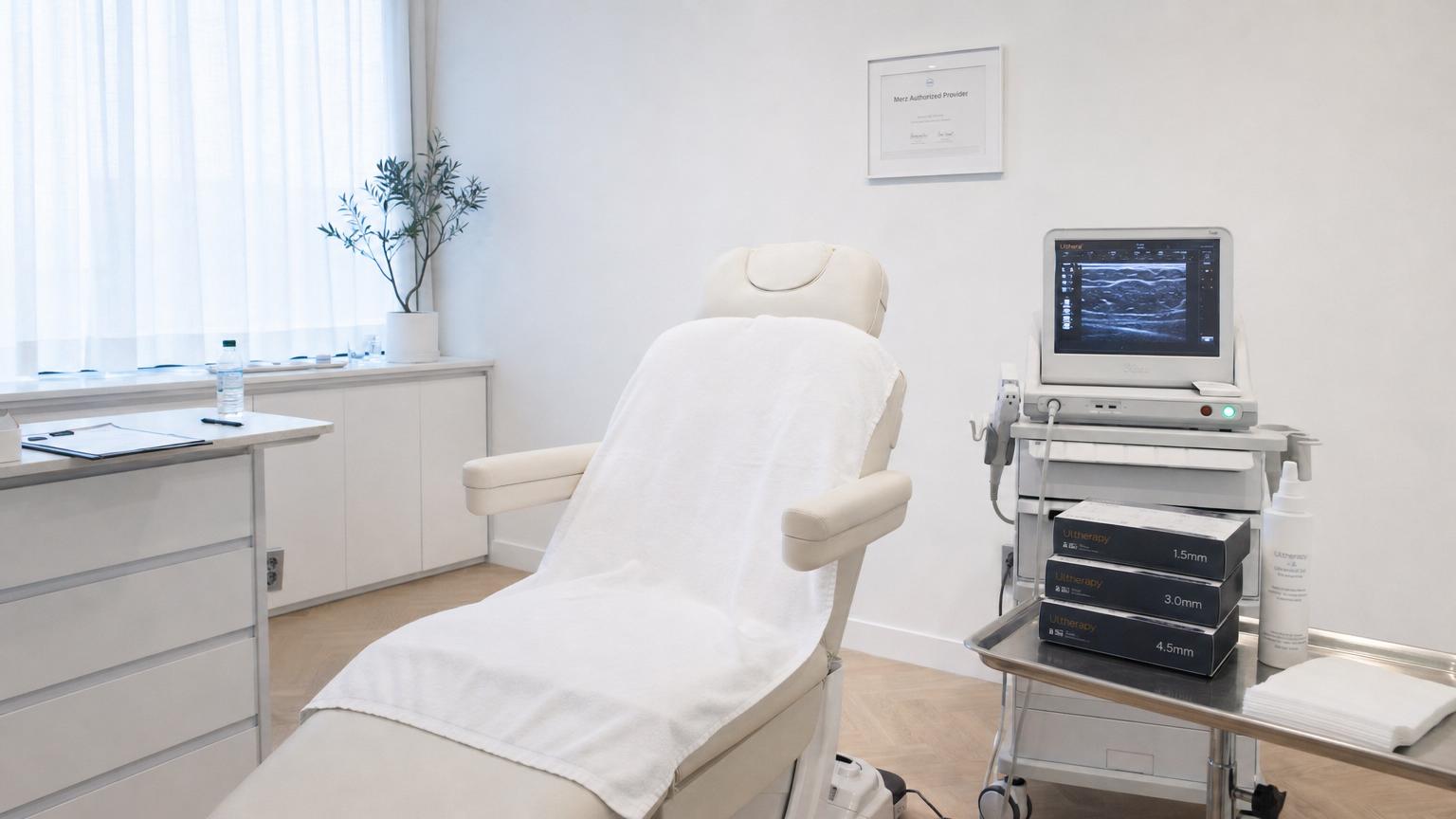
Foreign patients fly into Asian medical tourism destinations chasing Ultherapy at 30 to 50 percent Western pricing, and a meaningful share of them end up with HIFU knockoffs sold under “Ultherapy” marketing. The real Merz Ultherapy device — formally called MFU-V, microfocused ultrasound with visualization — has two non-negotiable features that separate it from generic high-intensity focused ultrasound platforms. The first is the serial-numbered transducer cartridge, sourced from authorized Merz distribution channels, with a finite shot count that the device tracks. The second is DeepSEE, the real-time ultrasound imaging window that lets the clinician actually see the SMAS layer before delivering thermal coagulation points. Generic HIFU devices without DeepSEE are, in plain language, blind HIFU. They may technically deliver focused ultrasound energy at a stated depth, but the operator cannot confirm whether the energy is landing inside the SMAS layer or above it or below it. Korean clinics with verified Merz authorization, including Link Plastic Surgery in Seoul, run the genuine MFU-V protocol and will show foreign patients the Merz certificate, the sealed cartridge box, and the DeepSEE imaging screen during the actual treatment. This guide explains what real Ultherapy is, why DeepSEE is the feature that determines whether the lift actually happens, and the five-step verification checklist a foreign patient should run before sitting down on the treatment table.
The pricing gap that pulls foreign patients to Asia is genuine. A full-face plus neck Ultherapy session in the United States or the United Kingdom typically runs USD 3,500 to 5,500. The same protocol in Seoul runs the equivalent of USD 1,400 to 2,400 at an authorized Merz clinic. That is not a discount made possible by cutting corners on the device. It is a function of currency, clinic operating costs, and the volume of Ultherapy sessions Korean dermatology and plastic surgery clinics perform. The risk is not that authorized Seoul clinics are giving a worse Ultherapy. The risk is that unauthorized clinics across the broader Asian medical tourism corridor are selling generic Korean or Chinese HIFU devices under the Ultherapy name, and the foreign patient who books on price alone has no way to tell the difference until the energy is already delivered. Verification before treatment is the only defense, and this guide walks through it step by step.
Section 1 — What Real Ultherapy Actually Is
Ultherapy is the trade name for a specific device manufactured and distributed by Merz Aesthetics — MFU-V, microfocused ultrasound with visualization. The device is FDA-cleared for non-surgical lifting of the brow, submentum, neck, and decolletage, and CE-marked in Europe for the same indications. There is no generic equivalent that legally markets under the “Ultherapy” name. Devices that compete on similar mechanism but are not Merz MFU-V include the Korean Shrink Universe (Classys), Doublo (Hironic), Liftera (Classys), Sofwave (Sofwave Medical, separate FDA clearance category), and various Chinese HIFU systems that enter the Korean and Southeast Asian market under different brand identities. Each of these competes with Ultherapy on either price, comfort, or single specific anatomy — but none of them is Ultherapy. A clinic that uses the word “Ultherapy” on its menu or signage and treats with a non-Merz device is misrepresenting the procedure, and patients in that situation typically only realize the substitution after the fact, often when the expected lifting outcome does not arrive.
The MFU-V Mechanism in Plain Language
Microfocused ultrasound delivers acoustic energy that converges to a precise focal point inside the tissue. At that focal point, the energy is dense enough to produce a small zone of thermal coagulation — the Merz literature calls these TCPs, thermal coagulation points — at temperatures of approximately 60 to 70 degrees Celsius. The TCPs are placed inside the SMAS layer (superficial musculoaponeurotic system), which is the same fibromuscular sheet that surgeons tighten during a traditional face lift. The thermal injury triggers a healing cascade that produces new collagen over the following 2 to 3 months and contracts the existing collagen network over weeks to months. The clinical result is a gradual lift of the lower face, submentum, and neck that becomes visible at 8 to 12 weeks and reaches peak appearance at month 6, with the structural lift remaining detectable for 12 to 18 months before gradual decline.
Why DeepSEE Is the Critical Feature
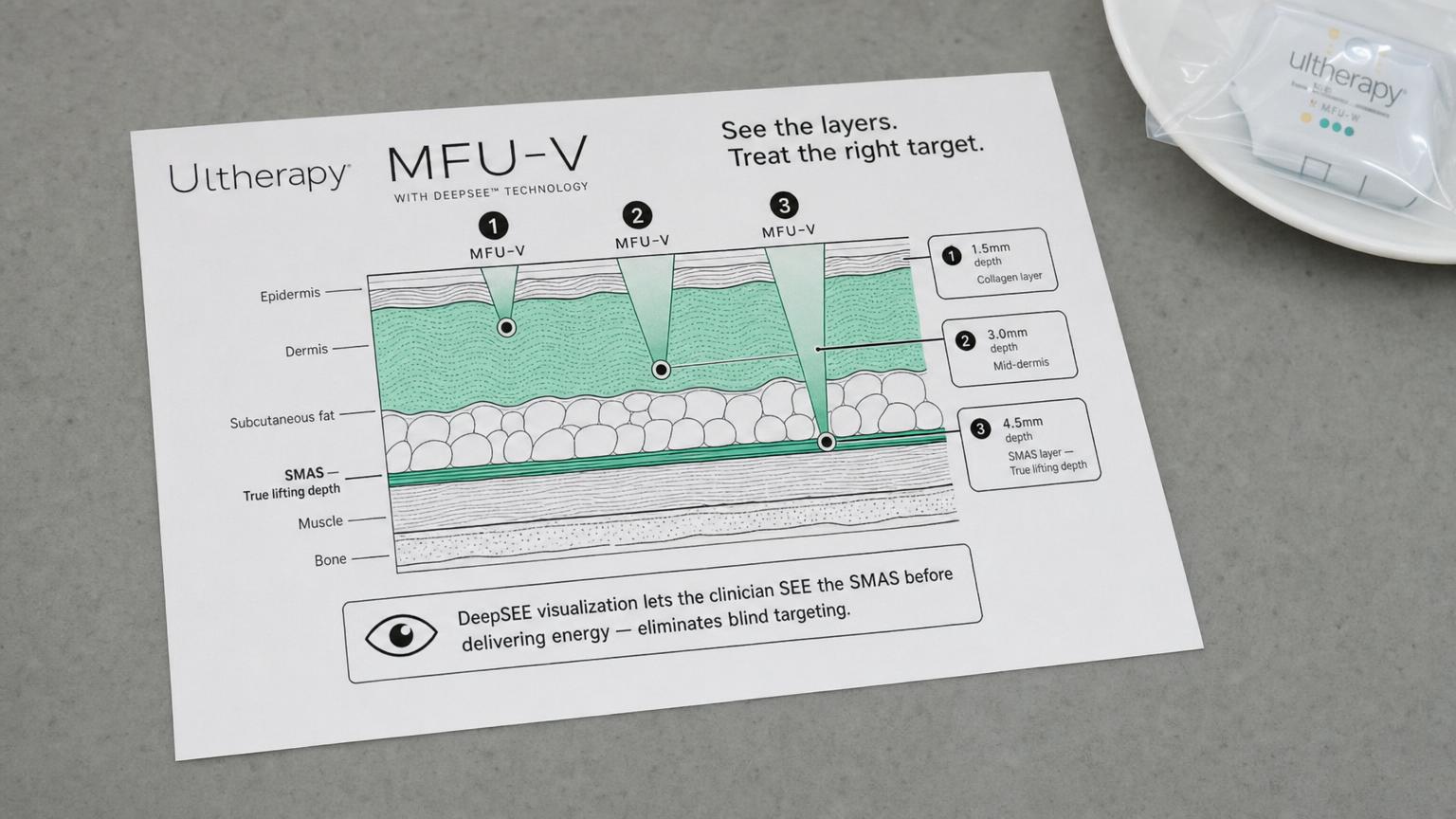
The mechanism described above only works if the TCPs land inside the SMAS layer. The SMAS is not at a uniform depth across the face. In thinner patients, the SMAS sits closer to the skin surface. In patients with more subcutaneous fat, the SMAS sits deeper. The same anatomical landmark — say, the lateral cheek — can have the SMAS at 4.0 mm in one patient and 4.8 mm in another. A device with no imaging window has to guess. The operator picks a depth cartridge (typically 4.5 mm for SMAS, 3.0 mm for deep dermis, 1.5 mm for superficial dermis) and trusts that the energy lands where the cartridge label says it will. If the patient’s SMAS is at 4.2 mm and the cartridge fires at 4.5 mm, the energy lands in subcutaneous fat below the SMAS — wasted, and potentially producing volume loss in the treated area, the cause of the “Ultherapy made me look gaunt” complaints in patient forums. DeepSEE eliminates the guess. The clinician sees the SMAS as a bright echogenic line on the imaging screen and confirms, before each treatment row, that the focal point is landing inside the layer that needs to contract. This is not a luxury feature. It is the difference between a procedure that produces structural lift and a procedure that produces nothing.
Single Session, Not a Series
One of the consistent points of confusion for foreign patients is whether Ultherapy is a single session or a series. The answer for authentic MFU-V is single session, with optional touch-up at the 12 to 18 month mark when the original effect begins to decline. The “needs 3 to 5 sessions” framing that circulates in some clinic marketing typically belongs to other categories of treatment — Rejuran for skin texture, Exosome for regeneration, Sculptra and PLLA-based volumizers for collagen building, or generic HIFU devices that deliver lower per-session energy and compensate by stacking sessions. Genuine Ultherapy is dosed in a single comprehensive session that places the appropriate number of lines and points across the targeted anatomy (typically 600 to 1,200 lines for a full face and neck), with the collagen response unfolding over the subsequent months. A clinic that recommends 3 to 5 Ultherapy sessions spaced a month apart is either selling a generic HIFU as Ultherapy or under-dosing the genuine device to upsell additional sessions.
Section 2 — SMAS Depth and Why the Visualization Window Matters
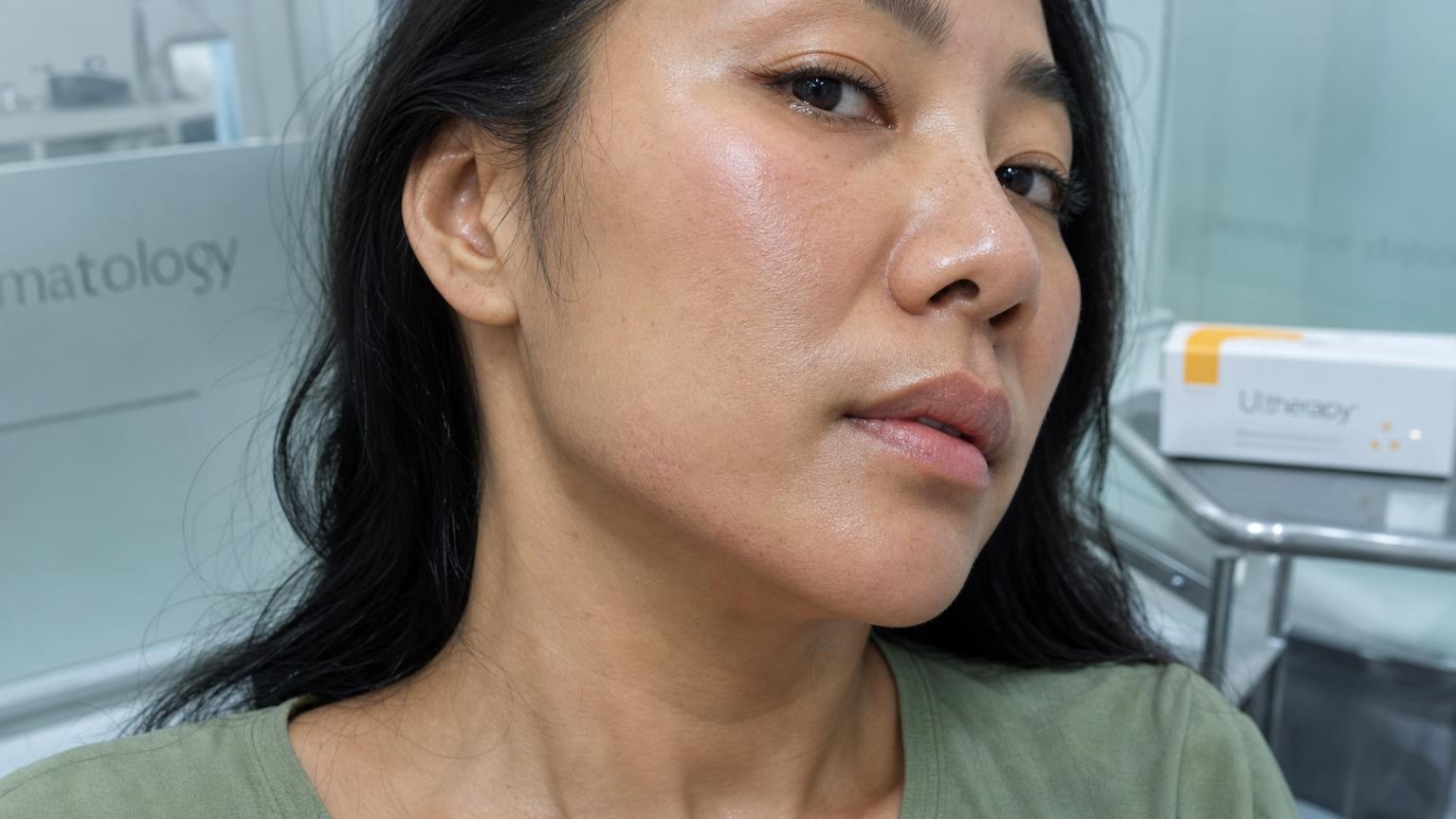
The SMAS (superficial musculoaponeurotic system) is a continuous fibromuscular sheet that lies under the subcutaneous fat and over the deep facial fascia. It connects to the platysma muscle in the neck below and to the galea aponeurotica of the scalp above. When surgeons perform a face lift, the SMAS is what they grasp, mobilize, and re-suspend — it is the structural layer of the face. Microfocused ultrasound treats the same layer non-surgically by inducing thermal coagulation inside the SMAS rather than mechanically lifting it. Understanding why DeepSEE matters requires understanding how variable the SMAS depth actually is from patient to patient and from facial zone to facial zone within the same patient. Link Plastic Surgery’s Ultherapy verification protocol includes a written depth map, generated from the DeepSEE imaging at the consultation, that confirms exactly where the SMAS sits for that individual patient before any treatment lines are placed.
The Three Cartridge Depths and What They Target
Merz MFU-V uses three primary cartridge depths for facial treatment. The 4.5 mm cartridge targets the SMAS layer and is responsible for the structural lift component of the result. The 3.0 mm cartridge targets the deep dermis and produces collagen stimulation in the dermal layer for textural and tonal improvement. The 1.5 mm cartridge targets the superficial dermis for fine line and texture work, often used around the eyes and on the decolletage where the tissue is thinner. A complete Ultherapy treatment typically combines all three depths in a layered protocol — superficial first, then deep dermal, then SMAS — with the line counts at each depth calibrated to the patient’s anatomy. The 4.5 mm SMAS lines are the highest-value part of the protocol because they produce the structural lift. The other two depths add quality, but without the SMAS lines, the treatment does not lift.
How DeepSEE Imaging Changes the Treatment Decision
Before any energy is delivered, the clinician glides the imaging-enabled transducer across the treatment area and confirms, in real time on the imaging screen, where the SMAS sits. In some patients the SMAS is consistently at 4.5 mm, which matches the standard cartridge perfectly. In other patients the SMAS dips to 4.0 mm in the lower face but sits at 4.5 mm in the cheek, which means the lower face requires careful cartridge selection or operator adjustment. In a third group of patients — most commonly thin patients with low subcutaneous fat — the SMAS sits at 3.5 mm or shallower, and the standard 4.5 mm cartridge would deliver energy below the SMAS into the deep fascia or the underlying fat pad. For these patients, the 3.0 mm cartridge is used for the structural lift component rather than the 4.5 mm, with the operator confirming on the imaging screen that the focal point lands in the SMAS rather than passing through it. None of this anatomical tailoring is possible on a blind HIFU device. The cartridge label says 4.5 mm, the energy fires at 4.5 mm, and the patient’s anatomy is whatever it is.
What Happens When the Energy Lands in the Wrong Layer
If the energy lands above the SMAS, in the subcutaneous fat layer, the fat partially atrophies. Small volumes of fat atrophy spread across the face produce the gaunt or hollowed appearance that some Ultherapy patients report in online forums — the result is not actually from Ultherapy as a category, it is from Ultherapy or generic HIFU delivered without the imaging verification that the depth was correct. If the energy lands below the SMAS, in the deep fascia or the buccal fat compartment, the result is either no visible effect (energy absorbed by tissue that does not contract usefully) or, in the worst cases, deep fat atrophy in zones where volume loss is unwanted. The DeepSEE imaging window is what prevents both errors. The clinician looks at the screen, sees where the SMAS is, and adjusts the cartridge or the contact angle so the focal point lands inside the target layer.
Section 3 — The Foreign Patient Verification Checklist
The verification problem is concrete and the solution is concrete. A foreign patient cannot evaluate device authenticity from marketing copy or before-and-after photos on a clinic Instagram. The verification has to happen in person, at the clinic, before the treatment begins. Five specific steps cover the question of whether the patient is about to receive genuine Merz Ultherapy or a substitution.
Recommended for Your Recovery
Products commonly used before and after Korean ultherapy verify real merz mfu — same items routinely recommended in the recovery instructions Seoul clinics hand out at discharge.
- COSRX Advanced Snail 96 Mucin Power Essence — Korean barrier essence for the post-laser tissue regeneration window. Check price on Amazon
- Beauty of Joseon Relief Sun SPF 50+ — strict SPF 50+ daily for at least 3 months after any pigment or resurfacing laser — UV reverses results. Check price on Amazon
- Gel Eye Mask (Cold Compress) — cold compress for residual redness in the first 24 to 48 hours after a session. Check price on Amazon
- Silicone Scar Sheets — for ablative laser zones with crust formation, support scar maturation as new skin emerges. Check price on Amazon
As an Amazon Associate, GlobalBeautySpot earns from qualifying purchases at no extra cost to you.
Step 1: Confirm Merz Authorization in Writing
Merz Aesthetics distributes Ultherapy through authorized channels in each country. In Korea, the authorized distribution is through Merz Korea, and authorized clinics receive a certificate of authorization that should be visible in the clinic — either on the consultation room wall, in the treatment room, or available on request. The certificate identifies the clinic by name, identifies the authorized Merz Korea entity, and is dated. A clinic that uses the Ultherapy name but cannot produce the authorization certificate is, at minimum, in a documentation gap and possibly using a non-genuine device. Foreign patients should request to see this certificate during the consultation, not after the deposit is paid. An authorized clinic will produce it without hesitation. An unauthorized clinic will redirect the question, claim the certificate is “in the office,” or offer assurances without documentation.
Step 2: Inspect the Cartridge Box and Serial Number
Authentic Merz MFU-V transducer cartridges arrive in sealed Merz-branded packaging. Each cartridge is serial-numbered, and the cartridge has a finite number of shots (typically several hundred per cartridge) before it must be replaced. Before the treatment begins, the clinician should open a fresh cartridge in front of the patient or, if the cartridge was opened earlier in the day, show the box and the cartridge serial number that matches the device’s internal log. The sealed Merz packaging has anti-counterfeit features — holographic markings, embossed Merz branding, and country-specific distribution labeling. A clinic that uses cartridges from unmarked packaging, or that refuses to show the cartridge before treatment, is a clinic where the patient should pause and reconsider. This is a 30-second verification that the clinic either accommodates immediately or evades, and the response itself is diagnostic.
Step 3: Verify the DeepSEE Imaging Screen Is Active During Treatment
The DeepSEE imaging window is what separates MFU-V from generic HIFU. During the actual treatment, the device shows a real-time ultrasound image of the tissue layers on a screen visible to the clinician. Patients can ask to see the screen — many clinics will position it so the patient can also watch — and confirm that the imaging is active, that the SMAS layer is identifiable as a bright echogenic line, and that the clinician is referencing the image before placing each treatment row. A clinic that delivers “Ultherapy” without showing the imaging screen, or where the device has no imaging screen at all, is not running genuine MFU-V. Generic HIFU devices that compete with Ultherapy do not have the visualization capability — the absence of the screen is the absence of the device.
Step 4: Confirm the Single-Session Protocol and the Line Count
Genuine Ultherapy is dosed by the line — each line is a row of TCPs delivered along a treatment vector. A typical full-face and neck protocol places 600 to 1,200 lines depending on patient anatomy and treatment goal. A clinic that markets Ultherapy as a series of sessions — say, 3 sessions spaced 4 weeks apart, each “Ultherapy” — is either fragmenting the dose to upsell or substituting a generic HIFU that operates on a series protocol. The honest Korean Ultherapy clinic will provide a treatment plan with the line count for that specific session, identified by anatomical zone (lower face, submentum, neck, decolletage), and will explain that the result unfolds over 2 to 3 months from the single session with optional touch-up at the 12 to 18 month decline point.
Step 5: Match the Quoted Price Against the Line Count
The line count and the price should be internally consistent. In Seoul, full-face plus neck Ultherapy at an authorized Merz clinic with 600 to 800 lines typically runs KRW 1,800,000 to 3,200,000 (USD 1,300 to 2,400). Submental-only Ultherapy with 150 to 250 lines runs KRW 700,000 to 1,200,000. A quote dramatically below this range — say, a “full face Ultherapy” for KRW 350,000 — is mathematically inconsistent with the cost of authentic Merz cartridges and is almost certainly a generic HIFU substitution. Foreign patients evaluating clinics on price alone often get steered toward the low-price option without realizing the price gap is itself the signal. The genuine procedure has a floor cost driven by the cartridge expense and the clinical time, and authorized clinics cannot price below that floor without losing money on the device alone.
Section 4 — Recovery and the Realistic Result Timeline

One reason Ultherapy is popular for medical tourism is that the recovery is genuinely minimal — patients can fly home the following day and return to normal activity immediately. This is an honest advantage of the procedure, separate from the device authenticity question. The trade-off is that the result also unfolds slowly and is least visible in the first few weeks, which is a pattern that confuses patients who expected immediate change. Understanding the realistic timeline prevents the “did anything happen?” frustration that some Ultherapy patients experience at the 2 to 4 week mark.
Day 0: The Single Session
The treatment itself takes 60 to 90 minutes for a full face and neck protocol, depending on the line count and the number of cartridge depth changes. Topical numbing is applied 30 to 45 minutes before treatment. Some clinics also offer pro re nata oral analgesia (a single dose of an oral analgesic before treatment) for patients who anticipate discomfort, or a short period of light sedation for the most pain-sensitive patients. The clinician glides the imaging transducer across the treatment area, identifies the SMAS depth, and delivers lines in a systematic pattern across the targeted anatomy. The sensation during treatment is a brief pulse of heat at each shot, sometimes with a mild prickling or electrical feeling as the energy reaches the focal point. Pain varies substantially by patient and by anatomical zone — the brow and the immediate jawline tend to be the most sensitive, the cheek and submentum are usually well tolerated. The treatment ends when all planned lines are delivered, and the patient walks out within 15 minutes of the end of treatment.
Days 1 to 3: Mild Flush, No Downtime
For most patients, the immediate post-treatment appearance is a mild flush across the treated area that resolves over a few hours. Some patients have minor swelling that persists for 24 to 48 hours, particularly in the jawline and submentum where the soft tissue is more reactive. Rare patients have small areas of localized bruising at high-energy zones, particularly if Ultherapy was combined with other procedures the same day. None of this prevents normal activity. Foreign patients routinely fly home the day after treatment with no visible markers of having had a procedure, which is a meaningful logistical advantage compared with surgical lifting or even thread lifting.
Week 2: Nothing Visible, This Is Normal
The most common point of patient anxiety is around week 2. The mild flush is gone, the swelling has resolved, and the patient looks at the mirror and sees the same face they started with. This is expected. The collagen response is not yet visible at this stage — the thermal coagulation points have been placed, the healing cascade has begun, but the new collagen formation has not yet remodeled the SMAS enough to produce visible contour change. Patients who message the clinic at week 2 asking “did it work?” are reassured that the timeline does not run on week 2, it runs on month 2 and month 3.
Weeks 8 to 12: Collagen Build Becomes Visible
Around week 8, the contour change begins to register. The jawline appears slightly more defined, the submentum tightens, the cheek volume sits a little higher, and the overall face feels structurally more taut without looking “done.” Patients who took standardized photos at day 0 and compare them at week 10 see the change clearly. Patients who did not take photos sometimes need a friend or family member to point it out — the change is structural rather than dramatic. The neck contour and the decolletage texture also improve at this window, often more visibly than the face because the starting point is thinner skin with less competing volume.
Month 6: Peak Result
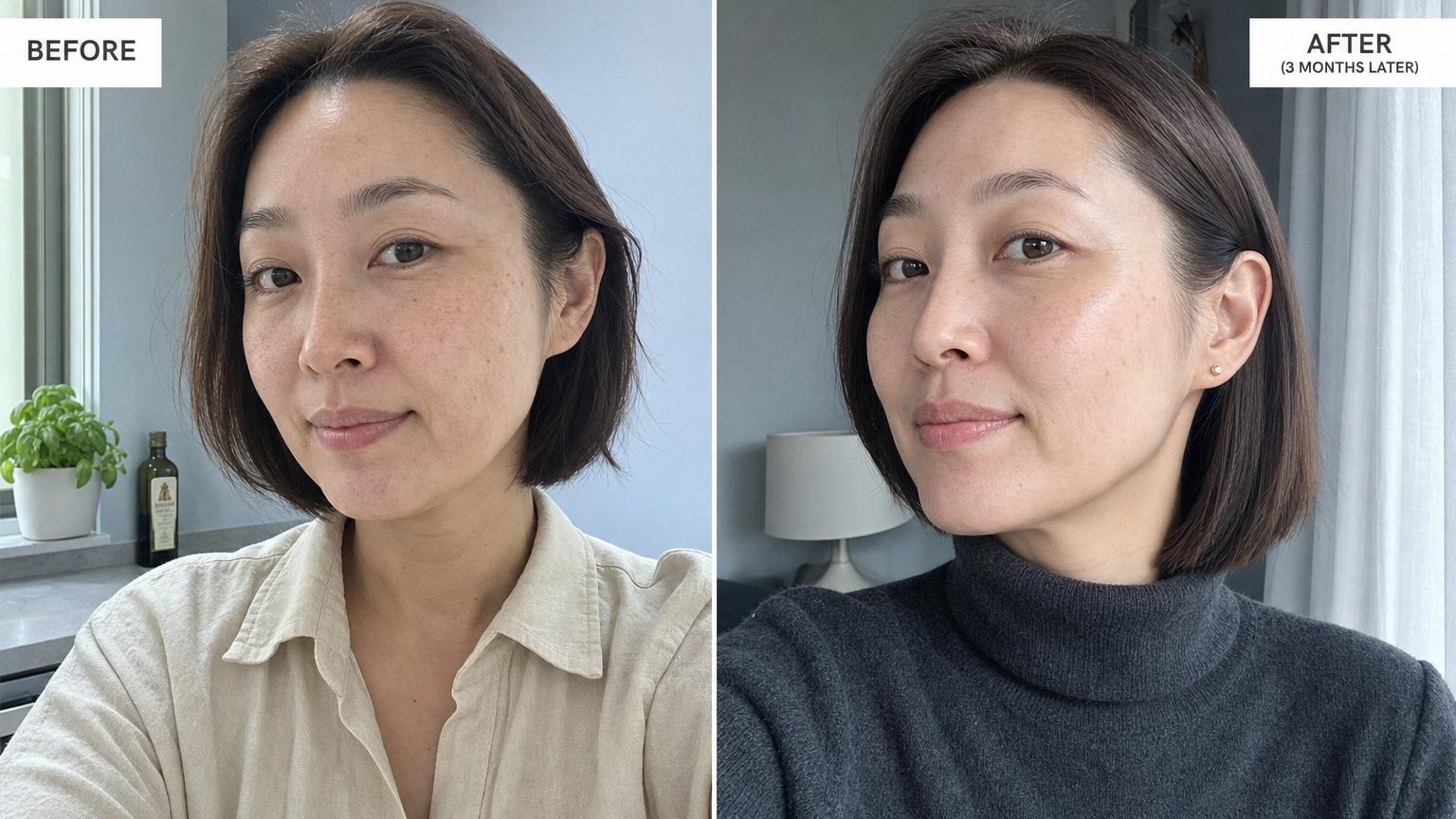
The peak appearance of an Ultherapy result is typically reached at month 6. The collagen formation has fully integrated, the SMAS has contracted to its new tone, and the lifting effect is at its most visible. Patients who proceeded with realistic expectations — looking for structural lift rather than dramatic transformation — are generally satisfied at this point. The face looks like the same face, but the lower jawline is sharper, the submentum is firmer, the neck is more defined, and the overall age impression has moved several years younger in a way that does not register as “having had work done.”
Months 12 to 18: Gradual Decline and the Touch-Up Decision
The Ultherapy result is not permanent. The collagen built from a single session gradually remodels and the SMAS contraction relaxes over 12 to 18 months. Most patients begin to notice the decline around month 12, and most opt for a touch-up session at some point between month 12 and month 24. The touch-up is typically a reduced-line-count session focused on the zones where the decline is most visible — usually the lower face and submentum — and produces a renewed peak result at the 6-month mark after the touch-up. Some patients prefer to space the touch-ups further apart (every 2 to 3 years) and accept a gradual decline between sessions. There is no medically correct answer; the decision is aesthetic and budgetary.
Section 5 — Cost, Combination Protocols, and Coordinating With Other Korean Treatments
Korean Ultherapy pricing is competitive globally because the underlying device cost (the cartridge expense from Merz) is roughly the same worldwide, and the difference is driven by clinic operating costs, currency, and the volume of sessions per clinic. The pricing table below reflects current authorized Merz pricing in Seoul versus other major medical tourism destinations and Western markets.
| Region | Ultherapy Cost | Notes |
|---|---|---|
| Korea (Seoul) — Full face + neck | KRW 1,800,000–3,200,000 (USD 1,330–2,370) | Authorized Merz clinic, 600–1,200 lines, includes consultation and DeepSEE depth mapping |
| Korea (Seoul) — Lower face + submentum | KRW 1,200,000–2,000,000 (USD 890–1,480) | Most common foreign patient package, 400–600 lines |
| Korea (Seoul) — Submentum only | KRW 700,000–1,200,000 (USD 520–890) | Short session, 150–250 lines, frequently added to other procedure trips |
| USA — Full face + neck | USD 3,500–5,500 | Variable by region and clinic, often quoted per zone |
| USA — Lower face + submentum | USD 2,500–4,000 | Available at dermatology and aesthetic clinics |
| UK / EU — Full face + neck | GBP 2,800–4,500 | Authorized Merz clinics in major cities |
| Australia — Full face + neck | AUD 4,500–7,000 | Higher operating costs, similar device protocol |
| Southeast Asia (unauthorized risk) | USD 300–900 | Often generic HIFU sold as Ultherapy, verification critical |
The pricing typically includes the consultation, the DeepSEE depth mapping, the actual treatment session, and any immediate post-treatment care. Foreign patients should also budget for hotel accommodation for 1 to 3 nights minimum (the procedure itself is single-day, but most patients combine it with consultation appointments and other procedures during the trip). Authorized Merz clinics in Seoul do not require pre-payment or large deposits, and the procedure can typically be booked with 1 to 2 weeks of lead time.
The Layered Korean Protocol: Ultherapy + Rejuran + Exosome
One of the strengths of the Korean aesthetics ecosystem is that Ultherapy is rarely the only thing a patient does on a trip. The mature Korean protocol layers Ultherapy with Rejuran and Exosome treatments to address structural, dermal, and regenerative components in a coordinated plan. Each component targets a different tissue layer and a different aesthetic outcome — together they produce a result that no single procedure can deliver.
- Ultherapy + Rejuran for combined lift and skin quality. Patients combining Ultherapy with Korean Rejuran skin booster therapy (Post 911 covers Rejuran in depth) get the structural SMAS lift from Ultherapy and the dermal regeneration and texture improvement from Rejuran’s polynucleotide-based mechanism. Rejuran works in the dermal layer that 3.0 mm Ultherapy cartridges touch but does not transform on its own — Rejuran adds the cellular-level skin regeneration that complements the Ultherapy structural change. The protocol is typically Ultherapy first (single session), followed by Rejuran in a series of 3 to 4 sessions spaced 3 to 4 weeks apart, with the Rejuran series timed so that the final session falls around the Ultherapy peak result window at month 6.
- Ultherapy + Exosome for accelerated recovery and dermal regeneration. Patients adding Korean Exosome therapy (Post 918 covers Exosome misconceptions and the Korean combination protocol) layer the regenerative signaling component over the Ultherapy structural change. Exosome is most commonly applied immediately post-Ultherapy or post-microneedling to accelerate the healing cascade — the cell signaling molecules in Exosome therapy enhance the same wound-healing pathways that the Ultherapy TCPs trigger. The protocol is Ultherapy on day 0, Exosome at the same session or within 1 to 2 weeks, with optional Exosome series continuation through the collagen-build window at month 2 to 3.
- The full three-layer protocol. For patients with budget and trip length to support it, the complete protocol combines all three — Ultherapy for SMAS structural lift, Rejuran for dermal regeneration and texture, Exosome for cellular signaling and healing acceleration. The total cost of the layered protocol in Seoul typically runs KRW 4,500,000 to 7,000,000 (USD 3,330 to 5,180), comparable to the cost of Ultherapy alone in the US. The trip length to complete the initial sessions is typically 7 to 10 days for the first round, with a follow-up Rejuran session that can be done on a return trip or, for patients with longer stays, completed within a single 3 to 4 week visit.
- Ultherapy + Thread lifting comparison and combination. Patients considering thread lifting as an alternative to or addition to Ultherapy are often best served by understanding the mechanism difference. Ultherapy contracts the SMAS layer through controlled thermal injury. Thread lifting mechanically lifts the SMAS using PDO or PLLA threads with cogs that anchor in the SMAS layer. The two procedures are not redundant — they are complementary. Patients with substantial laxity often benefit from thread lifting first (immediate mechanical lift), with Ultherapy added 6 to 8 weeks later to consolidate the lift through collagen building. Patients with mild to moderate laxity often get sufficient lift from Ultherapy alone and add threads only if the result is incomplete at month 6.
What to Do if the Clinic Did Not Use DeepSEE
If a foreign patient completes a session and only afterward realizes the device did not have a DeepSEE imaging screen — or that the screen was present but never used during treatment — the most likely scenario is that a generic HIFU was delivered as Ultherapy. The refund question is concrete. Authorized Merz clinics will provide refunds for substitutions if proven, but the burden of documentation falls on the patient. Specific recommendations: request a copy of the cartridge serial numbers used during the session, request a copy of the device service log showing the shots delivered, and document the absence of the imaging screen with timestamps. If the clinic refuses to provide documentation, contact Merz Korea directly with the clinic name and the session date — Merz monitors authorized distribution and will confirm whether the clinic has active authorization. Patients who suspect substitution after the fact often have limited recourse beyond the original clinic, but Merz Korea is generally responsive to documented authentication questions and can confirm clinic status.
Frequently Asked Questions
What are the actual risks of getting a counterfeit HIFU instead of real Ultherapy?
The clinical risks of a generic HIFU device are not necessarily different from real Ultherapy in terms of immediate safety — most generic HIFU devices in clinical use are not dangerous in the sense of producing burns or major adverse events. The risks are aesthetic and economic. A blind HIFU device cannot confirm SMAS depth, so the energy may land outside the target layer, producing either no result (energy absorbed by non-contractile tissue) or unwanted fat atrophy (energy landing in subcutaneous fat layer). Patients who pay Ultherapy pricing for a generic HIFU substitution have spent USD 1,500 to 3,000 on a procedure with substantially reduced lift outcome compared with the genuine MFU-V. The financial loss is the verification motivation. The clinical risk is unwanted volume loss in the face, which can take 6 to 12 months to resolve and in some cases requires fat grafting to correct.
Is DeepSEE really necessary, or is it just a marketing feature?
DeepSEE is the defining feature of Ultherapy as a category. The Merz technology platform is named MFU-V (Microfocused Ultrasound with Visualization) specifically because the visualization component is what distinguishes the device. Without DeepSEE, the operator is guessing the SMAS depth based on the cartridge label and the patient’s external anatomy. With DeepSEE, the operator sees the actual SMAS position on imaging before placing each line. The clinical literature supporting Ultherapy’s FDA clearance was generated on devices with the imaging window active. Generic HIFU devices that do not have imaging are not Ultherapy and should not be marketed as such. The feature is not marketing — it is the core mechanism that makes the procedure predictable.
Can I get Ultherapy in a series of smaller sessions instead of one large session?
Authentic Ultherapy is dosed as a single session by design. The total line count placed in one session produces the thermal coagulation pattern that drives the collagen response. Fragmenting the dose into multiple smaller sessions does not produce a better result and is not how the device was designed to be used. Clinics that recommend Ultherapy as a series of 3 to 5 sessions are typically either delivering a generic HIFU under the Ultherapy name (those devices often do run on a series protocol) or under-dosing the genuine device to upsell additional sessions. If a clinic recommends a series approach, it is reasonable to ask why the dose is being fragmented and to compare the proposal against the single-session standard at other authorized clinics.
How does Ultherapy compare to Shrink Universe and other Korean HIFU devices?
Shrink Universe (Classys), Doublo, Liftera, and similar Korean HIFU devices are competent within their own category but are not Ultherapy. They deliver focused ultrasound at fixed cartridge depths without imaging, so the depth selection is anatomical estimate rather than imaging confirmation. The clinical results are generally less predictable than Ultherapy for the structural lifting indication, but the devices are also less expensive per session and are often combined with other treatments for skin quality rather than used as standalone lifters. Patients with mild laxity, who prioritize cost over guaranteed structural change, may be reasonable candidates for these devices. Patients with moderate to substantial laxity, who need confidence that the energy is landing in the SMAS, are better served by authentic Ultherapy with DeepSEE imaging. A clinic that offers both and is transparent about the difference is more trustworthy than a clinic that sells one device under the other’s name.
How does Ultherapy compare to thread lifting?
Thread lifting mechanically lifts the SMAS using PDO or PLLA threads with anchoring cogs, producing an immediate visible lift that becomes apparent within days of the procedure. Ultherapy thermally contracts the SMAS through energy-induced collagen response, producing a gradual lift that unfolds over 2 to 3 months. The two procedures are complementary rather than competitive. Patients with substantial laxity often benefit from threads first for the immediate lift and Ultherapy added 6 to 8 weeks later to consolidate the result through collagen formation. Patients with mild laxity often get sufficient correction from Ultherapy alone. Patients with the most substantial laxity, particularly older patients with skin redundancy as well as SMAS descent, are typically candidates for surgical face lift rather than either non-surgical option. The full Korean laser and energy treatment category covers the comparison between these and other layered approaches.
How painful is Ultherapy, and what pain management is available?
Pain varies substantially by patient and anatomical zone. The lower face and submentum are generally well tolerated with topical numbing alone. The brow and the immediate jawline tend to be the most sensitive areas, where some patients describe a brief sharp pulse at each shot. Korean clinics typically offer topical numbing applied 30 to 45 minutes before treatment as the standard pain management. Patients who anticipate higher sensitivity can request a single dose of oral analgesia before treatment, or light sedation in some clinics for the most pain-sensitive patients. The pain is brief — only during the energy delivery itself, which lasts perhaps a fraction of a second per shot — and is not persistent after the session. Patients who fly home the next day generally report no residual discomfort from the treatment itself.
Are men good candidates for Ultherapy?
Yes, and male patients are an increasingly common Ultherapy demographic. Male skin tends to be thicker and the SMAS is generally more substantial than female patients of similar age, which means the same line count delivers a slightly less dramatic structural change in men but also tends to produce a more robust long-term result. The most common male treatment plan is lower face plus submentum, often with the goal of sharpening the jawline rather than producing overall lifting. Men typically respond well to single-session protocols and frequently combine Ultherapy with Rejuran or Exosome for skin quality, particularly for the neck where male skin shows aging earlier than the face. The procedure is the same; the line distribution is adjusted slightly to emphasize structural jawline definition rather than overall mid-face elevation.
What is the appropriate age range for Ultherapy?
The optimal age range is typically late 30s through 60s, with the strongest results in patients aged 40 to 55. Patients younger than 35 generally have sufficient native SMAS tone that Ultherapy adds incremental rather than dramatic lift, and the procedure may not be the most efficient use of the budget. Patients older than 65, particularly those with substantial skin redundancy as well as SMAS descent, often need surgical face lifting for adequate correction — Ultherapy alone is unlikely to address skin laxity at that level. The middle range is where Ultherapy produces the most visible structural change because the SMAS is still responsive to thermal coagulation but has begun to lose tone on its own. Patients in their late 30s and early 40s often do Ultherapy as preventative maintenance, with the goal of slowing the visible aging trajectory rather than reversing established laxity.
Can I combine Ultherapy with other Korean procedures on the same trip?
Yes, and this is the most efficient way for foreign patients to use a Korea trip. The most common combinations are Ultherapy with Rejuran (skin texture and dermal regeneration), Ultherapy with Exosome (cellular signaling and healing acceleration), Ultherapy with thread lifting (mechanical lift consolidated by collagen building), Ultherapy with PLLA-based volumizers like Sculptra (volume restoration in zones where Ultherapy alone produces tightening without volume change), and Ultherapy with non-surgical eye procedures such as upper eyelid skin tightening. The single Ultherapy session is short enough (60 to 90 minutes) that combining it with other same-day procedures is logistically straightforward. Korean clinics coordinate this routinely and will schedule a single consultation that maps out the full procedure sequence across the trip.
What can I do if I think the clinic used a generic HIFU instead of real Ultherapy?
The first step is documentation. Request from the clinic the cartridge serial numbers used during the session, the device service log showing the shots delivered, and any photographs or video of the treatment if available. Document any observations from the session itself — whether the imaging screen was active, whether the cartridge box was shown, whether the cartridge was opened in front of you. Contact Merz Korea directly with the clinic name and session date — Merz monitors its authorized distribution network and can confirm whether the clinic has active authorization. If Merz confirms the clinic is not authorized, you have grounds to request a refund from the clinic itself, and Merz will sometimes intervene on behalf of patients who were misled by unauthorized use of the Ultherapy name. The verification before treatment, which is the focus of this guide, is much easier than the refund process after treatment, which is one of the reasons the five-step pre-treatment checklist matters so much.
Closing
The pricing gap that pulls foreign patients to Korea for Ultherapy is genuine and the genuine product is genuinely available at authorized Merz clinics in Seoul. The risk to manage is not whether Korean Ultherapy is good — at authorized clinics it is the same Merz MFU-V device delivered by experienced operators on a high session volume — but whether the specific clinic the patient books is one of those authorized clinics or one of the unauthorized vendors selling generic HIFU under the Ultherapy name. The five-step verification checklist (Merz authorization in writing, sealed cartridge with serial number, active DeepSEE imaging during treatment, single-session protocol with documented line count, and price internally consistent with the line count) takes less than 15 minutes to run at the consultation and is the single most reliable defense against substitution. The procedure itself rewards patience — visible structural change unfolds over 2 to 3 months, peak result at month 6, gradual decline over 12 to 18 months — and combines well with the broader Korean aesthetic protocol of Rejuran and Exosome layered treatments. Foreign patients who run the verification, plan for the timeline, and consider the layered protocol get the result the procedure was designed to deliver. Foreign patients who book on price alone, without the verification, sometimes get a different device and a different result.
For patients planning their treatment in Seoul, Link Plastic Surgery’s official website lists the verification documentation, the layered protocol options, and consultation booking details in English.