Korean Shrink Universe vs Ultherapy: Which HIFU Lifting Device Foreign Patients Actually Need
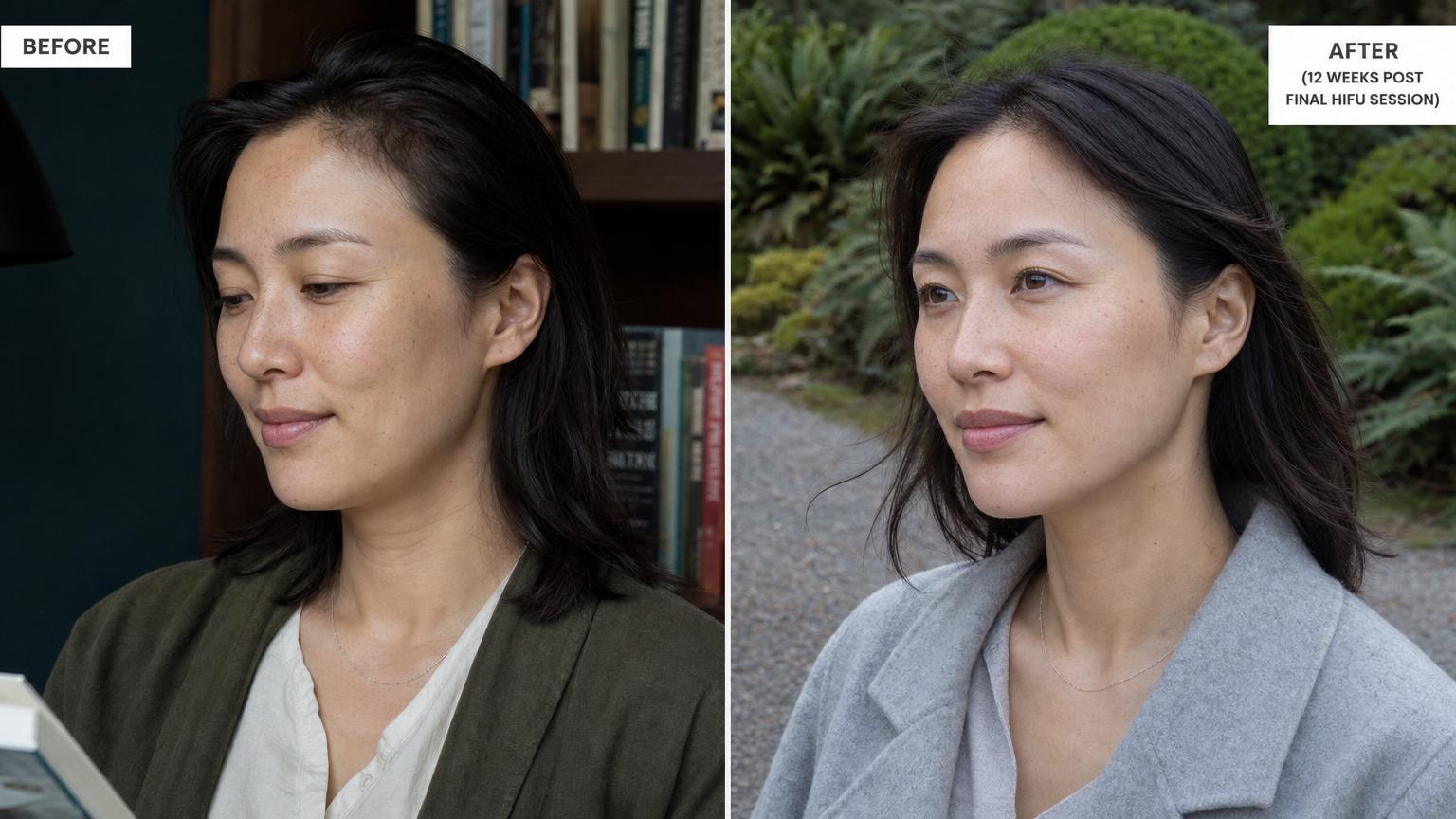
Foreign patients arrive at Seoul consultations with one of two assumptions about Korean HIFU lifting, and both assumptions are wrong. The Reddit-trained patient assumes Shrink Universe is a cheap Ultherapy clone and that Ultherapy is the “real” device worth paying for. The Western-derm-trained patient assumes Ultherapy is the only FDA-cleared option that meets evidence-based standards and that Shrink Universe is an unregulated knockoff. Neither framing maps to what actually happens inside Korean clinics, where both devices coexist as legitimate platforms built on different engineering trade-offs for different patient profiles. The honest answer to “which one do I need” depends on seven specific factors — skin laxity stage, time budget, pain tolerance, result timeline, body-versus-face goals, age, and whether the patient wants a single session or a series. Link Plastic Surgery operates both devices, which means the consultation recommendation is driven by anatomy rather than inventory. This guide walks foreign patients through the seven-factor framework they can apply before walking into any Seoul consultation, with honest acknowledgment that for many patients either device produces a satisfactory result, for some patients only one device is genuinely appropriate, and for a small group neither is the right starting point.
The English-language conversation around Korean HIFU is unusually polarized. On Reddit threads, foreign patients steered by cost shock collapse the entire category into “Korean HIFU = generic Ultherapy clone” and recommend whichever device the most upvoted commenter chose. On Western dermatology blogs, the framing inverts: Shrink Universe is dismissed as not FDA-cleared (which is true) and Ultherapy is positioned as the only credible option (which ignores that KFDA approval, Korean clinical context, and the actual engineering differences make the picture more nuanced). Korean clinic blogs sit between these two and rarely help — most are advertorial, recommending whichever device the writing clinic happens to stock. The patient walking into a consultation with one of these framings already pre-decided is the patient most likely to end up with the wrong device for their anatomy, because the recommendation pipeline that brought them there was distorted in one direction or the other. This article does the opposite. It treats both devices as legitimate platforms, names the genuine engineering differences, and gives foreign patients a framework they can use to evaluate clinic recommendations against their own anatomy.
Section 1 — Why This Comparison Is Harder to Get a Straight Answer On Than It Should Be
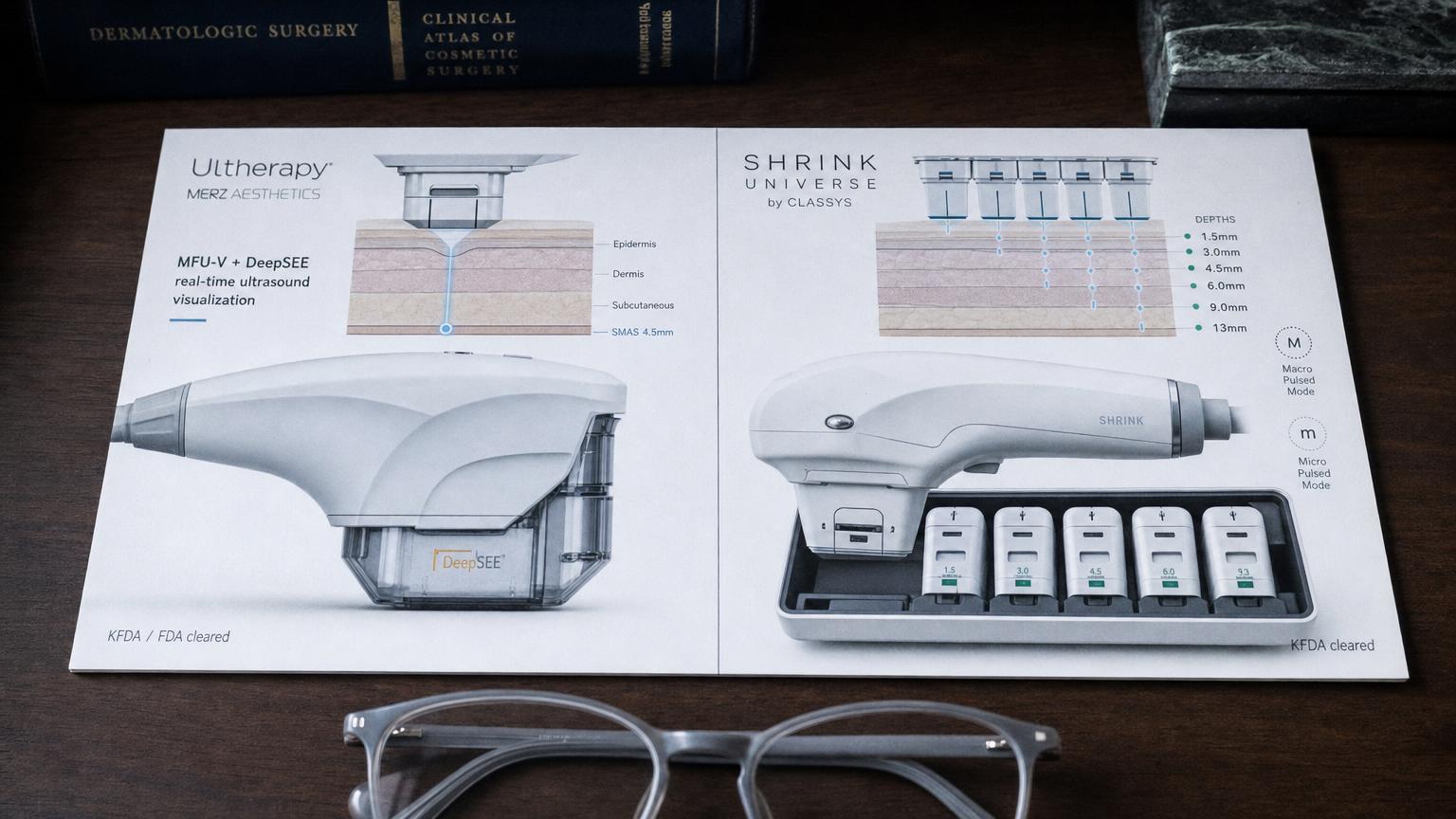
Three distortions shape the English-language conversation around Korean HIFU. The first is the Reddit cost-shock pattern. A US patient sees a USD 4,500 Ultherapy quote in their home market, encounters a Seoul clinic offering “Korean HIFU lifting” for USD 800, and posts asking whether the gap is real. The thread fills with replies from patients who had Shrink Universe and were happy, patients who had Ultherapy in Korea and were happy, and patients who had something at an unverified clinic and were not happy — and the conclusion that gets upvoted to the top is some version of “Korean HIFU is the same thing, just go to Korea.” The conflation hides that Shrink Universe and Ultherapy are different devices from different manufacturers (Classys lineage versus Merz) using different ultrasound technologies (broad-depth HIFU versus narrow-focal MFU-V with visualization). The price difference is not a discount on the same device. It is a different device at a different price point with different clinical trade-offs.
The second distortion is the Western dermatology pattern. A US or UK dermatologist trained on FDA-cleared devices encounters questions about Korean HIFU and answers with a binary: FDA-cleared (Ultherapy) is acceptable, not-FDA-cleared (Shrink Universe) is not. The framing is correct as a US regulatory statement and wrong as a clinical statement. Shrink Universe holds KFDA approval, has been in clinical use across Asia for over a decade, and operates within a Korean regulatory framework that scrutinizes medical devices differently from but not less rigorously than the FDA pathway. The Western dermatologist who flatly dismisses Shrink Universe is applying a regulatory filter to a clinical question, which produces guidance that does not match the reality of mature Asian clinical practice. Foreign patients steered by this framing miss device options that would have served them well, simply because the device does not carry US clearance.
The third distortion is the Korean clinic blog pattern. A clinic operating Shrink Universe writes a blog explaining why Shrink Universe is the better device. A clinic operating Ultherapy writes a blog explaining why Ultherapy is the better device. Each blog is technically accurate in selective ways and misleading in aggregate, because the writing clinic’s incentive aligns with the device it sells. Foreign patients reading these blogs in sequence end up with two contradictory recommendations and no framework to choose between them. The advertorial bias is not corrupt — clinics genuinely believe their preferred device serves their case mix well — but it is structural, and patients who read only clinic-published material miss the broader context.
What this article does differently: it treats both Shrink Universe and Ultherapy as legitimate Korean lifting platforms, identifies the patient profiles where each device produces the best outcome, and gives readers a seven-factor decision framework they can apply themselves before any clinic recommendation. Honest disclosure upfront: Link Plastic Surgery in Seoul operates both Shrink Universe and Ultherapy. The clinic’s consultation recommendation is therefore driven by patient anatomy rather than by which device sits in the treatment room. This is the credibility move that separates a clinic willing to recommend the off-inventory device when anatomy demands it from a clinic constrained by single-device inventory. The framework below is the same framework the Link clinical team applies internally during consultations.
Section 2 — The Two Devices: What They Actually Are (Without the Marketing)
Before the framework can be applied, the underlying devices have to be understood at the engineering level. Most of the confusion in the English-language conversation comes from collapsing the two devices into “Korean HIFU” as if they were variations of the same product. They are not. The two devices target the same general tissue layer (the SMAS) using the same general physical principle (focused ultrasound) but the engineering trade-offs they make are different enough that a clinical recommendation for one is not interchangeable with a recommendation for the other.
Ultherapy (Merz, US-developed)
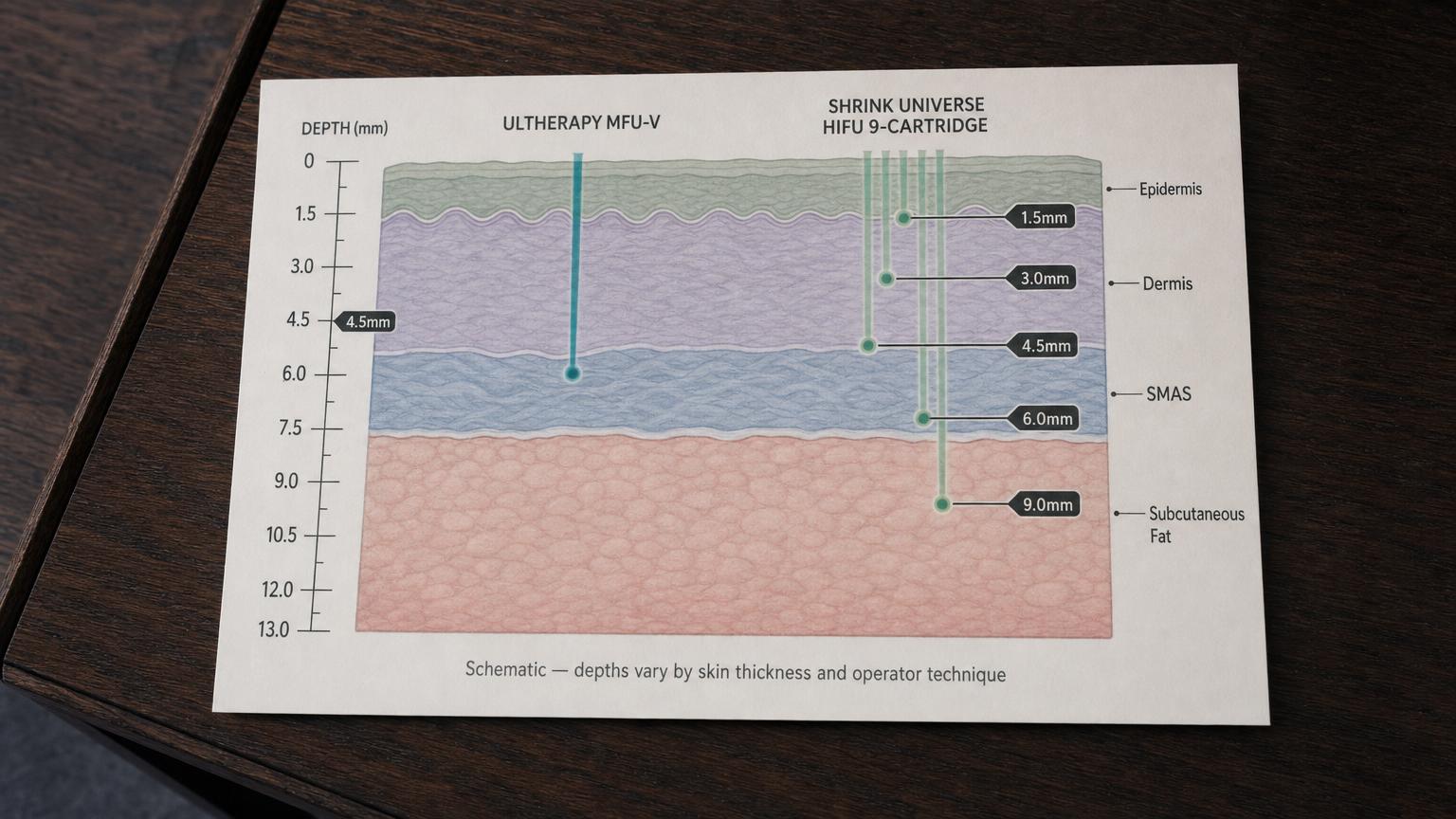
Ultherapy is the trade name for the Merz Aesthetics MFU-V platform — Microfocused Ultrasound with Visualization. The device was FDA-cleared in 2009 and holds KFDA approval for use in Korea. The defining feature is the “V” — DeepSEE, a real-time ultrasound imaging window that displays the tissue layers on a screen during treatment, allowing the operator to visualize the SMAS depth before placing each treatment line. Three primary cartridge depths cover the facial protocol (1.5 mm for superficial dermis, 3.0 mm for deep dermis, 4.5 mm for SMAS), with each cartridge delivering microfocused ultrasound that converges to a narrow focal point at the labeled depth. Korean Ultherapy authorized clinics verify device authenticity through the Merz Korea distribution certificate, sealed cartridge serial numbers, and active DeepSEE imaging during treatment — a five-step verification checklist covered in depth in the dedicated Ultherapy guide.
The clinical philosophy behind Ultherapy is single-session SMAS-targeted lifting. The device places thermal coagulation points inside the SMAS layer to trigger collagen contraction and remodeling, with the result unfolding over 2 to 3 months and peaking at month 6. A typical facial protocol places 600 to 1,200 lines in one session, and the dose is not designed to be fragmented across multiple visits. This single-session efficiency is the procedural advantage that makes Ultherapy popular with foreign patients on short Korea trips — the treatment is completed in 60 to 90 minutes, the result unfolds while the patient is back in their home country, and the touch-up cycle is 12 to 18 months.
Shrink Universe (Classys, Korean-developed)
Shrink Universe is the Korean domestic brand name for the Classys HIFU platform that exports internationally as Ultraformer III, Ultraformer MPT, or related brand names depending on the market. The device holds KFDA approval and is one of the most widely deployed HIFU platforms in Korean clinics. The defining feature is depth flexibility — 9 cartridge depths spanning 1.5 mm to 13 mm, with Macro Pulsed Treatment (MPT) mode for deeper SMAS and subcutaneous targeting and Micro Pulsed mode for dermal layers. Korean Shrink Universe protocols typically use multi-depth layered treatment to address dermal density, SMAS contraction, and broader tissue zones in a single coordinated plan.
The clinical philosophy behind Shrink Universe is multi-depth flexibility and series-based dosing. Without real-time imaging, the device relies on cartridge selection based on anatomical estimate and operator experience rather than imaging confirmation. The trade-off is that what the device gives up in single-point precision, it gains in breadth — 9 depths cover treatment scenarios that a 3-depth device cannot reach efficiently, particularly for body contouring, broader neck work, and decolletage treatment where the relevant tissue depth extends beyond 4.5 mm. A typical Shrink Universe facial protocol runs as a series of 2 to 3 sessions spaced 4 to 6 weeks apart, with the cumulative collagen response building over the series rather than from a single high-energy session.
What Both Have in Common
Both devices use focused ultrasound to deliver thermal energy to the SMAS and dermal layers. Both trigger collagen remodeling that unfolds over 8 to 12 weeks and produces visible structural change at month 2 to 6. Both are non-surgical with no incisions, minimal downtime, and immediate return to normal activity. Both have substantial clinical safety records in their respective regulatory contexts. Both are appropriate for the same broad range of facial lifting indications — jawline definition, submental tightening, mid-face elevation, neck contouring. The differences are not in whether they work, but in how they work and which patient profile each one serves better.
What the Marketing Collapses
One specific confusion deserves explicit attention: the depth numbers on a Shrink Universe chart and the depth numbers on an Ultherapy chart are not directly comparable. A 4.5 mm Ultherapy cartridge delivers microfocused energy that converges to a narrow focal point at 4.5 mm with high energy density. A 4.5 mm Shrink Universe cartridge delivers HIFU energy at the same depth label but with a different focal geometry, different energy density, and different dwell time. The same depth label means something slightly different on each device. Marketing collateral that places the two charts side-by-side as if they were equivalent measurements is technically misleading. Both devices treat the SMAS at roughly 4.5 mm, but the way the energy is delivered to that depth, and the way the SMAS responds, differs enough that the clinical recommendation for one does not transfer to the other.
Section 3 — The 7-Factor Decision Framework: Which Device Matches Which Patient
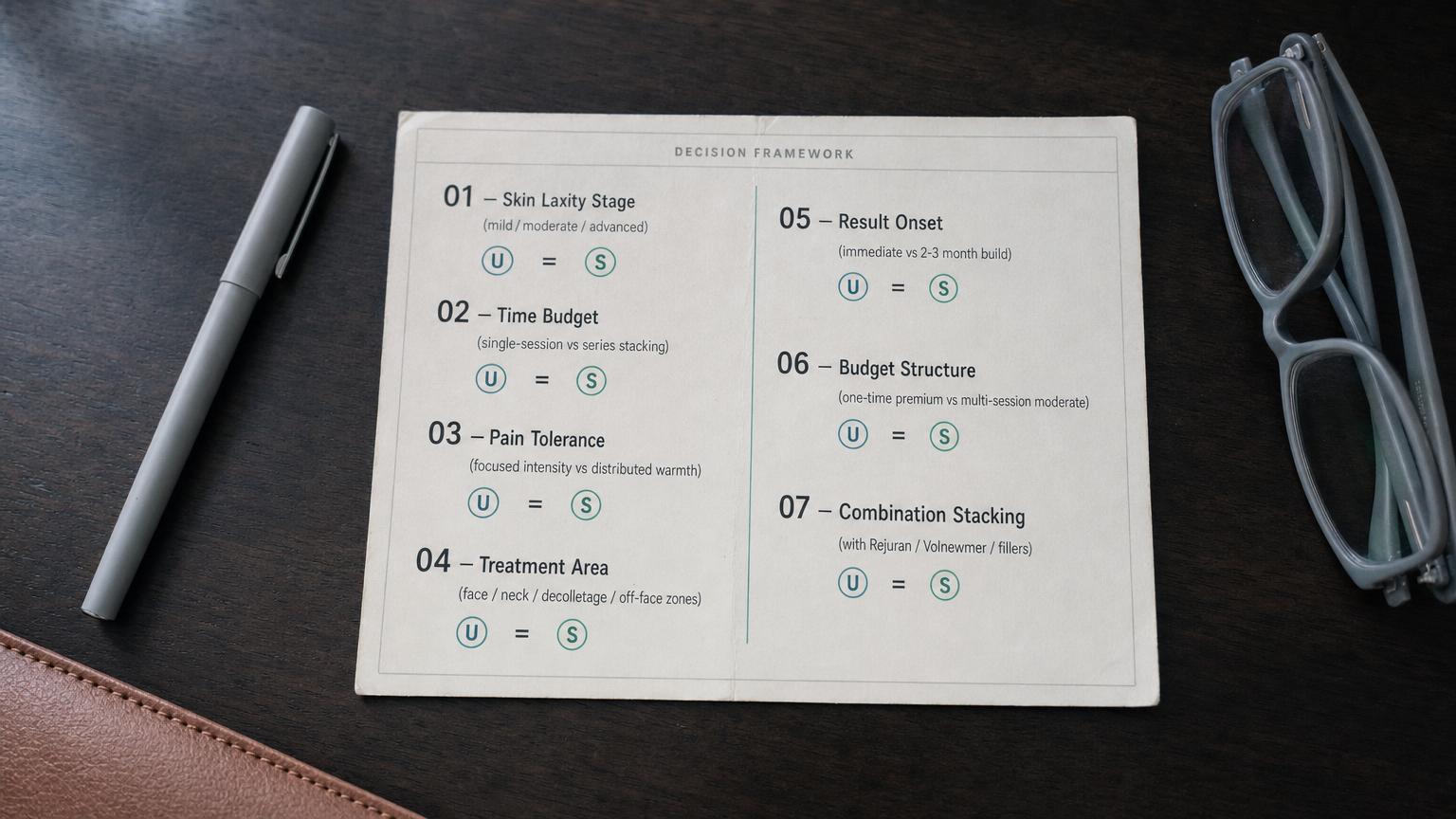
The seven factors below cover the questions a foreign patient should answer before walking into a Seoul consultation. The framework is anatomy-driven and goal-driven rather than device-driven, which means it can be applied without pre-deciding which device the consultation will recommend. The clinic’s job is to map the patient’s answers across these factors to a device recommendation. The patient’s job is to evaluate whether the clinic’s recommendation aligns with the factor framework and to ask follow-up questions where it does not.
Recommended for Your Recovery
Products commonly used before and after Korean shrink universe vs ultherapy — same items routinely recommended in the recovery instructions Seoul clinics hand out at discharge.
- COSRX Advanced Snail 96 Mucin Power Essence — Korean barrier essence for the post-laser tissue regeneration window. Check price on Amazon
- Beauty of Joseon Relief Sun SPF 50+ — strict SPF 50+ daily for at least 3 months after any pigment or resurfacing laser — UV reverses results. Check price on Amazon
- Gel Eye Mask (Cold Compress) — cold compress for residual redness in the first 24 to 48 hours after a session. Check price on Amazon
- Silicone Scar Sheets — for ablative laser zones with crust formation, support scar maturation as new skin emerges. Check price on Amazon
As an Amazon Associate, GlobalBeautySpot earns from qualifying purchases at no extra cost to you.
Factor 1: Skin Laxity Stage
Skin laxity sits on a continuum from early (mild jawline softening in patients in their late 20s and early 30s) through established (visible jowl drop and submental laxity in patients from mid 30s through late 40s) to substantial (skin redundancy combined with SMAS descent in patients over 55). Each stage matches one device more naturally than the other.
- Early laxity — Shrink Universe multi-depth protocol typically suits this profile because the goal is preventive collagen stimulation distributed across dermal and SMAS layers rather than focal structural lifting. The series-based dosing gradually improves dermal density and tissue tone over the 2-to-3-session course. Ultherapy at this stage adds incremental rather than dramatic change because the SMAS is not yet substantially descended, and the cost-per-visible-result ratio favors Shrink Universe.
- Established laxity — Ultherapy single-session SMAS-targeted lifting addresses structural sag more directly. The DeepSEE-confirmed 4.5 mm SMAS lines produce the focal contraction that is visible as jawline sharpening and submental tightening. Shrink Universe at this stage can produce a good result but typically requires the full series plus annual maintenance to match what Ultherapy delivers in one session.
- Substantial laxity — Neither HIFU device alone is generally sufficient for skin redundancy combined with SMAS descent. Patients in this zone typically need surgical face lifting or, at minimum, thread lifting combined with HIFU. The HIFU component is supportive rather than corrective at this severity.
Factor 2: Time Budget
Foreign patient trip length is one of the most underdiscussed factors in HIFU device selection. A patient with a 3-to-5 day Korea trip and other procedures planned cannot complete a Shrink Universe series within the visit. A patient with a 14-day trip can comfortably complete 2 sessions of Shrink Universe series within the visit and follow up with the third session on a return trip.
- Short trip (3 to 7 days) — Ultherapy single session is logistically aligned with this budget. The 60-to-90-minute session fits into one day, the collagen response unfolds while the patient is back home, and the result peaks at month 6 with no return trip required.
- Medium trip (8 to 14 days) — Both devices fit. Shrink Universe first session can be scheduled early in the trip, with the second session 4 to 6 weeks later either on a return trip or for resident patients. Ultherapy single session fits any day of the trip.
- Long trip or resident in Korea — Either device. Shrink Universe series can be completed in full over 8 to 12 weeks. Ultherapy single session plus annual touch-ups is also accommodated.
Factor 3: Pain Tolerance
The sensation profile of the two devices differs in ways that matter for patient comfort. Ultherapy’s high-energy single-session delivery produces brief sharp pulses at each treatment line, particularly along the brow and jawline. Patients describe the sensation as a quick deep pulse of heat with occasional electrical prickling at the focal point. Topical numbing reduces the surface sensation but does not eliminate the deep pulse. Shrink Universe’s lower-energy multi-session protocol distributes the sensation across more shots with less peak intensity per shot. Patients describe the sensation as a sustained warmth rather than discrete pulses.
- High pain tolerance — Either device. Ultherapy single session is genuinely brief and the pain is well-defined.
- Moderate pain tolerance — Either device with topical numbing. Patients who anticipate higher sensitivity can request light sedation or pre-treatment oral analgesia for Ultherapy. Shrink Universe typically does not require additional pain management beyond topical numbing.
- Low pain tolerance — Shrink Universe is generally more tolerable per session, though the total sensation accumulated across the series approaches the Ultherapy single-session total. Some clinics offer light sedation for Ultherapy patients in this group, which makes the comfort gap smaller but adds cost and recovery time.
Factor 4: Result Timeline Expectations
Both devices produce results that unfold over weeks rather than days, but the timelines differ enough to matter for patients planning around specific events.
- Ultherapy — Week 2 minimal visible change, week 8 collagen build becomes visible, month 6 peak result, month 12 to 18 gradual decline. The result is single-session origin and unfolds continuously.
- Shrink Universe — Visible improvement after each session in the series (cumulative), peak result 2 to 3 months after the final session in the series, gradual decline over 9 to 12 months. The result accumulates across the series rather than emerging from a single point.
Patients with a fixed event date 4 to 6 months out (wedding, milestone birthday, professional photoshoot) can plan around either timeline, but Ultherapy’s predictable single-point timeline makes the planning slightly cleaner. Patients with longer planning horizons or no specific event often prefer Shrink Universe’s gradual emergence because the change is less likely to be noticed as “having had something done.”
Factor 5: Body Versus Face Goals
This factor is decisive when applicable. Shrink Universe’s 9-depth flexibility extends well into body contouring depths (6.0 mm, 9.0 mm, 13 mm cartridges) that Ultherapy’s 3-depth facial range does not address. Patients whose lifting goals include arm tightening, abdominal contouring, or broader body lifting need Shrink Universe or a comparable broad-depth HIFU. Ultherapy is fundamentally a facial and submental lifting device — the cartridge range does not extend to body depths.
- Face and neck only — Either device, decision driven by other factors.
- Decolletage included — Either device, both have appropriate cartridges, Ultherapy 1.5 mm and Shrink Universe equivalent.
- Body contouring included — Shrink Universe is the appropriate platform. Ultherapy does not cover this indication.
Factor 6: Age
Age correlates with skin laxity stage (Factor 1) but adds additional context. Younger patients often have other procedural alternatives that produce better cost-per-result outcomes than HIFU lifting at all.
- Under 30 — Neither device is typically indicated for lifting because native SMAS tone is intact. Patients in this group are usually better served by skin booster protocols (Rejuran, Exosome) for texture and dermal quality rather than lifting devices.
- 30 to 38 — Shrink Universe preventive multi-depth protocol works well as preventive maintenance.
- 38 to 55 — The strongest window for both devices. Ultherapy single session for established jawline laxity, Shrink Universe series for broader skin quality with mild lifting.
- 55 to 65 — Ultherapy works if SMAS descent is moderate and skin redundancy is mild. Shrink Universe works as adjunct to other procedures. Surgical lifting becomes a more reasonable comparison at this age.
- Over 65 — Either device as adjunct, neither as standalone solution. Skin redundancy at this age typically exceeds what non-surgical lifting can address.
Factor 7: Single Session vs Series Preference
This is the procedural preference question. Some patients prefer single-event procedures with predictable timelines and clean touch-up schedules. Other patients prefer incremental treatments with smaller per-session sensation and a series structure that allows pausing or adjusting course.
- Single session preference — Ultherapy.
- Series preference — Shrink Universe.
The framework’s seven factors do not produce a single deterministic recommendation. They produce a clinical conversation with structure. A 42-year-old foreign patient on a 7-day trip with established jawline laxity, moderate pain tolerance, face-only goals, and single-session preference is a relatively clean Ultherapy candidate. A 35-year-old resident patient with early laxity, body contouring goals included, low pain tolerance, and a year of available scheduling is a clean Shrink Universe candidate. Many patients sit between these clean profiles and benefit from a layered or staged protocol that uses both devices.
Section 4 — Cost and Combination Protocols Across Both Devices
Cost is one of the practical decision factors that often gets discussed in isolation, but the meaningful comparison is cost-per-visible-result rather than absolute session cost. Ultherapy’s higher per-session cost includes the more expensive Merz cartridges, the single-session dose, and the longer-duration result. Shrink Universe’s lower per-session cost is multiplied across the series. Net cost over a comparable result window often ends up similar between the two devices, though Ultherapy generally carries a higher upfront commitment while Shrink Universe spreads the cost across the series.
| Region / Protocol | Cost | Notes |
|---|---|---|
| Korea (Seoul) — Ultherapy full face + neck | KRW 1,800,000–3,200,000 (USD 1,330–2,370) | Single session, 600–1,200 lines, authorized Merz clinic with DeepSEE depth mapping |
| Korea (Seoul) — Ultherapy lower face + submentum | KRW 1,200,000–2,000,000 (USD 890–1,480) | Single session, 400–600 lines, common foreign patient package |
| Korea (Seoul) — Shrink Universe series (face) | KRW 900,000–1,800,000 per session (USD 670–1,330) | 2–3 session series, total KRW 1,800,000–5,400,000 depending on count |
| Korea (Seoul) — Shrink Universe single session | KRW 700,000–1,400,000 (USD 520–1,040) | Maintenance or first-time trial session |
| Korea (Seoul) — Layered protocol | KRW 3,000,000–5,500,000 (USD 2,200–4,070) | Shrink Universe series first, Ultherapy 4–6 weeks later for SMAS focal lift |
| USA — Ultherapy full face + neck | USD 3,500–5,500 | Authorized clinics, variable by region |
| USA — Ultraformer / Shrink Universe equivalent | USD 800–1,800 per session | Limited availability, not US-marketed under Shrink Universe name |
| UK / EU — Ultherapy full face + neck | GBP 2,800–4,500 | Authorized Merz clinics in major cities |
| UK / EU — Ultraformer III equivalent | GBP 600–1,400 per session | Series typically required |
| Australia — Ultherapy full face + neck | AUD 4,500–7,000 | Higher operating costs |
| Southeast Asia (unauthorized risk) | USD 200–800 | Often generic HIFU sold under either Ultherapy or Shrink Universe naming, verification critical |
The pricing reflects authorized clinic ranges in each region. Foreign patients evaluating clinics on absolute price alone risk steering toward unauthorized vendors that sell generic HIFU under either device name. The verification principles covered in the dedicated Ultherapy guide (Merz authorization, sealed cartridge, active DeepSEE) apply to Shrink Universe verification as well — authentic Shrink Universe arrives in Classys-branded packaging with serial-numbered cartridges and is delivered by clinicians familiar with the multi-depth protocol.
Layered Korean Protocols Across Both Devices
One of the practical strengths of the Korean aesthetic ecosystem is that Shrink Universe and Ultherapy are rarely the only treatments a patient receives during a Korea trip. The mature protocol layers HIFU lifting with petit-aesthetic procedures (Rejuran, Exosome, Juvelook) and sometimes thread lifting to address structural, dermal, and regenerative components in a coordinated plan. Each component targets a different tissue layer or aesthetic outcome, and together they produce a result that no single procedure alone delivers.
- Shrink Universe + Ultherapy staged protocol. Shrink Universe series completed first (2 to 3 sessions over 8 to 12 weeks) for broad multi-depth dermal density and tissue tone, followed by Ultherapy single session 4 to 6 weeks after the final Shrink Universe session for focal SMAS lifting in the jawline and lower face. The Shrink Universe pre-treatment improves overall skin condition so the subsequent Ultherapy SMAS contraction is supported by a more responsive dermal layer. Total cost typically KRW 4,000,000 to 6,500,000 (USD 2,960 to 4,810).
- Either lifting device + Rejuran. Korean Rejuran skin booster therapy in a series of 3 to 4 sessions spaced 3 to 4 weeks apart adds polynucleotide-based dermal regeneration and texture improvement. The Rejuran series is typically timed so that the final session falls around the lifting result peak window. Patients receive structural lift from Shrink Universe or Ultherapy and dermal quality from Rejuran in the same coordinated plan.
- Either lifting device + Exosome. Korean Exosome therapy applied immediately post-lifting or within 1 to 2 weeks accelerates the healing cascade. The cell signaling molecules in Exosome therapy enhance the same wound-healing pathways that the HIFU thermal coagulation triggers. Often combined with microneedling for layered delivery.
- HIFU lifting + thread lifting. For patients with substantial laxity where HIFU alone is insufficient but surgical lifting is not yet appropriate, thread lifting provides immediate mechanical lift and HIFU added 6 to 8 weeks later consolidates the lift through collagen building. The order matters — threads first for the immediate lift visibility, HIFU second for the collagen build that locks the lift in place.
- The comprehensive protocol. Patients with budget and trip length to support a full protocol combine structural lift (Shrink Universe + Ultherapy staged), dermal regeneration (Rejuran), regenerative signaling (Exosome), and where appropriate volume restoration (Juvelook or PLLA-based volumizer). Total cost in Seoul typically runs KRW 6,000,000 to 10,000,000 (USD 4,440 to 7,400), comparable to the cost of Ultherapy alone in US authorized clinics. The trip length for the comprehensive initial round is 10 to 14 days, with follow-up sessions on return trips or for resident patients.
Section 5 — Recovery, Realistic Timeline, and What to Ask in the Consultation
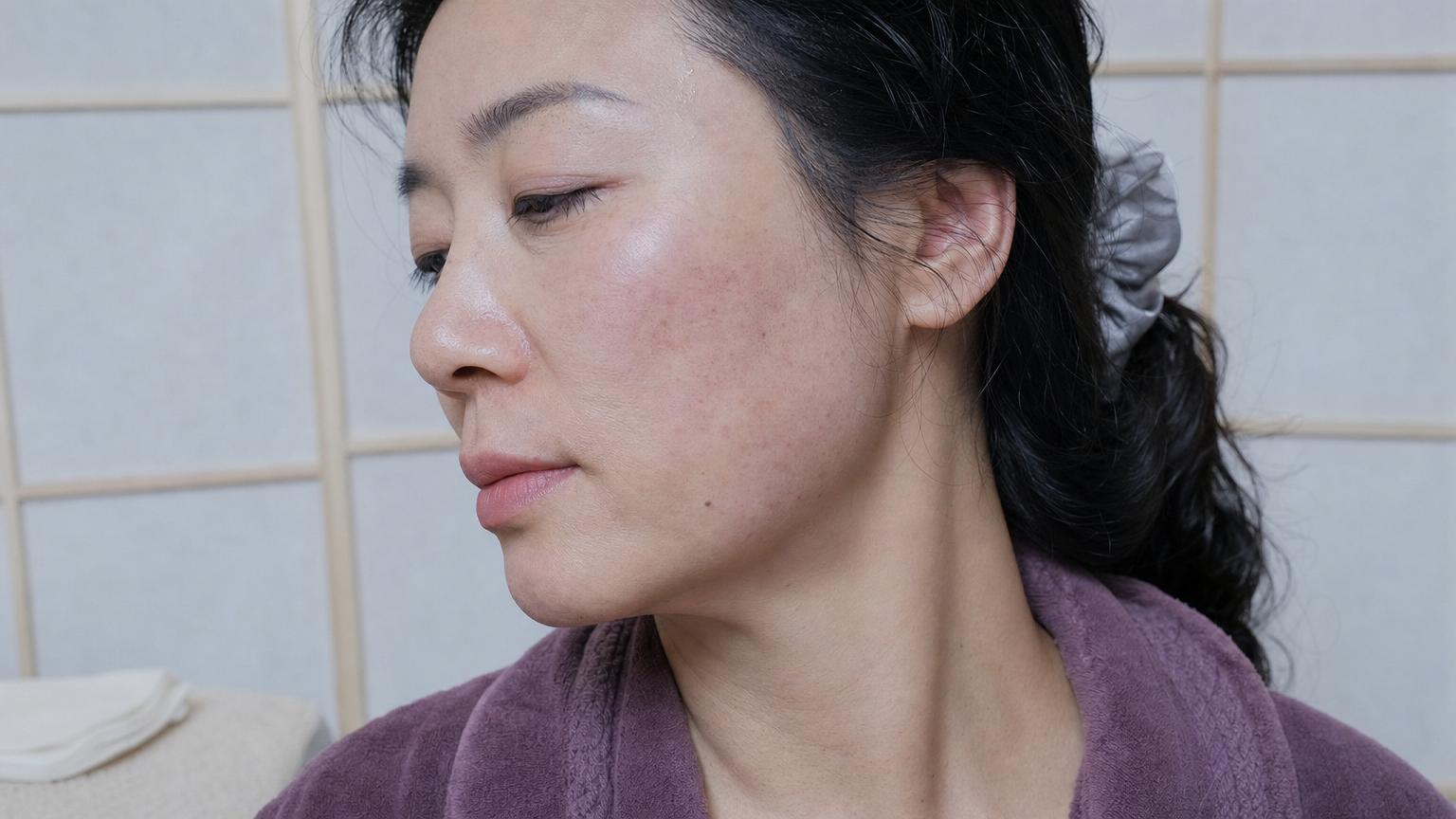
Both Shrink Universe and Ultherapy share a meaningful clinical advantage: recovery is minimal and foreign patients can fly home the next day with no visible markers of having had a procedure. The trade-off, also shared, is that the result unfolds over weeks rather than days, which creates a “did anything happen” anxiety window for patients who expected immediate change. Understanding the realistic timeline for the chosen device prevents this anxiety and makes the trip planning easier.
Day 0: The Treatment Session
An Ultherapy single session typically runs 60 to 90 minutes for a full face and neck protocol depending on line count and cartridge depth changes. A Shrink Universe single session in the series typically runs 30 to 60 minutes depending on the treatment plan. Topical numbing is applied 30 to 45 minutes before treatment for both. The sensation during treatment differs as described in Factor 3 — brief sharp pulses for Ultherapy, sustained warming for Shrink Universe — but neither produces persistent pain after the session ends. The patient walks out of the clinic within 15 to 20 minutes of treatment completion.
Days 1 to 3: Mild Flush, Minimal Downtime
For most patients, the immediate post-treatment appearance is a mild flush across the treated area that resolves over a few hours to 24 hours. Some patients have minor swelling for 24 to 48 hours, particularly in the jawline and submentum where soft tissue is more reactive. Rare patients have small localized bruising at high-energy zones, particularly when HIFU is combined with other same-day procedures. Foreign patients routinely fly home the day after treatment with no visible markers, which is one of the practical advantages that makes HIFU lifting attractive for medical tourism.
Week 2: Nothing Visible Yet, This Is Expected
The most common point of patient anxiety with both devices is around week 2. The flush is gone, the swelling has resolved, and the patient looks in the mirror and sees the same face they started with. This is normal. The collagen response is not yet visible at this stage. Patients who message the clinic at week 2 asking whether the treatment worked are reassured that the timeline runs on month 2 and month 3, not week 2.
Weeks 8 to 12: Collagen Build Becomes Visible
Around week 8 for Ultherapy and shortly after the final Shrink Universe series session, the contour change begins to register. The jawline appears slightly more defined, the submentum tightens, the cheek volume sits a little higher, and the overall face feels structurally more taut without looking different. Patients who took standardized photos at day 0 and compare them at week 10 see the change clearly. Patients who did not take photos sometimes need a family member or close friend to point it out — the change is structural rather than dramatic, which is the design goal of both devices.
Month 6: Peak Result
The peak appearance of an Ultherapy result is typically reached at month 6. The peak appearance of a Shrink Universe series result is typically reached 2 to 3 months after the final session in the series, which translates to month 5 to 6 from the first session for a 3-session series. Patients who proceeded with realistic expectations — looking for structural lift rather than dramatic transformation — are generally satisfied at this point. The face looks like the same face, but the lower jawline is sharper, the submentum is firmer, and the overall age impression has moved several years younger without registering as “having had work done.”
Months 12 to 18: Decline and Touch-Up Decision
Neither result is permanent. Ultherapy collagen built from a single session gradually remodels and the SMAS contraction relaxes over 12 to 18 months. Shrink Universe series collagen builds typically decline starting at month 9 to 12 from the series completion. Most patients opt for some form of touch-up between month 12 and month 24 for Ultherapy, or annual maintenance sessions for Shrink Universe. The touch-up cycle is one of the genuine ongoing cost considerations of HIFU lifting and should be included in the budget planning for the procedure.
What to Ask in the Consultation

The seven-factor framework above gives patients structure for the consultation conversation. Specific questions that surface clinic credibility:
- “Do you operate both Shrink Universe and Ultherapy, or only one of them?” A clinic with both can recommend by anatomy. A clinic with one is constrained by inventory.
- “What is my SMAS depth on imaging, and which cartridge depth do you recommend for it?” A clinic with Ultherapy and DeepSEE can answer this directly with imaging. A clinic without DeepSEE can answer with anatomical estimate, which is honest but less precise.
- “Why this device for my specific case, rather than the other?” A clinic that can articulate the anatomical reason in terms of your laxity stage and goals is more credible than a clinic that gives generic marketing about the device.
- “Where would the other device be a better fit, and why is that not me?” A clinic that can describe the patient profile for the off-recommendation device demonstrates that the recommendation was anatomy-driven rather than inventory-driven.
- “What is the realistic decline timeline, and what does the touch-up cycle cost?” A clinic that gives a clear ongoing cost picture is treating the patient as a long-term clinical relationship rather than a single transaction.
The questions above are not adversarial. A credible clinic answers them straightforwardly because the answers are the basis of any responsible recommendation. A clinic that deflects the questions, claims its device is universally optimal, or refuses to discuss the patient profile for the off-recommendation device is signaling something about its consultation approach. Foreign patients who run this question framework during the consultation get more useful answers than foreign patients who arrive pre-decided based on Reddit or Western blog framings.
Frequently Asked Questions
Is Shrink Universe just a cheaper Korean Ultherapy clone?
No. Shrink Universe is a Classys device with a different engineering lineage from Merz Ultherapy, and the two are not functionally equivalent. Shrink Universe uses HIFU with 9 cartridge depths from 1.5 mm to 13 mm and runs without real-time imaging. Ultherapy uses MFU-V (microfocused ultrasound with visualization) at 3 facial cartridge depths with DeepSEE real-time SMAS imaging. The Reddit framing that Shrink Universe is a knockoff conflates the two manufacturers and misreads the actual trade-offs. Shrink Universe is genuinely well-suited for preventive multi-depth treatment and broad-area body work; Ultherapy is genuinely better when SMAS-depth confirmation matters for a focal structural lift. Neither is a clone of the other.
If a Korean clinic only offers one device, does that mean the other is unavailable in Korea?
Both devices are widely available across Seoul. Most authorized clinics carry one of the two as their primary lifting device based on the clinic’s case mix and capital decisions. A clinic offering only Shrink Universe is not refusing to do Ultherapy; it likely treats a patient population whose anatomy and goals are well-served by Shrink Universe’s multi-depth flexibility. A clinic offering only Ultherapy typically prioritizes single-session SMAS-targeted protocols. Clinics that operate both devices are the minority but exist, and they are typically the right choice for foreign patients who want device selection based on individual anatomy rather than inventory.
How does pain compare between Shrink Universe and Ultherapy?
Ultherapy generally produces a higher per-shot sensation because the focused energy density is higher and the SMAS-targeted 4.5 mm cartridge fires deeper. Patients commonly describe brief sharp pulses at each line, particularly along the brow and jawline. Shrink Universe distributes lower energy across more shots in MPT (Macro Pulsed) and Booster modes, which most patients describe as a warming sensation rather than discrete sharp pulses. Topical numbing is standard for both. Patients who anticipate higher pain sensitivity may find Shrink Universe more tolerable; patients who prioritize the single-session structural result over comfort generally accept the Ultherapy sensation. Neither produces persistent pain after the session.
Which device is better for the neck and submentum?
For pure submentum tightening, Ultherapy at 4.5 mm with DeepSEE confirmation is the clinical standard and produces the most predictable structural change. For broader neck work that extends into the platysma and clavicular area, Shrink Universe’s deeper cartridges (6.0 mm to 13 mm) cover a wider tissue depth range and treat areas the 4.5 mm Ultherapy cartridge cannot reach efficiently. Many Korean clinics combine the two for comprehensive neck protocols: Ultherapy for submental SMAS and Shrink Universe for broader neck and decolletage coverage. The choice on neck alone often depends on whether the goal is focal submental tightening (Ultherapy) or generalized neck contouring (Shrink Universe or layered combination).
Can I do both Shrink Universe and Ultherapy on the same trip?
Yes, and this is increasingly common in mature Korean lifting protocols. The typical staging is Shrink Universe first for broad multi-depth dermal stimulation, followed by Ultherapy 4 to 6 weeks later for focal SMAS lifting in the lower face and jawline zones where structural change is the goal. The Shrink Universe pre-treatment improves overall skin condition and dermal density, so the subsequent Ultherapy SMAS contraction is supported by a more responsive dermal layer. Reverse staging (Ultherapy first, Shrink Universe later) is also reasonable for patients whose primary concern is structural lift with dermal quality as a secondary goal. Total cost for the layered protocol typically runs KRW 3,000,000 to 5,500,000 (USD 2,200 to 4,070) in Seoul depending on session size.
How long does Shrink Universe last compared to Ultherapy?
Both devices produce results that decline over 12 to 18 months from peak. Ultherapy’s single-session structural lift typically peaks at month 6 and remains visible for 12 to 18 months before gradual decline, with most patients opting for a touch-up at the 12 to 18 month mark. Shrink Universe is typically dosed as a series (2 to 3 sessions spaced 4 to 6 weeks apart), with the cumulative result peaking 2 to 3 months after the final session and maintaining for 9 to 12 months before declining. The shorter Shrink Universe duration is partly because the per-session energy is lower, and partly because the multi-depth protocol distributes the dose across more tissue layers. Patients who prioritize fewer touch-ups generally prefer Ultherapy; patients who prefer smaller incremental sessions generally prefer Shrink Universe.
Are men good candidates for Shrink Universe or Ultherapy?
Both devices treat male patients well, and male lifting is one of the fastest-growing segments in Korean aesthetics. Male skin tends to be thicker and the SMAS is generally more robust than female patients of similar age. For male patients with established jawline laxity, Ultherapy SMAS-targeted single session produces a focused jawline result with minimal time commitment. For male patients with broader skin quality concerns (texture, mild laxity across face and neck), Shrink Universe multi-depth series is often more comprehensive. Many male foreign patients with limited trip time prefer Ultherapy single-session efficiency; resident male patients with longer-term plans often choose Shrink Universe series for gradual maintenance.
What is the age range where each device works best?
Shrink Universe works well across a wider age range (late 20s through 60s) because its multi-depth protocol can address dermal density and texture in younger patients as well as deeper SMAS work in older patients. Ultherapy is most effective in the 38 to 60 range where SMAS descent is established but skin redundancy has not yet exceeded what non-surgical lifting can address. Patients under 35 often get more value from Shrink Universe preventive protocols than from Ultherapy structural lifting (which may add incremental rather than dramatic change at younger ages). Patients over 65 with substantial skin redundancy often need surgical face lifting rather than either device — both are appropriate as adjuncts but rarely as standalone solutions at that age.
How do I evaluate a clinic recommending one device over the other?
Three questions filter the credibility of the recommendation. First, does the clinic operate both devices, or only one? A clinic with both can recommend based on anatomy. A clinic with one is constrained by inventory and may recommend the available device even when the other would be a better fit. Second, can the clinic articulate the specific anatomical reason for the recommendation in terms of your SMAS depth, skin laxity stage, and treatment goals — rather than generic marketing about which device is better? Third, will the clinic acknowledge the limits of the recommended device and the situations where the other device would be preferable? A clinic that admits its device is not optimal for some patients is more trustworthy than a clinic that claims its device handles every case. The full Korean laser and energy treatment category covers comparisons across the broader lifting and skin-quality device range.
What can I combine with Shrink Universe or Ultherapy on the same Korea trip?
Both devices combine well with Korean petit aesthetic treatments. Rejuran (polynucleotide skin booster) layered with either lifting device adds dermal regeneration and texture improvement that complements the structural change. Exosome therapy applied at the same session or within 1 to 2 weeks of lifting accelerates the healing cascade and supports the collagen response. Thread lifting can be staged before or after either device — threads first for immediate mechanical lift, lifting device second for collagen consolidation. PLLA-based volumizers like Juvelook or Sculptra are appropriate for patients who need volume restoration alongside lifting. Foreign patients with 7 to 14 day Korea trips often complete a comprehensive protocol covering structural lift, dermal regeneration, and texture in a single visit.
Closing
Korean Shrink Universe and Ultherapy are not interchangeable, but neither is one universally better than the other. They are different devices built around different engineering trade-offs that serve different patient profiles. The seven-factor framework — laxity stage, time budget, pain tolerance, result timeline, body-versus-face goals, age, and single-session-versus-series preference — gives foreign patients a structure for evaluating clinic recommendations against their own anatomy. Patients who arrive pre-decided based on Reddit cost-shock threads or Western dermatology blogs often end up with the wrong device for their case. Patients who arrive with the framework in hand get a useful consultation conversation in which the clinic can articulate the anatomical reasoning behind the recommendation and acknowledge the situations where the off-recommendation device would be preferable. The credibility move that separates a good clinic from a marketing clinic is the willingness to recommend the other device when the patient’s anatomy points that direction. Link Plastic Surgery’s official website operates both Shrink Universe and Ultherapy and applies this seven-factor framework internally during consultations, which is the operational pattern foreign patients should look for when evaluating any Seoul clinic offering Korean HIFU lifting.
HIFU vs Ultherapy: The Short Answer
People often frame this comparison as “HIFU vs Ultherapy,” but that phrasing hides a technicality worth knowing: Ultherapy is itself a HIFU (high-intensity focused ultrasound) device. When patients search “HIFU vs Ultherapy comparison” in Seoul, what they usually mean is generic or lower-cost HIFU devices, such as Shrink Universe or Ultraformer, versus the branded, imaging-guided Ultherapy. The genuine difference is not the underlying energy, which is HIFU in both, but the precision: Ultherapy uses real-time ultrasound imaging so the practitioner sees the exact layer being treated, while many generic HIFU devices deliver energy to an estimated depth without live visualization.
So the short answer to “HIFU vs Ultherapy” is that both use HIFU, but Ultherapy adds imaging-guided precision and a higher price, while generic HIFU (like Shrink Universe) offers strong value and is often done in more frequent sessions. Neither is universally better; the right choice depends on your skin laxity, budget, and how much precision your case needs, which is exactly what the decision framework above walks through. For an honest assessment of which device suits you, a consultation for Link Plastic Surgery’s Ultherapy and HIFU lifting can map your goal to the right option rather than the more expensive one by default.