Korean Volnewmer Monopolar RF: The Lift That Builds Over 3 Months, Not 3 Days
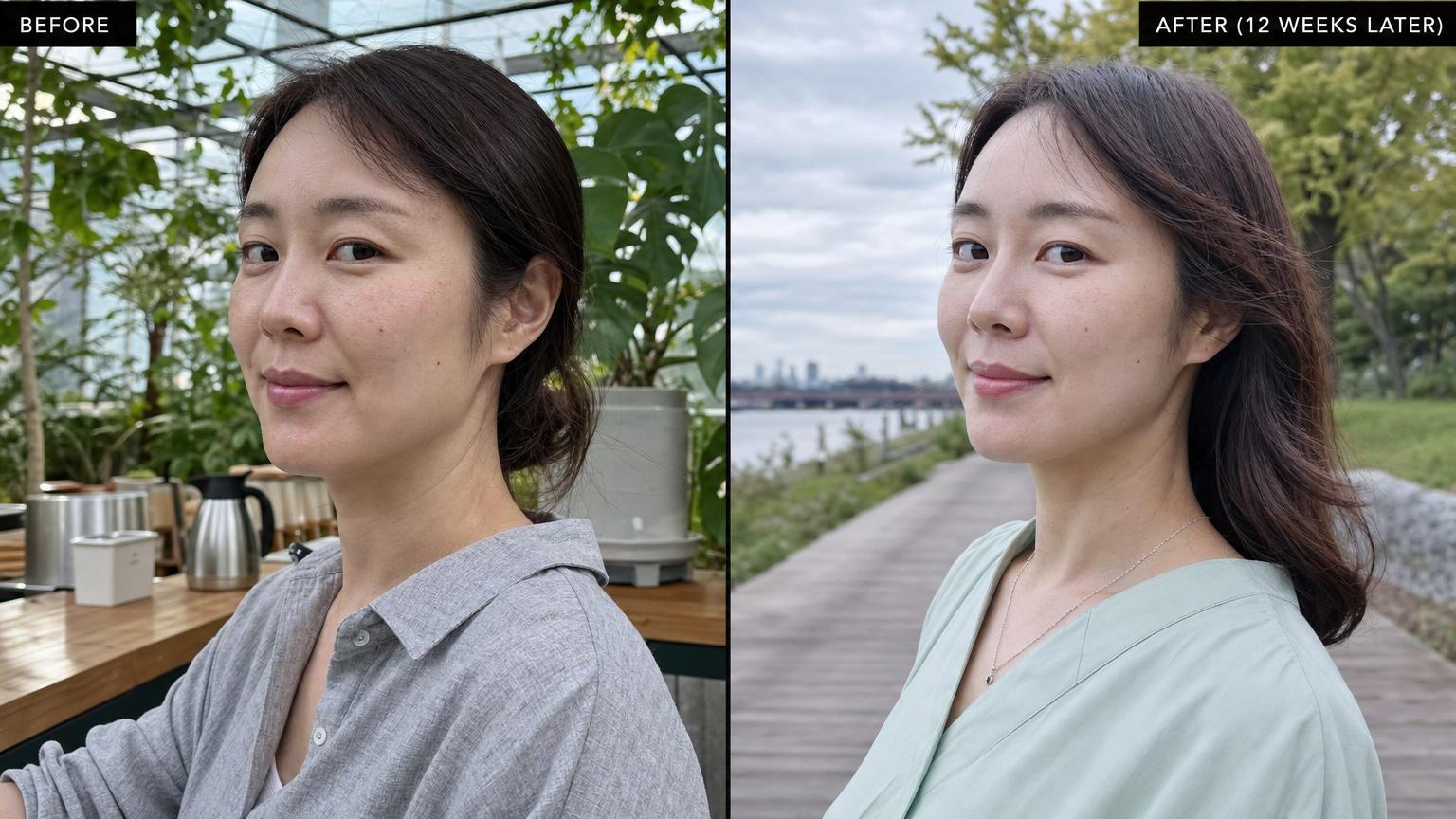
Foreign patients arrive in Seoul having read English-language forums that lump every monopolar RF device into the same category as Thermage, then book Volnewmer expecting either the dramatic same-day tightening Thermage marketing once promised, or the single-session SMAS lift that Ultherapy delivers. Korean Volnewmer does neither. The procedure is a monopolar RF platform that deposits controlled radiofrequency energy into the reticular dermis at 2 to 3 millimeter depth, triggering collagen contraction in the first two weeks and new collagen synthesis over weeks four through twelve, with peak visible result at month three. The Korean operator protocol matters as much as the device itself. Korean clinics run Volnewmer as a 60 to 90 minute hand-mapped session with integrated cooling-pulse-cooling cycles at progressive cumulative power levels, treating it as a single-session investment with a 12 to 18 month maintenance cadence. Western clinics often run abbreviated 30 minute Volnewmer sessions because of throughput pressure, which leaves the structural zones under-treated. Foreign patients booking Volnewmer at authorized Seoul clinics including Link Plastic Surgery get the full protocol at 30 to 50 percent of Western pricing, with the trade-off that the result requires patience: it is invisible at week one, barely visible at week four, and reaches peak at month three.
The misconception is mechanism-level, not technique-level. Monopolar RF at 2 to 3 millimeter dermal depth physiologically cannot deliver same-day SMAS-level tightening, and any clinic claiming otherwise is overstating outcomes. Patients who book Volnewmer expecting Ultherapy-style 24-hour lift are not getting a bad procedure. They are getting the wrong mental model. This guide explains what Korean Volnewmer actually is, the three misconceptions that send foreign patients home disappointed at the wrong week, the operator technique differences that explain why Korean clinics charge less and deliver more, the 12 to 24 week recovery timeline with the false plateau at week 4 explained, the cost comparison versus Western markets, and the realistic candidate profile.
Section 1 — What Korean Volnewmer Actually Is, and the Three Misconceptions Foreign Patients Bring
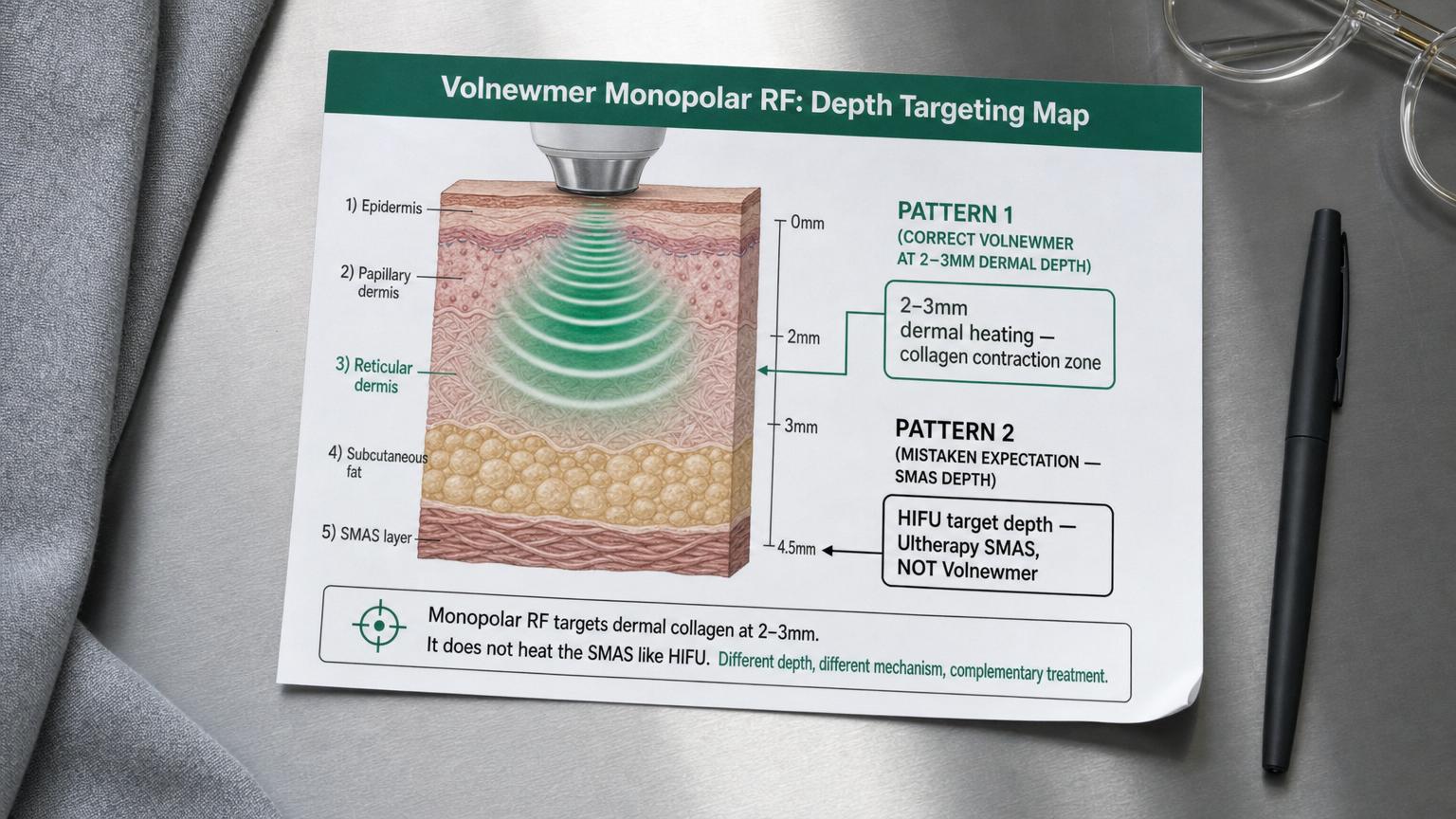
Volnewmer is a monopolar radiofrequency platform manufactured by Hironic in Korea, designed for non-surgical skin tightening through controlled dermal heating. The device delivers RF energy at approximately 6.78 megahertz through a single active electrode (the monopolar tip) with the return electrode positioned elsewhere on the body. The energy passes through the skin and converges at the dermal target depth, producing volumetric heating in the reticular dermis at 2 to 3 millimeter depth. The thermal effect at the target zone triggers immediate collagen contraction over the first two weeks (the visible portion of which is brief and largely water-loss driven) and a sustained collagen synthesis response over weeks four through twelve. The clinical result is a gradual tightening of the dermal layer that becomes visible at week four to six and reaches peak appearance at month three, with the dermal tone remaining detectable for 12 to 18 months before gradual decline.
This mechanism is genuinely different from HIFU (high-intensity focused ultrasound platforms like Ultherapy or Shrink Universe), which target the SMAS layer at 4.5 millimeter depth for structural lift. It is also genuinely different from thread lifting, which mechanically lifts the SMAS using PDO or PLLA threads with anchoring cogs. Volnewmer competes with other monopolar RF platforms like Thermage FLX, Inmode Forma, and Oligio, but each of these uses slightly different tip geometry, different pulse delivery curves, and different cooling integration. They are not interchangeable, and the differences matter for the foreign patient who has read forum threads conflating them all. Korean clinics with Volnewmer authorization publish the device serial number, the Hironic certification, and the per-session protocol parameters as standard verification.
Misconception 1: Volnewmer Is Korean Thermage
This is the single most common misconception, and it comes from English-language forum threads that frame Volnewmer as either a knockoff or a budget alternative to Thermage. Both are monopolar RF devices operating in the same therapeutic depth range, so the surface-level comparison is reasonable. The detail-level differences are substantial. Thermage FLX uses a 4.0 centimeter square treatment tip with a vibrating massage feature designed to mitigate discomfort during high-energy pulses. Volnewmer uses a smaller round tip optimized for hand-mapped per-zone treatment with progressive cumulative heating rather than high single-shot energy. Thermage typically runs at higher per-shot energy with fewer total passes; Volnewmer typically runs at moderate per-shot energy with more total passes and integrated cooling sandwiches between passes. The clinical results are within the same category but produced by different operator protocols, and the per-session experience is meaningfully different. Calling Volnewmer “Korean Thermage” is like calling a Ford Mustang “American Porsche”: both are performance cars, the mechanism overlaps, but the engineering choices and the driving experience are not the same thing.
Misconception 2: Monopolar RF Competes With HIFU
The second misconception is that Volnewmer and Ultherapy (or other HIFU platforms) are direct competitors that a patient should pick between. This frames the choice as either/or when the correct framing for most patients with moderate laxity is and/then. Volnewmer heats the reticular dermis at 2 to 3 millimeter depth, producing collagen contraction and new collagen synthesis in the dermal layer. Ultherapy delivers thermal coagulation points at 4.5 millimeter SMAS depth, producing SMAS contraction and structural lift. These are genuinely different tissue layers with genuinely different mechanical roles in facial aging. Patients with moderate laxity often benefit from both, applied in a layered protocol across 6 to 12 weeks. Patients with mild laxity often get sufficient correction from Volnewmer alone. Patients with substantial laxity often need either Ultherapy alone (for the structural lift component) or a combined Thread plus Volnewmer plus Ultherapy three-layer protocol. Treating Volnewmer and Ultherapy as competing options is a marketing framing, not a clinical framing.
Misconception 3: I Should See the Result at Week One
The third misconception is timeline expectation, and it is the misconception most likely to send foreign patients home disappointed. Some patients see a small amount of immediate tightening on day 0 driven by water-loss in the heated tissue. This effect fades within 48 to 72 hours and is not the actual Volnewmer result. The actual result is collagen-driven and unfolds over the following weeks. Week one shows essentially no change. Weeks two and three show essentially no change. Week four to six is when subtle improvement first becomes visible. Weeks eight through twelve are the build phase. Month three is peak. Foreign patients who book Volnewmer based on Western marketing that emphasizes the same-day tightening effect, then check the mirror at week one and conclude the procedure failed, are working from the wrong mental model. The Korean clinical positioning is explicit: Volnewmer is a 3 to 4 month procedure, not a same-day procedure. Patients who internalize this framing before booking are dramatically more satisfied with the result than patients who do not.
What Volnewmer Is Not
It is worth being explicit about what the procedure does not do. Volnewmer does not remove fat (it is not lipolysis). It does not lift severely descended SMAS (that is a surgical face lift question or a Thread-plus-HIFU layered question). It does not treat pigment or vascular concerns (those are Q-switched or pulsed-dye laser questions). It does not fill volume loss in the mid-face hollows (that is a filler or autologous fat grafting question). It does not deliver permanent results (the collagen built from a single session gradually remodels back toward baseline over 12 to 18 months). The procedure does one specific thing well: it heats dermal collagen at 2 to 3 millimeter depth and triggers a sustained collagen synthesis response. Used for that purpose in patients with appropriate candidacy, it produces a meaningful and natural-looking dermal tightening result. Used as a substitute for other procedures it is not designed to replace, it disappoints predictably.
The Korean Clinical Positioning: Foundation Layer, Not Standalone
Korean dermatology and plastic surgery clinics typically position Volnewmer as a structural foundation layer within a multi-procedure protocol rather than as a standalone lifting procedure. The reasoning is depth-based: Volnewmer addresses the dermal layer, Thread addresses the subdermal mechanical layer at 3 to 5 millimeter, Ultherapy addresses the SMAS at 4.5 millimeter. A patient with moderate laxity who books only one of these is addressing one tissue layer; a patient who books the layered protocol is addressing all three. The Korean clinic that recommends Volnewmer alone for a patient with significant laxity is typically being conservative rather than maximalist, and will frame the recommendation as “let us see the Volnewmer result at month three and then decide whether to add additional layers.” This conservative framing is honest about what a single modality can deliver.
Section 2 — Why Korean Clinics Use Volnewmer Differently: Power Density, Hand Technique, and Pulse Timing
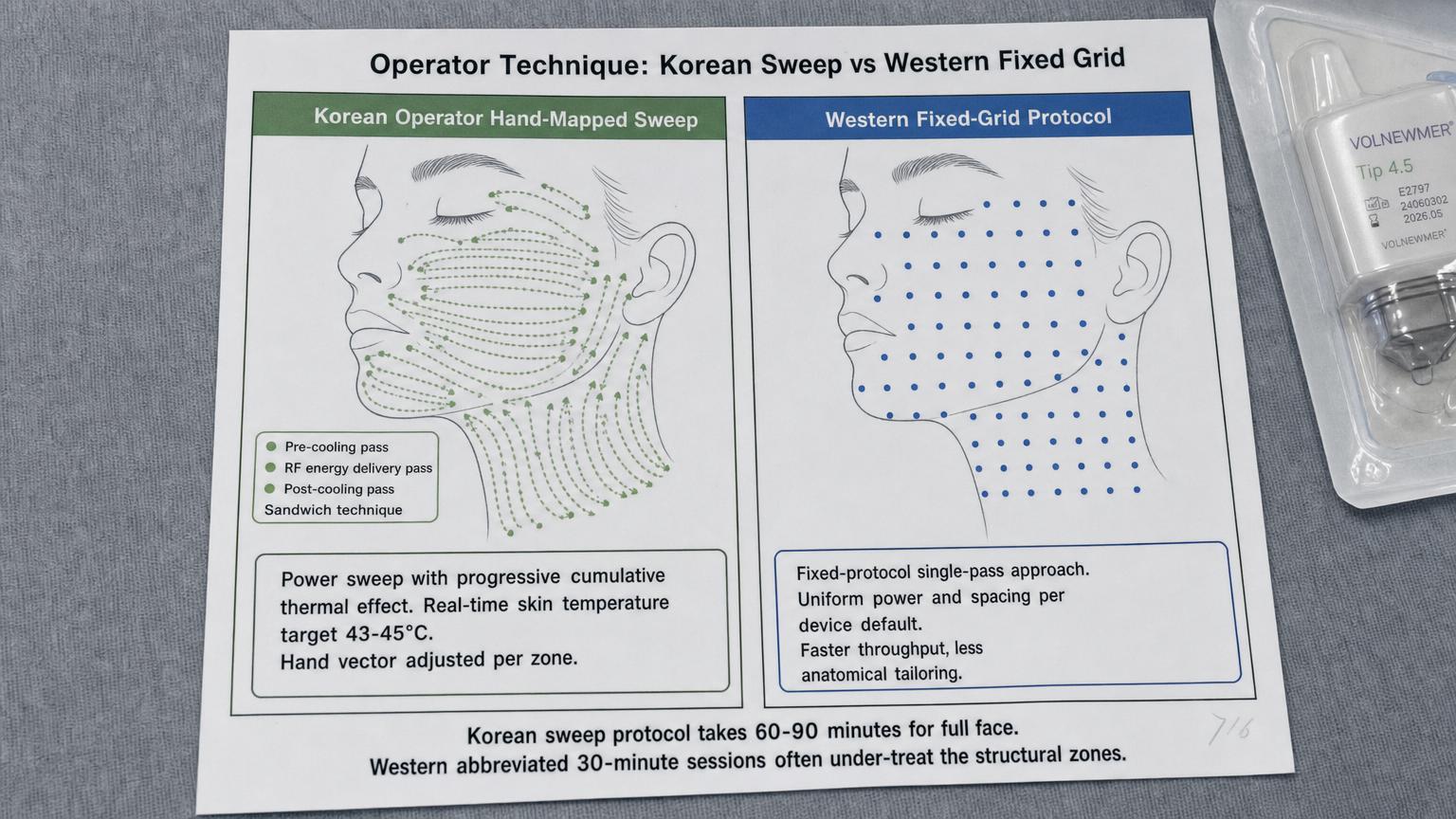
The operator technique is the single largest variable in Volnewmer outcomes, and it is the variable that explains why the same device produces meaningfully different results in Seoul versus Western markets. Korean clinical training emphasizes a specific protocol structure that takes substantially longer than the Western abbreviated approach and that prioritizes cumulative thermal effect over per-shot energy. Understanding the protocol differences explains both why Korean Volnewmer costs less per session and why it tends to deliver a more complete result. The operator difference is not marketing. It is a real and reproducible technique distinction.
Progressive Power Density: Cumulative Thermal Effect Over Single Shot Intensity
Korean operators run Volnewmer at moderate per-shot energy with multiple progressive passes across each zone rather than at high single-shot energy with single passes. The goal is to bring the dermal target temperature to the 43 to 45 degree Celsius therapeutic window through cumulative heating rather than through a single intense pulse. The advantages are twofold. First, the cumulative approach reduces patient discomfort substantially compared with the single-pulse high-energy approach, which means the operator can deliver more total energy per session without exceeding patient tolerance. Second, the cumulative approach allows real-time temperature monitoring at each pass, with the operator confirming the target temperature is being reached before moving to the next pass. The Western fixed-protocol approach typically delivers higher per-shot energy with less per-zone customization, which can either under-treat (if the patient’s anatomy doesn’t reach therapeutic temperature) or over-treat (if the fixed energy exceeds the patient’s tolerance and produces excessive surface heating).
Real-Time Skin Temperature Monitoring
The Volnewmer device includes a surface temperature sensor that reads the skin temperature continuously during treatment. Korean operators use this reading actively, adjusting power levels and pass timing based on the per-zone temperature response. The therapeutic window for dermal collagen contraction is 43 to 45 degrees Celsius at the target depth; below that temperature, the collagen response is incomplete; above that temperature, the risk of surface burn rises sharply. Korean training emphasizes spending real time in the consultation reviewing the per-zone temperature response and adjusting the protocol mid-session. Western abbreviated protocols often skip the active temperature monitoring step and run fixed power per zone, which means the patient with thicker skin gets under-treated and the patient with thinner skin gets pushed toward surface heating. The temperature monitoring is not a luxury feature. It is the difference between consistent results and inconsistent results.
Hand Vector Mapping
The third Korean technique distinction is hand vector mapping across the treatment zones. The face is not anatomically homogeneous. The jawline pulls in one direction, the cheek pulls in another, the periorbital area requires different energy than the submentum. Korean operators map the treatment passes in vectors that align with the natural lifting direction of each zone, with 30 to 50 percent overlap between adjacent passes to ensure no zone is missed and no zone is over-treated. The vector mapping also accounts for tip overlap pattern: the operator does not just press the tip and fire; the operator traces controlled vectors that distribute the energy evenly across the zone. Western fixed-grid protocols often deliver passes in a uniform mechanical pattern regardless of underlying anatomy, which produces inconsistent results across zones with different baseline laxity.
Cooling-Pulse-Cooling Sandwich Cycles
The Volnewmer device includes integrated tip cooling, and Korean operators run the protocol as a deliberate sandwich: pre-cooling of the surface, RF pulse delivery, post-cooling of the surface. The sandwich serves two purposes. First, the pre-cooling reduces surface skin temperature to create a thermal gradient that protects the epidermis while allowing the dermal target to reach therapeutic temperature. Second, the post-cooling rapidly dissipates surface heat to prevent post-treatment surface erythema and to limit the rebound thermal effect. Western abbreviated protocols often skip one or both cooling phases to save time, which produces more surface erythema, more patient discomfort, and a less controlled dermal heating curve. The cooling sandwich adds 30 to 60 seconds per pass, which is the math behind why Korean full-face protocols take 60 to 90 minutes and Western abbreviated protocols can be compressed to 30 minutes.
Stacking Protocol: Volnewmer as Part of a Three-Layer System
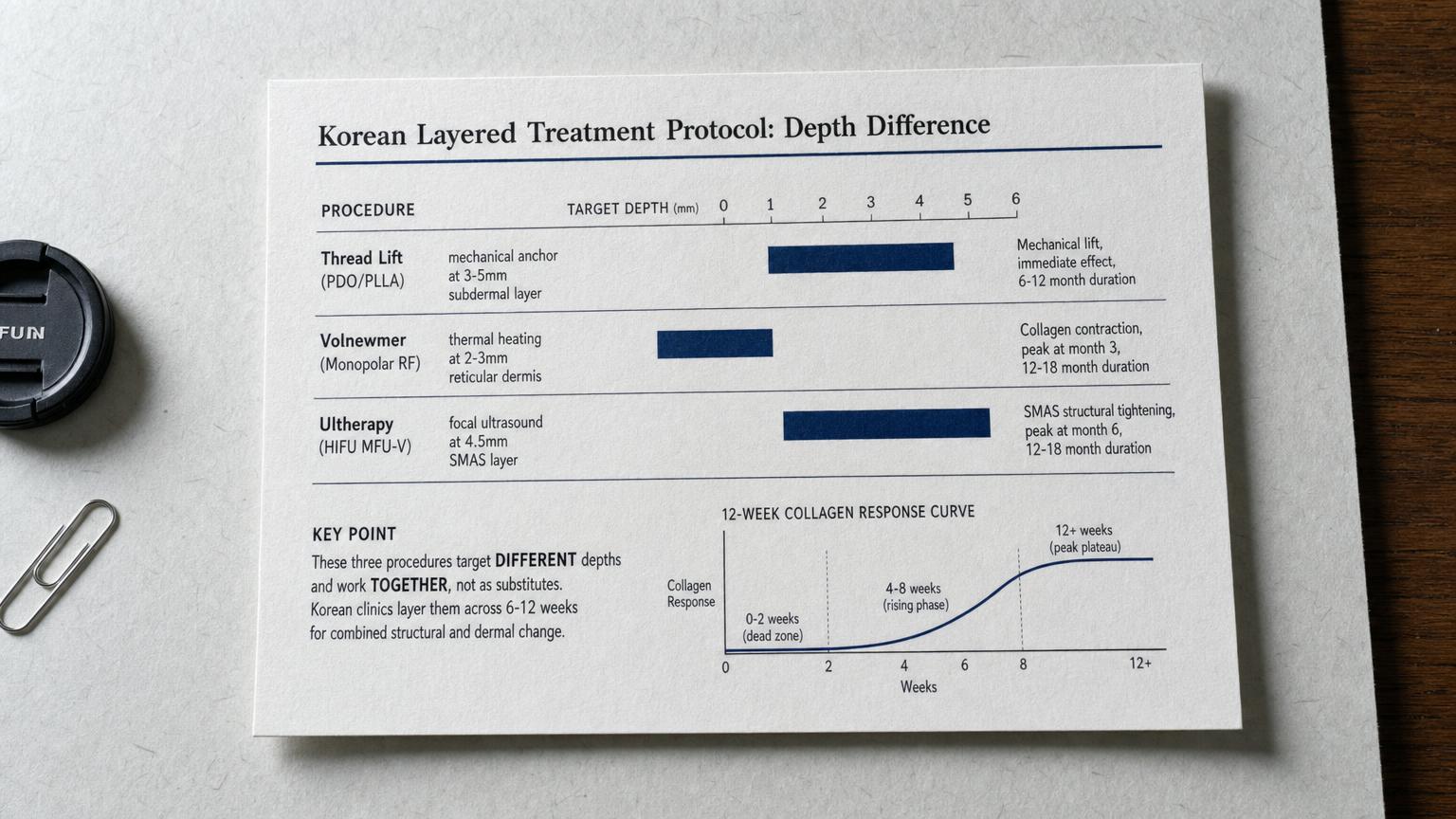
The Korean integrated approach combines Volnewmer with other modalities in a layered protocol that addresses different tissue depths in coordinated sequence. The typical three-layer protocol for moderate laxity is Thread Lift first at week 0 (mechanical lift at 3 to 5 millimeter subdermal layer for immediate visible lift), Volnewmer at week 4 (RF collagen contraction at 2 to 3 millimeter dermal layer for sustained collagen build), and Ultherapy at week 8 (HIFU thermal coagulation at 4.5 millimeter SMAS layer for structural tightening). The spacing across 6 to 12 weeks lets each layer mature before the next is added, and the combined collagen response peaks around month 4 to 6 with all three modalities active. The full Korean protocol cost in Seoul typically runs KRW 4,500,000 to 7,500,000 (USD 3,330 to 5,560), comparable to the cost of one of these procedures alone in Western markets. Patients can also do partial protocols: Korean Flower Lift thread lifting stacked with Volnewmer alone (skipping Ultherapy), or Volnewmer stacked with Korean Ultherapy verification (skipping Thread). The right combination is anatomy-dependent and consultation-driven, not menu-dependent.
Why Korean Clinics Treat Volnewmer as Foundation Rather Than Standalone
The Korean clinical position on Volnewmer is that it functions best as a foundation layer within a multi-procedure protocol rather than as a standalone lifting procedure. The reasoning is that dermal collagen contraction is one component of facial aging but not the only component. The mid-face hollow, the SMAS descent, the deeper fat compartment shift, the bony resorption — these are different aging mechanisms that Volnewmer alone does not address. Korean clinics that recommend Volnewmer as the sole intervention for a patient with substantial laxity are being either honest about budget constraints or conservative about over-treatment. Korean clinics that recommend Volnewmer as part of a layered protocol are usually framing the recommendation accurately: Volnewmer addresses the dermal collagen component, and the other layers address the other components. This framing is genuinely different from the Western marketing approach that often positions monopolar RF as a one-and-done lifting solution.
Section 3 — Six-Month Recovery and Result Timeline: The Four-Week False Plateau Foreign Patients Panic About
The Volnewmer recovery timeline is forgiving compared with surgical procedures, with no real downtime and immediate return to normal activity. The result timeline is the harder part. The visible change unfolds over 12 to 24 weeks, with the first six to eight weeks producing minimal visible change. This pattern confuses foreign patients who expected either same-day tightening (from Thermage marketing exposure) or visible structural change within a few weeks (from Ultherapy marketing exposure). Understanding the realistic timeline week by week prevents the predictable cycle of disappointment at week 4, premature panic-stacking of additional procedures during the dead zone, and incorrect conclusions that the procedure failed before it had a chance to deliver.
Recommended for Your Recovery
Products commonly used before and after Korean volnewmer monopolar rf mid face lift — same items routinely recommended in the recovery instructions Seoul clinics hand out at discharge.
- COSRX Advanced Snail 96 Mucin Power Essence — Korean barrier essence for the post-laser tissue regeneration window. Check price on Amazon
- Beauty of Joseon Relief Sun SPF 50+ — strict SPF 50+ daily for at least 3 months after any pigment or resurfacing laser — UV reverses results. Check price on Amazon
- Gel Eye Mask (Cold Compress) — cold compress for residual redness in the first 24 to 48 hours after a session. Check price on Amazon
- Silicone Scar Sheets — for ablative laser zones with crust formation, support scar maturation as new skin emerges. Check price on Amazon
As an Amazon Associate, GlobalBeautySpot earns from qualifying purchases at no extra cost to you.
Day 0: Immediate Micro-Tightening (Not the Real Result)
Some patients see a small amount of immediate tightening at the end of the session driven by water-loss in the heated tissue and by transient collagen contraction. The mirror at the end of the appointment shows slightly more defined jawline and slightly tighter cheek, and patients often photograph the result. This effect fades within 48 to 72 hours as the tissue rehydrates. The day-0 tightening is not the actual Volnewmer result and should not be the basis for any conclusion about whether the procedure worked. Patients who frame their satisfaction around the day-0 effect are essentially evaluating a temporary water-loss phenomenon rather than the durable collagen-driven outcome.
Days 1 to 7: Minimal Visible Change, Full Activity Resumption
The immediate post-treatment appearance is mild surface flush in the treated zones that resolves within a few hours. A small subset of patients have very minor swelling in the submentum or jawline that resolves within 24 to 48 hours. None of this prevents normal activity. Patients can apply makeup the next day, return to office work, and resume exercise within 48 hours. Foreign patients routinely fly home within 24 hours of the treatment with no visible markers of having had a procedure. The combination of no downtime and slow result curve is what makes Volnewmer logistically attractive for medical tourism: the trip can be short, the result builds while the patient is back home.
Weeks 2 to 4: The False Plateau (Patient Anxiety Peak)
Around week 2, the immediate water-loss tightening has fully faded and the patient looks at the mirror and sees what they perceive as their starting point. This is exactly what the procedure is supposed to look like at this stage: the dermal heating has triggered the healing cascade, but the new collagen formation has not yet remodeled the tissue enough to produce visible change. Weeks 2 through 4 are the period of maximum patient anxiety. Foreign patients message the clinic asking “did it work?” Patients who have already returned home and have no easy clinic contact often conclude the procedure failed. The temptation to panic-stack additional procedures during this window is high, and Korean clinics actively counsel patients against doing so. The dead zone is expected. The result is being built in the dermis during this period; it is just not visible yet.
Weeks 4 to 8: Subtle Improvement First Becomes Visible
Around week 4 to 6, the first subtle improvement becomes visible to careful observation. The jawline shows incrementally more definition, the cheek volume sits slightly higher, the overall face feels structurally more taut without looking different in any dramatic way. Patients who took standardized photos at day 0 can begin to see the change in side-by-side comparison; patients who did not take photos often need to be told the change is happening. Weeks 6 to 8 show progressive improvement at a similar slow pace. This is the build phase, and the build accelerates from week 8 onward.
Weeks 8 to 12: Collagen Build Accelerates, Visible Contour Change
Weeks 8 to 12 are when the collagen response becomes obviously visible without requiring photo comparison. The jawline is meaningfully sharper. The mid-face is elevated. The cheek contour is tighter. The submentum (the soft tissue under the chin) is firmer. The overall age impression has moved several years younger in a way that does not register as “having had work done.” Patients who endured the week 4 anxiety and trusted the timeline begin to feel that the procedure was worthwhile. Patients who panic-stacked additional procedures during the dead zone often cannot tell which intervention is responsible for the change.
Month 3: Peak Visible Result
The peak appearance of a Volnewmer result is typically reached at month 3. The collagen synthesis has fully integrated, the dermal tone has stabilized at its new level, and the tightening effect is at its most visible. Standardized photos at month 3 compared with day 0 show clear contour change in the jawline, the mid-face, and the submentum. Patients with realistic expectations — looking for dermal tightening and contour refinement rather than dramatic transformation — are generally satisfied at this point. The face looks like the same face, but the jawline is sharper, the mid-face is elevated, the cheek contour is tighter, and the overall age impression has moved several years younger in a way that reads as “well-rested” rather than as “treated.”
Months 6 to 12: Sustained Result, Onset of Gradual Decline
The peak result at month 3 is sustained through month 6 with minimal change. From month 6 through month 12, the collagen built from the single session begins gradual remodeling back toward the baseline. Most patients do not perceive the decline during the first 6 months past the peak, and many do not perceive it through month 12. The change is gradual enough that patients comparing month 12 to month 3 see only minor difference, while patients comparing month 12 to day 0 still see clear improvement over the starting point.
Months 12 to 18: Touch-Up Decision Window
By month 12 to 18, the decline becomes perceptible. The jawline is less defined than at the month 3 peak, though typically still more defined than at the original day 0 baseline. Most patients opt for a booster session at some point in this window. The booster is typically a reduced-protocol session focused on the zones where the decline is most visible, usually the jawline and the submentum, and produces a renewed peak result at the month 3 mark after the booster. Some patients prefer to space the boosters further apart (every 18 to 24 months) and accept a more gradual cumulative decline between sessions. There is no medically correct answer; the decision is aesthetic and budgetary.
Section 4 — Cost Comparison and the Five-Question Clinic Verification Checklist
Korean Volnewmer pricing is competitive globally because the underlying device cost is similar worldwide and the difference is driven by clinic operating costs, currency, and the volume of sessions per clinic. The pricing table below reflects current Volnewmer pricing in Seoul versus other major medical tourism destinations and Western markets, with the caveat that the per-session price needs to be evaluated alongside the protocol depth and the operator technique.
| Region | Volnewmer Cost (full face) | Notes |
|---|---|---|
| Korea (Seoul) — Full face + jawline | KRW 800,000–1,500,000 (USD 590–1,110) | 60–90 minute protocol with hand-mapping, integrated cooling sandwich, real-time temperature monitoring |
| Korea (Seoul) — Jawline + submentum only | KRW 500,000–900,000 (USD 370–670) | 45 minute session, common foreign patient quick-add procedure |
| Korea (Seoul) — Three-layer protocol (Thread+Volnewmer+Ultherapy) | KRW 4,500,000–7,500,000 (USD 3,330–5,560) | 6–12 week sequence, most comprehensive non-surgical lift option |
| USA — Full face Volnewmer (where available) | USD 1,800–3,500 | Variable availability, typically abbreviated 30–45 minute sessions |
| USA — Thermage FLX (comparable monopolar RF) | USD 2,500–5,000 | Different device, similar therapeutic category |
| Australia — Volnewmer or equivalent | AUD 2,500–4,500 | Higher operating costs, similar device protocol |
| UK — Volnewmer or equivalent | GBP 1,800–3,200 | Limited availability, usually at specialist dermatology clinics |
The pricing typically includes the consultation, the device protocol, and any immediate post-treatment care. Foreign patients should also budget for hotel accommodation for 1 to 3 nights (the procedure itself is single-day, but most patients combine it with consultation appointments and other procedures during the trip). Authorized Korean clinics including Link Plastic Surgery’s Volnewmer program do not require large deposits, and the procedure can typically be booked with 1 to 2 weeks of lead time.
The Five-Question Clinic Verification Checklist
Before booking Volnewmer in Seoul, the foreign patient should run a five-question verification at the consultation. The questions are concrete and the answers are diagnostic. A clinic that answers these confidently and with documentation is operating the genuine protocol. A clinic that evades the questions or answers with marketing language is worth pausing on.
Question 1: Can I see the Volnewmer authorization documentation and serial number on the device? Volnewmer is distributed through authorized channels and each device has a serial number that ties to clinic registration. The clinic should be able to show the authorization paperwork and the serial number on the device console without hesitation. A clinic that cannot produce this is using either a counterfeit device or an unauthorized parallel-import unit, and the device protocol may not match Hironic’s certified training program.
Question 2: What is the per-zone power density protocol, and is it progressive cumulative or fixed single-pass? The honest answer at a Korean authorized clinic will describe the progressive cumulative approach with multiple passes per zone at moderate energy. A clinic that describes a single-pass high-energy approach is using the Western abbreviated protocol, which is faster but typically under-treats. The answer should also reference per-zone customization rather than a uniform device default.
Question 3: Do you use real-time skin temperature monitoring during the session? The Volnewmer device includes a surface temperature sensor; the question is whether the operator actively uses it. The honest answer is yes, with reference to the 43 to 45 degree Celsius dermal target window. A clinic that does not use temperature monitoring is running the protocol blind, which produces inconsistent results across patients with different skin thicknesses.
Question 4: How long is the full-face session? The honest Korean protocol takes 60 to 90 minutes including pre-treatment numbing setup, the actual RF passes, and the integrated cooling sandwich cycles. A clinic quoting a 30-minute session is delivering an abbreviated protocol that skips either the cooling sandwich or the customization passes. Faster is not better for this procedure; the time matters.
Question 5: What is the recommended booster timing? The honest answer is 12 to 18 months from the original session, focused on the zones with most visible decline. A clinic recommending boosters at 3 months or 6 months is either compensating for an under-dosed original session (operator concern) or upselling additional sessions to generate revenue (commercial concern). Either way it is a red flag worth asking about.
Foreign Patient Travel Logistics
The single-session, no-downtime nature of Volnewmer makes it logistically forgiving for foreign patients. The typical trip structure is day 1 arrival and consultation, day 2 treatment, day 3 follow-up if scheduled (often combined with consultations for other procedures), day 4 departure. The procedure itself takes one afternoon. Patients can fly home within 24 hours of treatment with no visible markers and no activity restrictions. Most foreign patients combine Volnewmer with other procedures on the same trip — most commonly Ultherapy on the same day or within a week, Rejuran in a 3-session series during the trip if the trip is 2 weeks or longer, or thread lifting as the first layer of a multi-week protocol. Coordinating the full layered protocol within a single 10 to 14 day trip is logistically feasible at authorized Korean clinics.
Section 5 — Who Korean Volnewmer Is For, and Honestly Who It Is Not

Volnewmer has a relatively narrow window of ideal candidacy, and being honest about that window is the difference between satisfied patients and disappointed patients. The procedure does one thing well for a specific demographic, and it produces unsatisfying results when it is applied outside that demographic for non-clinical reasons (typically because a patient asked for it after reading about it online, or because a clinic recommended it without honest assessment of candidacy). Understanding the candidate profile prevents both wasted spending and disappointing outcomes.
The Ideal Candidate Profile
The strongest results from Volnewmer occur in patients aged late 30s to mid 50s with early to moderate dermal elasticity loss, mild jawline blur, and intact native facial structure. These patients have enough laxity that the dermal collagen contraction produces visible improvement, but not so much laxity that the dermal-only intervention is insufficient. The candidate also has realistic expectations about timeline (3 months to peak, 12 to 18 months to next booster), realistic expectations about result (refined version of own face, not dramatically transformed), and willingness to consider Volnewmer as part of a maintenance approach rather than as a one-shot fix. Patients who match this profile are reliably satisfied with the result and tend to return for boosters and combination procedures over time.
Combined Protocol Candidates
Patients with moderate to substantial laxity often benefit most from a combined protocol that includes Volnewmer as one of multiple layers. The most common combinations are Volnewmer plus Thread Lift (mechanical lift consolidated by dermal collagen building), Volnewmer plus Ultherapy (dermal tightening complemented by SMAS structural change), and the full three-layer protocol of Thread plus Volnewmer plus Ultherapy across 6 to 12 weeks. Patients who can budget for the full layered protocol typically get the most complete result and report the highest long-term satisfaction. Patients who can budget for one layer should choose the layer that best matches their specific anatomical concern: Volnewmer if dermal laxity is primary, Ultherapy if SMAS descent is primary, Thread if immediate mechanical lift is the priority.
Not Ideal: Severe Ptosis or Substantial Skin Redundancy
Patients with severe ptosis (substantially descended SMAS), substantial skin redundancy, or genuine surgical-grade laxity are not good Volnewmer candidates. The procedure addresses dermal tone but does not address the underlying SMAS descent or the redundant skin envelope. Patients in this category who book Volnewmer typically experience the dead zone, see a small amount of dermal improvement at month 3, and conclude that the procedure failed to address what they actually wanted. The honest recommendation for these patients is surgical face lifting (which addresses both the SMAS and the skin envelope) rather than any single non-surgical modality.
Not Ideal: Early 20s With No Real Laxity
Patients in their early 20s with full native dermal tone and no real laxity are not good Volnewmer candidates either, for the opposite reason. There is no laxity to address, so the procedure produces minimal visible change. The argument for “preventative” Volnewmer in younger patients is weak and is typically marketing-driven rather than clinically-driven. The budget is better spent on skin quality interventions (Rejuran, Exosome, professional sunscreen protocols) that have stronger evidence for prevention than dermal RF does.
Contraindications
Volnewmer is contraindicated for pregnant patients, patients with cardiac pacemakers or internal cardiac defibrillators (the RF energy can interfere with the implanted device), patients with significant metal implants in the treatment area (the RF energy can heat metallic foreign bodies), and patients with active skin infection in the treatment zone (the heating can worsen infection). Patients with dermal filler in the treatment area should disclose this; some clinics adjust the protocol to avoid heating filler material directly. Patients with autoimmune conditions affecting wound healing or with active isotretinoin use should discuss the timing of Volnewmer with both their dermatologist and the treating clinic.
Realistic Expectations Framing
The single most important framing for a satisfied Volnewmer patient is realistic expectations about both the timeline and the magnitude of result. Volnewmer does not deliver a 10-years-younger transformation. It delivers a refined-and-rested version of the patient’s current face with subtle but real dermal tightening that becomes visible at week 4 to 6, peaks at month 3, and sustains for 12 to 18 months. Patients who internalize this framing before booking are reliably satisfied. Patients who book based on dramatic before-and-after photos (which often show results that are not from Volnewmer alone but from layered protocols or filler combinations) are reliably disappointed. The procedure cannot deliver more than its mechanism allows, and the mechanism is dermal collagen contraction at 2 to 3 millimeter depth, not structural lifting.
The Maintenance Commitment
Volnewmer is not a one-and-done procedure. Patients who book a single session and never return tend to slip back to their pre-treatment baseline over 18 to 24 months. Patients who treat Volnewmer as annual or 18-month maintenance, with optional combination layers added over time, tend to maintain a sustained improvement over years rather than months. The cost calculation for a foreign patient should account for this maintenance reality: a single trip with a single Volnewmer session is the entry point, not the end state. The annual maintenance trip becomes a recurring trip structure rather than a one-time decision. Patients who frame the procedure this way and budget accordingly get the best long-term value from the Korean pricing advantage.
The Korean Conservative Approach Versus Western More-Is-Better Marketing
The final framing difference between Korean and Western Volnewmer positioning is conservative versus maximalist. Korean clinics typically recommend the minimum effective protocol for the specific patient’s anatomy and concerns, with the option to add layers or repeat sessions based on observed response. Western marketing often positions monopolar RF as a one-shot dramatic lift that competes with surgical face lifting, which sets expectations the procedure cannot meet. The Korean conservative framing is honest about what the procedure does and what it does not do, and it produces a more durable patient relationship across multiple sessions and combination protocols over time. Foreign patients who understand and accept the conservative framing get the procedure for which it was designed. Foreign patients who arrive expecting the maximalist framing get a procedure that did not match the expectations they were sold.
For patients ready to begin verification, the full Korean laser and energy treatment category at authorized Seoul clinics covers Volnewmer alongside Ultherapy, Shrink Universe, Fraxel, CO2 spot lesion removal, and the combination protocols that layer these modalities for comprehensive results.
Frequently Asked Questions
Is Volnewmer the same as Thermage?
Both are monopolar RF devices, but they are not the same. Volnewmer (Hironic, Korea) uses a different tip geometry, a different pulse delivery curve, and an integrated cooling-pulse-cooling sandwich cycle that Korean operators run at progressive cumulative power levels. Thermage FLX (Solta) uses a vibrating tip and a fixed-protocol single-pass approach at higher per-shot power. Clinically both can produce dermal collagen contraction at 2-3mm depth, but the Korean Volnewmer protocol prioritizes gradual cumulative heating to the 43-45 Celsius target window, while Thermage typically delivers higher per-shot energy with the comfort vibration mitigating discomfort. They are competitors in the same category, not the same device.
Why do I see nothing at week 1?
This is the most common point of foreign patient anxiety. The immediate water-loss-driven micro-tightening that some patients see on day 0 fades within 48-72 hours, and the actual collagen synthesis cascade does not produce visible results until week 4 to 6 at the earliest. Weeks 1 to 3 are a deliberate dead zone where the dermal heating has triggered the healing response but the new collagen formation has not yet remodeled the tissue enough to produce visible contour change. The result builds gradually from week 4 through month 3, and the peak is at month 3. Patients who judge Volnewmer at week 1 will incorrectly conclude that nothing happened. This is exactly the wrong mental model for monopolar RF as a category.
Can one session deliver the full result?
Yes, the standard Korean Volnewmer protocol is a single comprehensive session. The dermal heating delivered in a 60-90 minute full-face session produces the complete collagen response cascade. Most patients reach peak visible result at month 3 from this single session and maintain visible improvement for 12 to 18 months. A booster session at month 12 or 18 is optional for maintenance. Clinics that recommend Volnewmer as a series of 3 to 6 sessions spaced 4 weeks apart are either using a lower energy protocol that needs stacking to reach therapeutic dose, or are upselling. A single session at full protocol is the standard.
How is Volnewmer different from Ultherapy?
Different mechanism, different depth, different result curve. Volnewmer is monopolar RF that heats the reticular dermis at 2-3mm depth for collagen contraction and new collagen synthesis. Ultherapy is microfocused ultrasound that delivers thermal coagulation points at 4.5mm SMAS depth for structural lift. The two procedures target genuinely different tissue layers and produce complementary rather than overlapping effects. The Korean layered protocol often combines them across 6 to 12 weeks: Ultherapy for SMAS structural change, Volnewmer for dermal collagen building. They are not substitutes. A patient asking “should I do Volnewmer or Ultherapy” is often best served by understanding that the question is not either/or for moderate laxity cases.
How painful is Volnewmer compared to Ultherapy or Thermage?
Generally significantly less painful than either Ultherapy or Thermage. Korean Volnewmer operators use a pre-cooling, RF pulse, post-cooling sandwich cycle that keeps surface temperature controlled while the dermal target heats. The sensation during treatment is a brief warm pulse at each shot rather than the sharp deeper pulse of Ultherapy or the more intense thermal sensation of Thermage. Most patients tolerate full-face Volnewmer with topical numbing applied 30 minutes before treatment. Patients who anticipate higher sensitivity can request additional topical numbing or a single dose of oral analgesia. Brief discomfort during the session, no persistent discomfort after.
When is Volnewmer the wrong choice?
Volnewmer is the wrong choice for patients with severe ptosis or substantial skin redundancy that needs surgical correction. It is also a poor fit for patients in their early 20s who have full native dermal tone and no real laxity to address (overtreatment risk, and the budget is not well spent). It is contraindicated for pregnant patients, patients with cardiac pacemakers or internal defibrillators, patients with significant metal implants in the treatment area, and patients with active skin infection in the treatment zone. Patients with dermal filler in the treatment area should disclose this; some clinics adjust the protocol to avoid heating filler material directly. Realistic candidate: late 30s to mid 50s with early to moderate elasticity loss.
Should I combine Volnewmer with Thread or Ultherapy?
Combination is often the most efficient use of a Korea trip for patients with moderate laxity. The Korean three-layer protocol stacks Thread Lift (mechanical lift at 3-5mm), Volnewmer (RF collagen contraction at 2-3mm), and Ultherapy (HIFU SMAS tightening at 4.5mm) across 6 to 12 weeks. The three procedures target genuinely different depths and produce complementary rather than competing effects. Patients with mild laxity often do not need the full three-layer; one or two of these may be sufficient. Patients with severe laxity often need surgical face lift rather than any combination of non-surgical procedures. The right combination for your specific anatomy is a consultation decision, not a marketing menu decision.
How long does the Volnewmer result last?
Typically 12 to 18 months of visible result from a single session, with most patients experiencing peak appearance at month 3 and gradual decline beginning around month 12. The collagen built from a single session gradually remodels back toward the baseline tone over 12 to 18 months, and most patients opt for a booster session at some point in the 12 to 18 month window. The booster does not need to be the same line count as the original session; it is typically a reduced-protocol session focused on the zones where the decline is most visible. Patients in their late 30s and early 40s often do Volnewmer as annual maintenance rather than as a one-shot procedure.
Are men good candidates for Volnewmer?
Yes, and male patients are increasingly common. Male skin tends to be thicker than female skin of similar age, and the dermal collagen base is generally more substantial, which means Volnewmer delivers a slightly less dramatic per-session contour change in men but tends to produce a more robust long-term result. The most common male treatment plan is jawline plus submentum, often with the goal of sharpening the jawline rather than overall lifting. Men typically respond well to single-session protocols and often combine Volnewmer with Rejuran or Exosome for skin quality, particularly for the neck where male skin shows aging earlier than the face.
Can I fly home the day after Volnewmer?
Yes. Volnewmer has minimal immediate downtime; most patients have no visible markers of having had a procedure within 12 to 24 hours of treatment. Some patients experience mild redness or warmth in the treatment area for a few hours, and a small subset have minor swelling in the jawline or submentum that resolves within 24 to 48 hours. None of this prevents normal activity or flying. Foreign patients routinely book Volnewmer on day 1 or 2 of a Korea trip and continue with other consultations or procedures during the same trip. The procedure logistics are forgiving in a way that more invasive lifting options are not.
Closing
Korean Volnewmer is a competent monopolar RF platform delivered through a Korean clinical protocol that prioritizes hand-mapped per-zone customization, real-time temperature monitoring, and integrated cooling-pulse-cooling sandwich cycles over the abbreviated fixed-protocol approach common in Western markets. The cost in Seoul runs 30 to 50 percent of comparable Western pricing for the same device, and the operator technique difference means the Korean result is typically more complete rather than less. The misconception foreign patients should retire before booking is the timeline expectation: this is a 3-month procedure, not a 3-day procedure. Patients who internalize the slow result curve, plan for the week 4 false plateau without panic-stacking, and consider Volnewmer as part of a layered protocol rather than as a standalone lifting solution get the result the procedure was designed to deliver. Patients who book expecting Thermage-style same-day tightening or Ultherapy-style SMAS structural change are working from the wrong mental model and will be disappointed predictably. Authorized Korean clinics including Link Plastic Surgery will run the verification questions transparently and will set expectations accurately. The procedure rewards both honest framing and patient patience.