Korean Fraxel Dual: How Foreign Patients Verify Real Solta 1550nm + 1927nm Before the Discount Tempts Them
Foreign patients fly into Seoul chasing Fraxel Dual at roughly one quarter of Western pricing, and a meaningful share of them end up with non-Solta fractional lasers sold under the Fraxel brand name. The real Solta Medical Fraxel Dual platform has two non-negotiable features that separate it from the generic fractional laser market that competes against it across the Asian medical tourism corridor. The first is the dual-wavelength integration: a 1550nm Erbium-doped fiber wavelength for dermal remodeling and a 1927nm Thulium wavelength for superficial pigment and texture, with both available from a single device console rather than from two separate machines. The second is the intelligent optical tracking system that calibrates the micro-thermal zone density in real time, which is what produces the uniform pattern of treatment columns that Fraxel was designed to deliver. Generic fractional lasers without these features may still produce visible results, but they are not Fraxel, and the foreign patient paying Fraxel pricing for a substitution is paying for branding rather than the genuine Solta platform. Korean clinics with verified Solta authorization, including Link Plastic Surgery in Seoul, run authentic Fraxel Dual protocols and will show foreign patients the device console with both wavelength toggles, the Solta authorization paperwork, and the serial-registered platform during the consultation rather than only at the treatment table. This guide explains what real Fraxel Dual is, why two wavelengths matter, the five-step verification checklist a foreign patient should run before any energy is delivered, and the Korean 3 to 5 session protocol that produces the result the device was designed to deliver.
The pricing gap that pulls foreign patients to Seoul for Fraxel Dual is genuine. A complete acne scar series of 3 to 5 sessions in the United States typically runs USD 4,500 to 12,000 (USD 1,500 to 3,000 per session). The same series at an authorized Korean Solta clinic typically runs the equivalent of USD 1,200 to 3,000 total, depending on session count and clinic positioning. That is not a discount from substituting the device. It is a function of Korean dermatology economics: high session volume per device per week, dense competition among authorized Solta clinics in the Gangnam district, and currency conversion that favors the foreign patient. The risk to manage is not whether genuine Korean Fraxel is good. At authorized clinics, the device is identical to the device used in Beverly Hills and the operator skill is generally higher because Korean dermatologists do more Fraxel sessions per month than their Western counterparts. The risk is that unauthorized clinics in the broader Asian medical tourism corridor — including some clinics in Seoul that compete on price by sourcing non-Solta fractional lasers from Korean and Chinese manufacturers — sell those substitution devices under the Fraxel name. The foreign patient who books on price alone, without verification, has no way to tell the difference until the energy is already delivered. The verification before treatment is the only reliable defense, and this guide walks through it step by step.
Section 1 — What Real Fraxel Dual Actually Is (and What Counterfeits Skip)
Fraxel Dual is the trade name for a specific device manufactured by Solta Medical (the same company that manufactures Thermage and previously Fraxel Re:Store). The device is FDA-cleared for fractional non-ablative resurfacing of acne scars, surgical scars, melasma, hyperpigmentation, photodamage, periorbital wrinkles, and skin resurfacing. There is no generic equivalent that legally markets under the Fraxel name. Devices that compete on similar mechanism but are not Solta Fraxel Dual include various Korean fractional lasers (often marketed as fractional 1550 or Erbium-doped fiber fractional), Chinese fractional platforms entering the Korean and Southeast Asian market under different brand identities, single-wavelength imitations of either the 1550nm or 1927nm wavelength sold as Fraxel-style, and combination platforms that bundle fractional lasers with other modalities. Each of these may produce visible clinical results, but none of them is Fraxel. A clinic that uses the word Fraxel on its menu or signage and treats with a non-Solta device is misrepresenting the procedure, and patients in that situation typically only realize the substitution after the fact, often when the expected outcome does not arrive after the full session count.
The Fractional Mechanism in Plain Language
Fractional laser resurfacing works by creating columns of thermally treated tissue, called micro-thermal zones or MTZs, surrounded by columns of untreated tissue. The untreated tissue between MTZs serves as a reservoir of healthy cells that accelerates healing of the treated columns. This is the mechanism that differentiates fractional resurfacing from traditional full-field ablative or non-ablative resurfacing — fractional treats only a fraction of the skin surface in any single session (typically 15 to 35 percent depending on density settings), with the untreated bridges between MTZs allowing the skin barrier to recover within days rather than the weeks required for full-field resurfacing. Define fractional clearly: the laser does not treat the entire surface uniformly, it treats a precisely controlled pattern of microscopic columns with intact tissue between them. This is the feature that every counterfeit and generic fractional device skips or implements poorly. Cheap fractional platforms produce inconsistent column density, oversized MTZs that approach full-field ablation rather than fractional treatment, or uneven distribution that produces patchy healing and visible streaking. The real Solta Korean Fraxel Dual protocols at Link PS uses an intelligent optical tracking system that calibrates the MTZ density in real time as the operator passes the handpiece across the skin, which is what produces the uniform treatment pattern that the device was designed to deliver.
Why Two Wavelengths Are Integrated in One Platform
The Solta engineering decision to integrate two wavelengths in a single device platform reflects the clinical reality that most patients who arrive for fractional laser resurfacing have combined indications rather than a single isolated concern. A 27-year-old patient with active acne scarring also typically has some degree of pigment irregularity from post-inflammatory hyperpigmentation. A 45-year-old patient with melasma also typically has fine surface texture and pore changes. A 60-year-old patient with sun damage also typically has dermal-level texture loss. Single-wavelength fractional platforms force the clinician to either address only one indication per session, alternate sessions between different devices, or compromise on the dominant indication. The dual-wavelength platform allows the Korean clinical protocol of layering both wavelengths within a single session, with the wavelength split (typically 60/40 or 50/50 toward the dominant indication) tailored to the individual patient’s anatomy and treatment goal. This layering is one of the strongest clinical features of authentic Fraxel Dual and is genuinely not replicable on single-wavelength substitute devices.
What Real Solta Fraxel Dual Visibly Displays
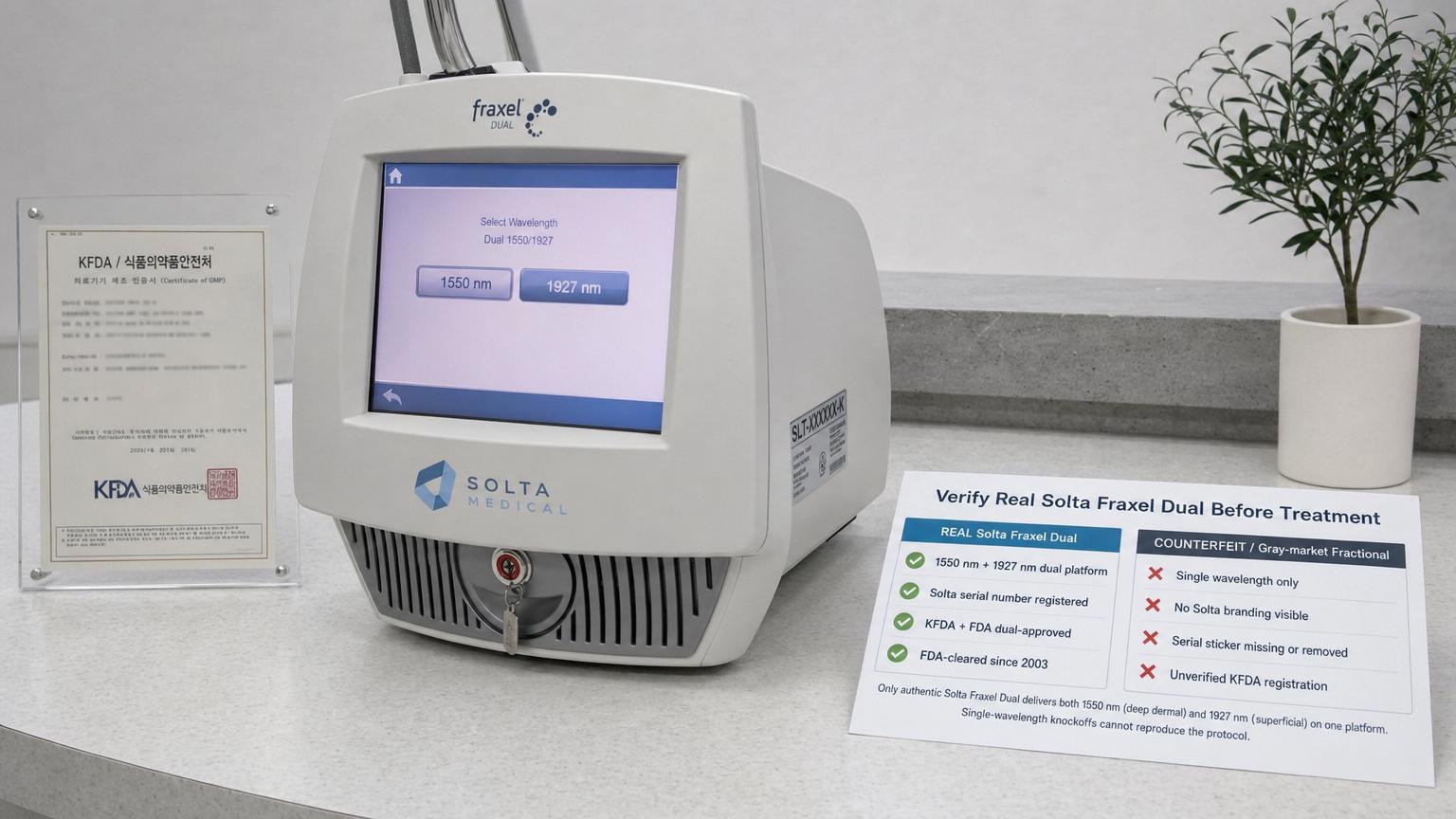
The verification cues that distinguish authentic Solta Fraxel Dual from substitution devices are concrete and visible during the consultation, before any energy is delivered. The device chassis carries the blue Solta branding logo prominently on the console exterior. The touchscreen interface displays both the 1550nm and the 1927nm wavelength selection toggles, with the operator able to switch between them or run them in sequence. The device serial sticker, typically on a side or rear panel of the chassis, is visible and matches the Solta Korea distribution log. The clinic carries dual-approval certificates — Korean KFDA registration for the specific device serial, and Solta Medical USA FDA clearance documentation for the platform. A clinic that uses the Fraxel name and cannot produce these visible markers is, at minimum, in a documentation gap and possibly using a non-Solta device. The verification is direct and physical: walk to the device, look at the console, ask the operator to switch between the two wavelengths, and confirm both are on a single integrated platform rather than on separate machines.
Why This Verification Matters More for Foreign Patients
Korean repeat dermatology patients have an advantage that medical tourists do not: they recognize the device by sight from previous sessions at other clinics, they compare price quotes across multiple clinics over weeks before committing, and they know the Korean dermatology market well enough to identify the standard authorized Solta clinics from the unauthorized ones. Foreign patients arrive on a 5 to 14 day trip, often with a single consultation window before booking, and fly home shortly after the treatment series ends. The chance to compare devices across clinics is minimal. The chance to follow up with the same clinic for concerns is minimal. The verification has to happen during the single consultation window, and the cues have to be checked physically rather than relied upon from clinic marketing materials. Section 3 of this guide details the five-step verification checklist that takes less than 20 minutes to run and provides the highest reliability defense against substitution.
The simplest verification test, before the detailed checklist, is a single sentence the patient can ask during the consultation: If the clinic cannot show you both the 1550nm and 1927nm wavelength toggle on the device console, it is not real Fraxel Dual. A device that displays only one wavelength, or that requires switching between two separate machines for the two wavelengths, is not the Solta Fraxel Dual platform regardless of how the clinic markets it.
Section 2 — 1550nm vs 1927nm: Why Two Wavelengths Matter (and Which One Treats What)

Understanding why Solta integrated two wavelengths in a single platform requires understanding what each wavelength does inside the skin and which indications each addresses. The two wavelengths target fundamentally different skin layers through fundamentally different absorption mechanisms, and a foreign patient who knows what to expect from each wavelength is in a much better position to evaluate whether the clinic’s recommended protocol matches the patient’s actual indication.
The 1550nm Erbium-Doped Fiber Wavelength
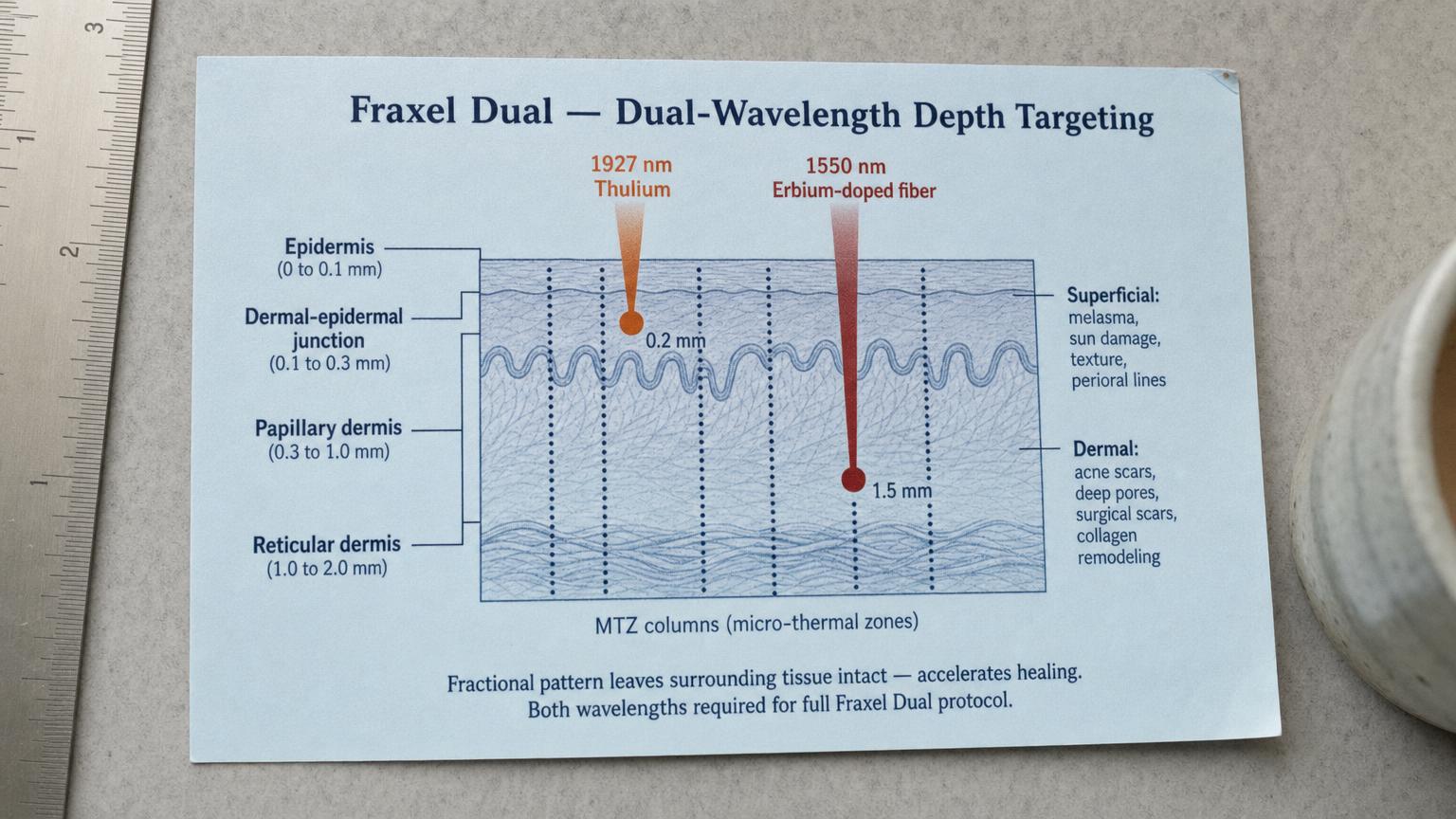
The 1550nm wavelength is generated by an Erbium-doped fiber laser, which produces light that is selectively absorbed by water in the skin. At 1550nm, the absorption coefficient in dermal water is high enough to produce thermal coagulation columns that penetrate to approximately 1.5mm depth — well into the reticular dermis where collagen remodeling produces the structural texture changes the patient is looking for. The clinical indications for 1550nm-dominant protocols are dermal-level conditions: acne scars (ice-pick, rolling, and boxcar morphologies), surgical scars and traumatic scars after the wound has matured, deep pores particularly across the cheek and nose, dermal-level laxity and texture loss, and stretch marks in their textural component. The 1550nm wavelength is also the wavelength that was used in the original Fraxel Re:Store single-wavelength platform, which is why many Western dermatology clinics still own only the 1550nm platform and lack the 1927nm capability.
For acne scar foreign patient protocols, the wavelength delivery is typically 1550nm-dominant (60 to 70 percent of session energy) with selective addition of 1927nm for any residual post-inflammatory hyperpigmentation around scar sites. The session count is 3 to 5 sessions spaced 4 to 6 weeks apart, with realistic expected improvement of 40 to 60 percent rather than 100 percent. Ice-pick scars are the morphology that responds least completely to fractional non-ablative resurfacing and typically benefit from layering subcision (a separate procedure that releases the fibrotic tethers anchoring the scar base) before or between Fraxel Dual sessions. Patients who arrive expecting Fraxel to completely erase deep ice-pick scars are typically counseled toward a combined protocol of subcision plus Fraxel rather than Fraxel alone.
The 1927nm Thulium Wavelength
The 1927nm wavelength is generated by a Thulium laser, which produces light with much higher absorption in water than the 1550nm wavelength. Because the absorption is so high at 1927nm, the laser energy is absorbed in the very superficial layers of the skin — approximately 0.2mm depth, primarily in the epidermis with only minimal penetration into the papillary dermis. This shallow absorption is exactly what is wanted for superficial pigment and texture indications. The clinical indications for 1927nm-dominant protocols are epidermis-level conditions: melasma (particularly in skin types II through IV that tolerate the energy without flare), sun damage and solar lentigines, post-inflammatory hyperpigmentation, fine surface texture, perioral lines, and the overall complexion-refresh result that some dermatology clinics call a Clear and Brilliant treatment (Clear and Brilliant is a separate Solta device that uses a related 1440nm wavelength but is not the same as the Fraxel Dual 1927nm).
For pigment plus pore patient protocols, the wavelength delivery is typically 1927nm-dominant (50 to 60 percent of session energy) or 50/50 dual depending on whether the pigment dominates the indication or the patient also has significant dermal-level concerns. Melasma cases require careful energy and density selection because melasma is heat-sensitive and aggressive treatment can flare the underlying pigment process rather than improve it. The Korean dermatology approach to melasma with Fraxel Dual is typically lower density (15 to 20 percent treatment coverage per session) over a longer series (5 to 8 sessions rather than 3 to 5) to minimize the inflammatory response that triggers melasma flare. Foreign patients with melasma who arrive expecting an aggressive single-trip treatment series are typically counseled toward a more conservative protocol that may require return trips or a longer stay.
The Misconception That One Wavelength Does Everything
The most common misconception foreign patients arrive with is that one Fraxel session, with one wavelength, addresses everything the patient is concerned about. This is not how the device or the underlying skin biology works. Acne scars in the dermis cannot be addressed by the 1927nm wavelength because the energy does not penetrate to the dermal depth where the scar tissue sits. Melasma and superficial pigment cannot be addressed by the 1550nm wavelength because the energy passes through the epidermis where the melanin sits and is absorbed primarily in dermal water below the pigment depth. The Korean clinical protocol of layering both wavelengths within a single session is not an upsell — it is the standard application of the dual-wavelength platform that allows simultaneous treatment of dermal and epidermal indications in a single device pass.
The 60/40 and 50/50 splits that Korean clinics use are tailored to the dominant indication. A patient with predominantly acne scars and minor pigment receives a 60/40 split favoring 1550nm, with the 1927nm component addressing the pigment around scar sites. A patient with predominantly melasma and minor texture receives a 60/40 split favoring 1927nm, with the 1550nm component addressing the texture without aggressive dermal stimulation that could flare the melasma. A patient with combined acne scars, pores, pigment, and texture (which is the most common foreign patient presentation in their 30s) receives a balanced 50/50 split that addresses each indication at moderate energy rather than aggressively addressing one indication.
What Goes Wrong Abroad on Single-Wavelength Devices
Many Western dermatology clinics own only the Fraxel Re:Store single-wavelength platform (1550nm only). This is not a deficient device — Fraxel Re:Store is a legitimate Solta platform that produces excellent results for dermal indications — but it cannot address pigment and superficial texture indications, which require the 1927nm wavelength. Western patients who arrive at their local Fraxel-owning clinic for pigment treatment are sometimes told that Fraxel addresses pigment, treated with the 1550nm platform, and then disappointed when the pigment does not improve. The same patients sometimes find their way to Seoul for Fraxel Dual specifically to access the 1927nm wavelength that their local clinic did not have. Korean clinics that handle high foreign patient volume typically stock the Dual platform precisely because the patient mix arrives with combined concerns. A foreign patient evaluating a Korean clinic for Fraxel Dual should confirm during the consultation that the device is the Dual platform rather than the Re:Store platform — both are authentic Solta, but only the Dual can address pigment and texture indications.
Section 3 — Verification Checklist: 5 Questions Foreign Patients Should Ask in Seoul
The verification problem is concrete, the solution is concrete, and five specific questions cover the question of whether the patient is about to receive genuine Solta Fraxel Dual or a substitution. Foreign patients who run these five questions during the consultation — before the deposit is paid, before the schedule is confirmed, and certainly before any energy is delivered — have substantially better outcomes than foreign patients who book on marketing alone. The questions are direct, the expected answers are specific, and the response pattern from a legitimate clinic is markedly different from the response pattern of a clinic that is misrepresenting the device.
Recommended for Your Recovery
Products commonly used before and after Korean fraxel dual verify real solta — same items routinely recommended in the recovery instructions Seoul clinics hand out at discharge.
- COSRX Advanced Snail 96 Mucin Power Essence — Korean barrier essence for the post-laser tissue regeneration window. Check price on Amazon
- Beauty of Joseon Relief Sun SPF 50+ — strict SPF 50+ daily for at least 3 months after any pigment or resurfacing laser — UV reverses results. Check price on Amazon
- Gel Eye Mask (Cold Compress) — cold compress for residual redness in the first 24 to 48 hours after a session. Check price on Amazon
- Silicone Scar Sheets — for ablative laser zones with crust formation, support scar maturation as new skin emerges. Check price on Amazon
As an Amazon Associate, GlobalBeautySpot earns from qualifying purchases at no extra cost to you.
Question 1: Can I See the Solta Fraxel Dual Console with Both 1550nm and 1927nm Wavelengths Displayed?
This is the foundational verification question. A real Solta Fraxel Dual device shows both wavelengths on the touchscreen interface, with the operator able to toggle between them or run them in sequence within a single session. The console carries the blue Solta branding and the Fraxel Dual product designation. A legitimate clinic walks the patient to the device, switches the touchscreen to display the wavelength selection screen, and demonstrates the toggle between 1550nm and 1927nm. The demonstration takes less than two minutes and confirms in the most direct way possible that the device is the Dual platform. A clinic that resists the request, that offers to send a photograph instead of an in-person view, or that produces a device displaying only one wavelength, is a clinic where verification has already failed. The honest answer is to walk away from that clinic and verify the next clinic on the shortlist.
Question 2: May I Photograph the Device Serial Number for My Records?
Authentic Solta devices carry a serial number on a chassis sticker that is registered with Solta Korea and traceable through the official distribution log. Legitimate clinics consent to the photograph without hesitation — there is no reason for a clinic running an authorized Solta device to refuse to let the patient document the serial. Clinics that operate non-Solta substitution devices typically refuse the photograph, cover the sticker, claim the serial is proprietary information, or produce a sticker that does not match the standard Solta serial format. The photograph itself rarely needs to be acted on after the fact, but the willingness or refusal to allow the photograph is itself diagnostic. The patient who collects the photograph also has documentation if a later authentication question arises with Solta Korea.
Question 3: What Density (MTZ per cm²) and Energy (mJ) Are You Using for My Indication?
The Solta Fraxel Dual platform allows the operator to select specific density (the number of micro-thermal zones per square centimeter of treatment area) and specific energy (the joule output per MTZ, measured in millijoules). A real Solta operator answers this question in specific numbers tailored to the patient’s indication. For acne scars, a typical 1550nm setting is 15 to 25 mJ at moderate to high density (20 to 30 percent coverage per pass). For melasma, a typical 1927nm setting is 5 to 10 mJ at low density (10 to 15 percent coverage per pass) to minimize inflammatory response. For combined indications, the operator describes the wavelength split, the density per wavelength, and the energy per wavelength. An operator who answers “standard setting” or “I just use the recommended parameters” without specific numbers is either not actually trained on Solta Fraxel Dual or is operating a different device that does not have the same parameter granularity. The specific-number answer is what distinguishes the trained Solta operator from the non-Solta substitution.
Question 4: Show Me Your KFDA Registration Certificate for This Specific Device
The Korean Food and Drug Administration (KFDA, now MFDS) tracks each medical device by serial number for clinics operating in Korea. The KFDA registration certificate identifies the clinic, the device manufacturer (Solta Medical), the device model (Fraxel Dual), and the specific serial number. A legitimate clinic produces the registration certificate in under five minutes — either from a clinic file, a wall display, or a digital archive accessible to the operator. A clinic that cannot produce the certificate during the consultation, that claims the certificate is “at the central office” or “with the manager,” or that produces a registration certificate for a different device model than Fraxel Dual, is a clinic where the verification has not been completed and the patient should pause before committing. The KFDA registration is not optional or aspirational — it is the legal documentation required for the clinic to operate the device on patients in Korea.
Question 5: What Is Your Post-Fraxel Exosome or LDM Protocol?
This question is indirect but diagnostic. Korean clinics that operate authentic Solta Fraxel Dual at high session volume typically also standardly layer regenerative aftercare — exosome therapy, Local Dynamic Micromassage (LDM), Rejuran polynucleotide therapy, or comparable post-laser regenerative protocols — to accelerate healing through the disrupted skin barrier and reduce post-inflammatory hyperpigmentation risk. The protocol is essentially universal in authorized Korean Fraxel clinics because it produces meaningfully better outcomes and meaningfully lower complication rates. A clinic that does not offer post-Fraxel regenerative protocols, that handles Fraxel as a standalone treatment without the layered aftercare, is operating outside the Korean clinical standard. Clinics that operate outside the Korean clinical standard on the aftercare component frequently also skip device authentication on the front end. The post-treatment protocol is a useful proxy signal for the overall clinical standard at the clinic.
Bonus Red Flag: Unlimited Fraxel Package Deals
Authorized Solta Fraxel Dual clinics do not sell unlimited Fraxel for a flat price. The device has a real per-session cost driven by tip consumption, calibration, and operator time, and the authorized pricing structure reflects that cost. A clinic that offers “unlimited Fraxel for one annual fee” or “10 Fraxel sessions for the price of 3” is mathematically inconsistent with the actual device economics and is almost certainly substituting a non-Solta fractional laser. The substituted device costs the clinic a fraction of the genuine Solta platform per session, which is what allows the unlimited offer. The patient who books the unlimited offer is paying Fraxel pricing for a generic fractional laser, which is the substitution this guide is trying to help foreign patients avoid.
Section 4 — Korean 3-5 Session Protocol vs Western Single-Shot Expectation
Foreign patients arrive in Seoul with two common mistaken expectations: that Fraxel is a single-shot treatment producing complete results after one session, or that Fraxel is essentially a stronger version of laser toning. Neither is accurate. Authentic Solta Fraxel Dual is dosed as a series, with each session producing partial improvement and the cumulative collagen remodeling across sessions producing the full result. Understanding the series mechanism, and planning the trip logistics around it, is the difference between a satisfied foreign patient and a frustrated one.
Why Series, Not Single
Fractional non-ablative resurfacing works through cumulative collagen remodeling. Each session treats 15 to 35 percent of the skin surface in the targeted area, leaving 65 to 85 percent of the surface untreated to serve as the healing reservoir. The treated micro-thermal zones heal over the following 4 to 6 weeks with new collagen and improved texture in the treatment columns. The next session then treats a different distribution of MTZs across the same treatment area, with the previously-treated columns now contributing to the healed surface that hosts the new MTZs. Over 3 to 5 sessions, the cumulative coverage approaches comprehensive treatment of the surface area while no single session disrupts the skin barrier so completely that recovery extends past 7 to 10 days.
A single session typically produces 15 to 25 percent improvement in the targeted indication. The full 40 to 60 percent improvement that most foreign patients are looking for requires 3 to 5 sessions of cumulative treatment. A clinic that promises 80 percent improvement in one session, or that recommends “Fraxel and you’re done in one trip,” is either substituting an ablative device (CO2 laser produces faster single-session results but with substantially more downtime and PIH risk) or misrepresenting the expected outcome. The honest Korean Fraxel clinic walks the foreign patient through the realistic improvement trajectory: 15 to 25 percent after session 1, 30 to 45 percent after session 2 to 3, and 40 to 60 percent after the full 3 to 5 session series.
Foreign Patient Travel Reality and Two Practical Options
3 to 5 sessions spaced 4 to 6 weeks apart equals 12 to 30 weeks of total treatment time, which is logistically impossible for most foreign patients to complete on a single trip. Korean clinics that handle high foreign patient volume have developed two practical protocols that allow medical tourists to complete a meaningful series within a manageable trip window.
Option A — Compressed Series. Three Fraxel Dual sessions delivered within 2 weeks, typically on days 1, 7, and 14. Each session uses reduced density (15 to 20 percent coverage rather than 25 to 30 percent) to allow the skin to recover sufficiently between sessions. The total cumulative coverage approaches a standard 3-session protocol but with the recovery compressed. The expected improvement at the end of the compressed series is roughly equivalent to a single standard-density session — 15 to 25 percent improvement — with the cumulative collagen remodeling continuing to develop over the following 2 to 3 months. The compressed series is appropriate for foreign patients with limited trip windows who want a meaningful start to the treatment without requiring return trips. Trip length: 16 to 18 days minimum (allowing for travel days and a buffer day after the final session).
Option B — Standard Series with Return Trips or Extended Stay. Three to five Fraxel Dual sessions delivered at the standard 4 to 6 week interval, requiring either return trips to Seoul or an extended single stay of 12 to 30 weeks. The standard series produces the full 40 to 60 percent improvement that the device was designed to deliver. Return-trip patients typically book sessions in two trips: sessions 1 to 2 on the first trip, sessions 3 to 5 on a return trip 6 to 8 weeks later. Extended-stay patients (sometimes patients who combine medical tourism with a broader Korea visit) complete the full series in a single stay. The full series is the protocol that produces the result the device was designed to deliver, and is the recommended option for foreign patients who can support the logistics.
The Recovery Timeline Per Session
Each Fraxel Dual session produces a predictable per-session recovery trajectory. Day 0 (immediately post-treatment): moderate to significant redness across the treated area, mild swelling lasting 6 to 24 hours, and a sensation comparable to mild sunburn. Days 1 to 3: continued redness gradually fading, with a fine sandpaper-like texture on the skin surface as the micro-thermal zones begin to heal. Days 4 to 7: micro-flaking and superficial peeling that resolves into refreshed-looking skin underneath. Patients can typically wear makeup from day 3 to 5 onward, and most patients are socially presentable from day 5 to 7. The downtime is genuinely lower than ablative resurfacing but is not zero, and foreign patients should plan for visible skin texture changes during the first week of each session. Patients on the compressed series should expect cumulative redness and texture changes that persist through the trip and resolve fully within 2 weeks of the final session.
The Layered Korean Protocol Beyond Fraxel
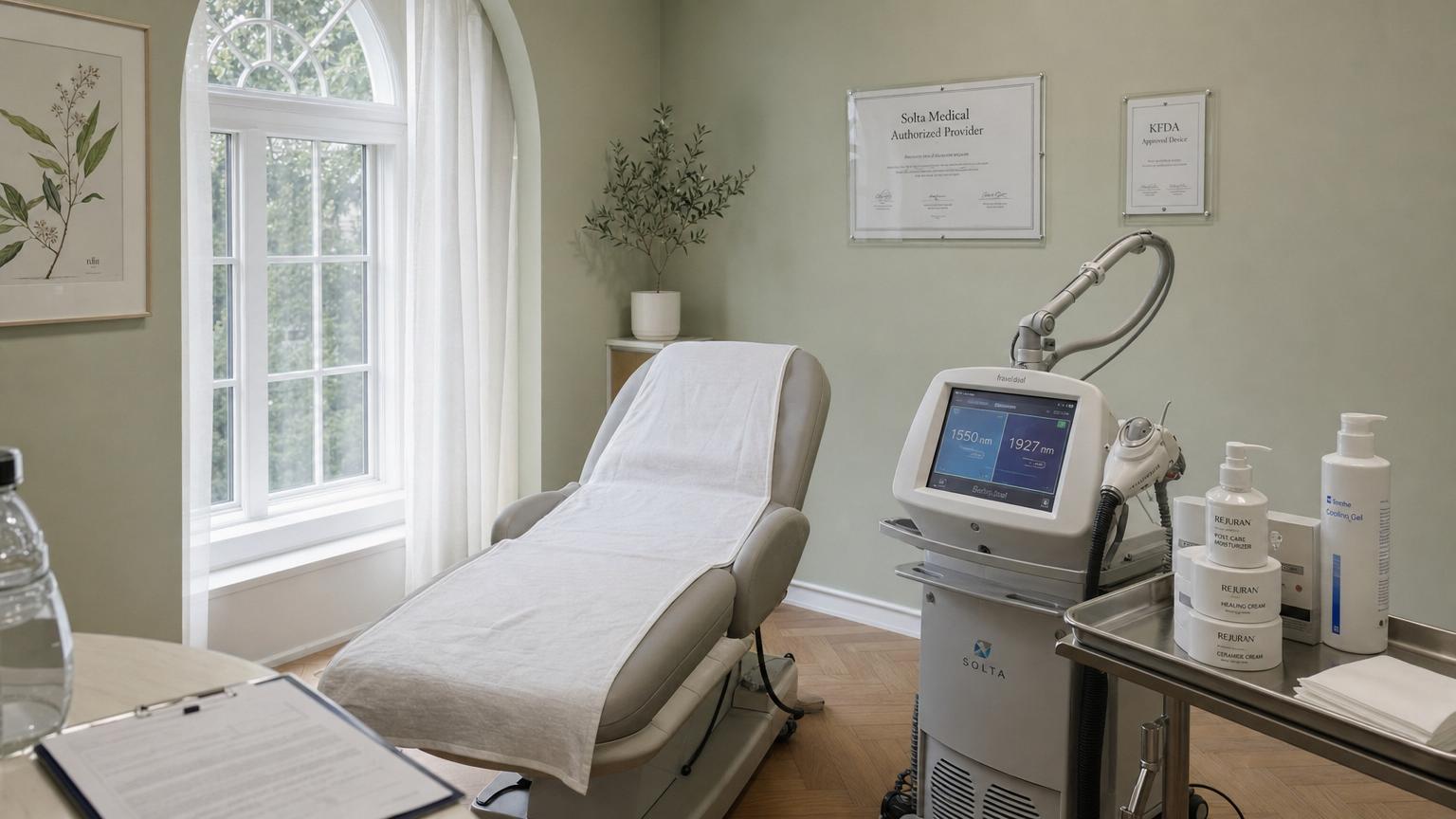
One of the strengths of the Korean aesthetics ecosystem is that Fraxel Dual is rarely the only treatment a foreign patient does on a trip. The mature Korean protocol layers Fraxel with exosome therapy and Rejuran skin booster therapy to address regenerative, dermal, and structural components in a coordinated plan. Each component targets a different mechanism, and together they produce a result that no single procedure can deliver. Patients combining Fraxel Dual with Korean exosome therapy get the fractional collagen remodeling from Fraxel plus the cellular signaling component that accelerates healing through the disrupted skin barrier. Exosome is most effectively applied immediately post-Fraxel because the micro-thermal zones create channels through which the regenerative molecules penetrate more effectively than they would through intact skin. The protocol is typically Fraxel Dual on session day, exosome at the same session or within 24 to 48 hours, with optional exosome series continuation through the collagen-build window over the following 2 to 3 months.
Patients adding Korean Rejuran skin booster therapy layer the polynucleotide-based dermal regeneration component over the Fraxel structural change. Rejuran addresses the dermal regeneration component that Fraxel’s 1550nm wavelength touches but does not transform on its own. The protocol is typically Fraxel Dual first (the laser series), with Rejuran sessions interleaved between Fraxel sessions or run as a separate series that overlaps the Fraxel collagen-build window. For foreign patients with broad concerns spanning scars, pigment, dermal regeneration, and surface texture, the triple combination of Fraxel Dual plus exosome plus Rejuran is the comprehensive Korean approach. The combined trip cost is meaningfully higher than Fraxel alone, but the cumulative result is substantially more comprehensive than fractional resurfacing in isolation.
Section 5 — Cost, Combination Protocols, and What to Expect
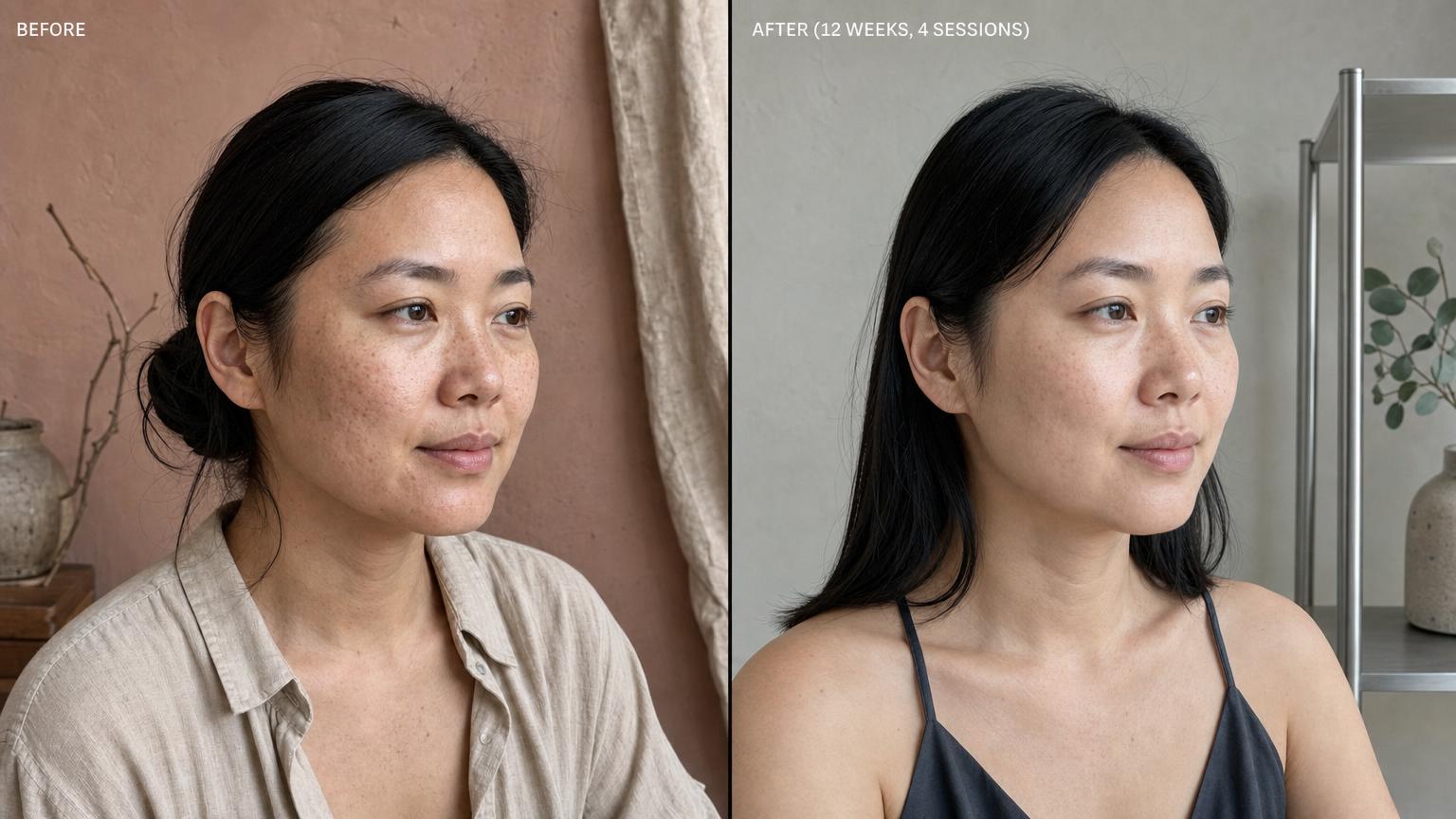
The cost gap between Korean Fraxel Dual and Western Fraxel Dual is one of the most consistent in the medical tourism space, partly because the underlying device cost (Solta tip consumption and platform amortization) is roughly the same worldwide, and partly because Korean dermatology economics favor the foreign patient through high session volume per clinic and dense Gangnam competition. The pricing structure below reflects authorized Solta Korean pricing in Seoul versus major Western markets.
| Region | Fraxel Dual Cost (Per Session) | Notes |
|---|---|---|
| Korea (Seoul) — Single session full face | KRW 350,000–700,000 (USD 260–520) | Authorized Solta clinic, dual-wavelength session, includes post-treatment regenerative aftercare |
| Korea (Seoul) — Compressed 3-session series | KRW 1,200,000–1,800,000 (USD 890–1,330) | Most common foreign patient package, 3 sessions in 2 weeks |
| Korea (Seoul) — Standard 5-session series | KRW 1,800,000–3,000,000 (USD 1,330–2,220) | Full standard protocol, requires return trips or extended stay |
| USA — Single session full face | USD 1,500–3,000 | Variable by region and clinic, often quoted per zone |
| USA — Full 5-session series | USD 4,500–12,000 | Available at dermatology and aesthetic clinics |
| UK / EU — Single session | GBP 800–1,500 | Authorized Solta clinics in major cities |
| Australia — Single session | AUD 1,800–3,500 | Higher operating costs, similar device protocol |
| Southeast Asia (unauthorized risk) | USD 80–250 | Often non-Solta fractional sold as Fraxel, verification critical |
The pricing typically includes the consultation, the session itself, immediate post-treatment care, and basic post-laser products. Foreign patients on the compressed series should budget for hotel accommodation for the full 16 to 18 day window. Foreign patients on the return-trip standard series should budget for two separate trips with the second trip 6 to 8 weeks after the first. Authorized Korean Solta clinics generally do not require large deposits and can typically book the session series with 1 to 2 weeks of lead time before the first session.
The Layered Korean Protocol Combined Pricing
Patients who layer Fraxel Dual with exosome therapy and Rejuran add meaningful but proportionate cost. A typical combined trip in Seoul running the compressed 3-session Fraxel series plus exosome plus Rejuran (3 sessions of each) totals KRW 3,500,000 to 5,500,000 (USD 2,590 to 4,070), comparable to the cost of a single Fraxel series alone in the United States. The cumulative effect is substantially more comprehensive than fractional resurfacing in isolation because each modality addresses a different mechanism — collagen remodeling from Fraxel, cellular signaling from exosome, polynucleotide dermal regeneration from Rejuran. The trip length to complete the layered protocol is typically 14 to 18 days for the initial round, with optional return-trip continuation of the Rejuran series over the following months.
Five Verification Questions to Run at Every Clinic Consultation
The five verification questions from Section 3, summarized as a checklist a foreign patient can run in under 20 minutes during the consultation. Question 1: Show me both wavelengths on the device console. Question 2: Can I photograph the device serial number. Question 3: What density and energy are you using for my indication. Question 4: Show me the KFDA registration certificate. Question 5: What is your post-Fraxel exosome or LDM protocol. The clinic that answers all five questions directly and produces the documentation is the clinic to book. The clinic that resists any of the five is the clinic to skip. Foreign patients who run the checklist consistently across 2 to 3 clinics in Seoul before committing have substantially higher satisfaction with the eventual treatment than foreign patients who book the first clinic that responded to their Instagram inquiry.
The Korean Operator Skill Difference
Beyond the device authentication question, the second meaningful Korean advantage is operator volume. A typical Gangnam dermatology clinic performs 30 to 100 Fraxel Dual sessions per week. A typical US dermatology clinic outside major metropolitan markets performs 5 to 20 Fraxel sessions per week. The operator skill that develops through high session volume — the wavelength selection judgment, the density calibration for individual skin types, the integration of post-laser regenerative aftercare — is genuinely better at high-volume Korean clinics than at lower-volume clinics elsewhere. This is not a discount-related difference; it is a volume-related difference that reflects how the Korean dermatology market is structured. Foreign patients who arrive at authorized Korean Solta clinics are typically receiving the same device delivered by a more experienced operator than they would receive at home, which is the second-order reason the Korean pricing gap is not purely a discount.
What to Do if the Series Did Not Use Dual Wavelengths
If a foreign patient completes the series and only afterward realizes that the operator never switched between wavelengths during any session — that every session was delivered at a single wavelength setting — the most likely scenario is that a single-wavelength substitution device was delivered as Fraxel Dual. The refund question and the documentation procedure are similar to the Korean Ultherapy verification (Post 954) substitution scenario covered in the prior Link PS guide: request the device serial numbers used during the series, request the Solta service log if available, document the session details. Contact Solta Medical Korea directly with the clinic name and the session dates — Solta monitors authorized distribution and will confirm clinic authorization status. The verification before treatment, which is the focus of this guide and especially of the Section 3 checklist, is much easier than the refund process after treatment.
Foreign patients evaluating their full set of Korean laser and energy options across acne scars, pigment, texture, and structural lifting may benefit from reviewing the complete Korean laser and energy treatment category, which covers Fraxel Dual alongside Ultherapy, Shrink Universe, Volnewmer, CO2 fractional, and the related modalities that Korean clinics layer in coordinated multi-modal protocols.
Frequently Asked Questions
What is the actual difference between real Solta Fraxel Dual and the cheaper fractional lasers labeled as Fraxel-style in Asia?
Real Solta Fraxel Dual is a specific FDA-cleared device manufactured by Solta Medical with two integrated wavelengths (1550nm Erbium-doped fiber and 1927nm Thulium) and a proprietary intelligent optical tracking system that calibrates the micro-thermal zone density in real time. Cheaper fractional lasers in the Asian market, including devices labeled as Fraxel-style, fractional 1550, or generic fractional laser, are typically single-wavelength platforms (most often 1550nm only or a non-Solta 1540nm clone) without FDA clearance, without Solta serial registration, and without the intelligent tracking system. The clinical risk is uneven energy distribution that produces patchy results, prolonged downtime from inconsistent micro-thermal zone density, and post-inflammatory hyperpigmentation in patients with melanin-rich skin. The financial risk is paying authentic Fraxel pricing for a device that costs the clinic a fraction of the genuine platform.
Why does Solta Fraxel Dual have two wavelengths instead of one?
The two wavelengths address fundamentally different skin layers and indications. The 1550nm Erbium-doped fiber wavelength penetrates to approximately 1.5mm depth, targeting dermal water and stimulating collagen remodeling, which is what addresses acne scars (especially rolling and boxcar types), surgical scars, deep pores, and dermal-level laxity. The 1927nm Thulium wavelength absorbs at approximately 0.2mm depth in the superficial epidermis, targeting melanin and superficial water, which is what addresses melasma, sun damage, hyperpigmentation, fine surface texture, and perioral lines. A single-wavelength device cannot do both. Korean clinics layer both wavelengths in most patient cases because most foreign patients arrive with combined concerns (acne scars plus pigment, or pores plus surface texture) rather than a single isolated indication.
Is Fraxel Dual really a series, or can I just do one session before flying home?
Authentic Fraxel Dual is dosed as a series. A single session typically produces 15 to 25 percent improvement in the targeted indication. The full 40 to 60 percent improvement that most patients are looking for requires 3 to 5 sessions spaced 4 to 6 weeks apart. The mechanism is cumulative collagen remodeling, which means each session builds on the response from the previous session, and a single session does not produce the same result as the equivalent total energy split across sessions. Foreign patients have two practical options: a compressed series of 3 sessions within 2 weeks at reduced density per session (Korean clinics offer this for medical tourists with limited trip windows), or the standard 3 to 5 session protocol that requires return trips or a longer single stay. A clinic that promises a complete result from one session is either substituting a generic fractional device or misrepresenting the expected outcome.
How does Fraxel Dual compare to CO2 laser and Erbium ablative resurfacing?
Fraxel Dual is non-ablative, meaning it heats and remodels tissue without vaporizing the surface, so the skin barrier remains intact during recovery. CO2 ablative laser vaporizes the surface, producing more dramatic single-session results but with 7 to 14 days of significant downtime, a visible weeping and crusting phase, and a higher risk of post-inflammatory hyperpigmentation in Asian skin. Erbium ablative laser sits between Fraxel Dual and CO2 in both result depth and downtime. For acne scars, CO2 produces faster single-session improvement but Fraxel Dual achieves comparable cumulative results across the 3 to 5 session series with substantially less downtime per session and lower PIH risk. For Asian and other melanin-rich skin types, the Korean dermatology standard is typically Fraxel Dual first for the lower PIH risk, with selective addition of fractional CO2 for the deepest ice-pick scars that fractional non-ablative cannot fully address.
What about Fraxel Re:Store (single wavelength 1550nm) versus Fraxel Dual?
Fraxel Re:Store is the older single-wavelength platform from Solta Medical that uses only the 1550nm Erbium-doped fiber wavelength. It is still a legitimate Solta device and produces excellent results for acne scars, surgical scars, and dermal-level texture, but it cannot address pigment and superficial texture indications, which require the 1927nm Thulium wavelength. Many Western dermatology clinics own only the Fraxel Re:Store platform because the cost of upgrading to Fraxel Dual is significant. Korean clinics that handle high foreign patient volume typically stock the Dual platform because their patient mix arrives with combined concerns rather than single-indication cases. If you arrive at a Korean clinic and the device is labeled Fraxel Re:Store rather than Fraxel Dual, the clinic is still using authentic Solta technology but the device cannot deliver the 1927nm wavelength, which means pigment indications would need to be addressed with a separate treatment such as PicoSure or Q-switched laser toning.
What is the realistic downtime for Fraxel Dual per session?
Day 0 typically involves moderate to significant redness across the treated area, sometimes with mild swelling, lasting 6 to 24 hours after treatment. Days 1 through 3 involve a fine sandpaper-like texture on the skin surface as the micro-thermal zones heal, with gradual fading of redness. Days 4 through 7 involve micro-flaking and superficial peeling that resolves into refreshed-looking skin underneath. Most patients can wear makeup from day 3 to 5 onward. The downtime is genuinely lower than ablative resurfacing but is not zero, and foreign patients should plan for visible skin texture changes during the first week. Patients planning to compress the series (3 sessions in 2 weeks) should expect cumulative redness and texture changes that persist through the trip and resolve fully within 2 weeks of the final session.
Can I combine Fraxel Dual with Rejuran, Exosome, or skin boosters during the same Korea trip?
Yes, and this is one of the strongest reasons foreign patients combine Korea trips with Fraxel Dual. The standard Korean layering protocol applies exosome therapy or skin boosters immediately post-Fraxel to accelerate healing through the disrupted skin barrier created by the micro-thermal zones. The exosome cellular signaling penetrates more effectively into freshly treated skin than it does into intact skin, which is why Korean clinics layer regenerative aftercare with laser treatments rather than treating them as separate procedures. The typical combined protocol is Fraxel Dual on day 0, exosome or Rejuran applied at the same session or within 24 to 48 hours, with the regenerative series continuing through the collagen-build window over the following 2 to 3 months. The total cost runs higher than Fraxel alone but produces faster healing, reduced PIH risk, and better long-term texture improvement.
Why does Korean Fraxel Dual cost less than USA Fraxel Dual at the same Solta device?
The pricing gap is not from substituting the device or cutting clinical corners at authorized Korean clinics. The drivers are currency conversion (KRW versus USD), clinic operating costs in Seoul versus US metropolitan markets, the volume of Fraxel sessions Korean dermatology clinics perform per week (which spreads the device acquisition cost across more sessions), and the price competition among the dense cluster of authorized Solta clinics in the Gangnam district. Korean authorized Solta clinics operate on lower per-session margin but higher session volume, which produces an end-user price 25 to 50 percent of US pricing without compromising the device or the operator skill. The risk to manage is that unauthorized clinics in the broader Asian medical tourism corridor sometimes substitute non-Solta fractional lasers under the Fraxel name, and the verification before treatment is what separates the authentic Korean discount from the substitution.
What is the appropriate age range for Fraxel Dual?
The optimal age range is wider than most laser treatments because Fraxel Dual addresses multiple indications across age groups. Patients in their late teens through twenties typically come for active acne scarring after the acne itself has stabilized, with the 1550nm wavelength addressing the dermal scar response. Patients in their thirties typically come for combined acne scar residue plus early texture and pore changes, layering both wavelengths in dual protocols. Patients in their forties and fifties typically come for pigment, sun damage, and combined texture concerns, with the 1927nm wavelength becoming more prominent in the protocol. Patients older than 60 with substantial laxity in addition to texture and pigment concerns may benefit from layering Fraxel Dual with structural lifting procedures rather than relying on the laser alone. The procedure is the same across age groups, but the wavelength split and session count are adjusted based on the dominant indication.
What should I do if I think the clinic used a non-Solta fractional laser instead of real Fraxel Dual?
The verification process after the fact is harder than the verification before treatment, which is why the five-step pre-treatment checklist matters so much. If you suspect substitution, the first step is documentation: request from the clinic the device model name and serial number used during your session, request the Solta service log if available, and document any observations from the session itself (whether the device console clearly displayed the Fraxel Dual interface with the 1550nm and 1927nm wavelength toggle, whether the operator selected wavelengths or operated on a single fixed setting). Contact Solta Medical Korea directly through their official customer service line with the clinic name and your session date — Solta tracks authorized distribution and can confirm whether the specific clinic has active authorization. If Solta confirms the clinic is not on the authorized list, you have grounds to request a refund from the clinic itself, and Solta Korea will sometimes intervene on behalf of patients who were misled by unauthorized use of the Fraxel brand name. Documentation is much more credible if collected at the time of the session rather than reconstructed after the fact.
Closing
The pricing gap that pulls foreign patients to Korea for Fraxel Dual is genuine, and the genuine product is genuinely available at authorized Solta clinics in Seoul. The risk to manage is not whether Korean Fraxel is good. At authorized clinics, the device is identical to the Solta platform used in Beverly Hills and the operator skill is generally higher because Korean dermatologists run more Fraxel sessions per month than their Western counterparts. The risk is that unauthorized clinics in the broader Asian medical tourism corridor — including some clinics in Seoul that compete on price by sourcing non-Solta fractional lasers — sell those substitution devices under the Fraxel name. The five-step verification checklist takes less than 20 minutes to run at the consultation and is the single most reliable defense against substitution. The series itself rewards patience and proper planning: 15 to 25 percent improvement after one session, 40 to 60 percent improvement across the full 3 to 5 session series, peak result at 2 to 3 months after the final session, and the option to layer exosome or Rejuran regenerative protocols for a more comprehensive result. Foreign patients who run the verification, plan the trip logistics around the series mechanism, and consider the layered Korean protocol get the result the device was designed to deliver. Foreign patients who book on price alone, without verification, sometimes get a different device and a different result. The treatment you ask for is only the treatment you receive if the device is the device.
For patients planning their Fraxel Dual treatment in Seoul, Link Plastic Surgery’s official website lists the device verification documentation, the 3-5 session protocol options, and English-language consultation booking details.