Foreign patients arriving in Seoul for “Korean eyelid surgery” almost always book one procedure — usually upper blepharoplasty, sometimes double eyelid surgery, occasionally lower lid fat removal — and discover during the consultation that the actual concern they want to address requires two, three, or four separate sub-procedures combined into a single comprehensive plan. Korean blepharoplasty is not one surgery. It is a family of anatomy-specific sub-procedures (upper skin and fat / ptosis correction / lower transconjunctival fat repositioning / lateral canthoplasty) that the surgeon combines per patient based on which eyelid anatomy issues actually exist. Clinics like Link Plastic Surgery treat blepharoplasty as a 4-element decision tree, not a single menu item. This guide is the hub article for foreign patients who want to understand the full surgical scope before booking one piece of it.
 Korean comprehensive blepharoplasty before and after 12 weeks. Combined upper + lower + ptosis correction. Eyes rested and open, age markers preserved.” />
Why “One Blepharoplasty” Is Almost Never the Right Plan
The Western mental model of blepharoplasty is typically a single procedure — either upper eyelid skin removal or lower eyelid fat removal — performed in isolation. Foreign patients researching “Korean blepharoplasty” import this mental model and book one piece, often the upper lid surgery, expecting that to address the overall tired-eye appearance they want to fix. In Korean clinical practice, the upper lid heaviness is rarely the only issue. It typically coexists with mild ptosis, lower lid fat bag bulge, tear trough hollow, lateral canthal tilt, and pretarsal heaviness — five anatomical issues that together produce the tired-eye look the patient came to fix. Surgically addressing only one of them leaves the other four untouched, and the patient sees only partial improvement.
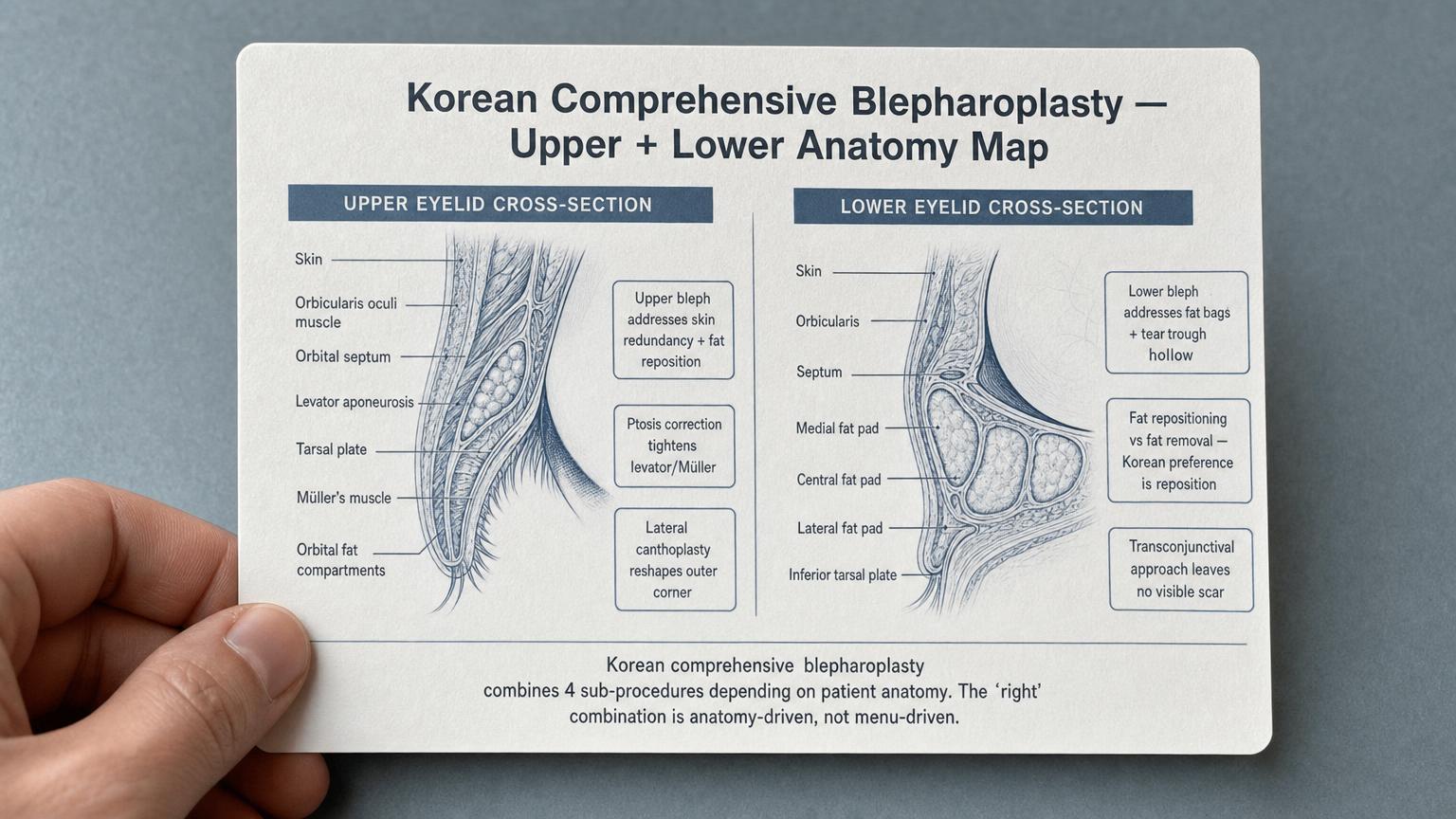
Korean dermatology and plastic surgery training emphasizes a different mental model — comprehensive eyelid evaluation followed by anatomy-driven sub-procedure selection. The surgeon evaluates upper skin redundancy, levator function, fat compartment integrity, tear trough depth, lateral canthal tilt, and orbicularis tone as six separate measurements. The recommended procedure is the combination of sub-procedures that addresses the patient’s specific findings, not a generic “blepharoplasty” applied uniformly.
The 4 Sub-Procedure Decision Tree
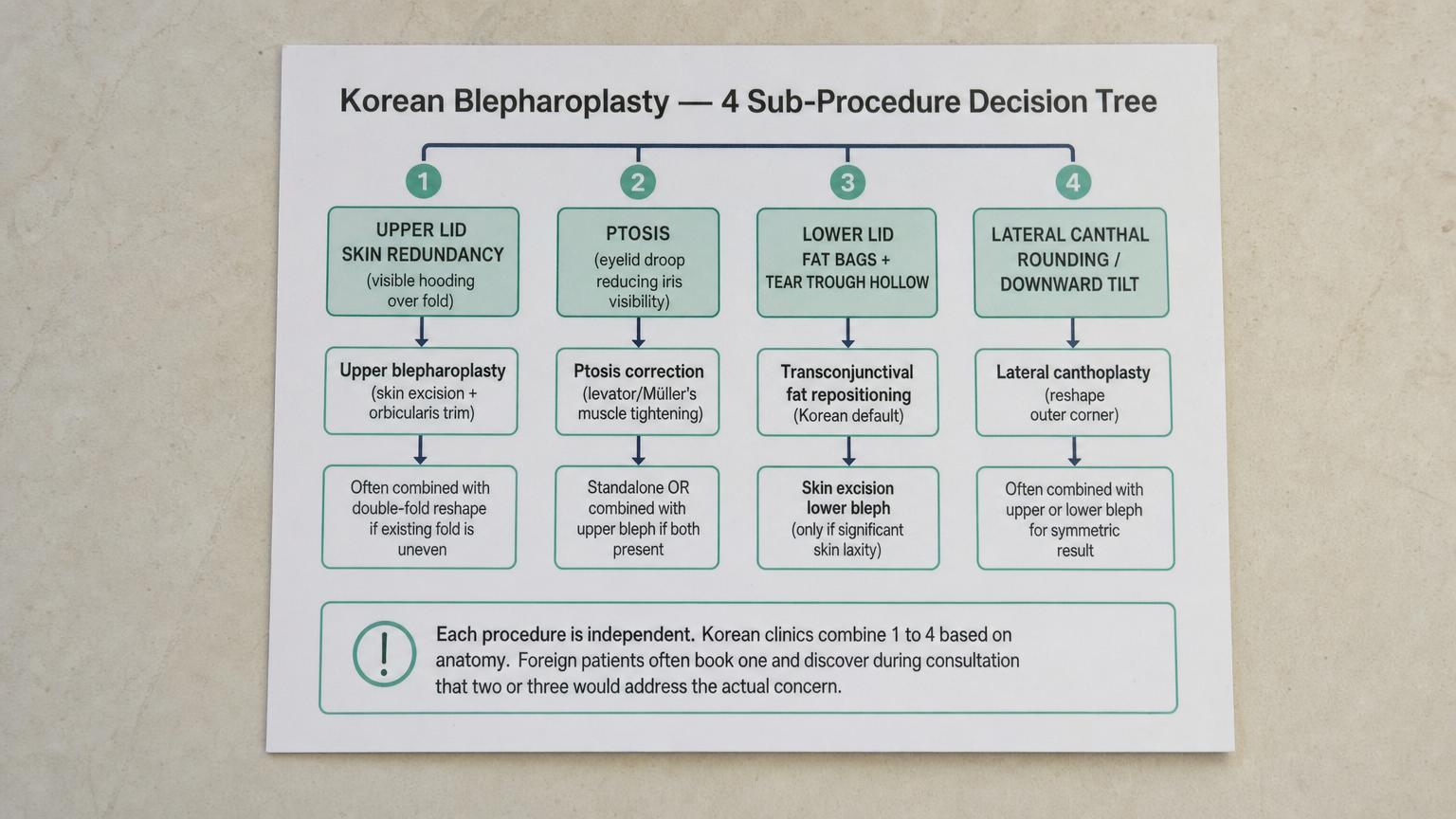
1. Upper Blepharoplasty (Skin Excision + Orbicularis Trim)
Indication: visible skin redundancy over the natural upper eyelid fold, often described as “hooding” or “heavy upper lid.” Surgical action: precise excision of redundant skin along the natural fold line, with optional trimming of the underlying orbicularis muscle if it contributes to the heaviness. When the patient’s existing double eyelid fold is uneven or undefined, the upper blepharoplasty is often combined with a fold-reshape that integrates with the procedures covered in our Korean double eyelid surgery guide. Recovery is 5 to 7 days for sutures, 10 to 14 days for social return.
2. Ptosis Correction (Levator / Müller’s Muscle Tightening)
Indication: eyelid droop reducing iris visibility, often subtle and mistaken for “tiredness.” Surgical action: tightening of the levator aponeurosis or Müller’s muscle (via internal Müller’s muscle conjunctival resection or external levator advancement) to lift the upper eyelid margin to its anatomically correct position. Foreign patients often miss this diagnosis entirely because mild ptosis can look like generalized fatigue. Many “upper blepharoplasty disappointment” cases are actually undiagnosed ptosis — the skin was removed but the underlying eyelid droop was never corrected. Ptosis correction is frequently combined with upper blepharoplasty when both findings are present.
3. Lower Transconjunctival Fat Repositioning
Indication: lower eyelid fat bag bulge with hollow tear trough beneath. Surgical action: a transconjunctival incision (inside the lower lid, no visible external scar) accesses the three lower lid fat compartments. Rather than removing fat (as Western blepharoplasty often does), Korean technique repositions the fat to fill the tear trough hollow below — addressing both the bag and the hollow in a single move. This is one of the most distinctive Korean approaches and forms the foundation of our Korean under-eye fat repositioning protocol. When the lower lid also has significant skin laxity, a small skin excision can be added; otherwise transconjunctival is the default.
4. Lateral Canthoplasty (Lateral Canthal Reshaping)
Indication: lateral canthal rounding, downward tilt of the outer eye corner, or asymmetric outer canthal position. Surgical action: reshape and reposition the lateral canthal tendon to restore a slight upward tilt and sharper outer corner. Often combined with upper or lower blepharoplasty for symmetric integrated result.
Korean vs Western Blepharoplasty — Anatomy and Approach
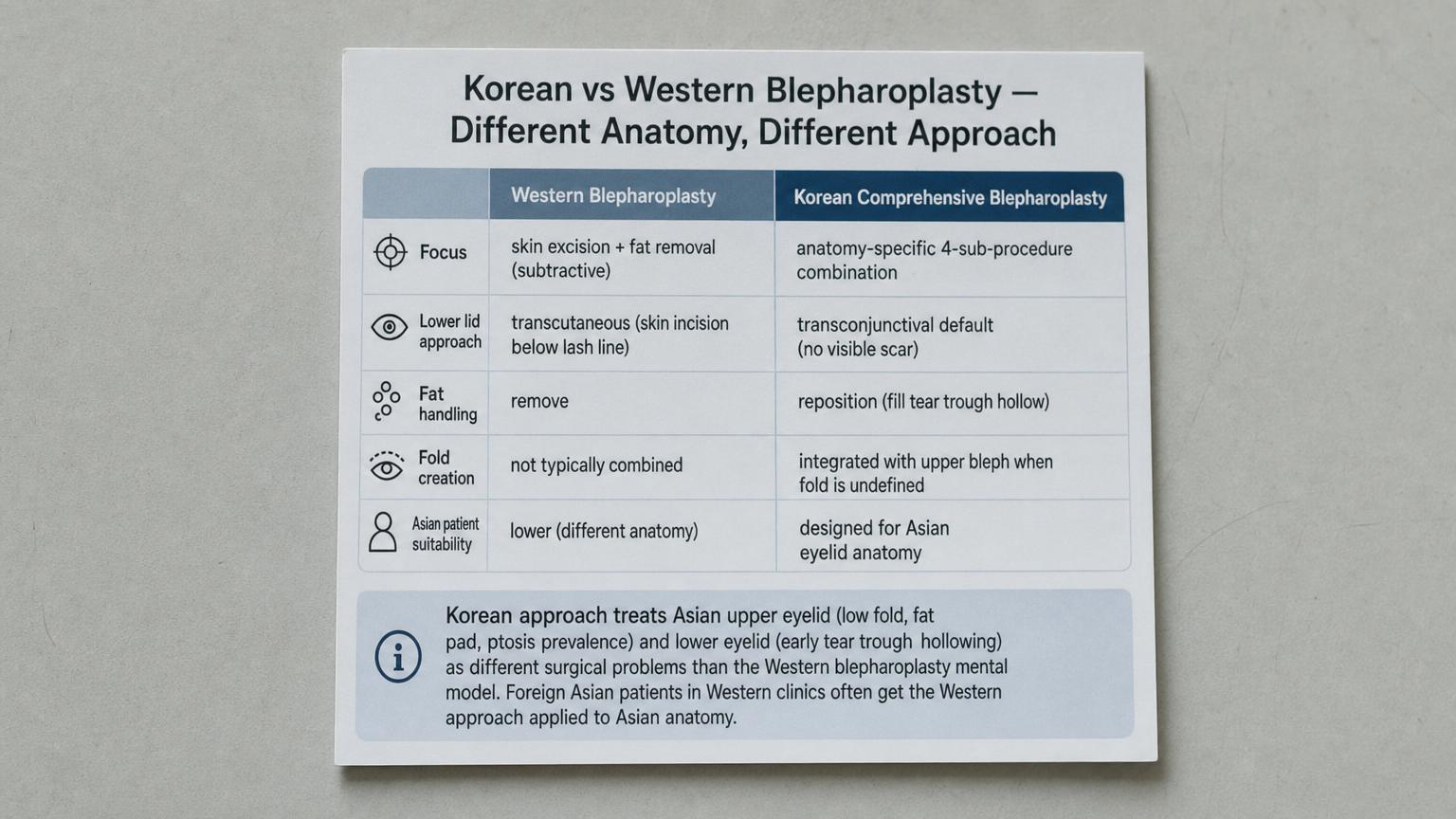
The Western blepharoplasty mental model was developed for Caucasian eyelid anatomy — typically a high upper lid fold, less prominent epicanthal fold, and a different lower lid fat distribution. Western blepharoplasty technique tends toward subtractive (skin excision + fat removal) with a transcutaneous lower lid approach that leaves a visible scar below the lash line. Asian eyelid anatomy is structurally different — lower upper lid fold (sometimes absent), prominent epicanthal fold, fat pad above the tarsal plate, and earlier tear trough hollowing with age. Korean technique evolved specifically for this anatomy.
Recommended for Your Recovery
Products commonly used before and after Korean comprehensive blepharoplasty — same items routinely recommended in the recovery instructions Seoul clinics hand out at discharge.
- Arnica Montana Tablets — begin 3 days before eyelid surgery to reduce periorbital bruising and swelling. Check price on Amazon
- Gel Eye Mask (Cold Compress) — reusable cold pack for the every-two-hour icing schedule on day 1 to day 3. Check price on Amazon
- Silicone Scar Sheets — apply from week 3 onward along the upper lid incision line if your procedure was incisional. Check price on Amazon
- Beauty of Joseon Relief Sun SPF 50+ — lightweight Korean sunscreen to protect the healing scar and prevent post-inflammatory pigmentation. Check price on Amazon
As an Amazon Associate, GlobalBeautySpot earns from qualifying purchases at no extra cost to you.
The clearest divergence is the lower lid approach. Korean clinics default to transconjunctival fat repositioning (no visible scar, fat moved to fill the hollow) rather than transcutaneous skin excision plus fat removal. Foreign Asian patients treated in Western clinics often receive Western-style lower lid blepharoplasty applied to Asian anatomy, with results that look unnatural because the procedure was designed for different tissue characteristics.
The integrated decision tree is the second major difference. Korean clinics evaluate all 4 sub-procedures at consultation and combine the ones that match the patient’s anatomy. Western clinics more often treat blepharoplasty as a single procedure with optional ptosis correction add-on, requiring the patient to book multiple separate surgeries to address the same concerns.
Combination Patterns by Patient Profile
The combination of sub-procedures that an individual patient needs depends on the specific anatomy findings. Common combination patterns:
Late 30s to early 40s with mild upper hooding and subtle ptosis. Upper blepharoplasty + ptosis correction. Recovery 10 to 14 days social return. This combination addresses the most common “tired eye” complaint at the earliest age group that typically seeks surgical intervention.
Mid-40s to early 50s with upper hooding, lower fat bags, and tear trough hollow. Upper blepharoplasty + lower transconjunctival fat repositioning. Recovery 14 to 21 days social return. This is the typical comprehensive combo that addresses both upper and lower lid issues in a single surgical day.
Mid-40s to early 50s with all four findings. Upper blepharoplasty + ptosis correction + lower transconjunctival + lateral canthoplasty. Recovery 14 to 21 days, occasionally extended. This is the full comprehensive blepharoplasty and is more common than foreign patients expect — many late-40s patients have all four findings to varying degrees.
Late 50s and beyond with significant skin laxity. Upper blepharoplasty + lower skin excision (transcutaneous) + ptosis correction + lateral canthoplasty. Recovery 21 days social return. When lower lid skin laxity is substantial, the transconjunctival approach alone cannot address the redundant skin and a small lower lid skin excision is added.
Patients with isolated single findings (only mild upper hooding, or only lower fat bags) sometimes benefit from a single sub-procedure performed alone. The decision to combine versus isolate is anatomy-driven.
Recovery Timeline — What 12 Weeks Actually Looks Like
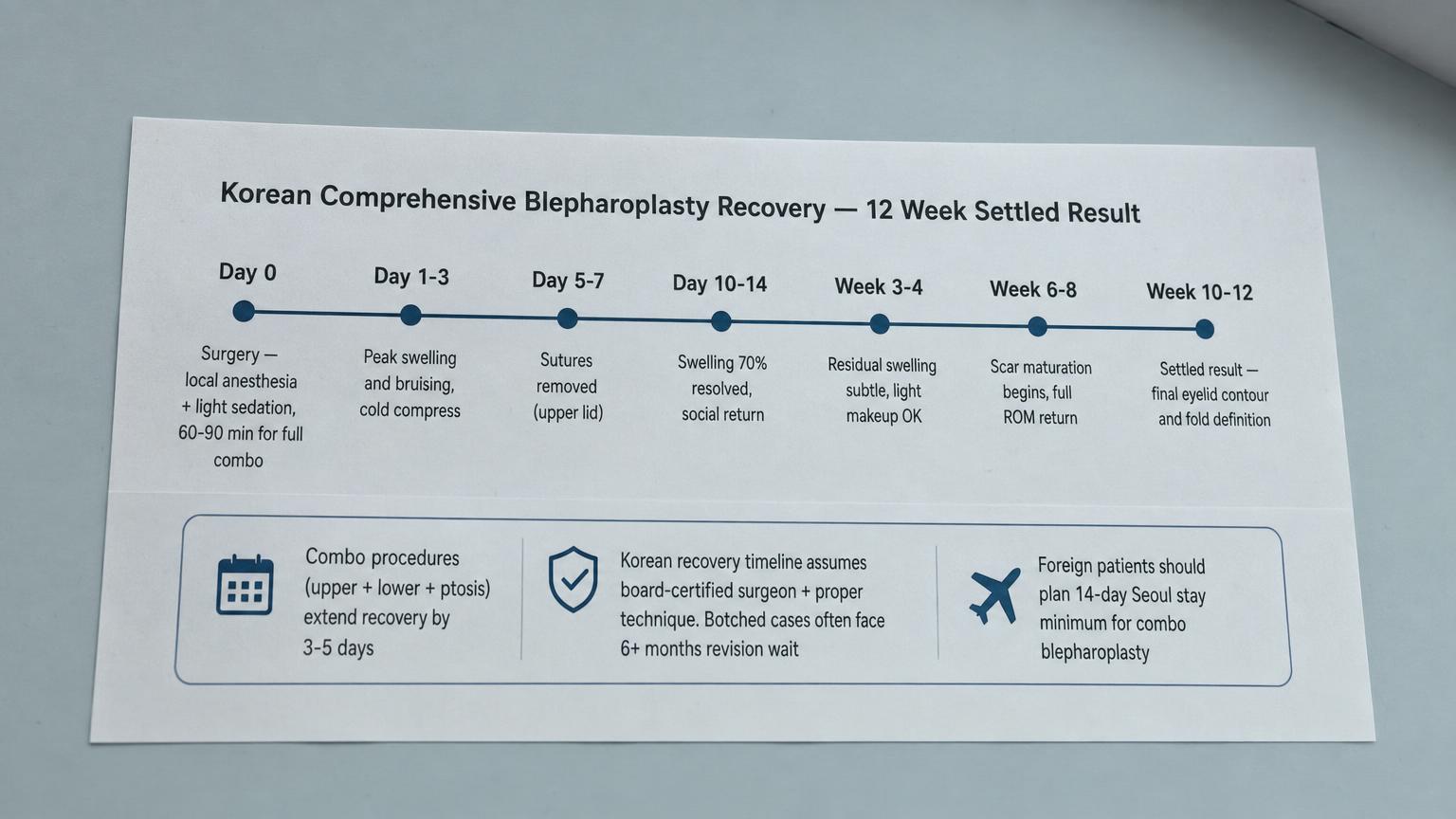
Comprehensive blepharoplasty recovery varies modestly by sub-procedure count, but the general timeline holds.
Day 0. Surgery under local anesthesia with light sedation. Full comprehensive combo (4 sub-procedures) typically takes 60 to 90 minutes. Single procedure (upper bleph alone) takes 30 to 45 minutes.
Day 1 to 3. Peak swelling and bruising. Cold compress for the first 24 to 48 hours. Most patients describe day 2 as the worst — significant eyelid swelling, periorbital bruising, restricted upward gaze. Sleep with the head elevated.
Day 5 to 7. Upper lid sutures removed. Swelling beginning to resolve. Bruising shifting from purple to yellow-green resolution phase.
Day 10 to 14. Approximately 70 percent of swelling resolved. Social return possible with light makeup coverage of residual bruising. Most foreign patients schedule departure from Seoul around day 14.
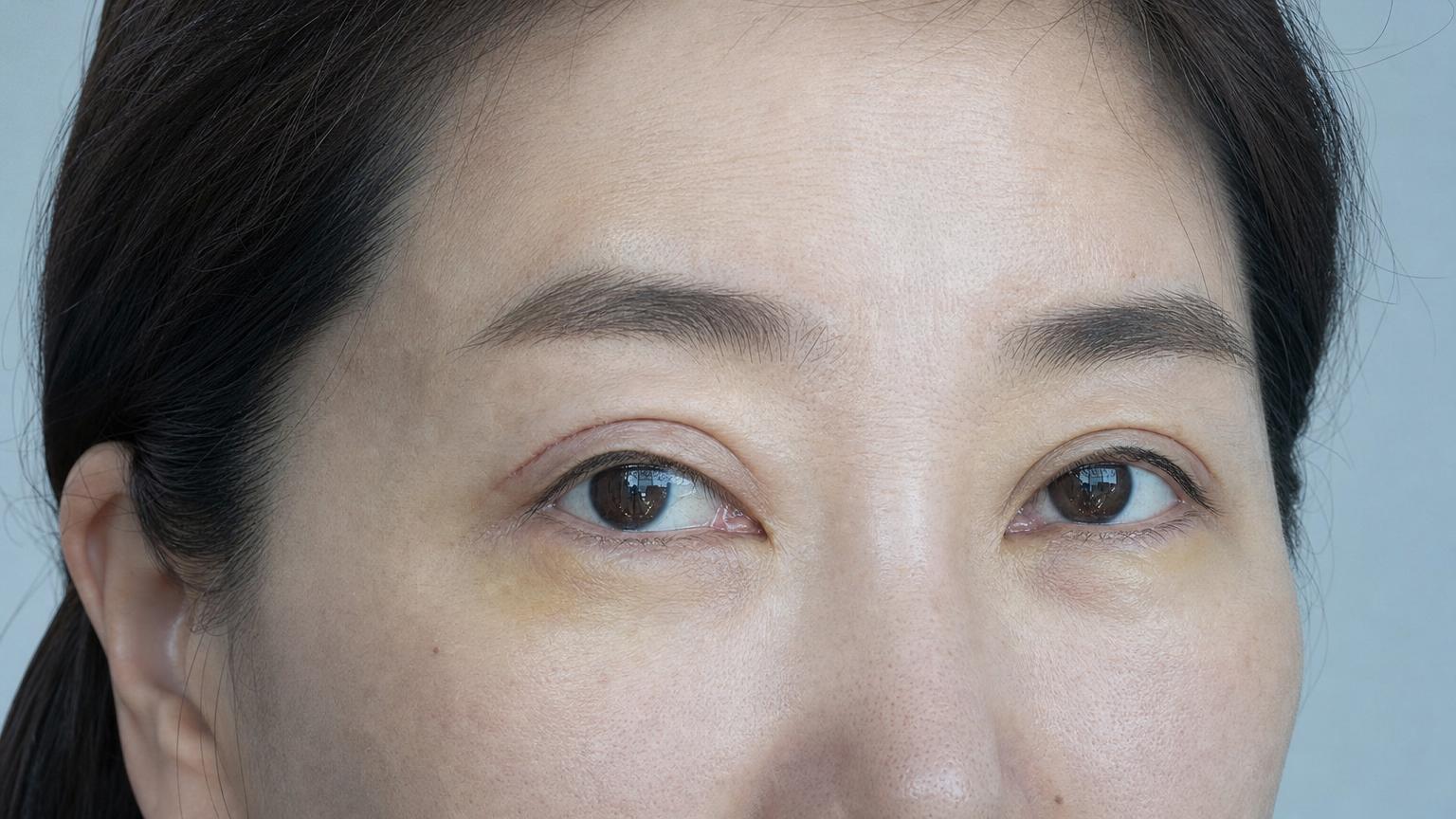
Week 3 to 4. Residual swelling subtle, scar lines on upper lid still pink. Light makeup application acceptable. Full sun exposure avoided (UV protection essential for scar maturation).
Week 6 to 8. Scar maturation begins. Eyelid fold definition settling. Full range of eye motion restored.
Week 10 to 12. Settled result. Final eyelid contour, fold definition, and overall facial appearance evaluable. This is the appropriate timepoint for “result evaluation” — earlier evaluations are looking at an incomplete recovery.
Foreign Patient Practical Planning
Foreign patients planning Korean comprehensive blepharoplasty in Seoul should account for the following logistics.
Minimum stay. 14 days from surgery date for comprehensive combo. 10 days for single sub-procedure. Many patients stay 17 to 21 days for additional follow-up safety margin.
Pre-surgical consultation. Most clinics require at least one in-person consultation before scheduling surgery — typically 1 to 3 days before. Some Korean clinics offer video consultation for international patients to discuss candidacy and provisional plan, with final consultation and surgery scheduled within the Seoul visit.
Post-operative follow-up. Standard schedule: day 1, day 7 (suture removal), day 14 (social return assessment). Foreign patients departing on day 14 should ensure their final in-person check is complete before flight. Some clinics offer remote photo consultation at week 4 and week 12 for international patients.
Combination with other procedures. Many foreign patients combine comprehensive blepharoplasty with other facial procedures during the same Seoul visit. Common combinations: blepharoplasty + Korean epicanthoplasty (inner corner) if epicanthal fold reduction is also desired, blepharoplasty + facial fat grafting for periorbital volume restoration, or blepharoplasty + brow lift for upper third rejuvenation. The recovery windows generally overlap, so combination during a single trip is logistically efficient.
Cost. Korean comprehensive blepharoplasty pricing ranges widely depending on sub-procedure count and clinic tier. Typical ranges: upper bleph alone KRW 2 to 4 million; comprehensive 4-procedure combo KRW 6 to 10 million; revision blepharoplasty KRW 4 to 8 million. Compared to single-procedure equivalent in the US ($5,000 to $12,000 for upper bleph alone, $15,000 to $30,000 for comprehensive), Korean cumulative pricing typically runs 40 to 60 percent of equivalent Western cost.
Frequently Asked Questions
Can I get just upper blepharoplasty without the other procedures?
Yes, if your anatomy evaluation shows only upper skin redundancy without ptosis, lower lid issues, or lateral canthal concerns. Many patients book what they think they want and discover during consultation that additional sub-procedures are recommended. The decision is anatomy-driven and the surgeon should explain the reasoning, not pressure for additional procedures.
What is the difference between blepharoplasty and double eyelid surgery?
Double eyelid surgery creates or reshapes the upper eyelid fold and is often performed on younger patients without significant skin redundancy. Blepharoplasty addresses age-related changes including skin redundancy, ptosis, and lower lid fat bags. The procedures can be combined when a patient has both concerns.
Will I have visible scars?
Upper blepharoplasty leaves a fine line along the natural fold that typically fades to nearly invisible by month 3 to 6. Lower transconjunctival fat repositioning leaves no external scar (the incision is inside the lower lid). Lateral canthoplasty leaves a small lateral extension that fades. Scar visibility at 12 weeks settled result is generally minimal in well-executed Korean technique.
Can comprehensive blepharoplasty be done under local anesthesia?
Yes, with light sedation. General anesthesia is not typically required for the standard combinations. Some clinics offer general anesthesia option for patient comfort preference.
How long until I can wear contact lenses again?
Typically 2 weeks after surgery, depending on swelling resolution and corneal comfort. Glasses can be worn from day 1.
Will my eyes look “different” or “unnatural”?
Well-executed Korean comprehensive blepharoplasty aims for a rested-and-rejuvenated appearance with preserved natural features. Patients are recognizable as themselves with eyes that look open and not tired. Over-correction (eyes that look pulled or surprised) is a sign of poor surgical technique or excessive removal — Korean approach generally favors conservative correction with revision option if more is needed.
How do I know if I have ptosis?
The diagnostic test is measuring the marginal reflex distance (MRD1) — the distance from the corneal light reflex to the upper lid margin. Normal is 4 to 5 mm. Mild ptosis is 2 to 3 mm, moderate is 1 to 2 mm, severe is less than 1 mm. Foreign patients often have undiagnosed mild ptosis (MRD1 of 2 to 3 mm) that is mistaken for tiredness. Ask your surgeon to measure MRD1 explicitly at consultation.
Can I have revision blepharoplasty if I had surgery elsewhere?
Yes. Revision blepharoplasty is technically more complex than primary and requires careful evaluation of existing scar tissue, eyelid position, and any over-correction or under-correction from the original surgery. Many foreign patients arrive in Seoul for revision after dissatisfying primary surgery in their home country. Revision pricing is typically higher than primary due to the technical complexity.
What about combination with other Korean petit procedures?
Many patients schedule comprehensive blepharoplasty with non-surgical complementary procedures during the same Seoul visit. Korean Rejuran skin booster for periorbital skin quality, exosome therapy for accelerated healing, or facial fat grafting for periorbital volume restoration are common additions.
How do I find the right surgeon?
Look for a board-certified plastic surgeon with documented comprehensive blepharoplasty volume (not just double eyelid surgery), an in-person consultation that includes MRD1 measurement and full 4-element anatomy evaluation, transparent pricing for each sub-procedure, and consistent before/after gallery showing comprehensive cases. Avoid clinics that quote a single “blepharoplasty package” without anatomy-specific evaluation.
For patients planning comprehensive blepharoplasty in Seoul, Link Plastic Surgery’s official website lists the surgeon credentials, the 4-element evaluation protocol, and English-language consultation booking details. For an overview of related eye procedures, see the full Korean eye surgery category.