She kept being told she looked tired even when she was well rested, and she could not work out why. She had good skin, no major wrinkles, and her cheeks were full enough. A friend suggested cheek filler, which she nearly booked. But when she consulted a surgeon in Seoul, he barely looked at her cheeks. He pressed gently at her temples, the area beside her eyes, and showed her in the mirror how hollow they had become, sinking inward and casting a faint shadow that pulled her whole upper face down. The tired look she had been chasing in her cheeks was coming from her temples, an area she had never once thought about. The consultation at Link Plastic Surgery often finds that the source of a tired appearance is the upper face, not the part the patient came in worried about.

The temples and upper forehead are the most overlooked area in facial aging. Almost everyone focuses on cheeks, jawlines, and folds, while the upper face quietly hollows out and drags the whole face down with it. Korean clinics pay close attention to this region precisely because restoring it can refresh an entire face more subtly and effectively than treating the areas patients usually fixate on. Understanding why the upper face matters, and how it is restored, fills in the missing piece of a lot of frustrated aesthetic journeys.
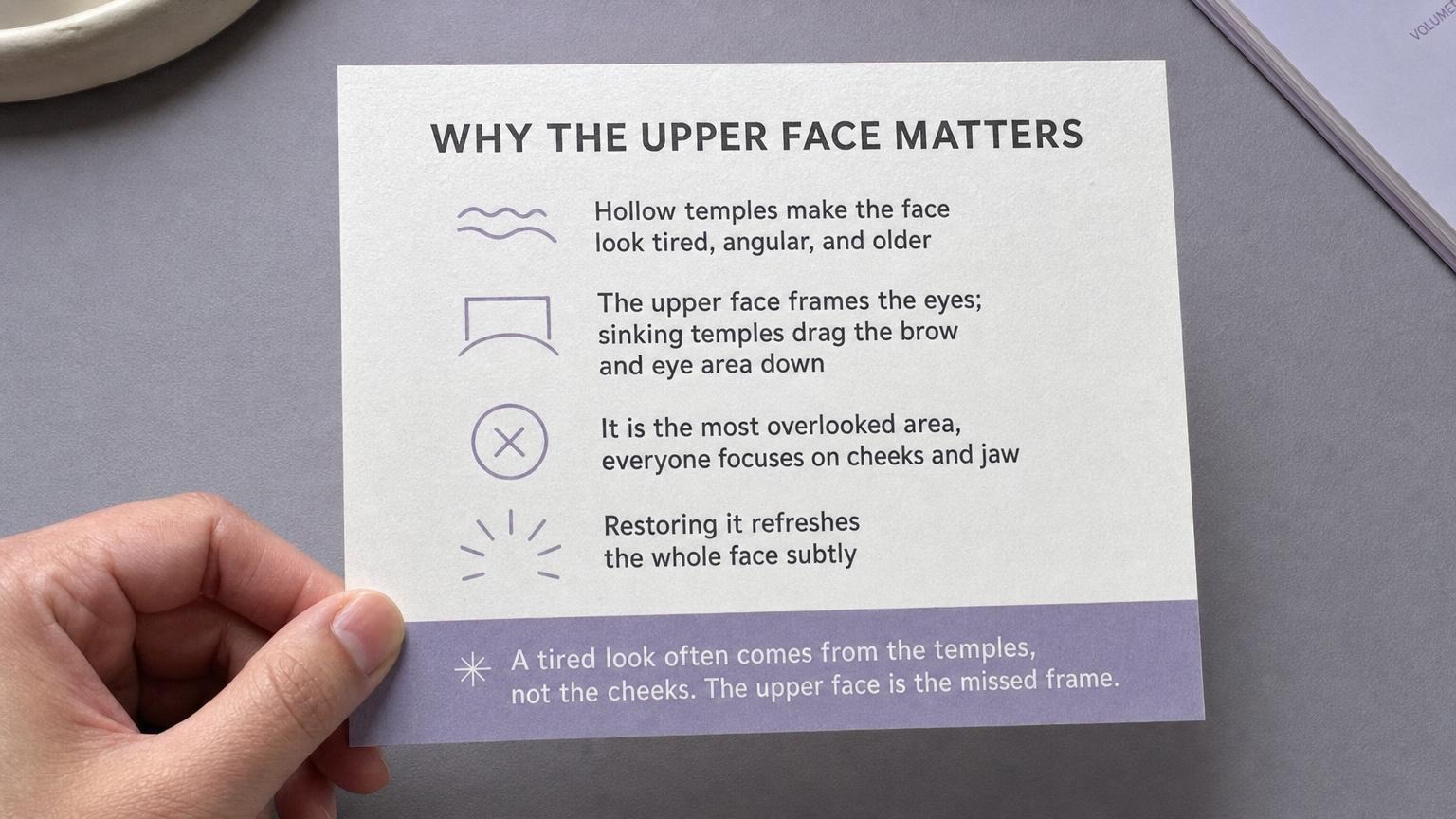
Why the Upper Face Matters
The temples and upper forehead do something most people never consider: they frame the eyes and set the overall contour of the upper face. When they are full, the face reads as rested and youthful. When they hollow, several things happen at once, and none of them are obvious unless you know to look.
Hollow temples make the face look tired, angular, and older, because the sunken area catches shadow and exaggerates the bony structure beneath. The upper face frames the eyes, so when the temples sink, the brow and the outer eye area lose their support and drift downward, adding to a tired or heavy-eyed look. And because almost everyone focuses on cheeks and jaw, this area goes untreated while people spend on regions that were never the real problem. Restoring upper-face volume refreshes the whole face in a way that is hard to pinpoint, which is exactly why it is so effective: the change reads as looking rested rather than as having had something done.
Two Ways to Restore It
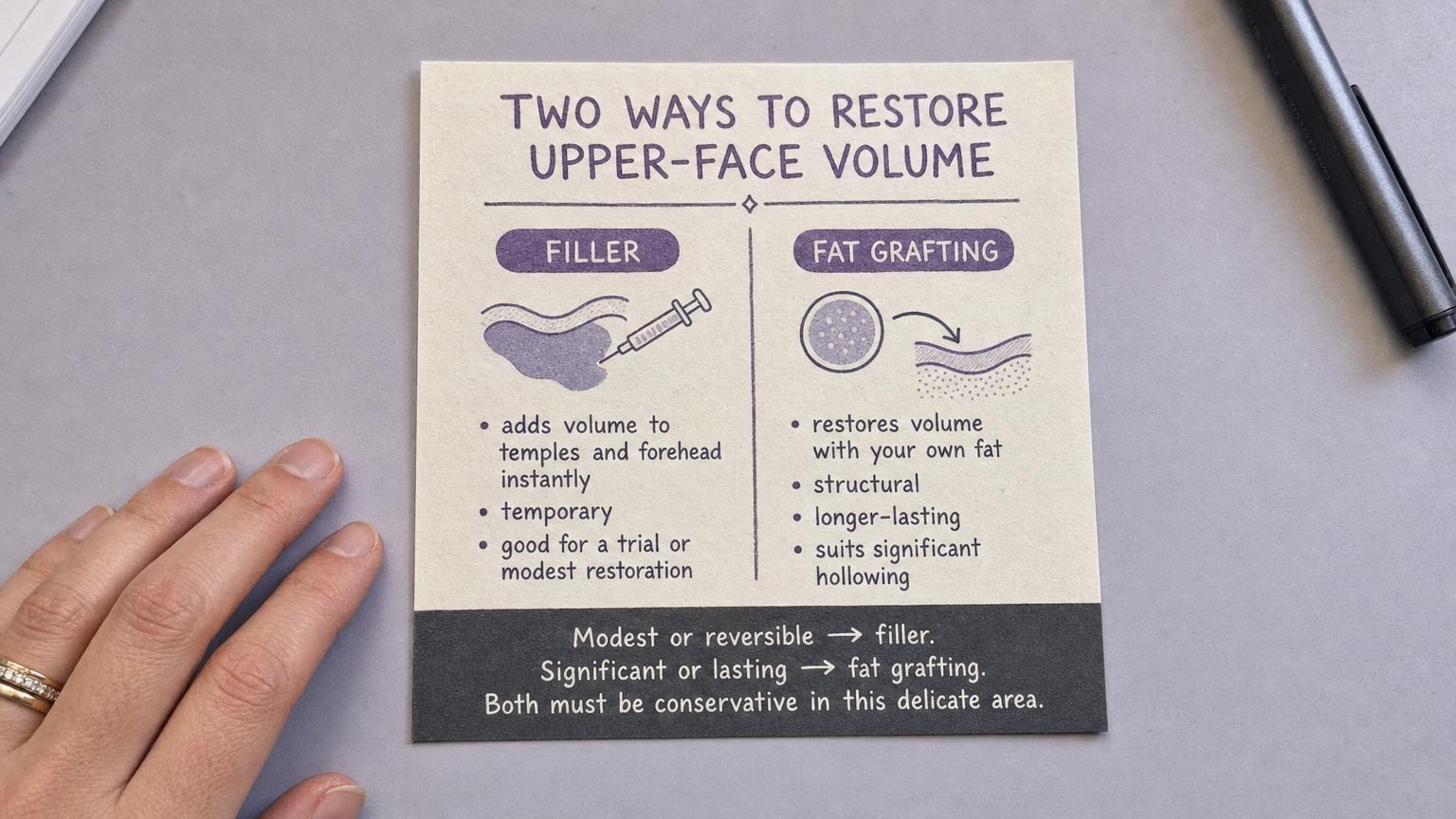
There are two main tools for restoring upper-face volume, and the choice follows the same logic as volume restoration elsewhere on the face.
Filler adds volume to the temples and forehead instantly and is reversible, which makes it good for a modest restoration or for trying the effect before committing to something permanent. It is temporary and needs maintenance. Fat grafting restores volume using your own fat, which is structural and longer-lasting, and it suits more significant hollowing where a durable result is wanted. Because the temple in particular contains important blood vessels and the skin over the upper face is relatively thin, both approaches demand a conservative, experienced hand here more than almost anywhere else. This is the same restraint applied in our guide to Korean facial fat grafting, and it sits within the wider family of Korean non-surgical petit treatments when filler is the chosen route.
Which Option Fits
The decision turns on how much hollowing there is and how lasting a result you want. Mild hollowing, or a wish to try the effect reversibly, points to filler. Significant hollowing, or a preference for a durable result over repeated top-ups, points to fat grafting. When the goal is to restore the temples specifically to support and lift the brow and outer eye area, the assessment is done with the eyes in mind, since the upper face and the eye area are connected. And in thin-skinned patients, extra caution and softer technique apply, because the structure shows more readily here.
Recommended for Your Recovery
Products commonly used before and after Korean temple forehead volume restoration — same items routinely recommended in the recovery instructions Seoul clinics hand out at discharge.
- Arnica Montana Tablets — start 3 days before facial surgery to reduce bruising in the treated area. Check price on Amazon
- Silicone Scar Sheets — for procedures with visible incisions, apply from week 3 onward to support scar maturation. Check price on Amazon
- Beauty of Joseon Relief Sun SPF 50+ — daily Korean SPF 50+ to protect freshly treated facial skin. Check price on Amazon
- COSRX Advanced Snail 96 Mucin Power Essence — Korean snail mucin essence to support the post-procedure skin barrier. Check price on Amazon
As an Amazon Associate, GlobalBeautySpot earns from qualifying purchases at no extra cost to you.
The temple is an area that rewards a conservative approach over aggressive volume. The important vessels in this region mean that experience matters more than ambition, and the aesthetic goal is restoration rather than inflation. A little volume restored carefully in the right plane refreshes the face; too much, or placed wrong, creates a rounded, bulging upper face that looks worse than the hollowing it was meant to fix. This is consistent with how Korean clinics approach the whole face, as covered across our Korean facial procedure guides.

Keeping It Subtle
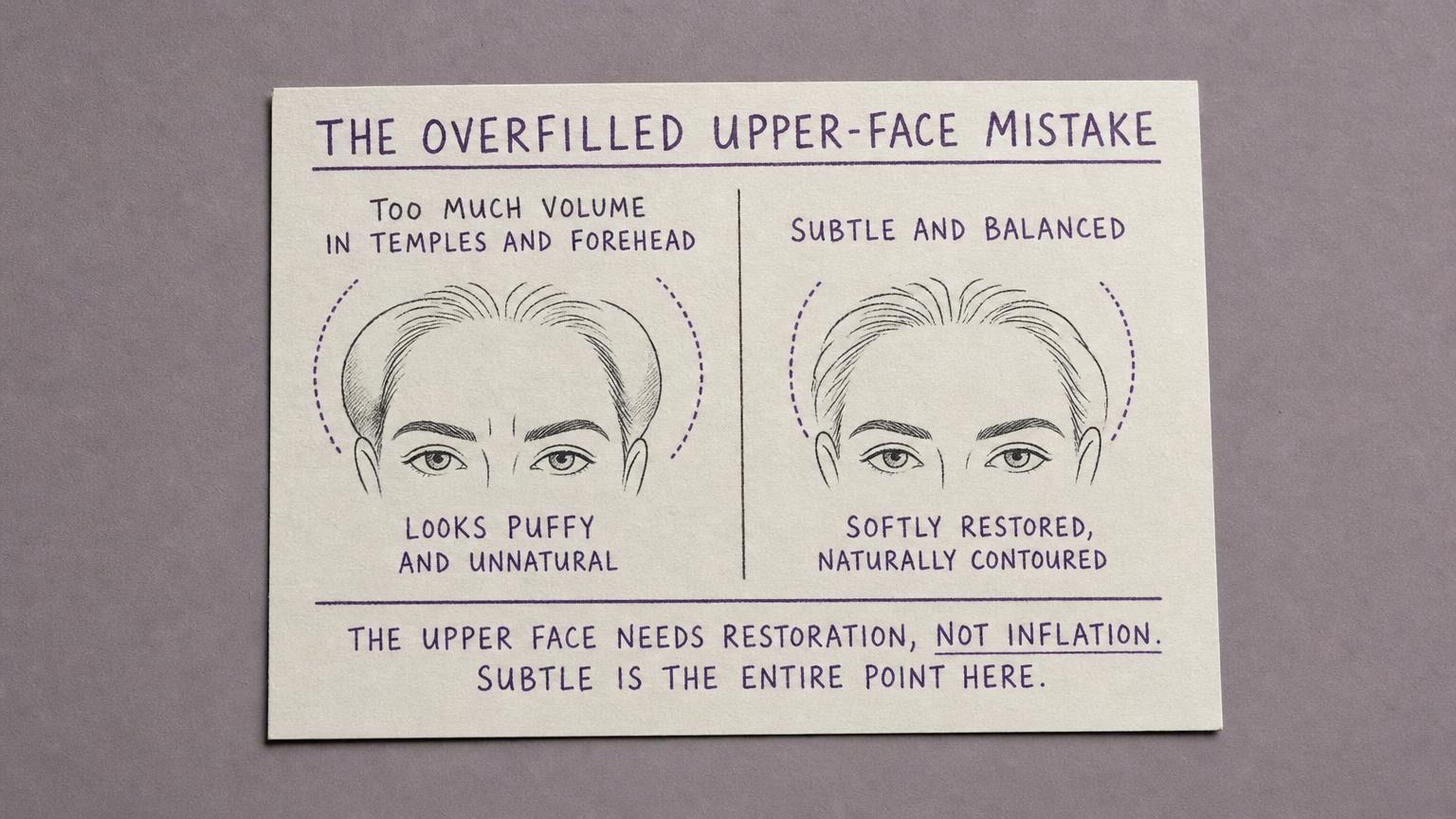
The overfilled upper face is less commonly discussed than overfilled lips or cheeks, but it is just as real and arguably more unnatural-looking, because the upper face is not supposed to be convex and rounded. Too much volume in the temples and forehead produces a puffy, overly curved upper face that reads instantly as artificial. The entire value of upper-face restoration lies in subtlety; the change should be invisible as a procedure and visible only as looking more rested.
This is why upper-face work, more than most areas, is about restoration rather than enhancement. The aim is to put back what has been lost so the face returns to looking rested, not to add volume the face never had. A surgeon who treats this area conservatively, who restores the temples just enough to lift the tired look without rounding out the upper face, understands what the region is for. Aggressive volume here is one of the clearer signs that an area is being inflated rather than restored.
Cost and How to Verify the Plan
Pricing depends on the tool. Filler in the temples is priced per session and needs maintenance, while fat grafting is a one-time procedure that lasts longer but costs more upfront. These costs are generally below the equivalent abroad. Because the upper face is often treated alongside other areas in a fuller facial-balancing plan, the cost is usually considered as part of a wider consultation rather than in isolation.
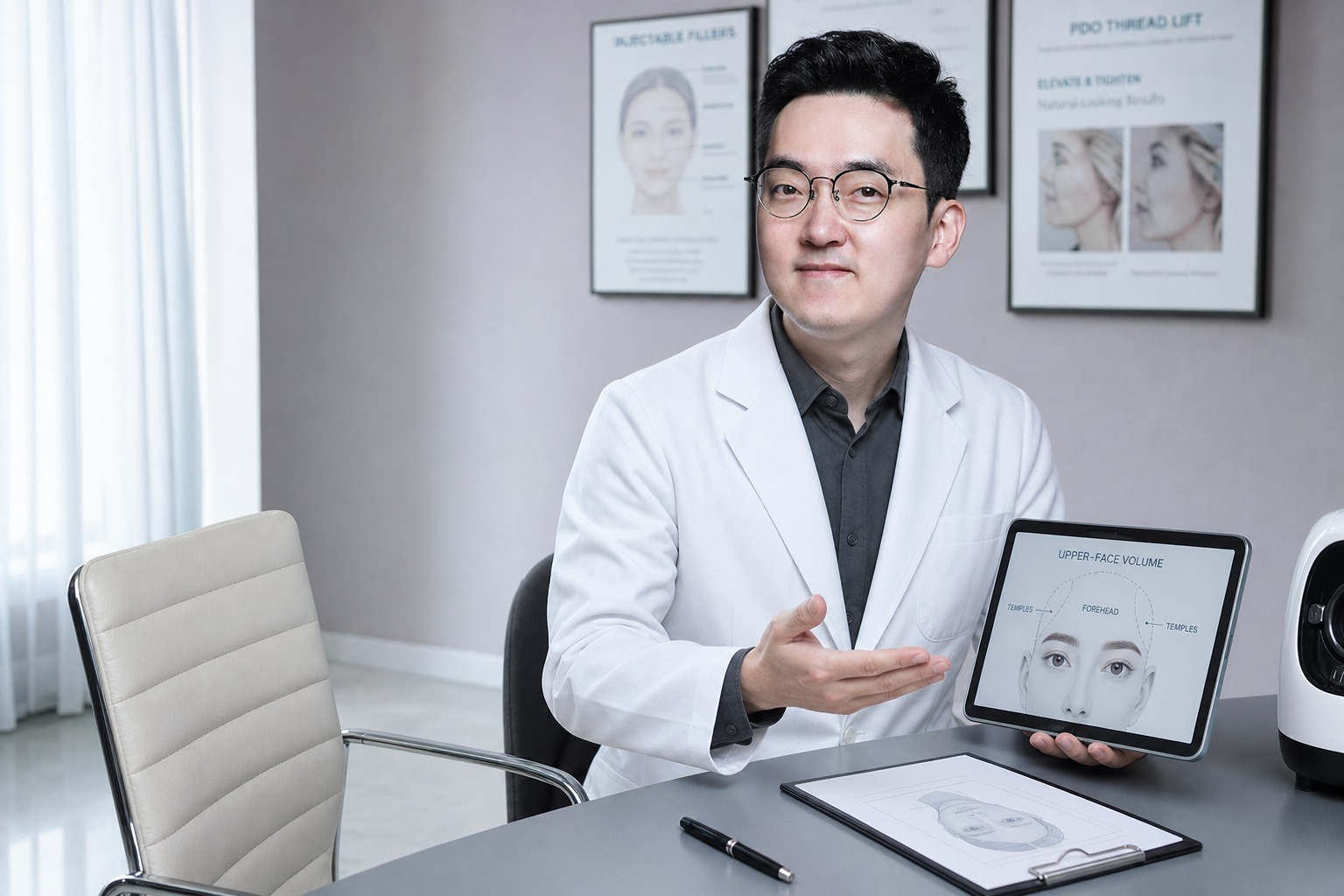
Before committing, five questions tell you whether a surgeon understands this area. Did the surgeon assess your temples and upper face, not just the area you came in worried about? Is your tired look actually coming from upper-face hollowing rather than the cheeks? Why filler versus fat grafting for your degree of hollowing? How is the delicate temple area being treated conservatively given the vessels there? And how is the result kept subtle and restorative rather than rounded? A surgeon who looks at the upper face when you came in talking about your cheeks, and who treats the temples with caution, is the one who understands the region. For trip-planning details, visit Link Plastic Surgery’s official website.
Frequently Asked Questions
1. Why do I look tired even when I am rested?
A common and overlooked cause is hollow temples. When the temples sink, the area catches shadow and the brow and outer eye lose support and drift down, producing a tired look that has nothing to do with sleep. Many people chase this in their cheeks when the source is the upper face.
2. Is temple hollowing really a sign of aging?
Yes. The temples lose volume with age like the rest of the face, but because the area is overlooked, the change is rarely attributed correctly. Restoring temple volume is one of the more effective and subtle anti-aging moves precisely because it addresses a cause most treatments ignore.
3. Should I get filler or fat grafting for my temples?
Mild hollowing or a wish to try the effect reversibly points to filler, which is instant and temporary. Significant hollowing or a preference for a lasting result points to fat grafting, which uses your own fat and lasts longer. Both must be done conservatively because the temple contains important vessels.
4. Is temple filler safe?
In experienced hands and done conservatively, it is a standard treatment, but the temple contains important blood vessels, so it is an area where the skill and caution of the injector matter more than almost anywhere. This is not a region for aggressive volume or an inexperienced hand, which is why clinic and surgeon selection is important here.
5. Will restoring my temples help my eyes?
It can. Because the upper face frames and supports the eye area, restoring sunken temples can subtly support the brow and outer eye, easing a heavy or tired-eyed look. The assessment is done with the eyes in mind, since the two areas are connected, though it is not a substitute for eye-specific procedures.
6. Why does no one talk about the upper face?
Because attention defaults to cheeks, jawline, and folds, the temples and upper forehead are simply overlooked, by patients and sometimes by clinics. That is exactly why treating this area can be so effective; it addresses a cause that has usually gone untreated while money was spent elsewhere.
7. Can the upper face be overfilled?
Yes, and it looks particularly unnatural because the upper face is not meant to be convex and rounded. Too much volume in the temples and forehead creates a puffy, overly curved look. The value of this treatment is in subtlety, so restoration, not inflation, is the goal.
8. Does this differ for Asian and Western faces?
The principle is the same: the upper face hollows with age and framing the eyes matters. Differences in bone structure and fat distribution change how hollowing presents and how much restoration suits the face, so the surgeon adjusts the amount and placement. Conservative restoration is the constant.
9. How long do the results last?
Filler in the temples generally lasts several months to a year or so and needs maintenance. Fat grafting lasts longer because the surviving fat is structural, though only a portion of grafted fat takes. The choice depends on whether you want a reversible trial or a durable restoration.
10. How do I plan upper-face treatment as an international patient?
Have a consultation that assesses the whole upper face, not only the area you are worried about, and choose between filler and fat based on the degree of hollowing and the maintenance you can manage from abroad. For scheduling and trip-planning details, visit Link Plastic Surgery’s official website.