Most Foreigners Pick the Wrong Method Before They Even Walk Into a Korean Clinic
The non-incision method is “less invasive.” That’s the line you’ve read on every K-beauty blog. It is also the reason a fair number of patients fly home, look in the mirror six months later, and book a revision they could have avoided.
The honest version: incision and non-incision are not a hierarchy. They are tools. And the tool you need depends on your eyelid anatomy — not on which sounds gentler in English.

- Non-incision (suture) is reversible and faster to heal, but the crease can soften or disappear in 5–10% of cases — especially with thicker lids.
- Incision is permanent, handles ptosis and excess fat in one go, and is what most foreign patients actually need once a Korean surgeon examines their lids.
- Combo procedures — incision plus ptosis correction plus epicanthoplasty — are standard in Seoul. Asking for just “rough double eyelids” without the underlying corrections is how you end up disappointed.
- Recovery for incision: roughly one week of visible swelling, two to three weeks before makeup looks normal, full settling around three months.
- Sleep sedation is the standard at Korean clinics. You will not be awake for it. You will also not be intubated.
- Pricing in Seoul ranges from roughly KRW 1.5M for non-incision alone to KRW 4–6M for a full combo with a senior surgeon — about USD 1,100 to 4,400.
Incision vs Non-Incision: What Actually Happens Under Your Eyelid
Both procedures create the same end product — a visible upper lid crease. The mechanics behind that crease are completely different, and that is where outcomes diverge.
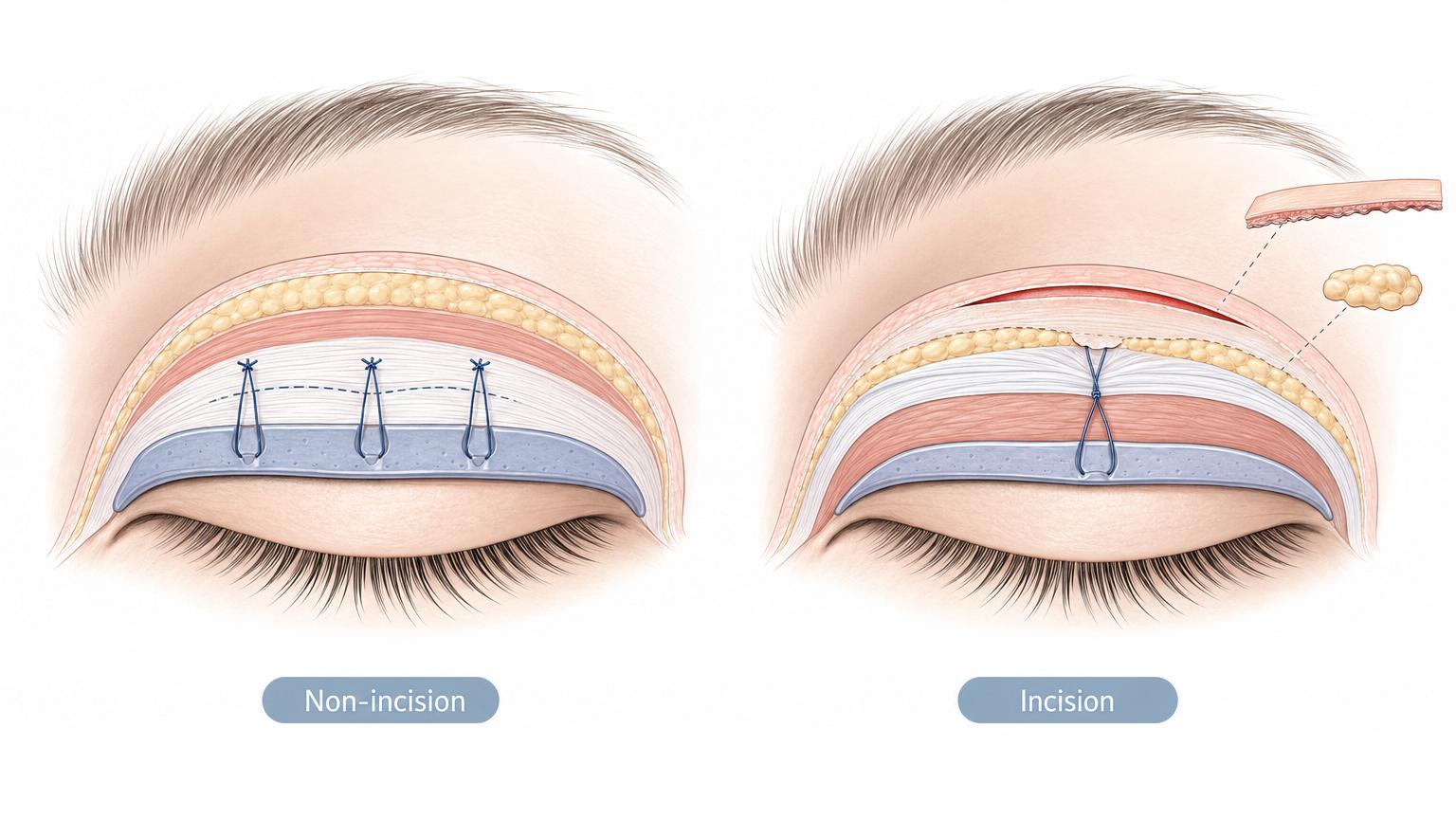
Non-incision (suture method, 매몰법)
The surgeon makes three or four tiny puncture points along the planned crease line. A non-absorbable suture is threaded through the tarsal plate and the orbicularis muscle, then tied internally. That knot is what holds the crease.
It is fast — usually under 30 minutes. Bruising is minimal. The puncture points heal without a visible line. And if you hate the result, the surgeon can untie the sutures and you go back to monolids. That reversibility is the real selling point.
The catch: the knot is doing all the structural work. If your lid is thick, fatty, or has loose skin, the knot eventually loosens or the crease softens. Most surgeons in Gangnam will quietly tell you the long-term hold rate sits around 90–95% — not the 99% you see on clinic websites.
Incision (절개법)
The surgeon makes a horizontal incision along the planned crease, removes a strip of skin and a small amount of pre-aponeurotic fat, and sutures the deeper tissues to the levator aponeurosis. The crease forms because the skin physically attaches to a deeper structure. It is permanent in the sense that the underlying anatomy is rebuilt.
It also lets the surgeon do everything else through the same opening: levator advancement for ptosis, fat repositioning, skin trimming. One incision, multiple corrections.
The downsides everyone glosses over: a thin scar that takes three to six months to mature, more swelling at week one, and a real risk of asymmetry if the surgeon’s design is off by even a millimeter.
The combo problem most foreign patients miss
Here is what surprised me when I first sat in Korean consultations as a coordinator: almost no Korean patient walks out with just “double eyelid surgery.” The chart almost always reads incision + ptosis correction + epicanthoplasty.
One patient I worked with had been quoted “non-incision double eyelid” at three clinics in her home country. The Korean surgeon spent eight minutes examining her lids, then explained that her eyes were asymmetric because the levator muscle on the right side was weak. Suture method would have given her a crease and left the asymmetry untouched.
A recent review on the Link Plastic Surgery community echoed this almost word for word — a patient noted she had ptosis (her forehead wrinkled every time she opened her eyes) and asymmetric eyes, and after combined ptosis correction with epicanthoplasty, “opening my eyes is much more comfortable now.”
That is not a cosmetic upgrade. That is a functional fix. And it cannot be done with sutures alone.
What it costs in Seoul
| Procedure | Korea (KRW) | USD approx. | US/EU range |
|---|---|---|---|
| Non-incision only | 1.5M – 2.5M | $1,100 – $1,800 | $3,000 – $5,000 |
| Incision only | 2.5M – 3.5M | $1,800 – $2,600 | $4,000 – $7,000 |
| Incision + ptosis | 3.5M – 4.5M | $2,600 – $3,300 | $6,000 – $10,000 |
| Full combo (incision + ptosis + epi) | 4M – 6M | $3,000 – $4,400 | Often not offered as one procedure |
Korean clinics that publish prices openly — places like Link Plastic Surgery or the larger Gangnam-area clinics — tend to sit in the middle of these ranges. The very cheap quotes you see on app-based platforms usually exclude follow-ups, the design consultation fee, or assume a junior surgeon. Ask what is included before you compare numbers.
Recovery Week by Week — and What Nobody Tells You
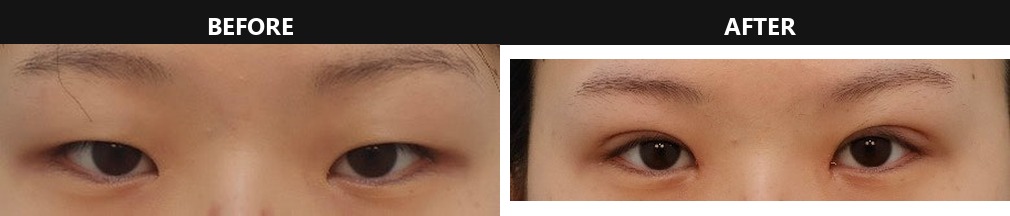
The before-and-after photos clinics post are taken at the right moment. Real recovery looks worse than the curated three-month shot, especially if you are reading this from a country where you have to fly home in seven days.
Here is the actual timeline, based on combined incision cases.
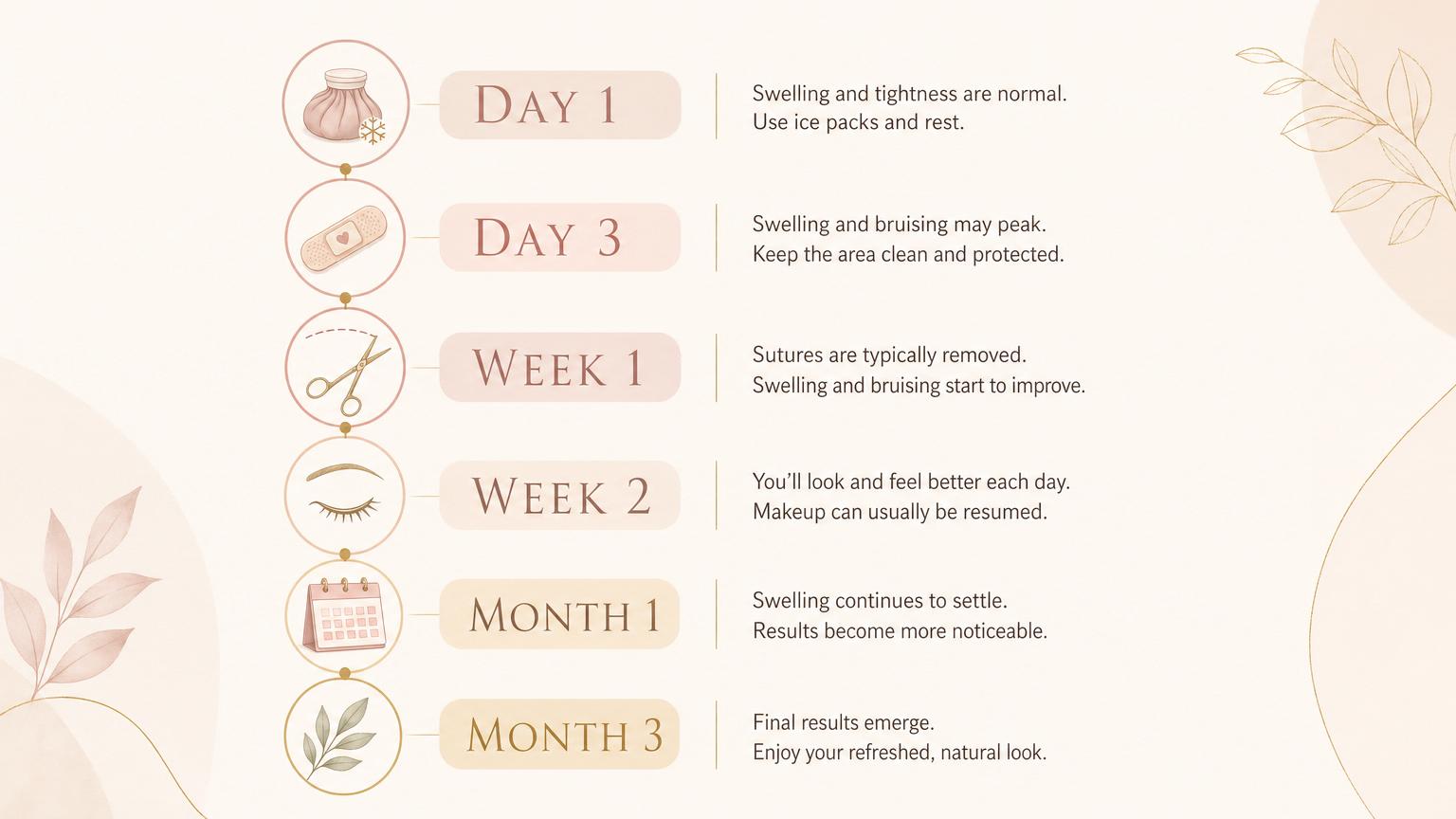
Day 0 to Day 3: the part that looks alarming
You wake up from sleep sedation with cold compresses on your eyes. There is no pain — the local anesthetic blocks it for several hours. The pressure feels heavy.
By morning the eyelids are visibly puffy, often with patches of bruising. You can see, but everything is slightly blurry from the ointment. Most patients ice every two hours for the first 48 hours.
Day 4 to Day 7: stitches out, makeup off-limits
Stitches come out around day five to seven. The crease line is dark pink — a thin red thread along the lid. Bruising fades from purple to yellow. Some patients return to office work at this point with sunglasses and minimal eye makeup avoidance.
One patient on the Link Plastic Surgery community shared that she had her surgery on January 22nd and was back at her desk within days, noting that the swelling was lighter than she expected and her eyes already felt more open.
That tracks with what I see in clinic — the worst day is day two, not day seven.
Week 2 to Week 4: the awkward middle
This is the period nobody talks about. The crease looks too high. One eye looks more swollen than the other. The scar line is still visible up close. You will text your friend a panicked photo at week three asking if it looks normal.
It does. Eye asymmetry during weeks two through four is universal — it resolves as the deeper tissues settle.
Makeup becomes possible around week three, but most surgeons recommend waiting until the scar has fully closed.
Month 1 to Month 3: settling
By the one-month mark the crease starts to look natural. The line softens. Asymmetry usually evens out. Patients posting one-month updates on Korean clinic communities consistently describe it as “still a bit swollen but settling, and friends say my eyes look bigger.” That is what month one is supposed to look like.
By month three the scar has matured into a thin pale line that is invisible from any normal viewing distance. Most patients stop thinking about their eyelids at this point — which is the real measure of success.
Anesthesia: less than you fear
Korean clinics use IV sedation paired with local anesthetic for double eyelid surgery. You are not under general anesthesia, and you are not intubated. You are also not awake — you sleep through the surgery and wake up groggy, with no memory of the procedure.
Patients consistently describe the experience the same way: a needle, a warm feeling, and then waking up. It is the part of the process people fear most before, and rarely think about after.
What nobody tells you
Three things the consultation will not cover unless you ask.
First, dry eyes. The first two to three weeks you will wake up with your eyes feeling like sandpaper. Artificial tears help. It resolves on its own, but nobody warns you and you will think something went wrong.
Second, the crease will look different for the first six weeks. Higher, more dramatic, more obvious than what you saw in the simulation. This is not the result. It is the swelling. Wait.
Third, scar massage matters. Surgeons rarely emphasize it because it is on you, not them. Light circular massage along the incision line from week three onward genuinely improves how the scar matures. Patients who skip this end up with slightly more visible lines at the six-month mark.
Recommended for Your Recovery
Products patients commonly use before and after Korean double eyelid surgery — same items routinely recommended in the recovery instructions Seoul clinics hand out at discharge.
- Arnica Montana Tablets — start 3 days before surgery to reduce bruising and post-op swelling around the lids. Check price on Amazon
- Gel Eye Mask (Cold Compress) — reusable cold pack shaped to the eye area for the every-two-hour icing schedule on day 1 to day 3. Check price on Amazon
- Silicone Scar Sheets — cut to size and apply along the crease line from week 3 onward (incision method only). Check price on Amazon
- Beauty of Joseon Relief Sun SPF 50+ — lightweight Korean sunscreen to protect the healing scar line and prevent post-inflammatory pigmentation. Check price on Amazon
As an Amazon Associate, GlobalBeautySpot earns from qualifying purchases at no extra cost to you.
Frequently Asked Questions
Can I fly home one week after surgery?
Yes, and most foreign patients do. Bring sunglasses, a moisturizing eye drop, and accept that you will look puffy in your passport photo if it is taken on day seven.
Will I look obviously “done”?
If your surgeon designs a 6–8 mm crease that matches your eye size, no. The fake-looking results you see online almost always come from a too-high or too-deep crease — that is a design problem, not a method problem.
I had non-incision five years ago and the crease faded. Can I redo it?
You can, and most surgeons in Korea will recommend switching to incision the second time. Repeat sutures tend to fail again. Incision rebuilds the structure properly.
Is ptosis correction risky?
It is more technique-dependent than basic incision. The surgeon adjusts the levator muscle by fractions of a millimeter, and getting it wrong means undercorrection (eyes still droopy) or overcorrection (surprised look). Senior surgeons have a much narrower error band — this is one of the procedures where you do not save money on a junior doctor.
How do I find a good surgeon in Seoul?
Look for a board-certified plastic surgeon (성형외과 전문의) with a focus on eye surgery, ask to see their own before-and-after gallery rather than the clinic’s general portfolio, and avoid clinics that quote you a price before examining your lids. Several Gangnam clinics — including Link Plastic Surgery — publish their senior surgeons’ specific case galleries online, which is a reasonable starting filter.
Sleep sedation versus local-only — does it matter?
Local-only is rare in Korea for incision. The procedure takes 60–90 minutes and lying still that long with your eyes being operated on is harder than it sounds. Sleep sedation makes it easier on both you and the surgeon, and recovery is quick — most patients are walking out within an hour.
If you are choosing between a method that sounds gentler and a method that actually fits your anatomy, choose the one that fits. The body keeps the score either way.