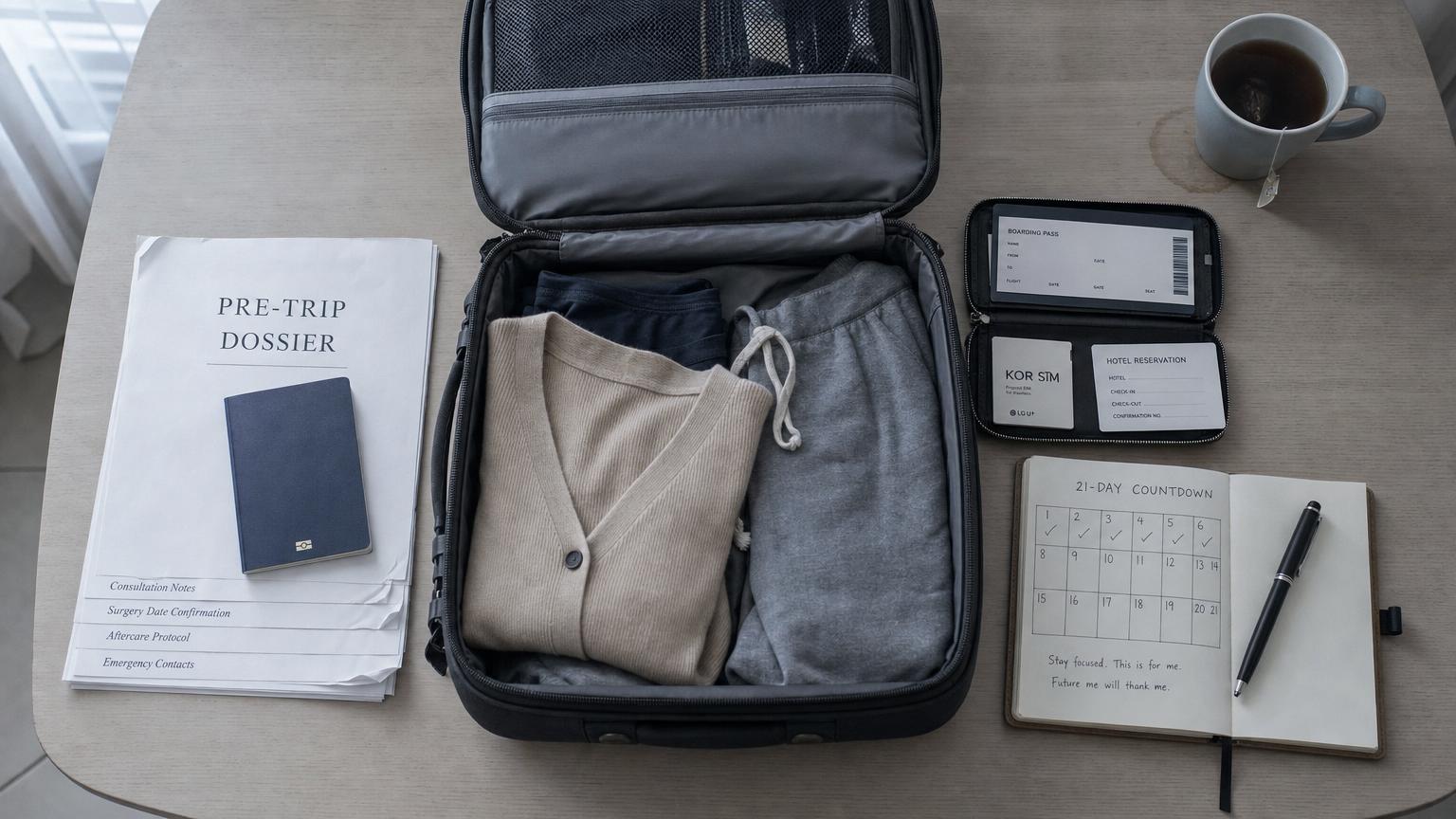
The 21 days before a Korean plastic surgery trip determine almost as much as the surgery itself. Foreign patients tend to focus heavily on choosing the clinic and the procedure, then treat the pre-trip preparation window as logistical detail to handle in the final few days before departure. This is the single most consistent preparation mistake in Korean medical tourism, and it surfaces as a measurable cluster of arrival-day surgery delays, cancellations, and compromised outcomes. Korean clinics including Link Plastic Surgery and many others in the Gangnam and Sinnonhyeon districts maintain detailed pre-trip protocols for foreign patients, but the burden of executing those protocols rests with the patient. This guide covers the six categories of preparation that foreign patients should complete in the 21 days before a Korean plastic surgery trip — documentation, medication stop windows, pre-consultation preparation, travel logistics, insurance coverage, and post-operative return planning. Each category is independently checkable. None of them are optional.
Why Pre-Trip Prep Matters as Much as the Surgery Itself
The framing many foreign patients arrive with — that the trip is logistics and the surgery is the substantive event — does not match how Korean clinics actually operate. Korean surgeons work from a medication-cleared, fully consented, anatomically pre-evaluated baseline that the patient is expected to bring with them on arrival. A patient who arrives without that baseline does not receive an emergency catch-up. The standard protocol is to delay or cancel the surgical date and reschedule for a later trip, often weeks or months later.
The economics of this are unforgiving for foreign patients. A round-trip flight to Seoul, accommodation in Gangnam, and clinic deposit easily total several thousand dollars before the procedure begins. A surgical delay or cancellation means absorbing those costs and rebooking the entire trip. Pre-trip preparation is not an administrative chore — it is the financial protection layer for the entire investment.
Compare this with the Korean Plastic Surgery Clinic Verification: 12-Point Compendium framework, which addresses what the clinic must demonstrate to the patient before booking. The two frameworks are sister documents. Verification is what the patient checks on the clinic side. Pre-trip preparation is what the clinic expects the patient to check on the patient side. Both must be complete for the surgical date to hold.
The 21-day timeline is not arbitrary. It is built around the medical reality of blood-thinning medication clearance (14 days for aspirin and most NSAIDs to clear the platelet system), Korean medical visa processing windows where applicable (4-6 weeks for some nationalities, which itself starts before the 21-day window), and the practical timeline for a pre-operative video consultation, document gathering, and travel logistics. Compressing the 21 days into 7 or 10 days because the patient confirmed the surgical date late is possible in some cases but introduces risk that the clinic is not obligated to absorb.
Two categories of foreign patient consistently underestimate the preparation window. The first is the patient making a second or third Korean plastic surgery trip — having succeeded once, they assume the preparation can be lighter the second time. It cannot. Medication exposure and supplement use may have changed since the previous trip. The second category is the patient booking a “small” procedure — a petit aesthetic injection, a laser session — and treating it as low-stakes compared to surgery. Petit aesthetic procedures have their own medication and supplement interaction profiles, particularly with anti-aging supplements and skin-active topicals, and surgeons routinely reschedule petit aesthetic appointments for patients who arrive on retinoids or active acne medications without disclosure.
Documentation and Medication Stop List — The 14-Day Window
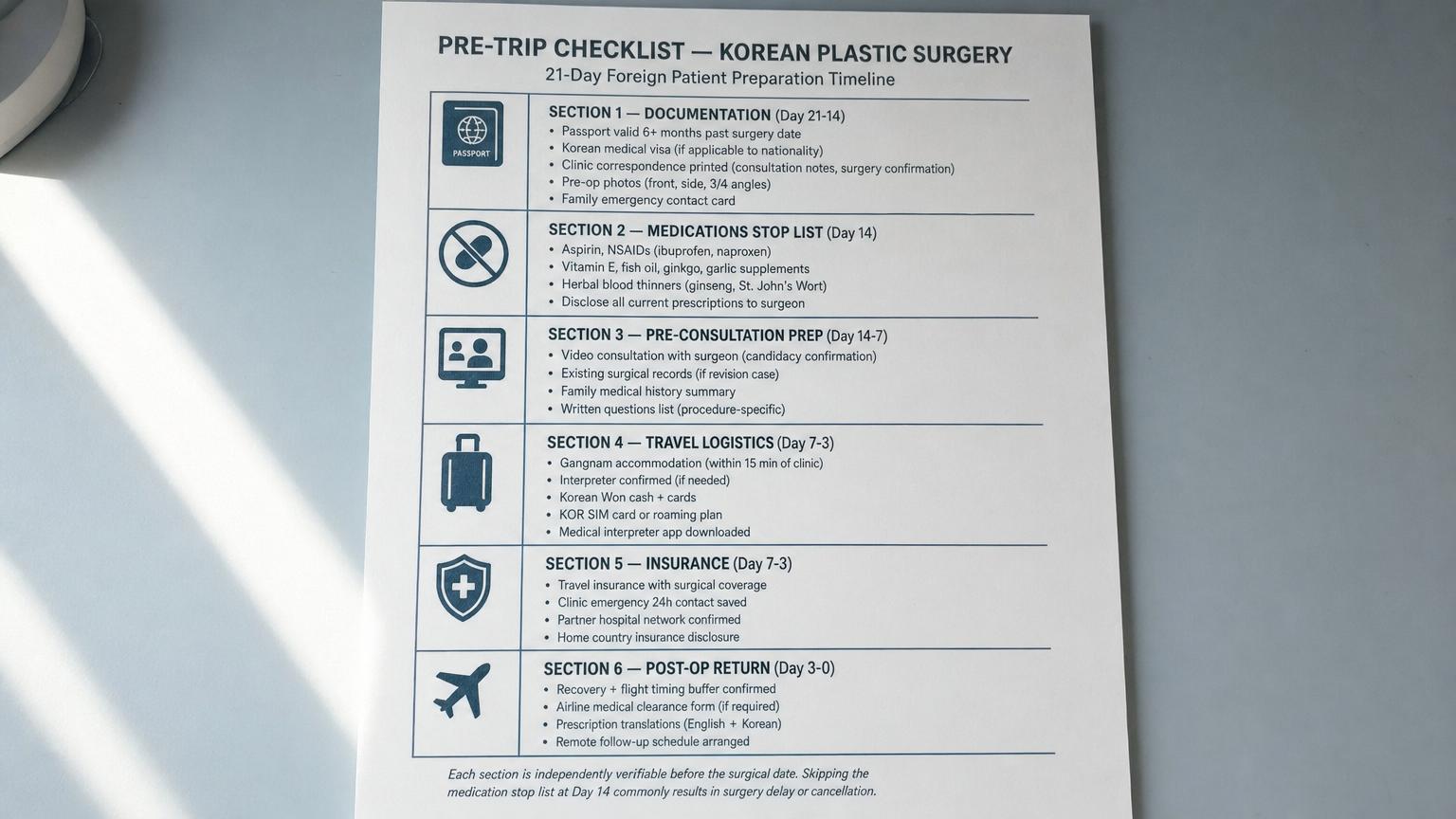
Documentation preparation happens in the first week of the 21-day window. Five documents form the core of the foreign patient travel dossier, and each has a verifiable deadline.
Passport and Visa Documentation
The first verification is passport validity. Korean entry requires a passport valid for at least 6 months past the planned departure date from Korea. A patient with 4 months of passport validity on the day of arrival will be refused entry, regardless of any clinic appointment confirmed. Renew the passport before the 21-day window if the validity is approaching this threshold.
The second verification is visa category. Korean visa-waiver agreements (K-ETA for most Western nationalities, visa-free entry for others, and formal visa requirements for the remainder) determine whether a Korean medical visa application is required. Foreign patients whose nationality requires a medical visa (C-3-3 for short-term medical procedures, G-1-10 for longer-term medical stays) should start the visa application at least 6 weeks before departure, which means the visa step actually precedes the 21-day window for those patients. Ask the clinic’s international coordinator which visa category applies to your nationality, and request the supporting clinic documentation (treatment plan, surgical date, accommodation confirmation, financial responsibility letter) at least 4 weeks before departure.
Clinic Correspondence Documentation
The third documentation category is the clinic correspondence packet. The patient should arrive in Seoul with a printed copy of all clinic communication — initial consultation notes, surgical date confirmation, treatment plan, pre-op instructions, accommodation arrangements, and emergency contact information. This is not optional. Mobile-phone-only documentation fails when the phone is unavailable (medication-induced grogginess on surgery day, lost phone, dead battery during taxi from hotel to clinic). Print everything. Keep the printed dossier with the passport.
Pre-Operative Photography
The fourth documentation category is pre-operative photography. Foreign patients should arrive with their own pre-op photos taken in consistent lighting from front, left 3/4, right 3/4, and profile angles. These photos serve two purposes: they allow the surgeon to confirm the planned procedure against the patient’s anatomy in advance (via video consultation), and they provide the baseline for evaluating the result post-surgery. Patients who rely on the clinic’s day-of pre-op photos as their only baseline have lost the ability to evaluate the result against the conditions that motivated the surgery in the first place.
Family Emergency Contact Card
The fifth documentation category is the family emergency contact card. A printed card listing two family members (full name, relationship, phone number with country code, email, and time zone) and one home-country physician (name, clinic, phone) should be in the patient’s passport pouch and a duplicate copy with the clinic on file. The clinic uses this information only in emergency situations — but emergency situations are exactly when phone-based contact lookup fails. Print it.
The Medication Stop List — The Single Highest-Stakes Pre-Trip Item
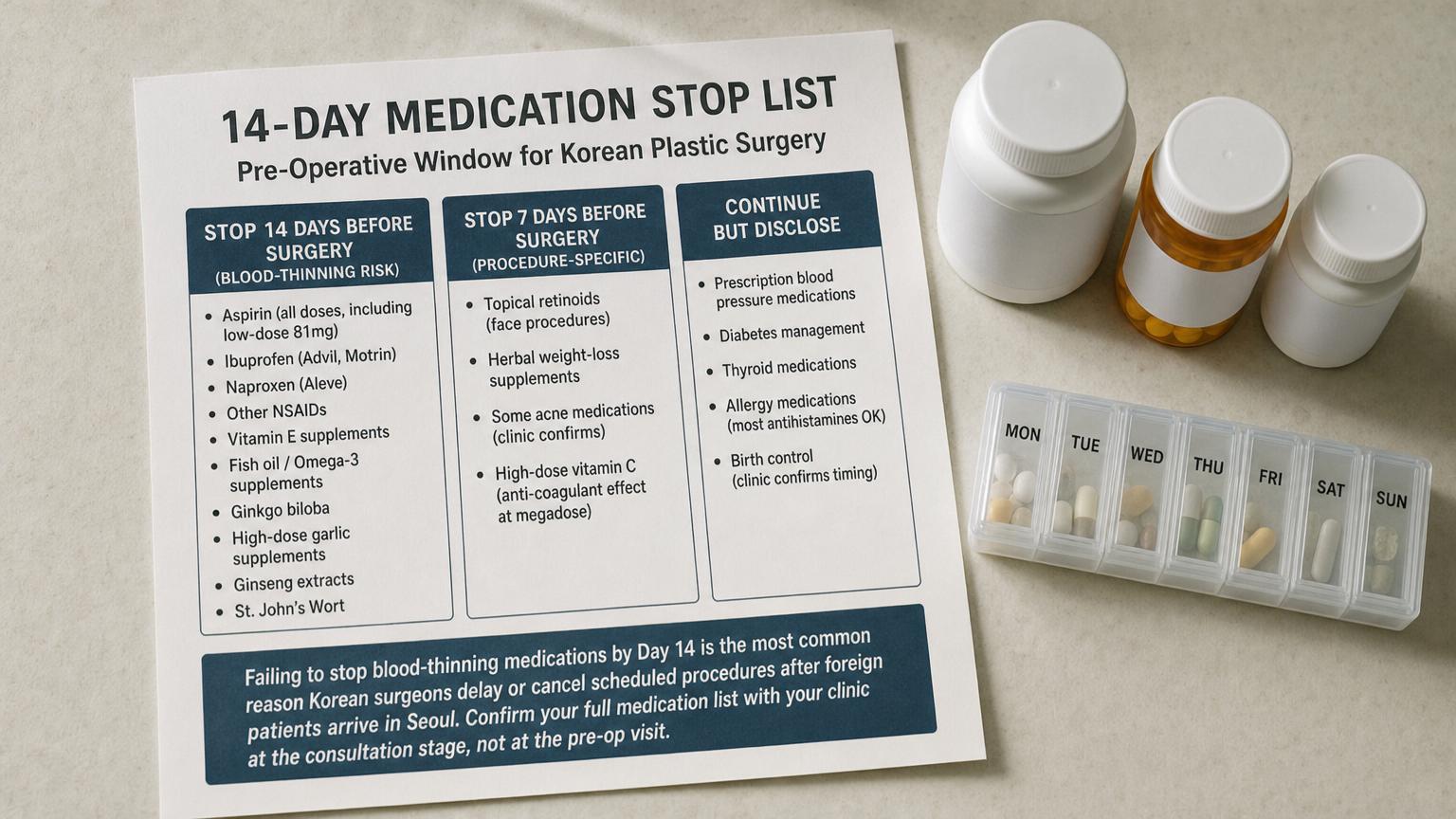
The medication stop list deserves its own section because it is the single most common cause of arrival-day surgical delay among foreign patients. The mechanism is platelet inhibition. Aspirin, NSAIDs, and several supplement categories inhibit platelet function for approximately 7-14 days after the last dose. A patient who arrives in Seoul having taken ibuprofen 3 days earlier presents with elevated bleeding risk during surgery, and Korean surgeons routinely delay the procedure rather than accept that risk.
The 14-day blood-thinning stop list:
- Aspirin — all doses, including low-dose 81mg cardio aspirin
- Ibuprofen (Advil, Motrin) — all OTC and prescription doses
- Naproxen (Aleve) — all OTC and prescription doses
- Other NSAIDs — diclofenac, meloxicam, celecoxib (consult prescribing physician before stopping prescription NSAIDs)
- Vitamin E supplements — particularly high-dose
- Fish oil and omega-3 supplements
- Ginkgo biloba
- High-dose garlic supplements (cooking garlic in food is fine)
- Ginseng extracts (Korean and American ginseng)
- St. John’s Wort
The 7-day procedure-specific stop list:
- Topical retinoids — for facial procedures, retinol and prescription tretinoin should pause
- Herbal weight-loss supplements — many contain stimulants and cardiovascular effects
- Some acne medications — the clinic confirms based on the specific medication
- High-dose vitamin C — megadose vitamin C has mild anti-coagulant effects
The continue-but-disclose category includes prescription blood pressure medications, diabetes management, thyroid medications, most antihistamines, and birth control. The patient does not stop these without consulting the prescribing physician, but every prescription medication must be disclosed to the Korean clinic during the consultation phase. The clinic determines whether any interaction with anesthesia or the planned procedure requires adjustment.
The most important rule: disclose every medication and supplement to the Korean clinic during the consultation stage, not on arrival. Patients who mention an aspirin dose only at the pre-op visit on the day before surgery routinely face a 14-day delay. The same disclosure made at the consultation, 3-4 weeks before the surgical date, allows planning around the stop window without disrupting the trip.
Pre-Consultation Preparation — Owning the Video Consultation
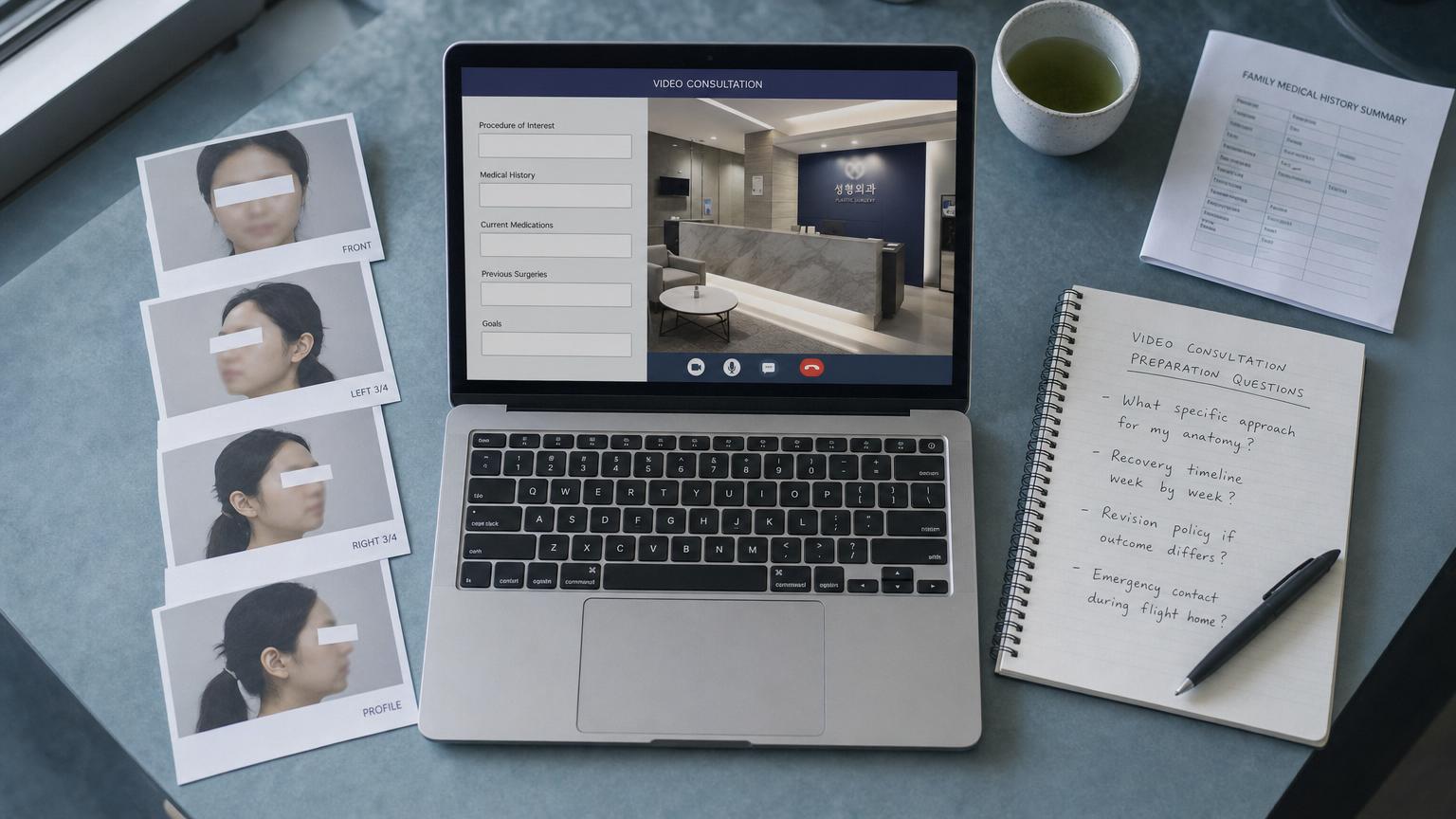
The pre-operative video consultation is the single most underused tool in Korean medical tourism preparation. Most Korean aesthetic clinics offer free or low-cost video consultations to foreign patients, conducted in English (or a major translated language) with the surgeon who will perform the procedure. A patient who skips the video consultation and books surgery on the basis of an English-language website and a coordinator’s email exchange is taking on substantial avoidable risk.
Recommended for Your Recovery
Products commonly used before and after Korean plastic surgery pre trip checklist — same items routinely recommended in the recovery instructions Seoul clinics hand out at discharge.
- Beauty of Joseon Relief Sun SPF 50+ — Korean SPF 50+ — universal aftercare staple across every procedure category covered in this guide. Check price on Amazon
- COSRX Advanced Snail 96 Mucin Power Essence — Korean skin barrier essence used widely in Seoul post-procedure aftercare routines. Check price on Amazon
- Arnica Montana Tablets — general bruising support — pack 1 bottle in your pre-trip kit regardless of procedure type. Check price on Amazon
- Silicone Scar Sheets — general scar support sheets — useful if any of your scheduled procedures include incision work. Check price on Amazon
As an Amazon Associate, GlobalBeautySpot earns from qualifying purchases at no extra cost to you.
What the Video Consultation Accomplishes
A 20-30 minute video consultation 7-14 days before departure accomplishes four things that no other preparation step can replicate.
First, it confirms candidacy. The surgeon evaluates the patient’s anatomy through video and pre-op photos, and confirms that the planned procedure is suitable. Foreign patients who arrive in Seoul to discover that the procedure they expected cannot be performed as planned (because the anatomy does not support it, because a different procedure would produce a better outcome, or because a revision case is more complex than initially scoped) face an immediate decision: change the plan in 24 hours or cancel and reschedule. The video consultation surfaces these issues with weeks of margin instead of hours.
Second, it allows the surgeon to communicate pre-op instructions in real-time with English-language clarification. Korean clinics send pre-op instruction PDFs to foreign patients, and these PDFs are accurate but sometimes ambiguous when translated. A real-time video conversation in which the surgeon explains the medication stop list, fasting protocol, hair washing schedule, and any procedure-specific instructions removes ambiguity that PDF text cannot resolve.
Third, it gives the patient the chance to ask procedure-specific clinical questions while still able to switch clinics. The question “How does the surgeon decide between transconjunctival and subciliary lower blepharoplasty for my anatomy?” produces a fundamentally different answer from a director surgeon versus a junior surgeon, and the video consultation is when the patient learns which kind of surgeon they actually booked. If the answer is unsatisfactory, the patient has time to switch.
Fourth, it generates a written consultation summary that the patient carries into the in-person consultation. Continuity matters. A patient who arrives in Seoul with no prior video consultation has to start from zero on the consultation day, ask all the same questions in person, and then either commit or cancel within hours. A patient who arrives with a 14-day-old video consultation summary can compare the in-person consultation against the prior conversation, notice any inconsistencies, and make a measured decision.
The Pre-Consultation Question List
The patient should arrive at the video consultation with a written list of procedure-specific questions. Generic questions like “What is the recovery time?” produce generic answers. Procedure-specific questions produce diagnostic answers.
For surgical procedures, recommended questions include: What approach do you recommend for my specific anatomy, and what alternative approaches did you consider? What is your annual case volume for this specific procedure? What is the timeline of the typical recovery for a patient with my profile? What is your revision policy if the outcome differs from the plan? What is the emergency contact protocol during the first 72 hours post-op? What is the protocol for complications discovered after I return home?
For petit aesthetic procedures, recommended questions include: What product brand do you use and can I see the authorization certificate? What is the session protocol — single session or series? What is the expected onset and duration of the result? What aftercare protocol applies, and what activities should I avoid? What is the revision or follow-up policy?
For revision cases (any second-or-later procedure on the same anatomical area), additional questions include: What is the unique challenge of revising the original procedure given the scar tissue and altered anatomy? What outcome is achievable given the prior procedure’s structural impact? What is the realistic timeline for the revision recovery versus a primary procedure? What is the success rate for revisions of this type?
Family Medical History Summary
The patient should prepare a one-page family medical history summary in advance of the consultation. The summary covers known bleeding disorders, family history of adverse anesthesia reactions, family history of keloid or hypertrophic scarring, and any cardiovascular, thyroid, or autoimmune conditions in the immediate family. Korean surgeons evaluate this history as part of the anesthesia and surgical planning, and the summary should be ready for both the video consultation and the in-person consultation.
Travel Logistics, Insurance, and Recovery Return Planning
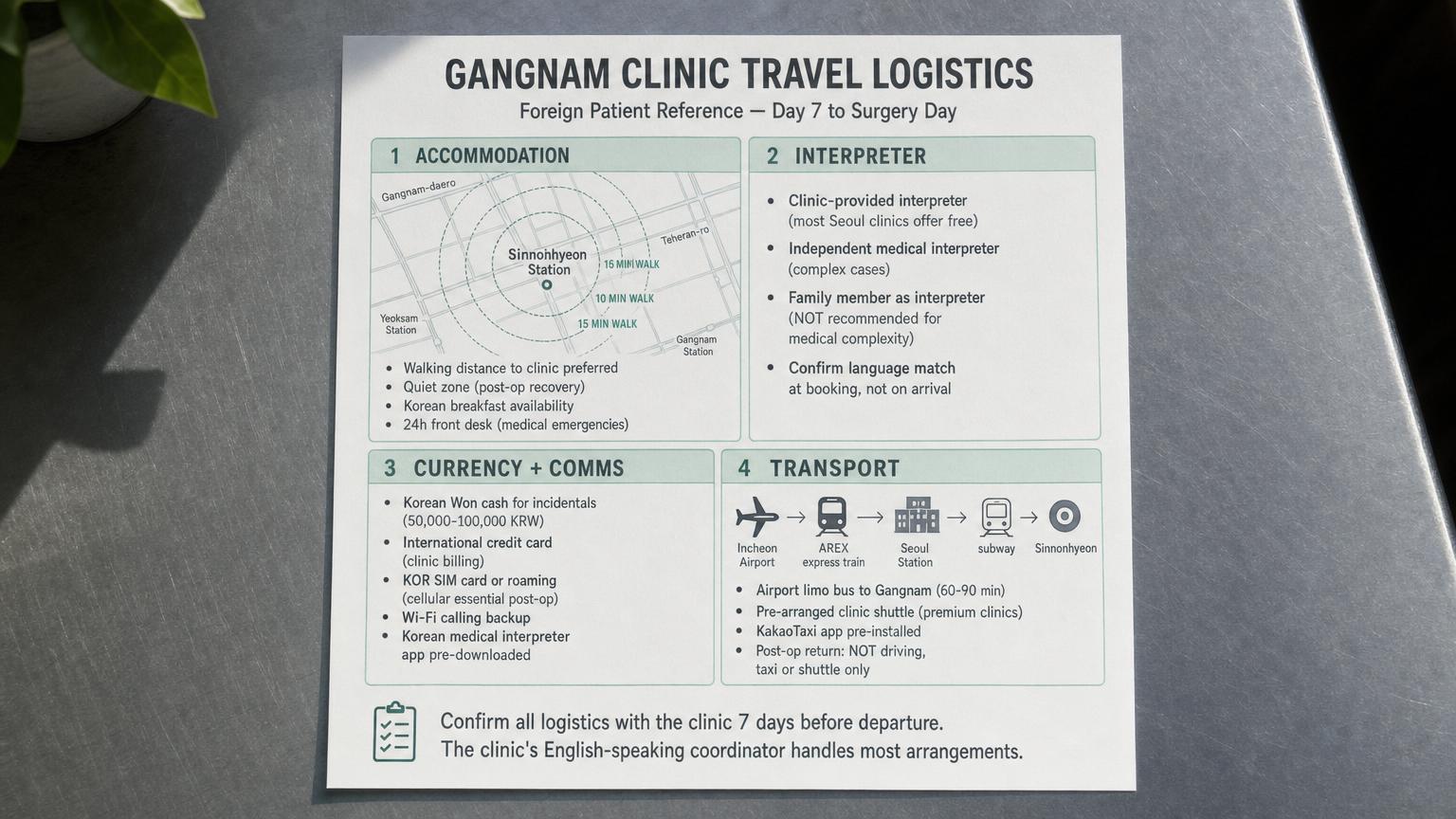
Travel logistics span the final 7 days before departure. Most logistics are simple but cumulative — small omissions stack into avoidable stress on arrival.
Accommodation Selection
Accommodation selection should optimize for distance to the clinic, not cost or hotel brand. Foreign patients recovering from any meaningful procedure (eye surgery, rhinoplasty, body procedures) should be within a 5-15 minute walk or short taxi ride from the clinic for post-op visits. A patient staying in Itaewon or Hongdae who has to navigate the Seoul subway system the day after rhinoplasty is solving a logistics problem at the worst possible time.
Specific accommodation criteria for foreign post-op patients:
- Walking distance or short taxi distance to the clinic (within 1.5 km / under 15 minutes)
- Quiet zone — Gangnam has both quiet residential streets and noisy entertainment streets; specify quiet
- Room service or Korean breakfast availability — the patient may not feel comfortable navigating restaurants on the first 2-3 post-op days
- 24-hour front desk staff — for medical emergencies, language barriers, transport requests
- Soft pillows and a slightly elevated bed angle option — particularly relevant for facial procedures
- Air conditioning and humidity control — Korean summers and winters have extreme conditions that affect healing
Many Seoul aesthetic clinics maintain partnership relationships with specific hotels and serviced apartments in the Sinnonhyeon area. Ask the clinic’s international coordinator for their recommended accommodation list, which typically includes properties that have hosted foreign patients before and have staff trained on post-op patient needs.
Interpreter Arrangement
Most Seoul clinics serving foreign patients provide English-language interpretation as part of the consultation and surgical day. Some provide additional translated languages (Mandarin, Japanese, Thai, Vietnamese, Russian, Arabic). Patients should confirm the interpreter language match at booking, not on arrival.
For complex consultations involving revision surgery, family medical history disclosures, or anesthesia planning, an independent medical interpreter (booked separately from the clinic’s interpreter) may be worth considering. The clinic’s interpreter is a clinic employee whose loyalty is to the clinic. An independent interpreter serves the patient. For routine cases this is excessive; for complex cases it can be valuable.
Family member as interpreter is not recommended for medical complexity. A family member may have language fluency but lacks medical vocabulary, and the loss of nuance in conveying procedural details, risk discussions, and aftercare instructions is meaningful. Family members are excellent companions but unreliable medical interpreters.
Currency, Communications, and Apps
Carry approximately 50,000-100,000 KRW in cash for incidentals (taxi, meals, pharmacy purchases for over-the-counter items the clinic recommends). Major Korean credit card networks accept international cards, but small purchases sometimes default to cash-only.
A Korean SIM card or roaming plan with reliable data is essential. Post-op patients depend on mobile data for clinic communication, taxi apps, translation apps, and emergency contact. Wi-Fi-only is not acceptable. Korean SIM card vendors at Incheon Airport sell prepaid SIMs for the trip duration. Alternatively, eSIM providers offer Korea-specific data plans that can be activated before departure.
Pre-install the following apps before departure: KakaoTaxi (Korean equivalent of Uber, dominant in Seoul), KakaoMap or Naver Map (Google Maps is functional but Korean apps offer better local data), Papago or Google Translate with Korean offline pack downloaded, a Korean medical interpreter app (several exist, the clinic typically recommends one), and the clinic’s own app or chat platform (KakaoTalk is dominant in Korea, but some clinics use WhatsApp or proprietary platforms for international patients).
Transport from Airport to Gangnam
The standard route from Incheon Airport to Sinnonhyeon (where many Gangnam clinics are located) is approximately 60-90 minutes by airport limousine bus or 75-105 minutes by AREX express train + subway. Premium clinics arrange a clinic shuttle from the airport for an additional fee. For a post-op return trip to the airport, taxi or pre-arranged shuttle is essential — driving or navigating public transit alone after a procedure is not appropriate.
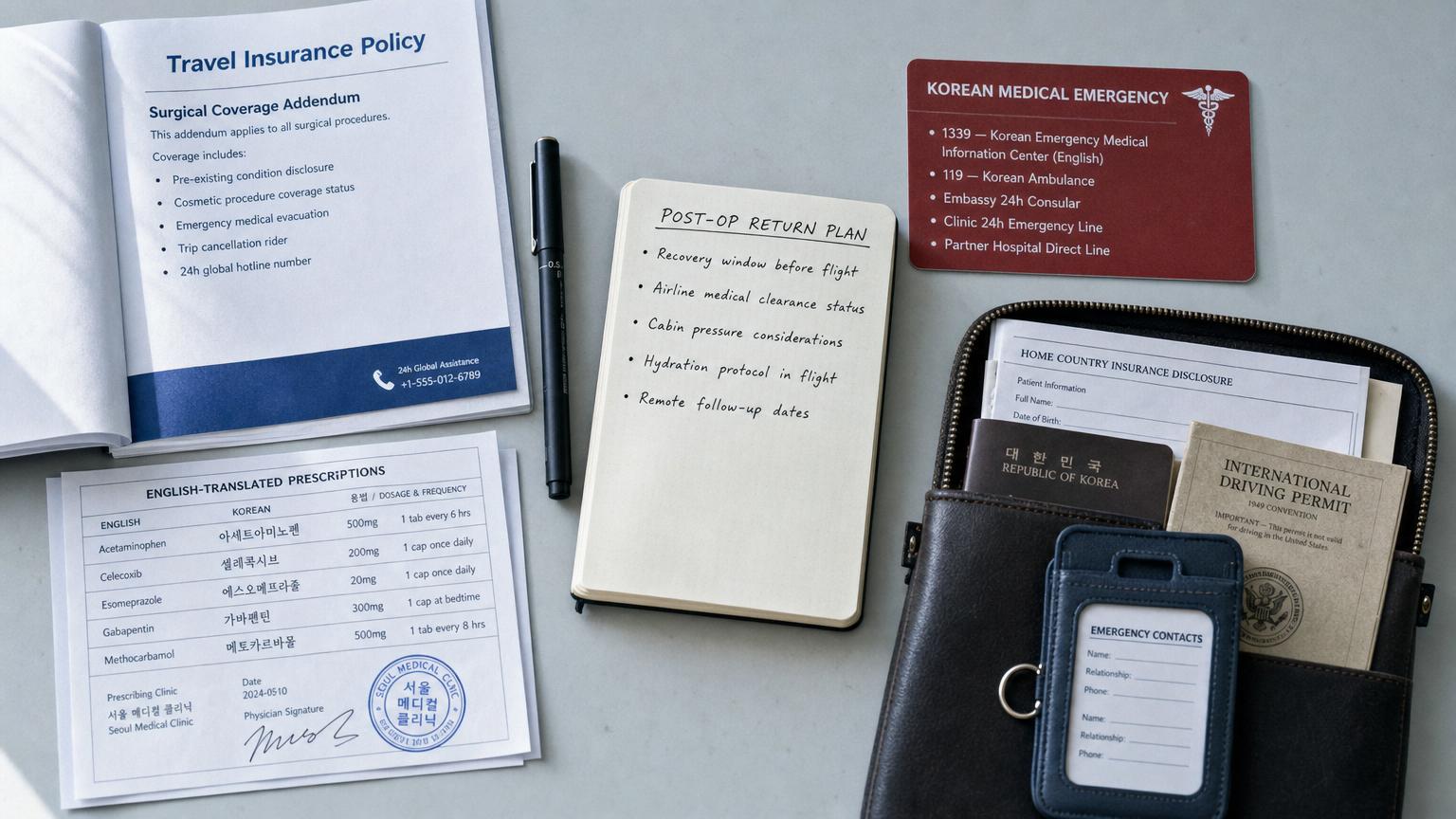
Insurance Coverage — Three Layers
Insurance coverage matters more than foreign patients typically anticipate. Three separate insurance layers apply.
Layer 1: Home-country health insurance. Most home-country insurance does not cover elective cosmetic procedures performed abroad. Some plans cover emergency complications during international travel. Some plans cover return-flight repatriation in medical emergencies. Confirm in writing before departure what your home-country insurance covers and what it excludes for Korean cosmetic procedures.
Layer 2: Travel insurance with surgical or medical tourism rider. Several insurance providers offer travel insurance with surgical coverage riders specifically for medical tourism patients. These typically cover trip cancellation due to medical reasons, emergency medical evacuation, and sometimes complications from the planned procedure. Cosmetic surgery is frequently excluded — read the fine print carefully. Reputable medical tourism travel insurance providers explicitly cover the planned procedure and its complications; less reputable providers exclude the planned procedure under “elective cosmetic” exclusion language. The price difference is usually small; the coverage difference is meaningful.
Layer 3: The Korean clinic’s malpractice insurance and complications coverage. The Korean clinic carries its own malpractice insurance, and many clinics also carry complications coverage that handles routine post-op complications (delayed healing, minor revision needs, common side effects) without additional patient cost. Confirm the carrier name and coverage scope with the clinic at the consultation stage. Foreign patients have limited legal recourse for procedures performed abroad, so the clinic’s own insurance is often the only practical safety net for complications that surface during the trip.
Emergency Contact Setup
Save the following emergency contacts in your phone and on a printed card carried in your passport pouch:
- 1339 — Korean Emergency Medical Information Center, English-language support available
- 119 — Korean ambulance and fire emergency
- Your embassy’s 24-hour consular line — varies by country
- Clinic 24-hour emergency line — provided by the clinic at booking
- Partner hospital direct line — for any hospital your clinic transfers to in emergencies
- Two family members in your home country — with country codes
- Your home-country physician — for medical history coordination
Post-Op Return Flight Planning
Recovery-to-flight timing varies sharply by procedure category, and patients consistently underestimate the window required.
Petit aesthetic procedures (Rejuran, Exosome, Juvelook, lip filler, laser toning, skin booster series): typically allow same-day or next-day return travel. The procedures are non-surgical and recovery does not interact significantly with cabin pressure or sitting position.
Eye surgery procedures (double eyelid, blepharoplasty, ptosis correction): require 5-7 days minimum before flight. Stitch removal typically happens at Day 5-7. Flying before stitch removal is possible but adds complications (dryness, eye strain, swelling exacerbation). The standard recommendation is to schedule the return flight for Day 7-10.
Rhinoplasty procedures (primary, revision, alar reduction): require 10-14 days minimum before flight. Cast removal happens at Day 5-7. Cabin pressure changes during the first 14 days can affect swelling and healing. Some surgeons specifically recommend 14 days minimum. International rhinoplasty patients commonly schedule a 2-week trip with surgery on Day 1-2 and return flight at Day 14-15.
Body procedures (liposuction, breast augmentation, tummy tuck, belly button surgery): require 14-21 days minimum before flight. Surgical drains may be in place for 5-10 days. Compression garments require careful management. Deep vein thrombosis (DVT) risk during long-haul flights is meaningful within the first 14 days post-op, and pre-flight DVT prophylaxis may be recommended. The clinic provides a fitness-to-fly assessment before discharge.
Add a 2-3 day buffer to whatever the clinic recommends as the minimum recovery-to-flight window. Recovery is variable. A patient who books the return flight at the absolute minimum window and then experiences slower-than-expected healing faces a stressful choice between flying earlier than the surgeon recommends or paying flight change fees on short notice.
Airline Medical Clearance
Most major international airlines (Korean Air, Asiana, the major US, EU, and Middle Eastern carriers, and most Asian regional carriers) require medical clearance for passengers within 10 days of surgery involving general or IV anesthesia. The clearance process is straightforward — the clinic completes a standard MEDIF form or equivalent, and the airline reviews. Submit the MEDIF at least 7 days before flight to allow processing time. Flying without required medical clearance, when the airline becomes aware of the recent surgery, can result in denied boarding.
Prescription Translation
The clinic should provide a bilingual prescription list at discharge — English drug names + Korean drug names + dosage + frequency, signed and stamped by the prescribing physician. Carry this list with the prescriptions themselves. Korean opioid pain medications and some controlled substances may require additional documentation for import into certain home countries; the clinic and your home-country customs office can clarify what additional documentation applies.
Remote Follow-Up Scheduling
Before departure from Seoul, schedule remote follow-up consultations with the surgeon. Standard follow-up cadence is Week 1, Week 2, Week 4, Week 8, and Month 6 — but many Korean clinics offer flexibility for international patients to coordinate remote follow-ups via video call. Schedule these in advance, ideally before leaving Korea, so the clinic and the patient both have a structured post-op contact plan that does not depend on the patient remembering to initiate contact during the recovery period.
Common Pre-Trip Mistakes Foreign Patients Make
Pattern recognition across thousands of foreign patient arrivals in Seoul each year converges on a consistent list of pre-trip mistakes. None of these mistakes are catastrophic individually. Most can be recovered from. But each adds friction, cost, or risk to the trip, and avoiding them entirely is the simplest preparation strategy.
Mistake 1 — Skipping the Video Consultation
The single most common preparation mistake is treating the video consultation as optional. Foreign patients book a clinic based on website research and coordinator email exchange, and arrive in Seoul with no prior surgeon contact. The in-person consultation then has to do the work of both consultation and surgical planning, with the patient under time pressure to commit to a surgical date. Patients who completed a video consultation 7-14 days earlier arrive at the in-person consultation already aligned with the surgeon, with substantive questions resolved, and able to make a measured commitment decision.
Mistake 2 — Treating the Medication Stop List as Optional
The second most common mistake is partial compliance with the 14-day medication stop list. Patients stop the aspirin and the ibuprofen but continue the fish oil “because it is just a supplement.” Korean surgeons treat these the same way — as blood-thinning agents requiring 14-day clearance. Partial compliance leads to surgery delays at the same rate as no compliance.
Mistake 3 — Not Disclosing Current Prescriptions
Patients sometimes withhold disclosure of prescription medications, particularly those they consider personal (mood disorder medications, hormonal medications, weight management medications). The Korean clinic needs full medication disclosure to plan around anesthesia and surgical safety. Non-disclosure is a safety risk that can surface only during surgery, by which point the surgical plan is already in motion.
Mistake 4 — Booking the Return Flight Too Soon
Foreign patients consistently underestimate the recovery-to-flight window. Patients book the return flight at the absolute minimum recommended window without buffer, and then face a stressful choice when recovery is slower than expected. Rhinoplasty patients trying to fly home at Day 10 instead of Day 14 are the most common case, but body procedure patients trying to fly at Day 14 instead of Day 21 are equally common. Add 2-3 days of buffer.
Mistake 5 — Skipping Travel Insurance
Foreign patients sometimes skip travel insurance for cosmetic procedures, assuming the clinic’s own coverage is sufficient. Travel insurance handles trip cancellation, lost luggage with prescriptions inside, and emergency medical evacuation — none of which the clinic’s malpractice insurance covers. The cost of a basic travel insurance policy for a 2-week Korea trip is modest. The cost of a cancelled trip without insurance is the full deposit and non-refundable flights.
Mistake 6 — Not Printing the Clinic Correspondence
Mobile-phone-only documentation fails predictably in the post-op window. The patient on Day 1 post-rhinoplasty does not want to navigate phone screens to find consultation notes. The patient with a dead phone battery in a taxi from hotel to clinic for a follow-up cannot reference the address. Print everything. Carry the printed dossier with the passport.
Mistake 7 — Underestimating Companion Need for Body Procedures
Foreign patients booking body procedures (breast augmentation, liposuction, tummy tuck) sometimes travel alone, assuming a strong recovery profile. Body procedures with limited mobility, surgical drains, and compression garment management benefit substantially from a designated companion for the first 5-7 days. The cost of bringing a companion is modest compared to the cost of struggling alone in an unfamiliar country during early recovery.
Mistake 8 — Not Asking the Clinic About Airline Medical Clearance
Patients sometimes discover at airport check-in that the airline requires medical clearance for the planned return flight. The MEDIF process takes several days and cannot be completed at the gate. Ask the clinic about airline medical clearance requirements at the consultation stage. The clinic typically handles the paperwork as part of standard pre-flight discharge documentation.
Mistake 9 — Assuming the Coordinator Owns Logistics
Korean clinic coordinators are excellent at handling clinic-side logistics (accommodation recommendations, interpreter scheduling, surgical date confirmation, pre-op instructions). They are not the patient’s general travel agent. Passport validity, home-country medication disclosures, airline medical clearance, return flight booking, and insurance coordination are the patient’s responsibility. Patients who assume the coordinator owns all logistics end up with gaps that surface late.
Mistake 10 — Treating Petit Aesthetic Procedures as Casual
Patients booking petit aesthetic procedures (Rejuran, Exosome, Juvelook, lip filler, laser toning) sometimes treat the trip as casual — minimal preparation, no medication review, no video consultation. Petit aesthetic procedures have their own medication and supplement interaction profiles, particularly with anti-aging supplements and topical actives. Surgeons reschedule petit aesthetic appointments at meaningful rates when patients arrive on retinoids, on active acne medications, or with undisclosed supplement regimens. Petit aesthetic preparation is lighter than surgical preparation, not absent.
Recovery From Common Mistakes
If any of these mistakes have already happened — partial medication stop, late visa application, no travel insurance, return flight booked too soon — the recovery is the same in every case: disclose immediately to the clinic and adjust the plan. Korean clinics are experienced with foreign patient logistical gaps. A patient who discloses a medication compliance gap 5 days before the surgical date can sometimes still complete the surgery on schedule (depending on the specific medication and the planned procedure). A patient who discloses the same gap on the morning of surgery rarely can. Disclosure timing determines whether a mistake costs a few days of adjustment or the entire trip.
Cross-Reference to Procedure-Specific GBS Articles
The pre-trip framework above is general. The procedure-specific articles below explain how each preparation point applies to specific Korean procedures, with procedure-specific recovery timelines and medication considerations.
Eye Surgery Procedures
Korean double eyelid surgery — incision vs non-incision, Tear trough vs eye bag — which Korean surgery applies, Under-eye fat repositioning recovery, Upper eyelid fat removal, Comprehensive blepharoplasty, Epicanthoplasty inner corner.
Rhinoplasty Procedures
Korean rhinoplasty — Asian and Western noses, Revision rhinoplasty for foreign patients, Korean alar reduction, Rhinoplasty 1-month recovery, Korean rhinoplasty overview.
Body and Breast Procedures
Korean breast augmentation Mentor, Korean umbilicoplasty 4 belly button types, Korean liposuction micro cannula, Elastic tummy tuck postpartum.
Petit Aesthetic Procedures
Korean Rejuran skin booster, Korean Exosome therapy, Korean Juvelook PLLA, Korean Lip Rejuran PN, Korean lip filler Restylane Kysse.
Laser and Energy Procedures
Korean Ultherapy verify Merz, Korean Fraxel Dual verify Solta, Korean Volnewmer monopolar RF, Korean Accento dual wavelength, Korean CO2 mole and spot removal.
Sister Framework
The patient-side preparation in this article is one half of a two-part framework. The clinic-side verification framework is documented in Korean Plastic Surgery Clinic Verification: 12-Point Compendium for Foreign Patients. Both should be complete before deposit.
Patient-Specific Cross-Cuts
Korean plastic surgery for men, Korean facial procedures overview, Korean body procedures overview, Korean petit aesthetic overview, Korean laser and energy procedures overview.
Frequently Asked Questions
When should I start the 21-day pre-trip preparation?
The 21-day window begins on the day you confirm a surgical date with the clinic. Documentation tasks happen between Day 21 and Day 14. Medication stop tasks happen at Day 14. Pre-consultation preparation happens between Day 14 and Day 7. Travel logistics happen between Day 7 and Day 3. Insurance arrangements happen between Day 7 and Day 3. Post-op return planning happens between Day 3 and the day of departure. Patients who confirm a surgical date with less than 21 days notice should compress the timeline carefully and disclose any missed steps to the clinic at the consultation.
Which medications absolutely must stop 14 days before surgery?
Aspirin (all doses, including low-dose 81 mg), NSAIDs (ibuprofen, naproxen, and similar), vitamin E supplements, fish oil and omega-3 supplements, ginkgo biloba, high-dose garlic supplements, ginseng extracts, and St. John’s Wort are the most common 14-day stop categories. The mechanism is platelet inhibition and bleeding risk during surgery. Failing to stop these by Day 14 is the most common reason Korean surgeons delay or cancel scheduled procedures after foreign patients arrive in Seoul. Confirm your full medication and supplement list with the clinic at the consultation stage, not on arrival.
Do I need a Korean medical visa for plastic surgery?
Korean medical visa (C-3-3 for short-term medical, G-1-10 for long-term) requirements depend on nationality and visa-waiver eligibility. Many nationalities can enter Korea visa-free for short stays and undergo medical procedures during that window, while others require a medical visa application supported by clinic-issued documentation. Ask your clinic’s international coordinator which visa category applies to your nationality and procedure length, and start any visa application at least 6 weeks before departure if required.
How long should I stay in Korea after surgery before flying home?
Recovery-to-flight timing varies sharply by procedure category. Petit aesthetic procedures typically allow same-day or next-day return travel. Eye surgery procedures require 5-7 days minimum before flight (stitch removal). Rhinoplasty procedures require 10-14 days minimum (cast removal, swelling stability). Body procedures require 14-21 days minimum before flight (drain removal, compression garment stability, deep vein thrombosis risk management). Confirm the procedure-specific window with your clinic and add a 2-3 day buffer for unexpected recovery variation.
What does a pre-operative video consultation actually accomplish?
A video consultation 7-14 days before departure accomplishes four things. First, it confirms candidacy. Second, it allows the surgeon to communicate medication stop lists, fasting protocols, and any procedure-specific pre-op instructions in real-time, with English-language clarification of complex points. Third, it gives you the chance to ask procedure-specific questions while still able to switch clinics if the answers are unsatisfactory. Fourth, it generates a written consultation summary you can carry into the in-person consultation, ensuring continuity. Skipping the video consultation and booking surgery directly is a documented risk factor for arrival-day cancellation.
Do airlines require medical clearance to fly after Korean plastic surgery?
Most major airlines require medical clearance (MEDIF or similar form) for passengers within 10 days of surgery, particularly surgery involving general or IV anesthesia, abdominal or chest procedures, or any procedure where cabin pressure changes could affect recovery. Rhinoplasty patients flying within 14 days typically need clinic documentation confirming fitness to fly. Body procedure patients often need formal MEDIF clearance. Petit aesthetic and laser-only procedures typically do not require clearance. Confirm with your specific airline at least 7 days before flight and request a clinic-issued fitness-to-fly letter as part of your post-op documentation.
Should I bring a family member as a companion?
Companion guidance varies by procedure category. Petit aesthetic procedures typically do not require a companion. Eye surgery and rhinoplasty benefit from a companion for the first 24-48 hours but do not strictly require one. Body procedures strongly benefit from a companion for the first 5-7 days due to limited mobility, drain management, and compression garment changes. If the procedure involves general anesthesia or significant immobility, most clinics require a designated responsible adult to escort the patient from clinic to accommodation on surgery day.
What insurance coverage should I confirm before departing?
Three separate insurance layers matter. First, your home-country health insurance — typically does not cover elective cosmetic procedures performed abroad, but may cover emergency complications during travel. Second, travel insurance with a surgical or medical tourism rider — covers trip cancellation, emergency medical evacuation, and sometimes complications from the planned procedure. Third, the Korean clinic’s own malpractice insurance and complications coverage — confirm carrier name, coverage limit, and what events trigger coverage.
How do I handle prescription medications during international travel?
Carry all post-operative prescriptions in their original clinic packaging with the pharmacy label intact. Request from the clinic a bilingual prescription list (English drug name + Korean drug name + dosage + frequency) signed and stamped by the prescribing physician — this satisfies most airport security and customs questions. Carry medications in carry-on luggage, not checked bags, to avoid temperature damage and lost-bag risk. Confirm with your home-country customs whether any of the prescribed medications require additional documentation for import.
What is the most common pre-trip mistake foreign patients make?
Across thousands of foreign patient arrivals in Seoul each year, the most common single pre-trip mistake is treating the 21-day preparation window as optional. Patients who confirm a surgical date and then arrive in Seoul without having stopped blood-thinning medications, without a video consultation in advance, without confirmed travel insurance with surgical coverage, or without a sufficient recovery-to-flight buffer routinely face surgery delays, cancellations, or compromised outcomes. The second most common mistake is over-relying on the clinic’s coordinator for logistics that the patient must own personally.
For foreign patients planning surgical or petit aesthetic procedures in Seoul, Link Plastic Surgery’s official website displays English-language pre-trip preparation guidance, surgeon-led video consultation booking, and procedure-specific medication and recovery information organized by category.