Korean Lip Filler with Restylane Kysse: Why Seoul Clinics Treat Lips as Geometry, Not Volume
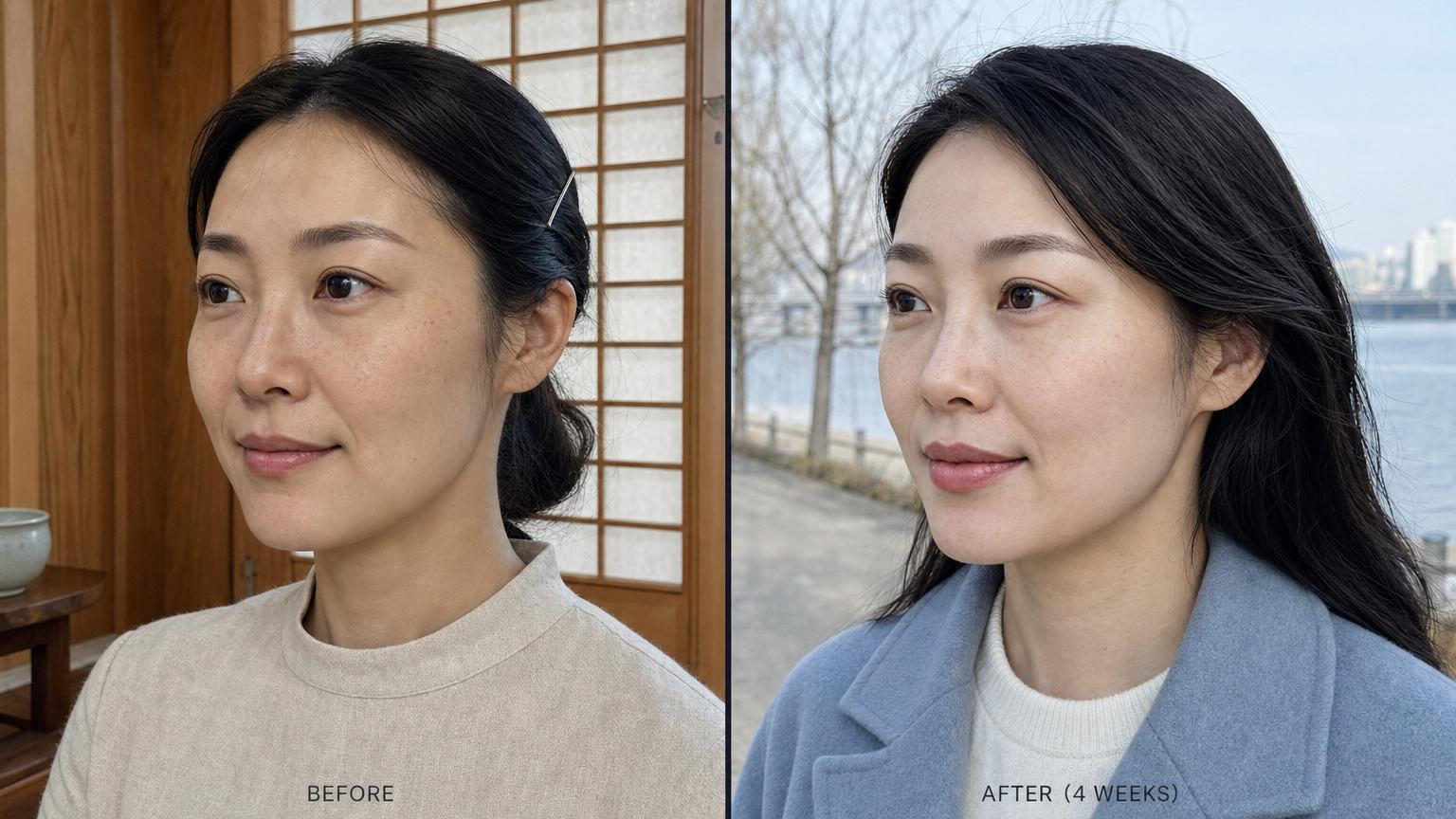
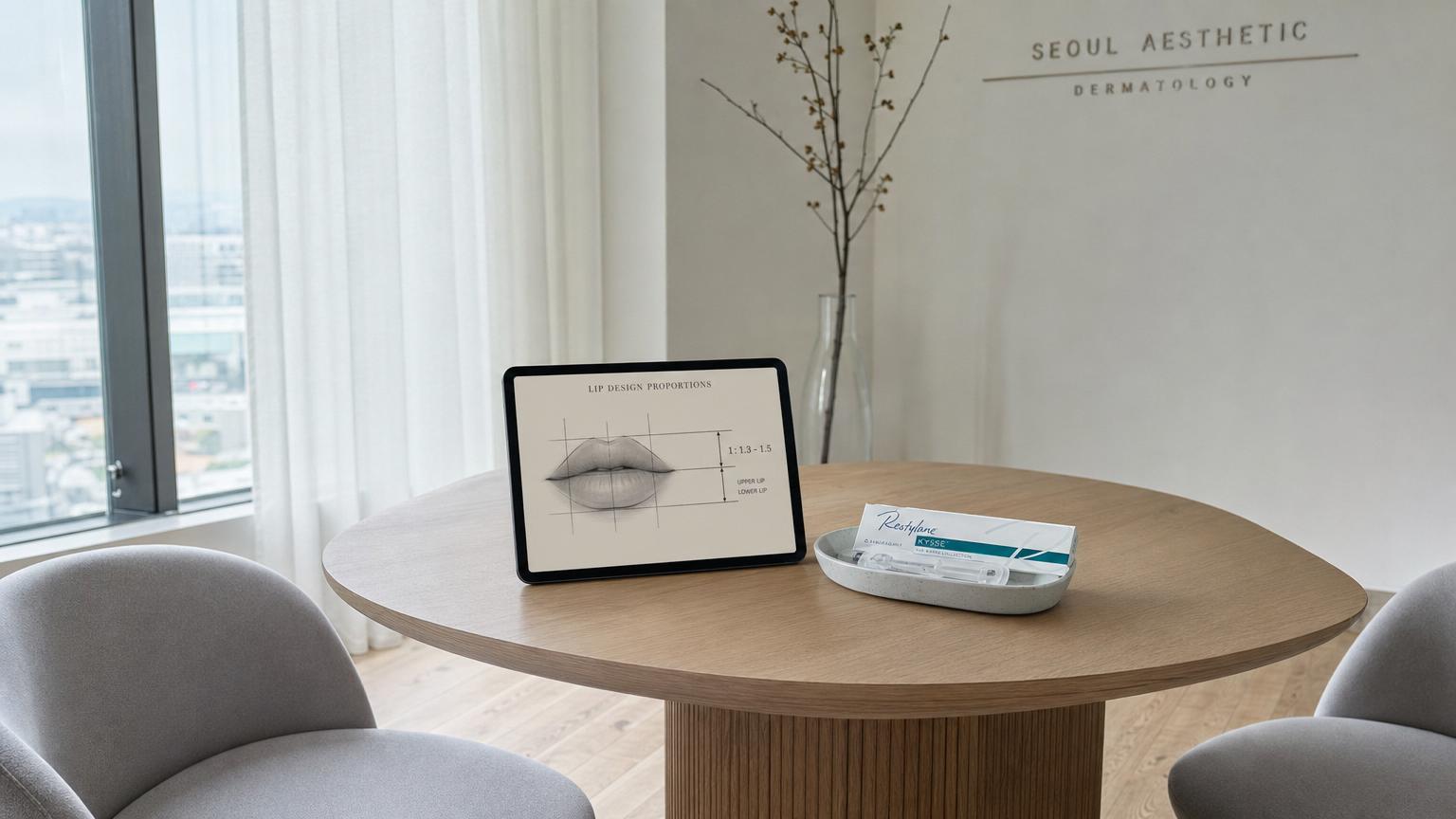
Foreign patients book Korean lip filler expecting the procedure they already understand from home — adding volume to the lips, syringe by syringe, until the lips look fuller. They sit down at the Seoul consultation, the clinician examines the lips for ten minutes, and then redirects the entire conversation. The Korean approach is not about adding volume. It is about geometric design with Restylane Kysse, where upper-to-lower lip ratio (target 1:1.3 to 1:1.5), philtrum column visibility, cupid’s bow apex sharpness, and lateral commissure tension are the four design axes the procedure actually targets. The volume increase is a side effect of the geometry, not the goal. This is why one syringe at Link Plastic Surgery in Seoul typically settles the shape that two or three syringes failed to achieve at the patient’s home clinic — different injection sequence, different design philosophy, and a product (Restylane Kysse) chosen specifically for its ability to move with the face rather than sit like a cushion. This guide explains what Korean lip filler actually targets, why Restylane Kysse is the default HA gel in Seoul aesthetic clinics, how the injection pattern produces sharper geometry from less product, and the realistic timeline foreign patients should plan for from pre-consultation to the settled four-week result.
The Korean shift from volume-first to geometry-first lip filler is not aesthetic preference dressed up as technique. It is a measurable difference in how the lips read on a face from the front, from the side, and during natural animation. The patient who arrives in Seoul with reference photos of Hailey Bieber, Kylie Jenner, or a Russian lift result is asking for a Western or Eastern European aesthetic vocabulary that Korean clinicians can produce technically but generally counsel against, because the underlying facial proportions, the smile mechanics, and the cultural reading of “natural beauty” in Korea all reward proportion over volume. The conversation that follows — the foreign-patient redirect — is where most lip filler frustration happens, and where most of the value of the Korean consultation comes from. Either the patient agrees to design-first work and gets the shape they actually wanted (which often turns out to be different from what the reference photos showed), or the patient insists on volume-first and the Korean clinic declines politely, which is more common than foreign patients expect.
Section 1 — What Korean Lip Filler Actually Targets (And Why It Is Not Volume)
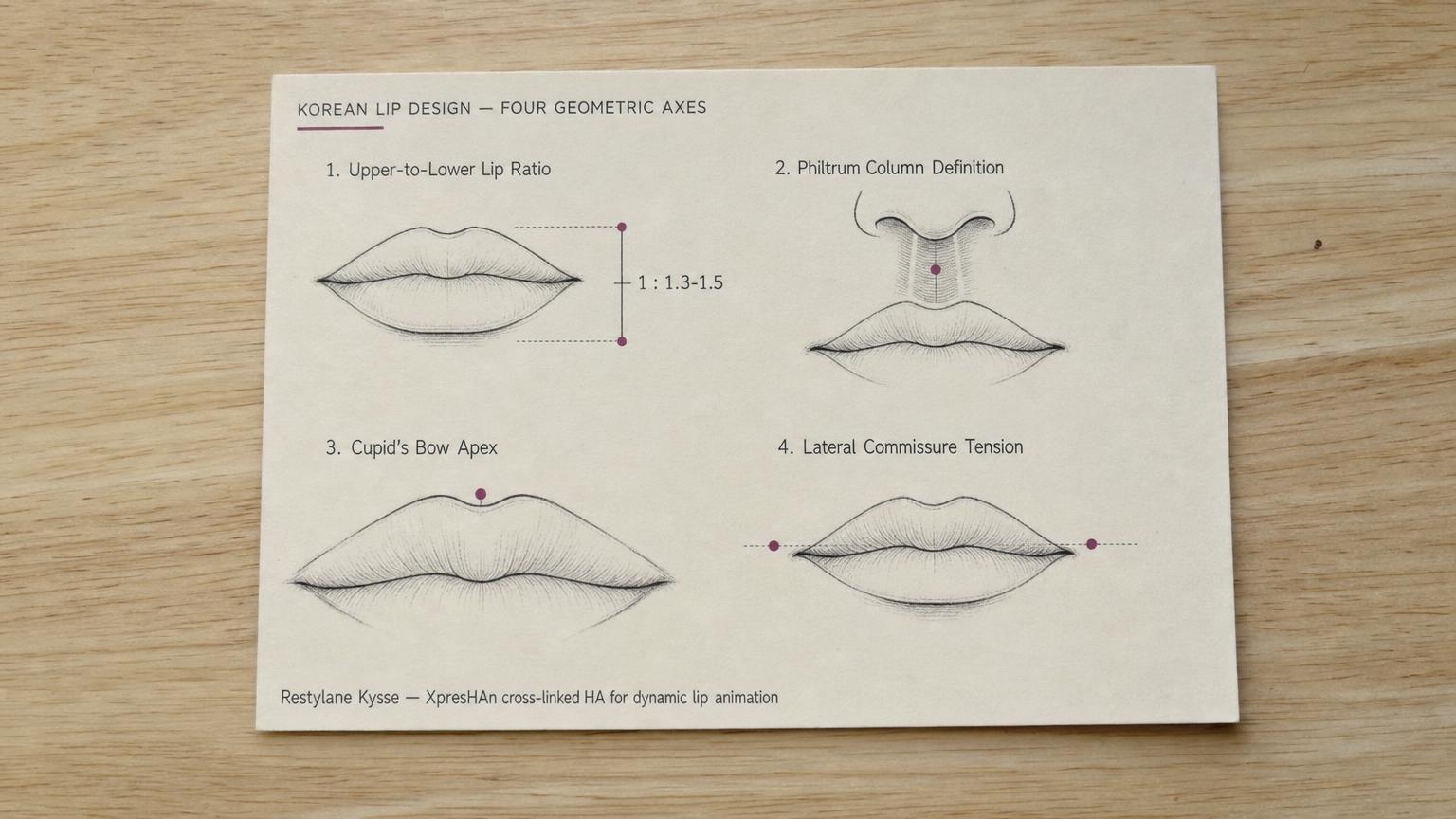
Korean lip filler with Restylane Kysse is geometric design, not volume amplification. The four design axes Seoul clinics measure during the consultation are concrete and visible, and once a patient has heard them named, the consultation reframes itself. The full Korean Restylane Kysse lip filler protocol at Seoul aesthetic clinics is documented around these four axes rather than around milliliter quantities. The lips are not a single feature to be enlarged. They are a small region of the face composed of four distinct geometric relationships, and the procedure adjusts each one toward a target proportion that the Korean clinical literature and the broader Korean aesthetic standard treat as default.
The Four Design Axes
The first axis is the upper-to-lower lip ratio. The Korean target sits at 1:1.3 to 1:1.5, with the lower lip proportionally fuller than the upper lip when viewed straight on. Many patients, particularly Asian patients, arrive with an upper-to-lower ratio closer to 1:1, sometimes even with the upper lip appearing fuller than the lower (1.1:1 or higher). The geometric correction is not to add volume to both lips equally but to redistribute the visual weight toward the lower lip while preserving or even slightly reducing apparent upper-lip projection. This single change moves a Korean face from “lips look slightly heavy” or “mouth area looks flat” toward the natural-proportion read that the eye registers as balanced.
The second axis is philtrum column definition. The philtrum is the vertical groove between the nose and the upper lip, bordered by two soft ridges (the philtrum columns) that should be subtly visible in a relaxed face. In many adult lips, particularly with age or with prior heavy filler placement, the philtrum columns flatten and the philtrum itself widens into a featureless plane. A small amount of HA placed precisely along the philtrum columns restores the vertical definition, which in turn sharpens the cupid’s bow above and makes the whole upper-lip region read as more defined without adding volume to the lip body itself.
The third axis is cupid’s bow apex sharpness. The cupid’s bow is the M-shaped curve along the upper lip vermilion border, with two gentle peaks framing the philtrum. The Korean target is “softly defined” — visible peaks that are not razor-sharp, not exaggerated, not over-pointed. The Western fuller-pout aesthetic often pushes the cupid’s bow apex toward sharper peaks; the Russian lift aesthetic exaggerates the eversion further so the peaks roll outward. The Korean approach restores a subtle M-curve, with the peaks present but soft, and the philtrum column definition (axis two) is what gives the bow its read rather than the bow itself being aggressively pointed.
The fourth axis is lateral commissure tension. The lateral commissures are the corners of the mouth where the upper and lower lips meet. With age, with chronic downward-sloping resting expression, or with certain anatomical patterns, the commissures sit slightly below horizontal at rest, giving the face a permanent “frowning” or “tired” read. A precise microbolus of HA at the commissure-supporting muscles can restore the corner to neutral horizontal without exaggerating into a lifted-corner Russian aesthetic. The change is small in absolute terms — perhaps a millimeter or two of vertical correction per side — but the visual impact on resting expression is disproportionately large.
What Korean Lip Filler Is NOT
Stating the negative is useful here because the misconceptions are concrete and recurring. Korean lip filler is not a Russian lip lift. The Russian technique uses vertical injection patterns to evert the upper lip outward, producing a rolled, exaggeratedly visible wet vermilion from the front view. It is a defined aesthetic and there are patients who want it, but it is not the Korean default and Korean clinics generally counsel against the request unless the patient’s existing lip anatomy specifically suits the eversion approach. Korean lip filler is also not a Western fuller-pout aesthetic — the cushion-look that adds volume to the entire lip body without changing proportion or definition. Korean lip filler is not lip-tenting projection either, where the lip is rolled outward on side profile to produce a wet, projecting appearance.
The Korean natural-lip standard, in plain language, is this: subtle wet vermilion edge visibility from the front (not hidden but not exaggerated), soft cupid’s bow without sharp peaks, no overprojection on the side profile (the lips should not push outward beyond the natural facial contour when viewed from the side), and philtrum length unchanged (the procedure should not visually shorten or lengthen the philtrum). The result is lips that read as the patient’s own lips, just better proportioned, which is the design objective the Korean industry has converged on over roughly the past decade.
Why This Matters for Foreign Patients
The frustration moment most foreign patients do not anticipate is the redirect at the consultation. The patient arrives with reference photos representing one aesthetic (Western fuller-pout, Russian lift, or similar), the Korean clinician examines the lips and proposes a different aesthetic (geometric proportion), and the patient has to choose: accept the Korean redirect and get a result they may not have explicitly asked for, push back and request the original Western or Russian aesthetic (which the clinic may decline or modify), or leave the consultation and book elsewhere. Most foreign patients who do their research before the trip end up accepting the Korean approach, because the result is closer to “natural beauty that does not register as filler” than the original reference photos were, but the consultation conversation itself is where the value of the Korean clinic and the source of the foreign-patient confusion both originate.
Section 2 — Restylane Kysse vs Other HA Fillers: Why Seoul Clinics Made the Switch
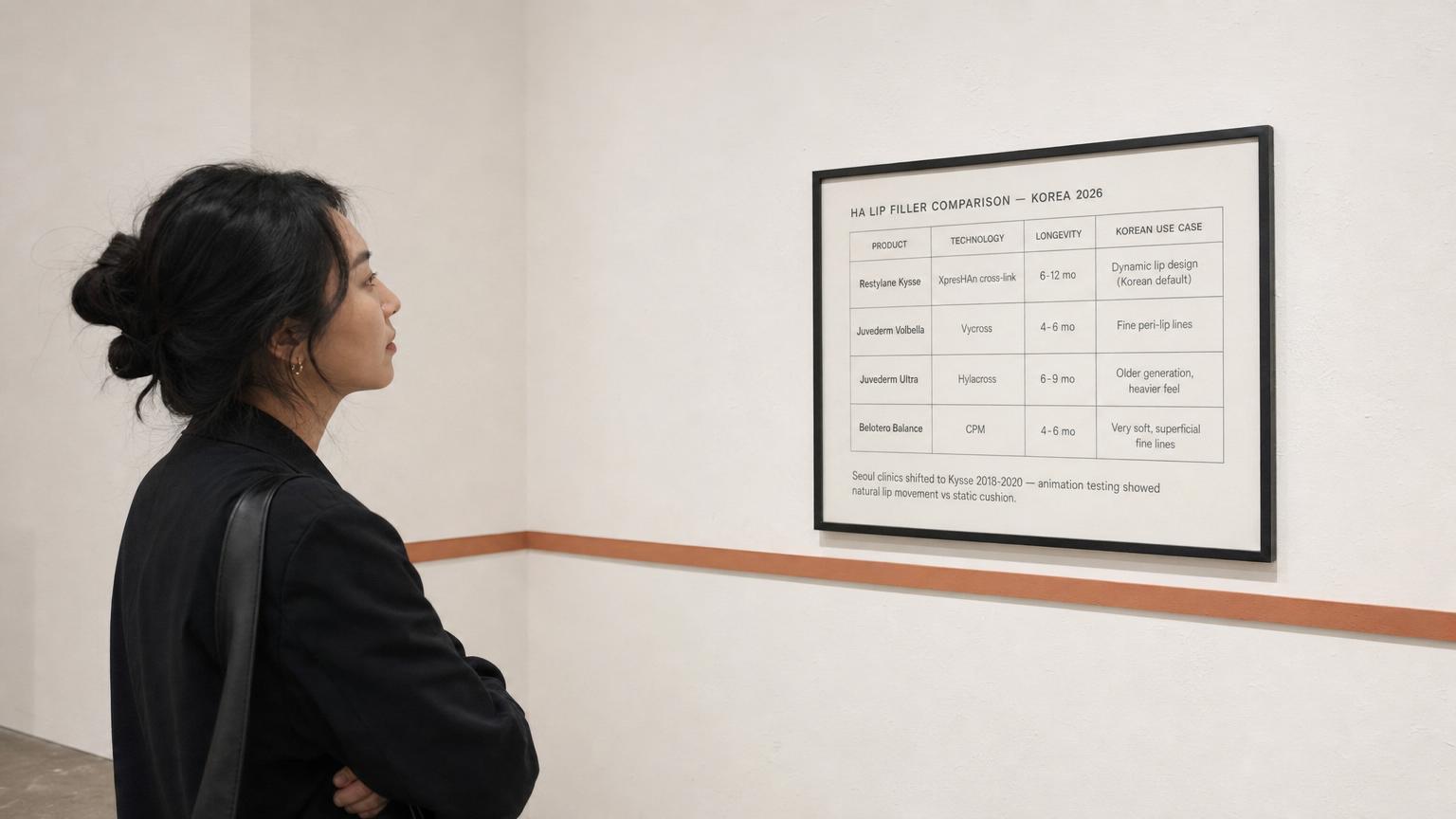
The product choice is not incidental. Korean clinics gravitated to Restylane Kysse around 2018 to 2020 specifically because the gel’s mechanical properties suit the geometry-first design philosophy better than older HA generations or competing newer products. The decision was driven by clinical animation testing — photographing and filming patients talking, smiling, and making expressions before and after various HA products were tested — rather than by marketing or brand positioning. The clinical observation that emerged was consistent: lips treated with Restylane Kysse moved more naturally during animation, looked less “done” in photos of patients talking, and held their geometric design longer than lips treated with heavier or stiffer HA gels.
Restylane Kysse and XpresHAn Technology
Restylane Kysse is manufactured with XpresHAn Technology, a cross-linking method that produces an HA gel with high cohesivity (the gel holds together as a unit rather than fragmenting) but lower stiffness than older Restylane formulations like Restylane Ultra. The clinical translation of the technology is that Kysse is flexible during dynamic facial movement. When the lips move — talking, smiling, kissing — the gel deforms with the tissue and returns to its design shape rather than holding rigidly. This is the property that produces the “lips move naturally” appearance that Korean clinicians began testing for and that most patients of any nationality prefer over the static-cushion look of older HA generations.
The longevity of Restylane Kysse in the lip region is typically 6 to 12 months, with substantial variation by patient metabolism, lip animation frequency (heavy talkers and big smilers metabolize the product faster), and the precision of the original placement. Korean clinics tend to quote 9 to 12 months as the typical longevity for a well-designed single-syringe placement, with patients returning for a touch-up around the 12-month mark when the design has softened enough to be visible but not yet fully resolved.
Comparison to Other HA Lines Used in Korea
Other HA products are available in Korean clinics and are used for specific indications. Juvederm Volbella, an Allergan product made with Vycross cross-linking technology, is softer and shorter-lasting than Kysse (typically 4 to 6 months) and is sometimes preferred for very young patients or for fine peri-lip line filling where a softer gel reads more naturally. Juvederm Ultra is an older Allergan product with Hylacross cross-linking, heavier in feel and less commonly used in modern Korean lip work because the newer XpresHAn and Vycross generations have largely replaced the older Hylacross category. Belotero Balance, from Merz, is a very soft HA gel made with CPM (Cohesive Polydensified Matrix) cross-linking, used in Korea primarily for fine peri-lip lines and the philtrum itself rather than for lip body design — its soft texture makes it less useful for geometric definition but excellent for delicate surface work.
The decision tree most Korean clinics follow is: Restylane Kysse for primary geometric lip design (the default), Belotero Balance for peri-lip fine line correction or delicate philtrum work, Juvederm Volbella as a softer alternative for very young patients or very subtle work, and Juvederm Ultra essentially out of rotation in modern Korean lip practice except for specific clinician preferences. The “Tasty” brand that some Seoul clinics including Link PS reference internally is not a separate product — it is an internal program name for the Restylane Kysse-based lip design protocol, with the same FDA and MFDS-approved product delivered with a specific Korean injection pattern. Patients should understand that the product itself is identical to Restylane Kysse anywhere else in the world; the Korean differentiator is the design philosophy and the injection technique, not a different molecule.
Why Korean Clinics Made the Switch Around 2018 to 2020
The pivot from older HA gels (Hylacross-era Juvederm Ultra, original Restylane line) to the newer XpresHAn and Vycross generations was driven by clinical photography. Korean dermatology and plastic surgery clinics, working with large patient volumes per month, began systematically photographing lips after various products were placed, then reviewing the photographs at staff meetings to assess the “natural read” of each result. The consistent finding was that older HA gels produced lips that looked competent in still photos at neutral rest but looked artificial in photos of patients talking or smiling. The newer XpresHAn-cross-linked Kysse produced lips that read naturally in both static and dynamic photos.
The Korean aesthetic standard places enormous weight on the dynamic read of facial features, more than the Western or Russian aesthetic traditions typically do. A face that looks beautiful in a still photo but looks “done” when the person talks is considered a worse result in Korea than a face that looks merely good in stills but moves naturally in conversation. This standard is what drove the product pivot, and it is also the standard that explains why Korean injection technique uses smaller volumes of more precisely placed product — the geometry has to read in both still and dynamic registers, which requires placement precision rather than volume.
What 1 Syringe Can Realistically Accomplish
One milliliter of Restylane Kysse — a single syringe — is typically enough for a complete proportional redesign on Asian lip anatomy when the injection follows Korean technique. This frequently surprises foreign patients who arrived expecting to use 2 to 3 syringes (sometimes more) based on Western market norms where the volume-first approach routinely consumes that quantity. The Korean injection sequence (described in the next section) places product at design points rather than throughout the lip body, which means the same 1 mL of product produces visible geometric change on all four design axes rather than diffuse volume increase distributed across the entire lip. Patients with substantially under-volume lips at baseline — for example, patients in their fifties or sixties who have lost significant lip volume to age — may require a second syringe to complete both the geometric design and meaningful volume restoration, but for the typical patient in their thirties or forties seeking lip filler for design rather than volume restoration, one syringe is the realistic baseline.
Section 3 — The Korean Injection Pattern: Why 1 Syringe Works When 3 Did Not
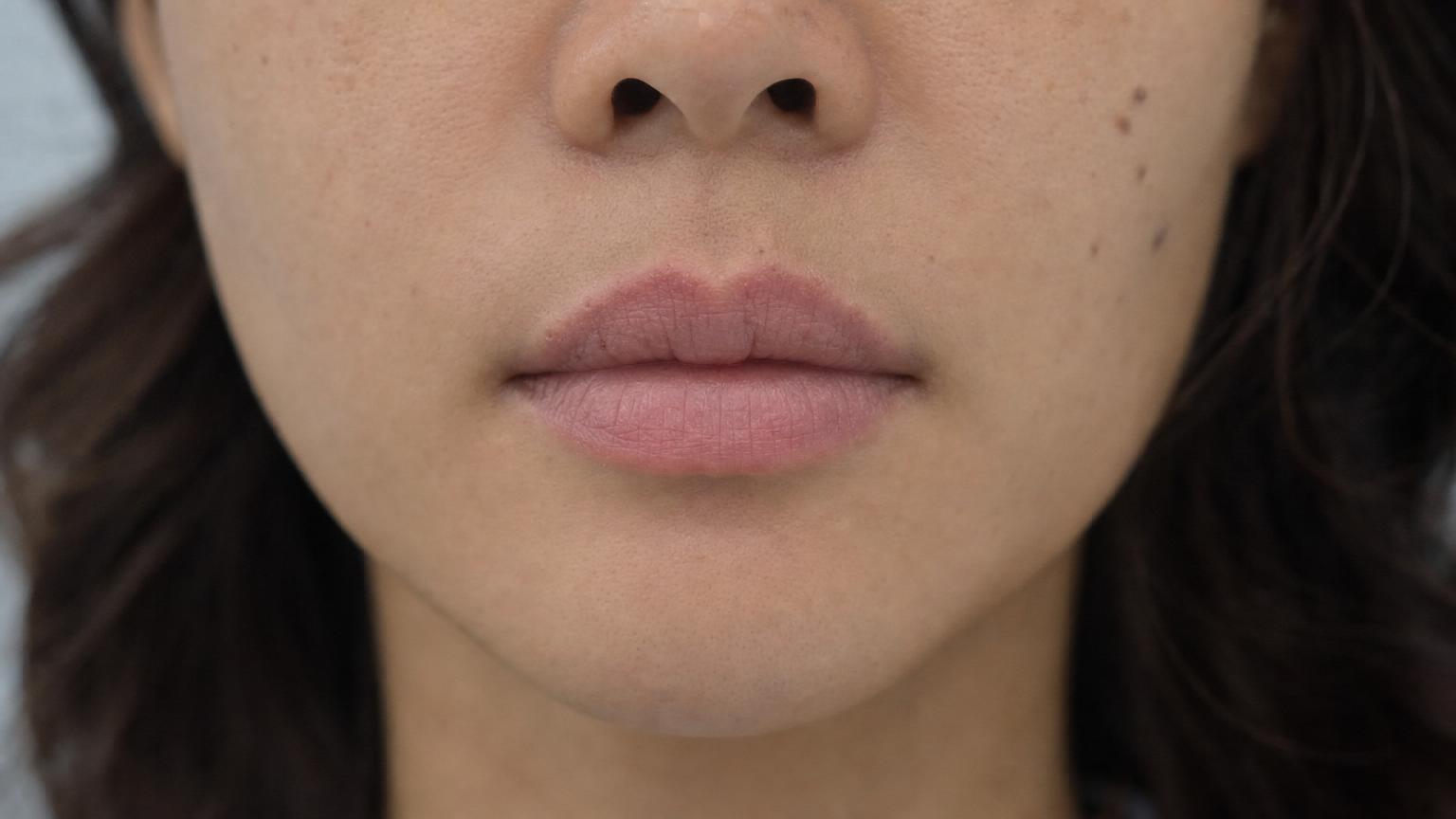
The injection sequence is the variable foreign patients rarely think about and almost never see explained in their home-clinic literature. The sequence is what determines whether the same milliliter of HA produces geometric design or diffuse volume increase. The Korean approach, refined across the major Seoul aesthetic clinics over roughly the past decade, follows a specific order with specific tool choices at each step, and the order itself is the part that takes years of clinical practice to internalize. The general principles are publicly documented in Korean clinical literature and aesthetic conference presentations; the execution is what separates the clinician who has injected Kysse on 500 Asian lips from the clinician who has injected Kysse on 50.
Recommended for Your Recovery
Products commonly used before and after Korean lip filler restylane kysse — same items routinely recommended in the recovery instructions Seoul clinics hand out at discharge.
- COSRX Advanced Snail 96 Mucin Power Essence — Korean barrier essence to support skin between injection sessions and reduce post-procedure dryness. Check price on Amazon
- Beauty of Joseon Relief Sun SPF 50+ — lightweight Korean SPF 50+ — UV protection is critical after any injectable to prevent pigment irregularities. Check price on Amazon
- Gel Eye Mask (Cold Compress) — cold compress for periorbital or perioral micro-swelling in the 24 hours after a session. Check price on Amazon
- Arnica Montana Tablets — optional 1 to 2 day course around injection day to minimize bruising at injection points. Check price on Amazon
As an Amazon Associate, GlobalBeautySpot earns from qualifying purchases at no extra cost to you.
The Standard Korean Injection Sequence
The Korean injection sequence typically follows this order: philtrum columns first, then cupid’s bow apex, then vermilion border, then body volume. This is the opposite of the Western body-first volume injection pattern, where the lip body is filled to the target volume and the design points (cupid’s bow, philtrum) are addressed afterward with whatever product remains.
The first step is the philtrum columns. Two precise microbolus deposits, one on each side of the philtrum near the upper vermilion border, restore the vertical column definition. The amount of product used here is small — perhaps 0.05 to 0.10 mL per side — but the effect on the overall lip read is disproportionate because the philtrum columns frame everything below. Once the columns are defined, the cupid’s bow above looks sharper without any product placed in the bow itself; the visual sharpening is from the framing rather than from the bow.
The second step is the cupid’s bow apex itself. Small precise deposits at each peak of the M-curve, again with minimal product (0.02 to 0.05 mL per peak), softly define the apex without producing the over-pointed peaks that the Russian and some Western aesthetics push toward. The Korean target is subtle visible peaks framed by the philtrum columns, not sharpened or exaggerated peaks.
The third step is the vermilion border outline. A linear threading pattern along the upper and lower vermilion borders, using small product quantities, sharpens the lip outline without adding body volume. This is where the Korean technique commonly uses microcannula rather than needle — the cannula reduces bruising risk along the long thread path and reduces vascular event risk along the upper-lip arterial network. The needle is used at design points (philtrum columns, cupid’s bow apex, commissures); the cannula is used for thread paths (vermilion border, body volume).
The fourth step is body volume, with whatever product remains in the syringe. By this point, the geometry has already been established by the first three steps, and the body volume placement is a final adjustment rather than the main event. The lower lip typically receives slightly more body volume than the upper lip to produce the 1:1.3 to 1:1.5 ratio target, with placement concentrated at the lateral lower-lip thirds rather than the central pillow.
Microbolus Technique vs Linear Threading
The technique distinction is between microbolus deposits (small precise quantities placed at single design points with a needle) and linear threading (continuous deposits along a path with retrograde withdrawal of the cannula). Korean technique uses microbolus for the design points and linear threading for the outline and body, with the design-point microbolus work happening first to establish the geometry. Western volume-first technique tends to use linear threading throughout, often with a needle, distributing the product across the lip body in long retrograde threads.
The mechanical consequence of the technique difference is that microbolus-placed product holds its shape at the design point (the deposit is small and localized, so it does not spread far during the immediate post-injection settling), while linear-threaded product migrates slightly along the path it was placed during the first 24 to 72 hours as the HA binds water and the tissue swells. This is why the Korean approach produces sharper geometry from less product — the design points are localized deposits that do not migrate, so the geometric definition holds.
Why This Controls Cost
The cost arithmetic follows directly from the technique. One syringe of Restylane Kysse 1 mL at a Seoul aesthetic clinic typically prices at KRW 450,000 to 650,000 (approximately USD 330 to 480), with some clinics including consultation and any touch-up adjustment within 4 weeks. The same procedure with volume-first technique at a Western clinic often requires 2 to 3 syringes to produce comparable visible change because each syringe contributes diffuse volume rather than localized geometric definition. The Western cost commonly lands at USD 1,200 to 2,400 for the multi-syringe approach. The Korean cost is lower not because Korean clinicians are charging less per syringe (they are not, in many cases) but because the procedure uses fewer syringes to achieve the design.
Cannula vs Needle Decision
Korean lip protocol routinely uses both needle and microcannula depending on the zone. Needles are used at sharp design points — the philtrum column microbolus deposits, the cupid’s bow apex deposits, and the lateral commissure deposits — where small precise placement matters more than reducing bruising risk. Microcannula is used for the longer thread paths — the vermilion border outline and the lip body — where reducing the entry-point count, the bruising risk along the path, and the vascular event risk are the priority. The cannula entry points are typically two per lip (lateral commissure entries), through which the entire vermilion border and body can be threaded.
The needle-cannula combination is a clinical detail that foreign patients rarely see explained at their home clinics but that has a meaningful effect on the bruising profile and the safety profile of the procedure. Korean clinics generally explain this distinction during the consultation and show the patient which tool will be used at which step.
Pain Management
Topical anesthetic cream applied 20 to 30 minutes before the procedure is the standard Korean approach. The cream is usually a compounded lidocaine-prilocaine formulation applied in a thick layer with occlusion, producing surface numbness sufficient for the needle entries at design points and the cannula entry at commissures. For anxious patients or those with low pain tolerance, dental block options (mental nerve block and infraorbital nerve block) provide deeper anesthesia and are routinely offered. The procedure itself takes 15 to 20 minutes of hands-on time once the numbing is established.
The Over-Correction Question
Korean protocol deliberately under-corrects by approximately 10 percent at Day 0 to account for HA’s water-binding swelling pattern over the subsequent 48 to 72 hours. The injected HA gel binds water from the surrounding tissue and physiologic swelling overlays the immediate placement volume, so lips that look exactly at-target on the treatment table will look slightly over-target at 48 hours and then settle back toward target by Day 5 to 7. By under-correcting at Day 0, the clinician produces a 48-hour appearance that lands at target rather than over, and the settled Day 7 appearance also lands at target without an extended over-swollen window.
This is one of the design details that foreign patients often misread as “you under-filled me.” The clinician under-fills intentionally; the swelling completes the design over the next 48 hours; the patient who messages at hour 6 worried that the result is too subtle is usually messaging at the lowest visible point of the settling curve. Korean clinics generally explain this in the post-procedure briefing and show the patient the expected swelling timeline, but the timeline mismatch between Day 0 expectation and Day 2 to 7 settled result is the most common cause of foreign-patient anxiety in the first week.
Section 4 — Real Timeline: From Pre-Consultation to Final Settled Shape

The Korean lip filler timeline runs in distinct windows from pre-consultation through settled four-week result, with each window producing different expectations and different patient experiences. Understanding the timeline in advance prevents the most common foreign-patient frustrations, which almost always cluster at hour 24, day 3, and day 7 when the appearance is most variable. The settled appearance — the one the procedure was designed to produce — does not register until approximately day 14, and the final assessable result lands at week 4. Foreign patients who book a Seoul trip should plan the trip around this timeline rather than around the day of the procedure itself.
Day Minus 7 to Day 0: Pre-Consultation and Preparation
The pre-procedure preparation window starts roughly one week before the procedure. Patients are typically asked to stop blood-thinning medications and supplements that affect bleeding (aspirin, ibuprofen, fish oil, vitamin E, gingko) for 5 to 7 days before treatment to reduce bruising risk. Alcohol is recommended off for 24 to 48 hours before treatment for the same reason. Active cold sores or herpes simplex virus history is flagged at consultation — patients with HSV history are typically prescribed prophylactic antiviral medication starting 2 days before treatment because lip filler can reactivate dormant HSV. Patients with active acne or active inflammation at the lip area are usually rescheduled to a later date until the skin is calm. Sun-protective measures the week before reduce the chance that sun-damaged skin contributes to immediate-post swelling.
Day 0: Procedure Day
The procedure itself runs about an hour of clinic time, with 20 to 30 minutes of topical numbing applied first, 15 to 20 minutes of hands-on injection work, and 10 to 15 minutes of post-procedure observation and aftercare briefing. Patients leave the clinic with lips that look slightly fuller than baseline, with the design intentionally placed at approximately 90 percent of target (anticipating the swelling that will complete the appearance over the next 48 hours). Mild redness at the entry points is normal. Pinpoint bleeding at the entries is normal and stops within minutes. Small bruises at one or two entry points are possible but not universal — Korean clinics with experienced injectors typically have low bruising rates, and the cannula-based technique reduces bruising further compared with all-needle approaches.
The immediate-post appearance is the appearance most patients fixate on, but it is the least informative read of the eventual result. The clinician at Day 0 is targeting Day 2 to 7 swelling completion and Day 14 settling, not Day 0 itself.
Hours 6 to 24: Peak Swelling Window
The first 24 hours produce the most swelling. The HA gel binds water from the tissue, the tissue itself swells in physiologic response to the injection, and the lips look fuller than the eventual settled result will look. Some patients experience visible swelling that extends slightly above the upper vermilion border and below the lower vermilion border, producing a temporarily “puffy” appearance that is normal but uncomfortable for patients who expected the Day 0 look to be the final result. Cold compress (ice wrapped in a clean cloth, 10 minutes on, 10 minutes off) is the standard intervention and reduces the peak swelling effectively when applied in the first 6 to 24 hours.
The hour 24 mark is the peak swelling point. Patients who message the clinic at hour 24 worried that the lips are too full or too uneven are usually messaging at the worst possible window. The clinician reviewing the photo at this point can usually predict from the swelling pattern what the settled result will look like, and the answer is almost always “this will settle to the target shape over the next week.”
Days 2 to 7: Settling and Initial Bruising Resolution
The 48 to 72 hour window is when the gel finishes its water-binding settling and the tissue swelling begins to resolve. Bruises (if present) typically darken to peak visibility around Day 2 to 3 and then begin to fade. Patients who flew into Seoul for the procedure can typically attend social activities by Day 4 to 5, with light makeup (lipstick or lip tint) covering any residual asymmetry or minor color change. Heavy exercise is recommended off for the first 3 days to avoid additional swelling. Sleeping with the head elevated reduces overnight swelling. By Day 7, the lips look approximately like the settled result will look at Day 14, with minor residual fullness still resolving over the second week.
Day 14: First Reasonable Assessment Point
Two weeks post-procedure is the first point at which the result can be fairly assessed. The swelling has fully resolved, any minor bruising has cleared, the HA gel has integrated with the surrounding tissue, and the design points are reading at their intended geometric positions. Most clinics offer an optional follow-up consultation at Day 14 to assess the result and to perform any touch-up adjustment if needed. Touch-up adjustments are uncommon when the original design was sound, but they are available without additional product charge at most reputable Seoul clinics (the touch-up is a small adjustment within the original treatment plan, not a new session).
Day 14 to Week 4: Final Settling
Between Day 14 and Week 4, minor additional settling continues, primarily as the HA gel completes its full integration with the tissue and the design points stabilize at their long-term positions. By Week 4, the result is at its final assessable state and will hold this appearance for approximately 6 to 12 months before gradual decline.
Week 4 to Month 12: Stable Result Window
The stable result window runs from approximately Week 4 through Month 6 to 9, with gradual visible decline beginning around Month 9 to 12 in most patients. Heavy lip animation (very expressive talkers, daily heavy smilers), faster metabolic rate, and certain lifestyle factors (heavy sun exposure, repeated chemical exfoliation in the perioral area) shorten the duration. Most patients return for a touch-up between Month 12 and Month 18, with the touch-up requiring approximately half the original product volume because the design framework laid down in the first session is still partially present and only needs reinforcement rather than full re-creation.
Section 5 — Cost, Touch-up Strategy, and Coordinating With Other Korean Procedures
Lip filler pricing in Seoul reflects the single-syringe Korean technique, the clinical time required for proper geometric design (substantially more than the volume-first approach), and the inclusion of consultation and touch-up within the original treatment fee at most reputable clinics. Foreign patients evaluating Korean lip filler should compare on total-procedure cost rather than per-syringe cost, because the Korean per-syringe price is competitive only when one syringe is enough — and the design philosophy is what makes one syringe enough. Pricing also intersects with the broader Korean aesthetic protocol, where lip filler frequently combines with other procedures on the same trip.
Pricing Reference Table
| Region | Approximate Cost | Notes |
|---|---|---|
| Korea (Seoul) — 1 syringe Restylane Kysse | KRW 450,000–650,000 (USD 330–480) | Geometric design protocol, includes consultation and Week 2 touch-up adjustment if needed |
| Korea (Seoul) — Touch-up (Month 12 to 18) | KRW 250,000–400,000 (USD 185–295) | Half-syringe top-up using existing design framework, frequently includes free assessment |
| Korea (Seoul) — 2 syringes (under-volume baseline) | KRW 800,000–1,100,000 (USD 590–815) | Older patients or significant baseline volume loss, geometric design plus volume restoration |
| USA — 1 syringe Restylane Kysse or Volbella | USD 650–900 | Variable by region, often quoted per syringe without consultation included |
| USA — 2 to 3 syringes (volume-first approach) | USD 1,200–2,400 | Common for first-time lip filler when technique is volume-first |
| UK / EU — 1 syringe | GBP 350–550 | Variable by clinician experience |
| Australia — 1 syringe | AUD 700–1,100 | Higher operating costs in the Australian market |
The Korean pricing assumes authentic Restylane Kysse sourced through the authorized Korean distribution channel. Foreign patients should confirm the product brand and lot number at consultation. The product packaging should be opened in front of the patient before the procedure, the lot number visible on the syringe and on the packaging, and the syringe itself should bear the Restylane Kysse branding and the expiration date. Unauthorized vendors in some Asian medical tourism corridors substitute non-Kysse HA products under the Kysse name; the verification step takes 30 seconds at the procedure and prevents the substitution issue that surfaces in some online clinic reviews.
The Touch-Up Strategy
Lip filler is most cost-effective when the patient commits to a multi-year touch-up cycle rather than treating each procedure as a one-off. The first session lays down the geometric framework — the philtrum columns, the cupid’s bow apex, the vermilion outline, the body proportions. The framework holds for 9 to 12 months. The touch-up at Month 12 to 18 reinforces the framework with approximately half the original product, and the framework now holds for another 12 to 18 months. After two or three touch-up cycles, the framework has become a stable architectural feature of the face and subsequent touch-ups require even less product.
Patients who treat lip filler as a one-time procedure and then let it fully resolve before the next session are essentially re-paying for the framework each time. Patients who commit to the touch-up cycle pay the full first-session price once and then half-price (or less) at each subsequent touch-up, with the result remaining stable across the multi-year window.
Combining Lip Filler with Other Korean Procedures
The Korean aesthetic ecosystem treats lip filler as one component of a larger facial design plan rather than a standalone procedure, and most Seoul clinics will offer combination protocols during the consultation. The most common combinations cluster around procedures that share the perioral and lower-face zone:
- Lip filler with lip lift (philtrum reduction). Patients with a long philtrum that pushes the upper lip downward and produces a heavy-upper-lip appearance often benefit from a surgical lip lift (philtrum reduction) before or instead of lip filler. The lip lift shortens the philtrum and rolls the upper lip upward, exposing more of the upper vermilion from the front. Adding lip filler after the lip lift completes the geometric design with proportional volume. The comparison between Korean lip lift (philtrum reduction) and lip filler alone is one of the most common consultation questions for patients in their forties and fifties — the short answer is that lip lift is structural (it changes the underlying anatomy) and lip filler is geometric (it changes the visible proportions), and patients with structurally long philtrums often need both for the full result.
- Lip filler with Rejuran for skin quality. The perioral area shows aging earlier than many patients realize, with fine vertical lip lines and decreased skin elasticity contributing to the “tired mouth” read that no amount of lip filler corrects on its own. Combining Restylane Kysse for lip geometry with Korean Rejuran skin booster therapy for perioral skin quality addresses both the geometric and the textural components of the lip-area appearance. The Rejuran series typically runs 3 to 4 sessions spaced 3 to 4 weeks apart, with the Rejuran final session timing roughly with the lip filler settled appearance at Week 4 to 8.
- Lip filler with Exosome for accelerated recovery and skin regeneration. Patients who want to compress the recovery timeline or who have skin that bruises easily often add Korean Exosome therapy on the same day as the lip filler. Exosome therapy delivers cell signaling molecules that accelerate the local healing cascade, reducing bruising visibility and shortening the swelling window. The combination is logistically straightforward — Exosome can be applied immediately after the lip filler placement, and patients flying home within a few days appreciate the faster bruising resolution.
- Lip filler with full Korean petit aesthetic procedure trip. Many foreign patients structure a Seoul trip around multiple petit aesthetic procedures completed in sequence over 5 to 10 days. A typical sequence might include Restylane Kysse for lips on Day 1, Botox for masseter or upper face on Day 2 (Botox first if planning multiple injectable sessions reduces logistic complexity), Rejuran or Exosome series starting Day 3, and any laser or energy procedures (Shrink Universe, Ultherapy, Volnewmer) at the end of the trip to avoid the immediate-post downtime overlapping with the injectable settling windows. Clinics that handle this routinely will map out the full sequence at the initial consultation.
- Lip filler with rhinoplasty refinement (specifically the lip-nose angle). Patients who have had rhinoplasty or who are considering rhinoplasty often discuss the nasolabial angle (the angle between the columella of the nose and the upper lip) as part of the planning. Adjusting upper-lip projection with filler can change the apparent nasolabial angle without changing the nose itself, which sometimes lets patients defer or skip a rhinoplasty revision that they were considering for the same aesthetic goal. The intersection between lip filler design and rhinoplasty design is a Korean-specific clinical conversation that is unusual at Western lip-filler-only clinics.
What to Discuss at the Consultation
Foreign patients planning a Seoul lip filler consultation should arrive prepared to discuss specific design questions rather than general “make my lips fuller” requests. The consultation runs better when the patient can articulate which of the four design axes (upper-to-lower ratio, philtrum column, cupid’s bow apex, lateral commissure) they want to change, even if the articulation is approximate. Reference photos are useful for identifying which aesthetic vocabulary the patient is drawn to (Korean natural, Western fuller-pout, Russian lift) but should be understood as one input rather than as a prescription — the clinician will assess the patient’s specific anatomy and propose a design that may or may not match the reference photo. Patients who arrive open to the clinical assessment generally get a better result than patients who arrive committed to a specific reference photo.
Cost expectations should be discussed at consultation, including the touch-up policy and the timing. Clinics that charge separately for Day 14 touch-up are common but should disclose the policy upfront. Clinics that include Day 14 touch-up within the original treatment fee are also common and are often the better value for foreign patients who are still in Seoul at the Day 14 mark. The product source (authentic Restylane Kysse with lot number visible on the syringe) should be confirmed before the procedure, with the syringe opened in front of the patient.
Frequently Asked Questions
How does Korean lip filler differ from what I would get in the US, UK, or Australia?
The technical product (Restylane Kysse) is identical worldwide. The difference is the design philosophy and the injection technique. Western lip filler approaches typically prioritize volume increase using a body-first injection sequence with multiple syringes per session. Korean lip filler approaches prioritize geometric design using a design-point-first injection sequence (philtrum columns first, then cupid’s bow apex, then vermilion border, then body volume) with typically one syringe per session. The visible result is lips that read as proportionally improved rather than as larger. Foreign patients who are happy with the Western fuller-pout aesthetic can find Korean clinicians who will execute that aesthetic on request, but it is not the Korean default and most Korean clinics will counsel toward the geometric-design approach during the consultation.
Will one syringe be enough? Most US clinics quote me 2 to 3 syringes.
For the typical foreign patient seeking lip design rather than substantial volume restoration, one syringe of Restylane Kysse is almost always enough at a Korean clinic using design-first technique. The reason the US clinic quoted 2 to 3 syringes is that volume-first technique requires more product to produce visible change — each syringe contributes diffuse volume across the lip body rather than localized geometric definition at design points. Patients with significant baseline volume loss (typically patients over 55 or patients with a history of substantial volume loss in the lip area) may require 2 syringes to combine geometric design with meaningful volume restoration, but for typical adult patients in their thirties and forties, one syringe is the realistic baseline.
What if I want the bigger, fuller, more obvious lip look?
Korean clinicians will typically counsel against the fuller-pout aesthetic during the consultation, with the caveat that some clinicians will execute the Western or Russian aesthetic on patient request after a thorough discussion of the trade-offs. Patients who arrive committed to the fuller aesthetic should research which Seoul clinicians are known to work in that style — there are clinicians who do this work well in Korea, but most of the major aesthetic clinics including the ones most commonly recommended for foreign patients will redirect toward the proportion-first design. If you are committed to the Western or Russian look, the Korean trip may not be the most efficient option; you may be better served by a clinician at home who already specializes in the aesthetic you want.
How painful is Korean lip filler with topical numbing?
Discomfort is mild for most patients with topical numbing properly applied (20 to 30 minutes of pre-procedure numbing under occlusion). The needle entries at design points feel like brief pin pricks, and the cannula entry at the lateral commissures feels like a stronger pinch followed by pressure as the cannula advances. Patients with low pain tolerance can request dental block anesthesia (mental nerve block and infraorbital nerve block), which provides deeper numbness and is routinely offered. The procedure itself takes 15 to 20 minutes of hands-on time once the numbing is established, so the discomfort window is short regardless of the numbing approach.
How much swelling and bruising should I expect, and when can I fly home?
Swelling peaks at hour 24 and resolves substantially by Day 5 to 7. Visible bruising at one or two entry points is possible (more common with all-needle technique, less common when microcannula is used for body and outline work). Most patients can attend social activities by Day 4 to 5 with light lip color covering any residual asymmetry. Patients who fly into Seoul on Day 0 of the procedure can typically fly home by Day 4 or 5 without obvious markers of having had a procedure, although the result has not fully settled until Day 14. Patients who can build a longer trip will benefit from the Day 14 follow-up touch-up opportunity if needed.
Can I have lip filler if I have a history of cold sores (herpes simplex)?
Yes, with prophylactic antiviral medication. Lip filler can reactivate dormant herpes simplex virus, so patients with HSV history are typically prescribed an antiviral medication (acyclovir or valacyclovir) starting 2 days before treatment and continuing for several days after. Patients with active cold sores or active perioral lesions are rescheduled until the lesions resolve. Discuss your HSV history openly at consultation — the prophylactic protocol is routine and prevents the otherwise meaningful risk of a herpes outbreak triggered by the injection trauma.
How long does Restylane Kysse last?
Typical longevity in the lip region is 6 to 12 months, with most patients seeing meaningful decline around Month 9 to 12. Heavy lip animators (very expressive talkers, daily heavy smilers) metabolize the product faster and may see decline at Month 6 to 9. Patients with slower metabolism, less lip animation, and good protection from sun and chemical exfoliation can sometimes hold the result through Month 12 to 15. The touch-up cycle is typically planned for Month 12 to 18, with the touch-up requiring approximately half the original product volume because the design framework laid down in the first session is still partially present.
What is the difference between Restylane Kysse and the “Tasty” brand I saw at some Seoul clinics?
“Tasty” is an internal program name used at some Seoul clinics including Link PS to refer to the Restylane Kysse-based lip design protocol. The product is identical to Restylane Kysse anywhere else in the world — same FDA and MFDS approval, same XpresHAn cross-linking, same gel properties, same manufacturer (Galderma). The Korean differentiator is the design philosophy and the injection technique, not a different molecule. Patients should not pay a premium for “Tasty” branding over standard Restylane Kysse pricing; the work is the work, and the product is the product.
Can I dissolve lip filler if I do not like the result?
Yes. Hyaluronidase is an enzyme that breaks down HA gels including Restylane Kysse. Korean clinics keep hyaluronidase on hand as standard practice and can dissolve all or part of an HA filler placement in the office, with the dissolution typically occurring over 24 to 48 hours after the hyaluronidase injection. Patients who are unhappy with the result at Day 14 to 30 can have the result dissolved and either revised at a follow-up session or simply returned to baseline. The dissolution option is one of the safety features of HA filler as a product category (as opposed to permanent or semi-permanent fillers, which cannot be dissolved easily and are not used in modern Korean lip work for exactly this reason).
What about lip filler for men?
Male lip filler is a smaller but growing segment of Korean lip work. The geometric targets are different — male lips typically have a flatter philtrum, less defined cupid’s bow, and a different upper-to-lower ratio than female lips. The Korean approach for men is even more design-restrained than for women, with smaller product volumes (often half a syringe rather than a full syringe) and a focus on subtle redefinition of the vermilion outline rather than ratio shifts. Men who are concerned about a “feminizing” result from lip filler should discuss this concern openly at consultation; the Korean clinical default is to under-correct for male lips and most Korean clinicians have experience with the subtler male-lip design vocabulary.
Closing
Korean lip filler is not the procedure most foreign patients think they are booking when they book it. The product (Restylane Kysse) is internationally available; the technique (design-first injection sequence with microbolus deposits at four geometric axes) is what produces the result Seoul clinics are known for. The conversation at the consultation — the redirect from volume-first to geometry-first — is where most of the value is created and also where most of the foreign-patient surprise originates. Patients who arrive open to the clinical assessment, who understand that one syringe is the Korean default rather than the Korean discount, and who plan the trip around the Day 14 settled result rather than the Day 0 procedure get the lip design the Korean industry has converged on over the past decade. Patients who insist on the Western or Russian aesthetic vocabulary find that Korean clinics will sometimes execute it on request but more often will counsel against it, and the trip may not have been the most efficient way to access the aesthetic they already wanted. Either outcome is a reasonable outcome; the value of the Korean consultation is that the patient learns which aesthetic they actually want before the needle goes in, rather than after. To see how the lip design protocol fits into the broader Korean aesthetic ecosystem, visit Link Plastic Surgery’s official website for the full procedure menu and consultation booking.