English-language search for Korean pigment treatment almost always lands on “Pico” — PicoSure, PicoWay, Discovery Pico, the picosecond Q-switched devices that English-language beauty forums have made synonymous with Korean laser. The result is that foreign patients arriving in Seoul ask exclusively for Pico, sometimes regardless of what their actual pigment concern requires. Pico is a strong device for what it does well. It is not the only Korean pigment laser, and for several common indications it is the wrong choice on its own. Link Plastic Surgery and other Seoul clinics that run a full pigment program operate Accento, a DEKA dual-wavelength Q-switched system that delivers both 755nm Alexandrite and 1064nm Nd:YAG, alongside their Pico unit. This guide explains why dual-wavelength matters, when Accento beats single-wavelength Pico, and the indication-method matching framework Korean dermatology uses to decide which device gets each patient.
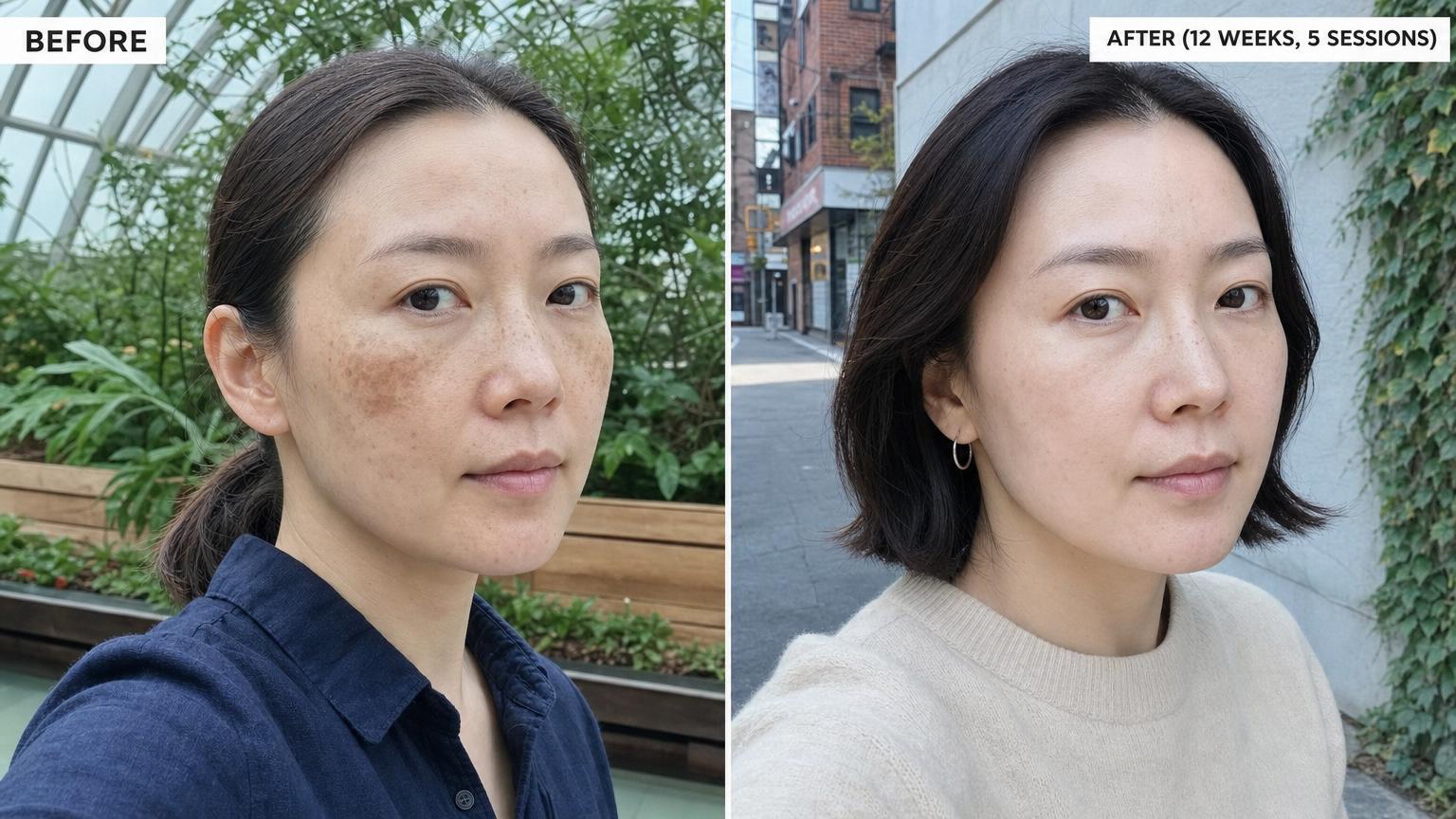
What Korean Accento Actually Is
Accento is a DEKA-manufactured Q-switched laser system that combines two distinct wavelengths in a single platform: 755nm Alexandrite and 1064nm Nd:YAG. Both wavelengths run in Q-switched nanosecond mode (5 to 10 nanosecond pulses), delivering high-energy bursts short enough to shatter pigment particles through photoacoustic disruption without sustained heat damage to surrounding tissue. The operator selects which wavelength to fire per shot based on the lesion target.
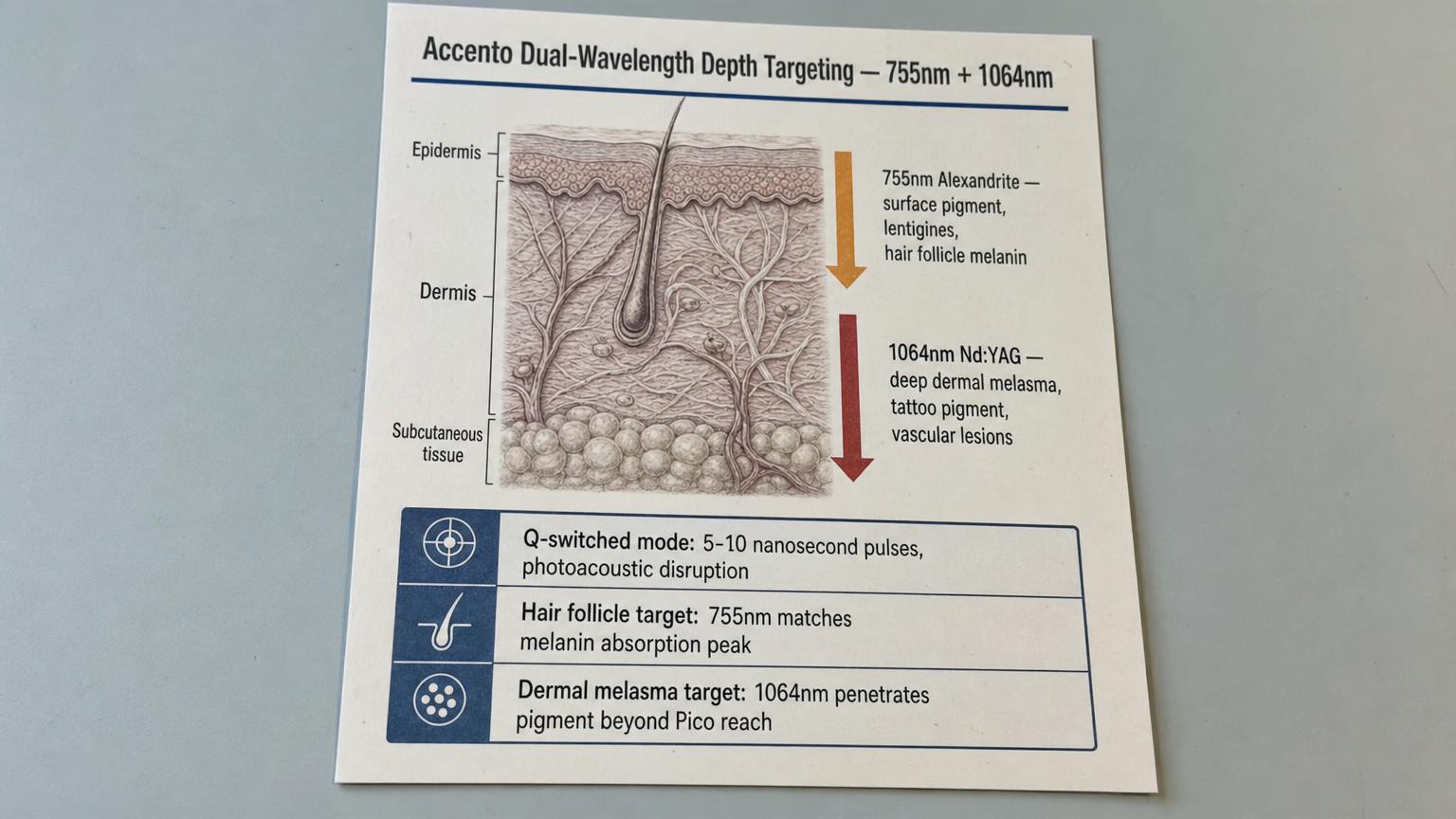
755nm Alexandrite targets the upper layers of skin — surface pigmented lesions like solar lentigines (age spots), 잡티 (small pigmented spots), and superficial hair follicle melanin. The 755nm wavelength matches the absorption peak of melanin in hair shafts particularly well, making this wavelength the standard for laser hair removal on Asian skin in Fitzpatrick types III to IV. 1064nm Nd:YAG penetrates much deeper into the dermis, reaching the pigment of dermal melasma, deeply embedded tattoo ink, and vascular lesions that lie beneath the epidermis. The same single device, depending on which wavelength the operator selects, treats five distinct categories of pigment concern.
Q-switched mechanism explained simply
Q-switched means the laser stores energy and releases it in extremely short pulses — typically 5 to 10 nanoseconds. These short pulses generate a photoacoustic shockwave that fragments pigment particles into small enough fragments for the body’s immune system to clear them through normal cellular turnover. Because the pulse is so short, heat does not have time to spread to surrounding tissue, which limits collateral damage and reduces the risk of post-inflammatory hyperpigmentation (PIH) common in Asian skin.
Why Dual-Wavelength Matters — Indication Mapping
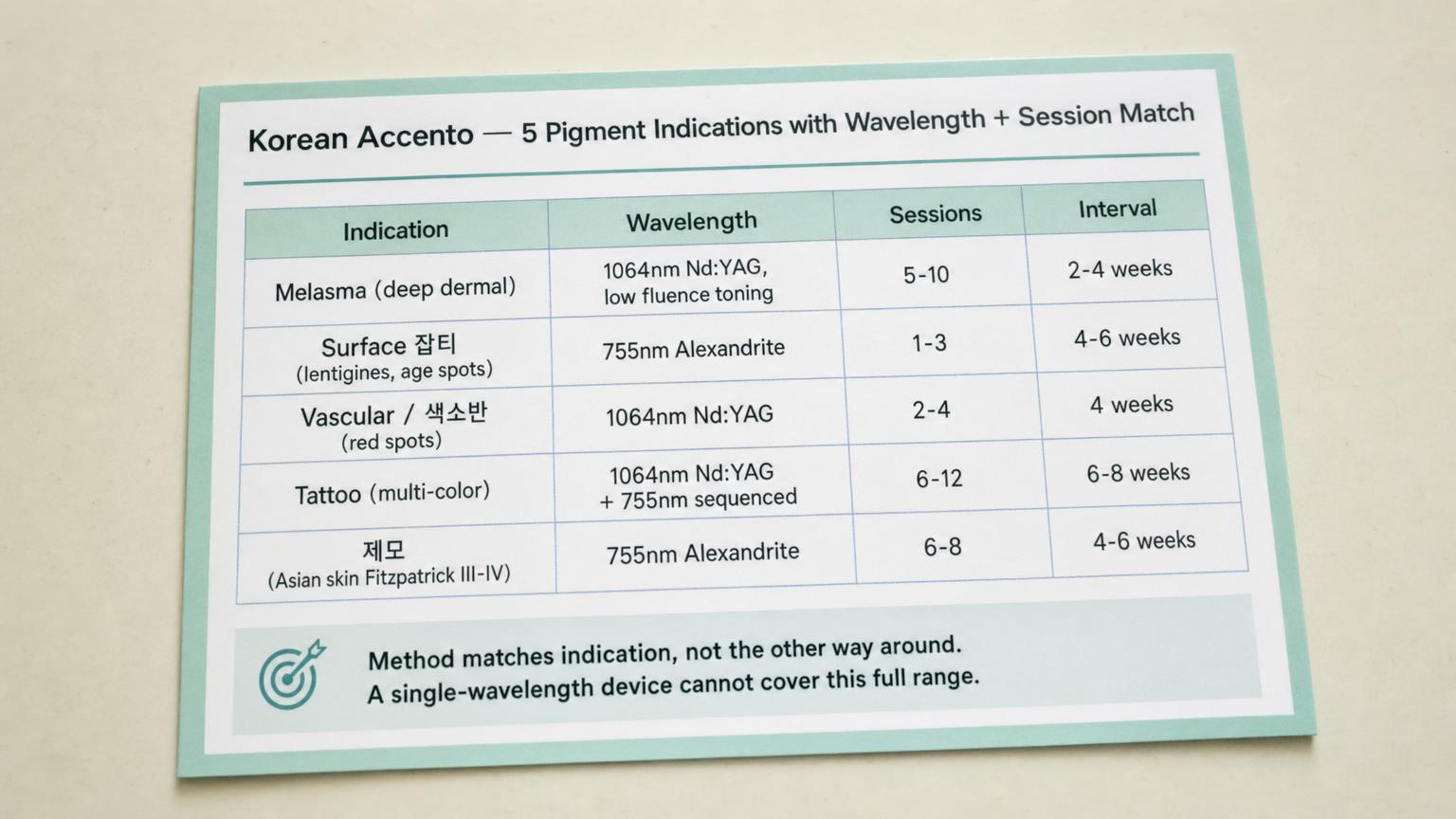
A single-wavelength device by definition cannot cover the full pigment spectrum. PicoSure operates primarily at 755nm, PicoWay offers 1064nm and 532nm. Each excels at what its wavelength matches but falls short where the other wavelength is needed. Accento’s dual-wavelength architecture lets a single device cover five distinct indications that a single-wavelength Pico cannot match on its own.
Melasma. The deep dermal component of melasma sits beneath the epidermis where 755nm cannot reach efficiently. Korean dermatology treats melasma with low-fluence 1064nm Q-switched (often called “laser toning”) delivered over 5 to 10 sessions at 2 to 4 week intervals. Single-wavelength 755nm Pico cannot deliver this protocol effectively.
Surface 잡티 and lentigines. Age spots and small pigmented patches sit in the upper epidermis. 755nm Alexandrite matches the melanin absorption curve at this depth and clears most surface lesions in 1 to 3 sessions at 4 to 6 week intervals.
Vascular 색소반 (red spots, telangiectasia). The 1064nm wavelength is also absorbed by hemoglobin in superficial vasculature, making it effective for small red vascular lesions over 2 to 4 sessions at 4 week intervals.
Tattoo removal. Multi-color tattoos require multiple wavelengths because different ink colors absorb different wavelengths. Black and dark blue inks respond to 1064nm; green and other colors require additional wavelengths. Accento’s dual-wavelength configuration covers more of the tattoo color spectrum than a single-wavelength Pico over 6 to 12 sessions at 6 to 8 week intervals.
Hair removal on Asian skin. The 755nm Alexandrite wavelength matches melanin absorption in the hair shaft while the cooling pulse architecture protects the epidermal melanin that gives Asian skin its color. Most Korean clinics that do hair removal on darker Asian skin use 755nm Alexandrite as the workhorse over 6 to 8 sessions at 4 to 6 week intervals.
The pattern is consistent: matching wavelength to lesion depth and target chromophore is more important than choosing the “newest” pulse technology. A device that can do both wavelengths can match more indications than a device that does only one.
Accento vs Pico — Different Tools, Different Jobs
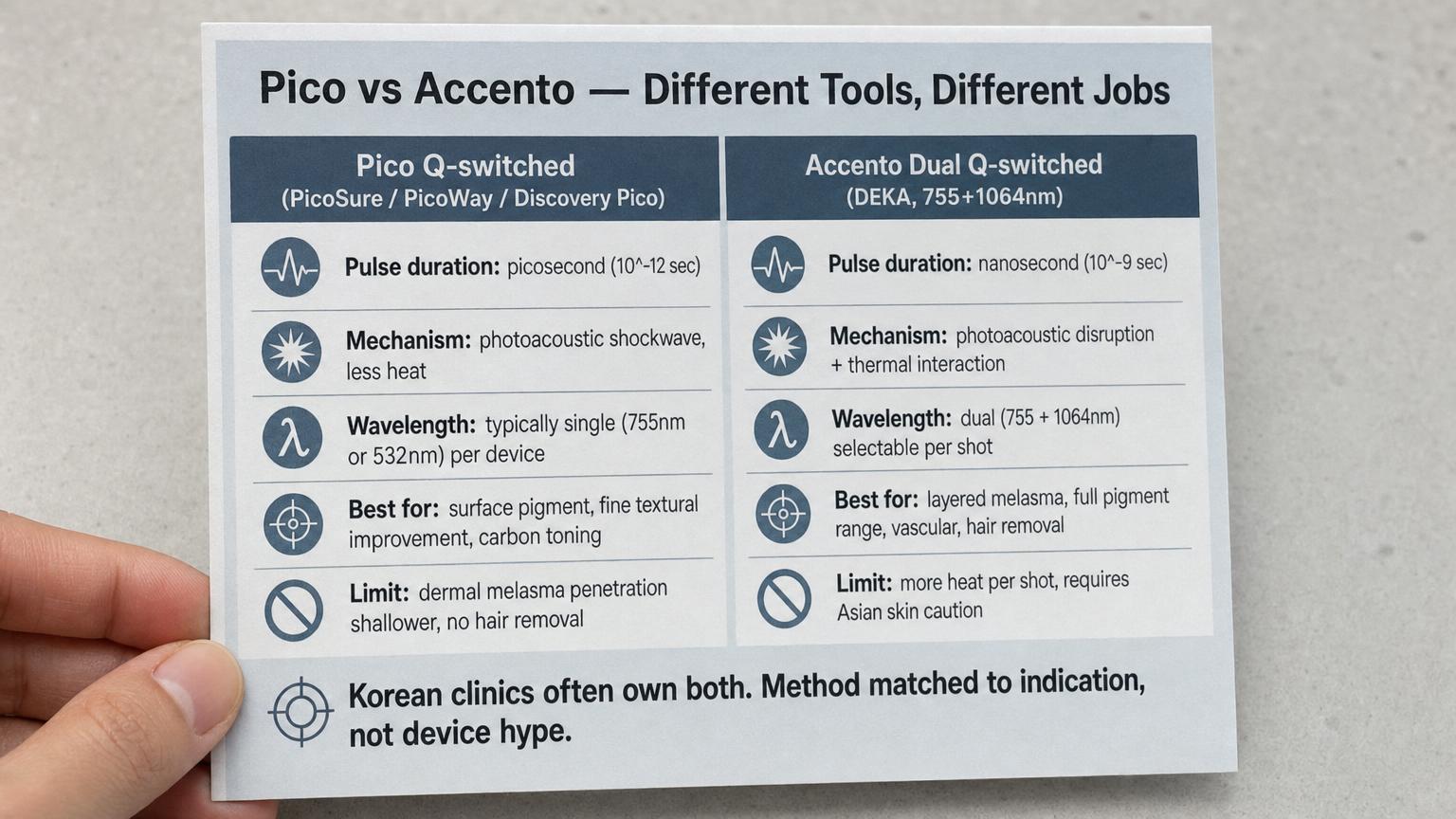
The Pico vs Accento conversation is often framed as a generational comparison — picosecond newer, nanosecond older, therefore Pico wins. The technical reality is more interesting. Picosecond pulses (10^-12 seconds) generate a stronger photoacoustic effect with less heat than nanosecond pulses (10^-9 seconds), which gives Pico an advantage for very fine pigment fragmentation, low-downtime carbon toning, and gentle textural improvement on sensitive skin. But Pico devices are typically built around a single wavelength per device, which limits indication coverage.
Recommended for Your Recovery
Products commonly used before and after Korean accento dual wavelength pigment laser — same items routinely recommended in the recovery instructions Seoul clinics hand out at discharge.
- COSRX Advanced Snail 96 Mucin Power Essence — Korean barrier essence for the post-laser tissue regeneration window. Check price on Amazon
- Beauty of Joseon Relief Sun SPF 50+ — strict SPF 50+ daily for at least 3 months after any pigment or resurfacing laser — UV reverses results. Check price on Amazon
- Gel Eye Mask (Cold Compress) — cold compress for residual redness in the first 24 to 48 hours after a session. Check price on Amazon
- Silicone Scar Sheets — for ablative laser zones with crust formation, support scar maturation as new skin emerges. Check price on Amazon
As an Amazon Associate, GlobalBeautySpot earns from qualifying purchases at no extra cost to you.
Accento’s nanosecond Q-switched pulses generate more heat per shot than picosecond devices. In return, the dual wavelength architecture covers the indication spectrum that a single-wavelength Pico cannot reach on its own. Link PS Accento program uses the device for the indications where dual-wavelength matters — layered melasma, mixed tattoo, hair removal — and reserves Pico for the indications where picosecond fragmentation matters more.
When Accento beats Pico
- Layered melasma where both surface and dermal components are present and a single-wavelength device cannot reach both layers
- Mixed-color tattoo removal where multiple wavelengths are needed
- Hair removal on Asian skin where 755nm Alexandrite matches melanin absorption efficiently
- Vascular lesions where 1064nm Nd:YAG penetrates and is absorbed by hemoglobin
- Combination indication patients where one device must cover several different pigment concerns
When Pico beats Accento
- Fine pigment fragmentation where picosecond pulse delivers more efficient particle break-up
- Low-downtime carbon toning where the shorter pulse generates less heat
- Very sensitive Asian skin where minimal heat is critical to avoid post-inflammatory hyperpigmentation
- Single-session textural improvement protocols
The Korean Accento Protocol — Indication-Specific Sessions and Recovery
Korean clinics that run Accento programs do not apply a single “Accento package” to every patient. The session count, interval, fluence, and wavelength selection vary by indication. This is the diagnose-first / method-match discipline that Korean dermatology applies across all laser modalities, including the precise lesion identification approach covered in our Korean CO2 spot removal protocol.
Melasma protocol. 1064nm Nd:YAG low-fluence Q-switched toning, 5 to 10 sessions, 2 to 4 week intervals. Visible improvement typically settles between session 4 and session 7. Strict SPF 50+ daily throughout the protocol and for 6 months after — melasma recurrence under UV exposure is the primary failure pattern.
Surface lentigines / 잡티. 755nm Alexandrite or 1064nm low-fluence depending on lesion type, 1 to 3 sessions, 4 to 6 week intervals. Immediate post-treatment shows a darker microcrust on each treated spot that flakes off within 5 to 7 days, leaving lighter skin underneath.
Vascular 색소반. 1064nm Nd:YAG, 2 to 4 sessions, 4 week intervals. Mild transient bruising possible.
Tattoo removal. Wavelength selected by ink color, 6 to 12 sessions, 6 to 8 week intervals. Most Asian patients require longer protocols than initially estimated because dermal ink deposition is often deeper than expected.
Hair removal on Asian skin. 755nm Alexandrite, 6 to 8 sessions, 4 to 6 week intervals. Avoid sun exposure on treated area for 4 weeks before and after each session.
Aftercare — The Half-of-the-Result Phase
Korean operators consistently say that for pigment laser treatment, aftercare is half of the result. The reasons are physiological — pigment fragmentation triggers a controlled inflammatory response, and any additional UV stimulus during the recovery window can re-trigger melanin production and reverse the result. The aftercare checklist:
- SPF 50+ broad-spectrum sunscreen daily, reapplied every 2 hours during sun exposure, for the entire treatment protocol duration plus 6 months after the final session
- Avoid direct sun exposure on treated areas for 2 weeks after each session
- Mild gentle cleanser only, no exfoliants, no retinoids for 7 days after each session
- Allow microcrust frosting to flake off naturally — do not pick
- Avoid hot baths, saunas, and intense exercise for 3 days after each session
- Document baseline photos under consistent lighting for accurate progress assessment
Cost, Combinations, and Layered Korean Protocols

Korean Seoul clinic Accento pricing typically ranges by indication and session count.
- Single melasma toning session: KRW 100,000 to 250,000. Full 5-10 session protocol: KRW 500,000 to 2,500,000.
- Surface lentigines / 잡티 single session: KRW 150,000 to 400,000 depending on lesion count.
- Vascular 색소반 session: KRW 150,000 to 300,000.
- Tattoo removal varies dramatically by size, color count, and ink depth — typically KRW 100,000 to 500,000 per session.
- Hair removal package by body area: KRW 200,000 to 800,000 per area for the full 6-8 session course.
Compared to single-session equivalent pricing in the US ($300 to $1,500 per session at most dermatology clinics), the Korean cumulative protocol typically costs 25 to 50 percent of the equivalent Western course.
Layered combinations. Korean derm clinics rarely treat Accento as standalone — most pigment protocols are layered with complementary procedures.
Accento + Rejuran post-laser. Korean Rejuran skin booster therapy applied within 24 to 48 hours of an Accento session can support tissue regeneration and reduce post-procedure inflammation.
Accento + Exosome. Korean Exosome therapy immediately after Accento can accelerate the inflammatory recovery window and reduce visible redness duration.
Accento + Fraxel for layered pigment + texture. For patients with melasma plus acne scarring or enlarged pores, Accento covers the pigment layer while a fractional resurfacing protocol handles texture in alternating sessions.
For an overview of the full Korean laser ecosystem, see the complete Korean laser and energy treatment category.
Frequently Asked Questions
Is Accento better than Pico?
Neither is universally better. Accento covers more indications because it has two wavelengths. Pico has stronger picosecond pulse advantage on fine pigment and gentle toning. Korean clinics typically operate both and select per indication.
Can Accento clear melasma in a single session?
No. Melasma requires the 5 to 10 session 1064nm low-fluence toning protocol over 2 to 4 month intervals to settle. Single-session melasma promises are unrealistic regardless of device.
Does Accento work on Asian skin without causing PIH?
Yes, when operated correctly. The Q-switched nanosecond pulse limits heat spread, and the dual-wavelength selection allows the operator to match the safest wavelength per indication. Strict SPF aftercare is essential to prevent UV-triggered PIH.
How is Accento different from IPL?
IPL (Intense Pulsed Light) is broad-spectrum non-coherent light over a wide wavelength range. Accento is a coherent laser at exactly 755nm or 1064nm with much higher fluence per pulse. Accento is more targeted and more effective for established pigment, while IPL is gentler and better for broader skin tone evening.
Will my freckles disappear after Accento?
Some lentigines may lighten, but freckles (which are often genetic and triggered by sun exposure) typically recur unless strict UV protection is maintained. Many Korean operators deliberately preserve freckles when treating other pigment concerns by avoiding direct treatment over freckled zones.
Can I have Accento and Pico at the same appointment?
Typically no — the cumulative heat load on tissue is too high in a single session. Operators alternate between Accento and Pico across separate appointments depending on the layered protocol.
What is the downtime?
Mild diffuse redness for 24 to 48 hours. Treated pigment spots show Q-switched microcrust frosting that flakes off naturally within 5 to 7 days. Most patients return to work the same day with light makeup coverage after the first 24 hours.
Is hair removal safe on darker Asian skin?
755nm Alexandrite with integrated cooling pulses is the standard for Asian skin Fitzpatrick III to IV. For darker Fitzpatrick V to VI, 1064nm Nd:YAG is sometimes preferred because it penetrates beyond epidermal melanin and reduces burn risk.
How do I know if my clinic operates real Accento?
Ask to see the DEKA Accento unit before the session. Genuine units carry DEKA branding and Korean MFDS authorization markings. A clinic that calls a generic Q-switched device “Accento” without showing the actual hardware is misrepresenting the device.
What’s the long-term result?
Surface pigment that has been fragmented and cleared by the immune system does not return unless re-pigmentation occurs (typically UV-driven). Melasma is hormone-influenced and can recur — long-term maintenance includes annual or semi-annual top-up sessions plus strict SPF discipline.
For patients planning their Accento pigment treatment in Seoul, Link Plastic Surgery’s official website lists the device authorization documentation, the indication-specific session options, and English-language consultation booking details.