For foreign patients researching Korean plastic surgery, the gap between marketing visibility and actual clinical quality is wider than almost any other medical tourism market in the world. A clinic that ranks at the top of an Instagram search may not be the clinic that produces the most consistent surgical outcomes. A clinic with the longest English-language landing page may not be the clinic whose surgeon performs the most procedures of the type you are considering. Korean clinics including Link Plastic Surgery and many others in the Gangnam and Sinnonhyeon districts operate at very different levels of clinical rigor, and the visible signals that foreign patients use to evaluate them are almost never the signals that matter. This compendium is a 12-point verification framework foreign patients can run before booking — covering surgeon credentials, device authorization, before-and-after authenticity, consultation format, anesthesia transparency, emergency response, English support depth, aftercare protocol, revision policy, pricing transparency, MFDS regulatory compliance, and post-operative follow-up. Each section cross-links to in-depth GBS articles that explain the specific procedure in detail.
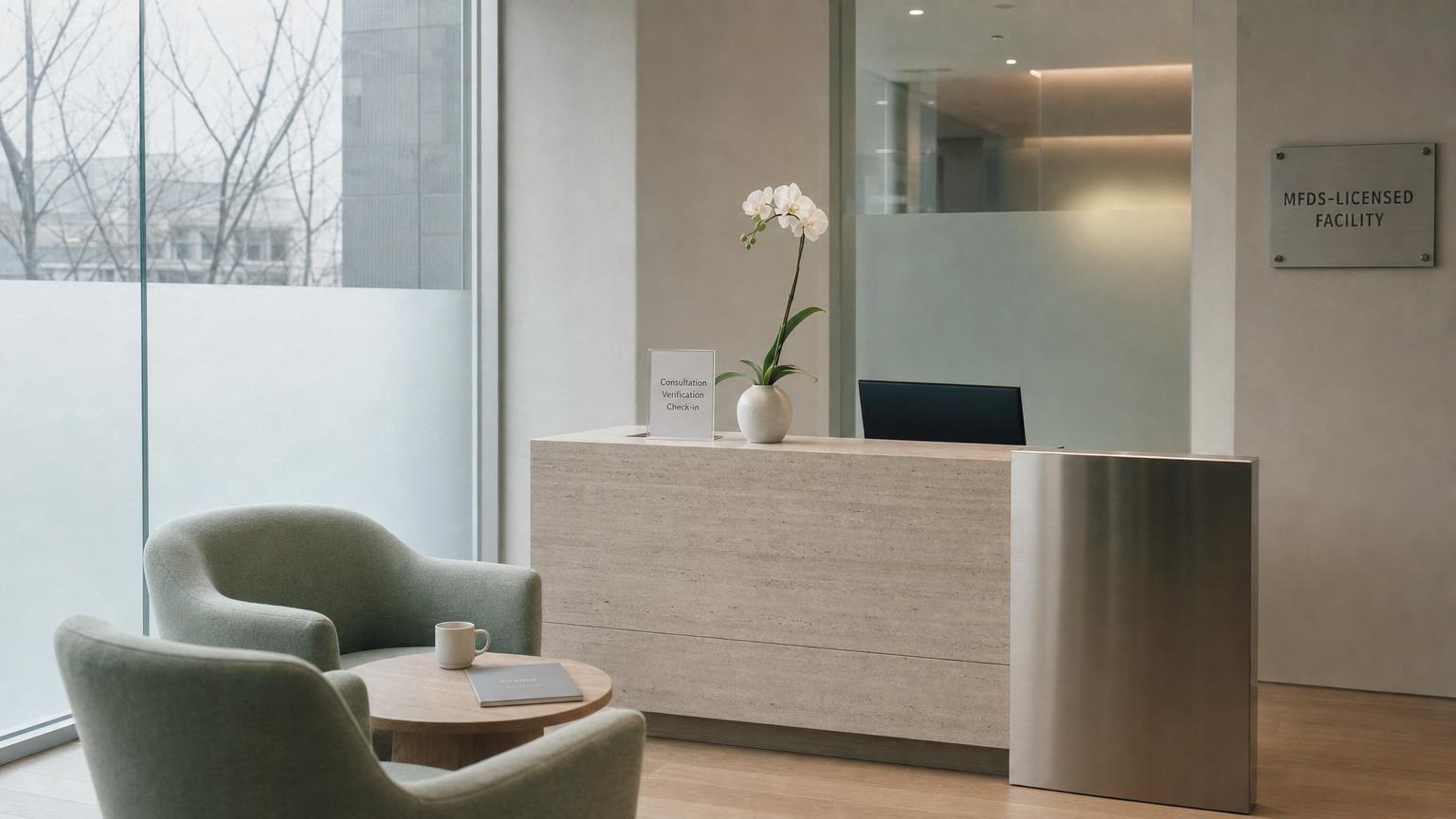
Why Foreign Patients Misjudge Korean Clinics
The pattern is consistent across thousands of foreign patient consultations in Seoul each year. A prospective patient researches Korean plastic surgery on Instagram, Reddit, YouTube, and a handful of English-language blogs. They build a mental shortlist based on three signals: visible reviews (volume and tone), photograph aesthetics (the clinic’s curated gallery), and a consultation coordinator’s responsiveness on KakaoTalk or WhatsApp. They book the clinic that scores highest on these three. Then, in the second week of recovery — or sometimes months later, evaluating their result — they discover that the clinic they chose was not the clinic that would have produced the best outcome for their anatomy.
The misjudgment is not a failure of intelligence. It is a failure of available information. Instagram reviews are curated by the clinic. Photograph aesthetics are produced by professional photographers and edited consistently regardless of result quality. KakaoTalk responsiveness measures sales capacity, not surgical capacity. None of these signals reach into the part of the clinic that actually determines results: the surgeon, the device authorization, the consultation depth, and the aftercare infrastructure.
Foreign patients who later compare notes — in private Reddit threads, in Discord channels, in the second-visit complaints that build up in clinic chairs — converge on a consistent pattern. The clinics that produce the best outcomes are not always the clinics that produce the most marketing visibility. The clinics that produce the most marketing visibility are sometimes excellent and sometimes weak. The two are independent variables, and treating them as the same is the most common error in Korean medical tourism.
The 12-point framework in this compendium is built to separate these variables. Each item is independently verifiable before booking. None of them require trust in the clinic’s own marketing. All of them can be checked from outside, before the consultation, and several can be re-verified during the consultation itself.
The 12-Point Verification Framework
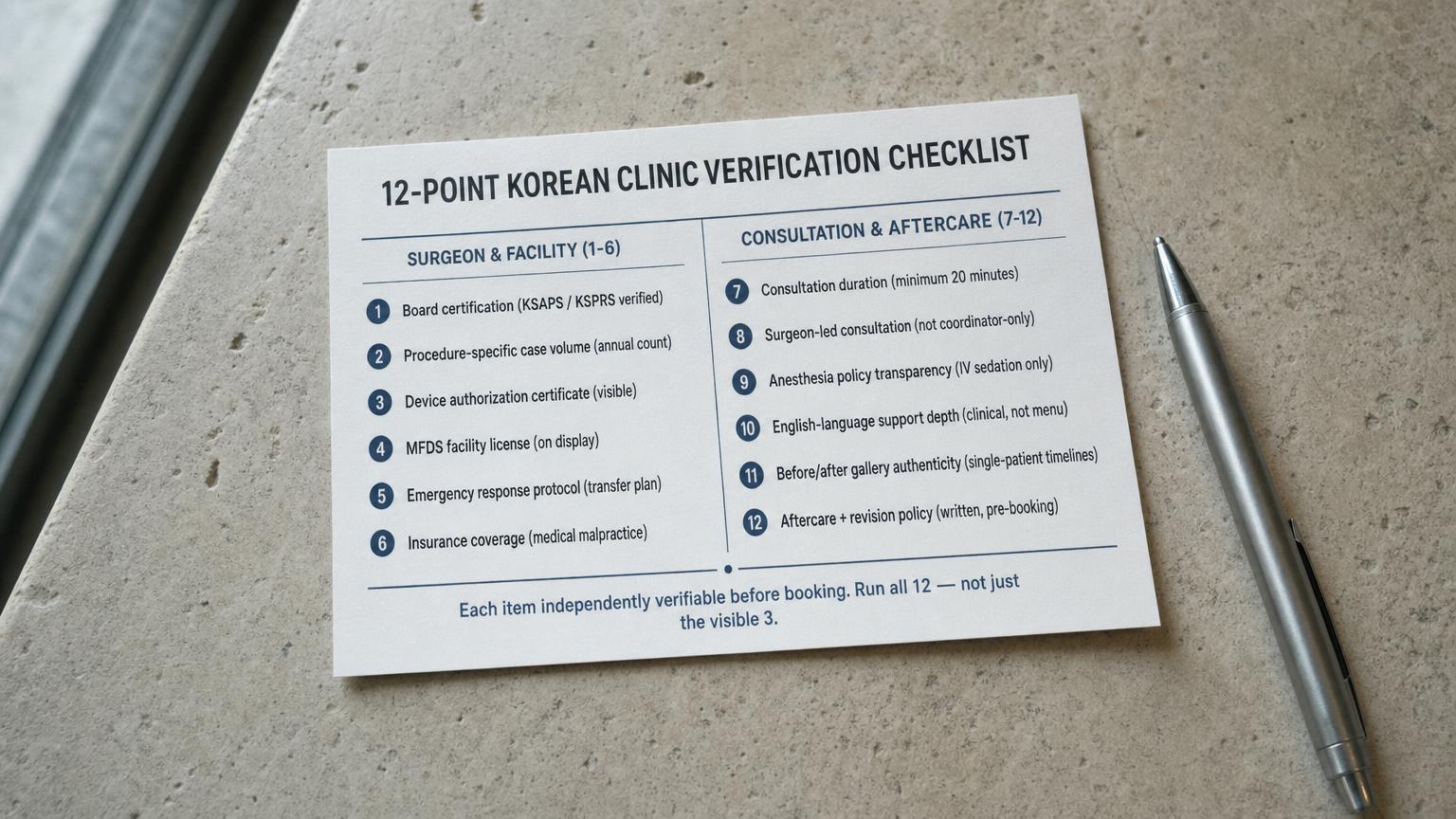
The framework groups verification into four categories: surgeon and facility (points 1 to 6), consultation depth (points 7 to 9), gallery and English support authenticity (points 10 to 11), and aftercare with revision policy (point 12, which expands into a layered set of sub-checks). Each point is verifiable. Each point is independent. A clinic that passes ten of twelve is not the same as a clinic that passes twelve of twelve — the missing two often signal exactly the area where outcomes degrade.
Category A — Surgeon and Facility (Points 1 to 6)
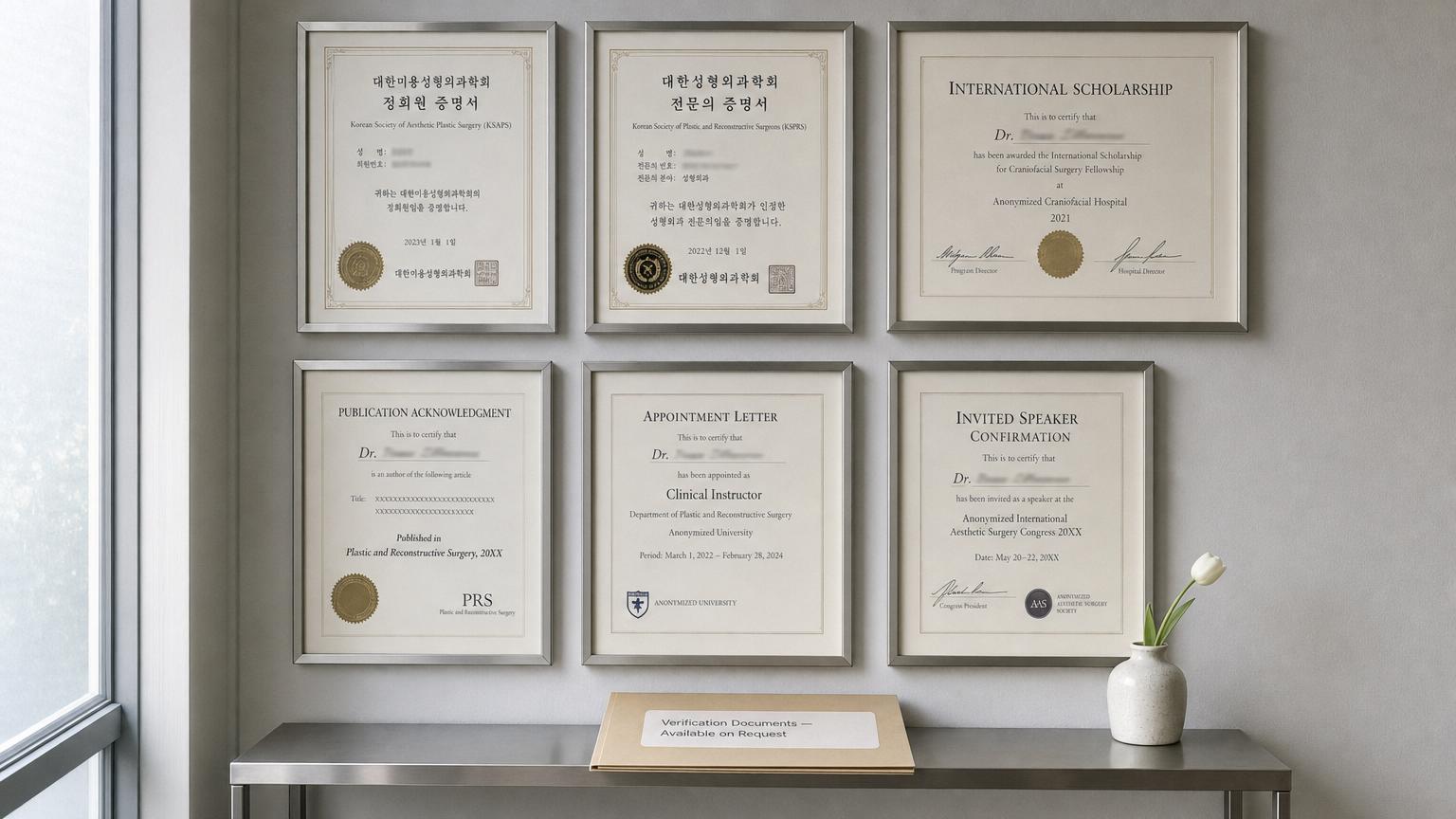
Point 1: Board certification. The surgeon should hold board certification from the Korean Society of Plastic and Reconstructive Surgeons (KSPRS) or the Korean Society of Aesthetic Plastic Surgery (KSAPS) — ideally both. Membership in only general medical associations is not equivalent. Board certification is publicly searchable. A clinic that does not display the surgeon’s certification number on its English-language site, or whose listed surgeon is not findable in the public registries, is missing the most basic verification document.
Point 2: Procedure-specific case volume. A surgeon’s annual case volume for the procedure you are considering matters more than total years in practice. A surgeon who performs 300 rhinoplasty revisions per year produces measurably more consistent results than a surgeon who performs 30, even if the latter has been practicing longer. Ask the clinic for procedure-specific case volume — not total surgical volume — for the previous twelve months. A clinic that cannot answer this question is not measuring its own results.
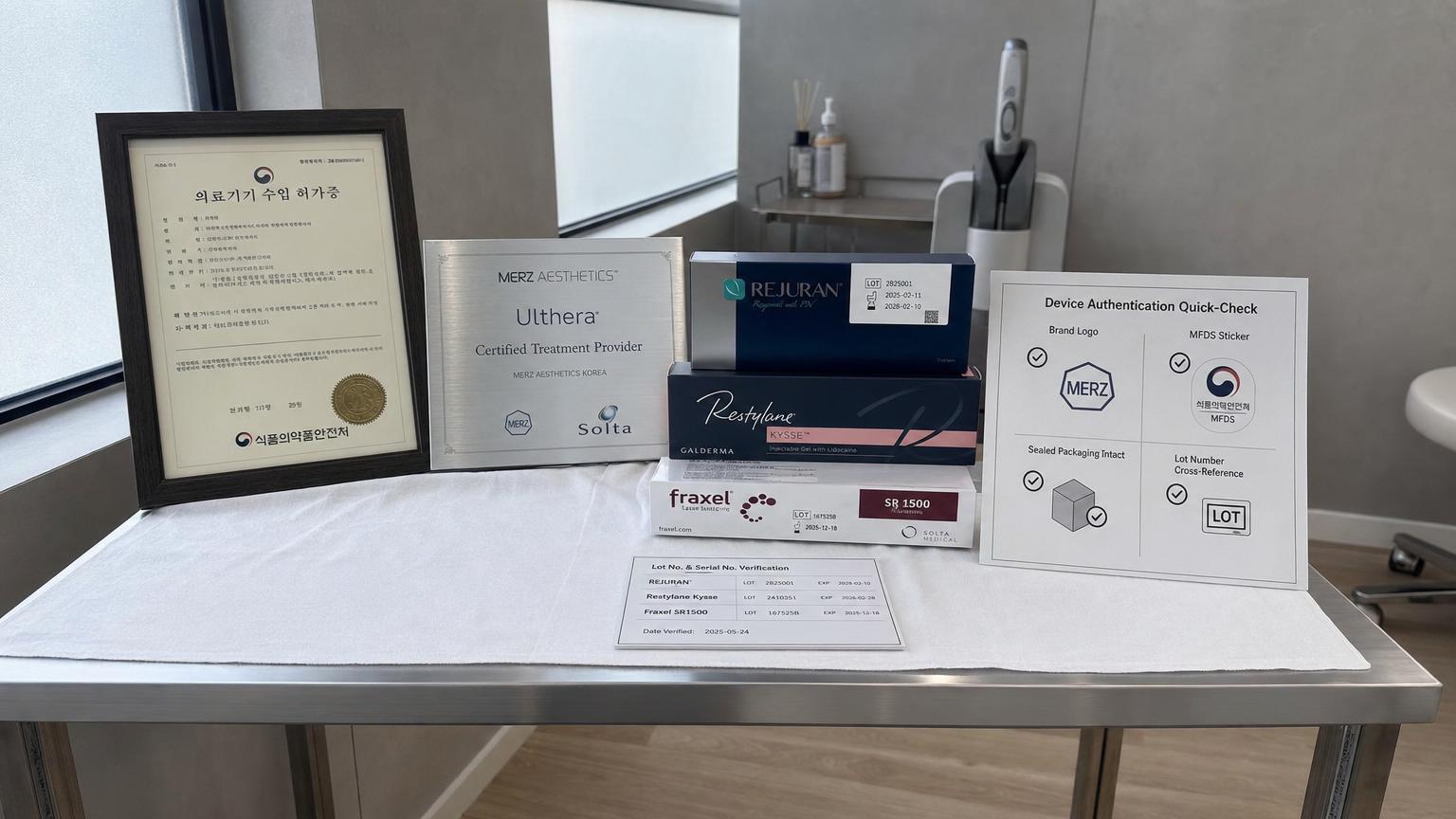
Point 3: Device authorization certificate. Any clinic offering procedures involving brand-name devices — Ultherapy by Merz, Fraxel by Solta, Accento by DEKA, Rejuran, Restylane Kysse, Mentor implants, and so on — should display an authorized provider certificate from the device manufacturer. The certificate should be specific to that clinic, not generic. Ask to see the sealed device packaging before treatment, with the brand logo, lot number, and MFDS sticker visible. A clinic that hesitates to show device authorization is delivering an unspecified product.
Point 4: MFDS facility license. The clinic itself must hold a current Korean Ministry of Food and Drug Safety (MFDS) facility license. This is separate from the surgeon’s individual board certification. The license number should be displayed in the clinic and on official documentation. Foreign patients can verify license status through the MFDS public registry.
Point 5: Emergency response protocol. Most Korean aesthetic clinics are not full hospitals. They operate as specialty facilities, which means an emergency during surgery requires transfer to a partnered hospital. Ask the clinic which hospital it transfers to, how long the transfer takes, and what the transfer protocol is. A clinic that cannot answer this in a single specific sentence has not thought through emergency response.
Point 6: Medical malpractice insurance. The clinic and the surgeon should both carry current medical malpractice insurance. Foreign patients typically have no recourse through their home-country insurance for procedures performed abroad. The clinic’s own coverage is the only safety net. Ask for the carrier name and the coverage limit.
Category B — Consultation Depth (Points 7 to 9)
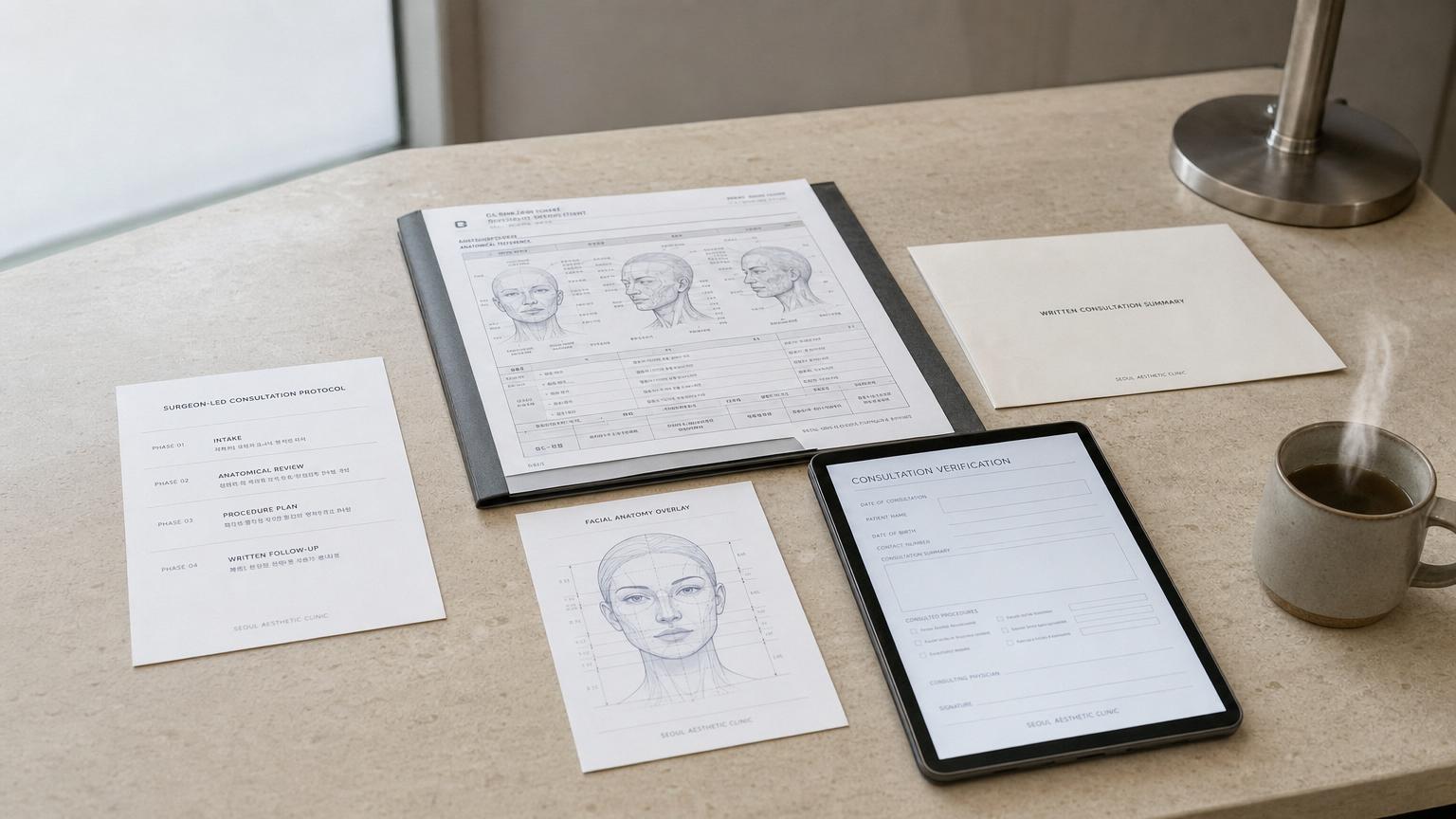
Point 7: Consultation duration. A genuine surgical consultation lasts a minimum of twenty minutes, and a complex case consultation lasts forty to sixty minutes. A ten-minute consultation that ends with a coordinator presenting a treatment package is a sales meeting, not a consultation. Foreign patients who feel pressured to commit during the consultation itself, before they have had time to think about the surgeon’s plan, are receiving a sales protocol rather than a medical one.
Point 8: Surgeon-led consultation. The surgeon performing the procedure should personally lead the consultation. A clinic in which a coordinator presents the plan, asks the patient to commit, and then has the surgeon briefly enter the room near the end of the conversation is operating on a shadow-doctor model, regardless of how it markets itself. Ask explicitly: who will perform my surgery, and will that person personally meet with me before the date? If the answer involves multiple surgeons rotating, the clinic does not have a single accountable owner of your result.
Point 9: Anesthesia policy transparency. Korean aesthetic clinics increasingly use IV sedation rather than general anesthesia for outpatient procedures. This is a meaningful safety decision — IV sedation is recoverable faster and has a lower complication profile for most outpatient cosmetic procedures. Ask the clinic specifically what anesthesia policy it uses, whether it is consistent across all procedures, and what its protocol is for procedures that exceed IV sedation’s comfortable duration window. A clinic that uses general anesthesia by default for routine outpatient cosmetic surgery is operating on a different risk calculus than the modern Korean standard.
Category C — Gallery and English Support Authenticity (Points 10 to 11)
Point 10: English-language support depth. There is a difference between clinical English and menu English. Menu English is sufficient to take a booking, list procedure names, and confirm appointment times. Clinical English is required to explain why a particular procedure suits your anatomy, what the recovery timeline looks like specifically for your case, what the trade-offs of alternative approaches are, and how to communicate emergency concerns post-operatively. Ask a complex clinical question during the consultation booking process — “How does the surgeon decide between transconjunctival and subciliary lower blepharoplasty for a patient with my anatomy?” — and see what answer comes back. Menu English will offer a generic procedure description. Clinical English will offer an actual answer.
Point 11: Before-and-after gallery authenticity. The single most manipulated artifact in Korean medical tourism marketing is the before-and-after gallery. Three patterns to verify before trusting any gallery: (a) The same patient should appear in both photographs — verifiable through facial geometry, skin texture, and identifying features beyond the procedural site. (b) The lighting, background, makeup, and camera distance should be identical in both photos — a “before” photograph taken under harsh overhead fluorescent lighting and an “after” taken under soft natural daylight is comparing two different lighting environments, not two states of the same patient. (c) The timeline should be stated explicitly — “3 months post-op” versus “1 year post-op” versus “5 years post-op” produce visually different results, and a gallery that omits the timeline is hiding the most important variable. Authentic galleries follow the same patient through a clearly marked timeline. Manipulated galleries cherry-pick the most flattering photographs from any time point and present them as standard outcomes.
Category D — Aftercare and Revision Policy (Point 12)
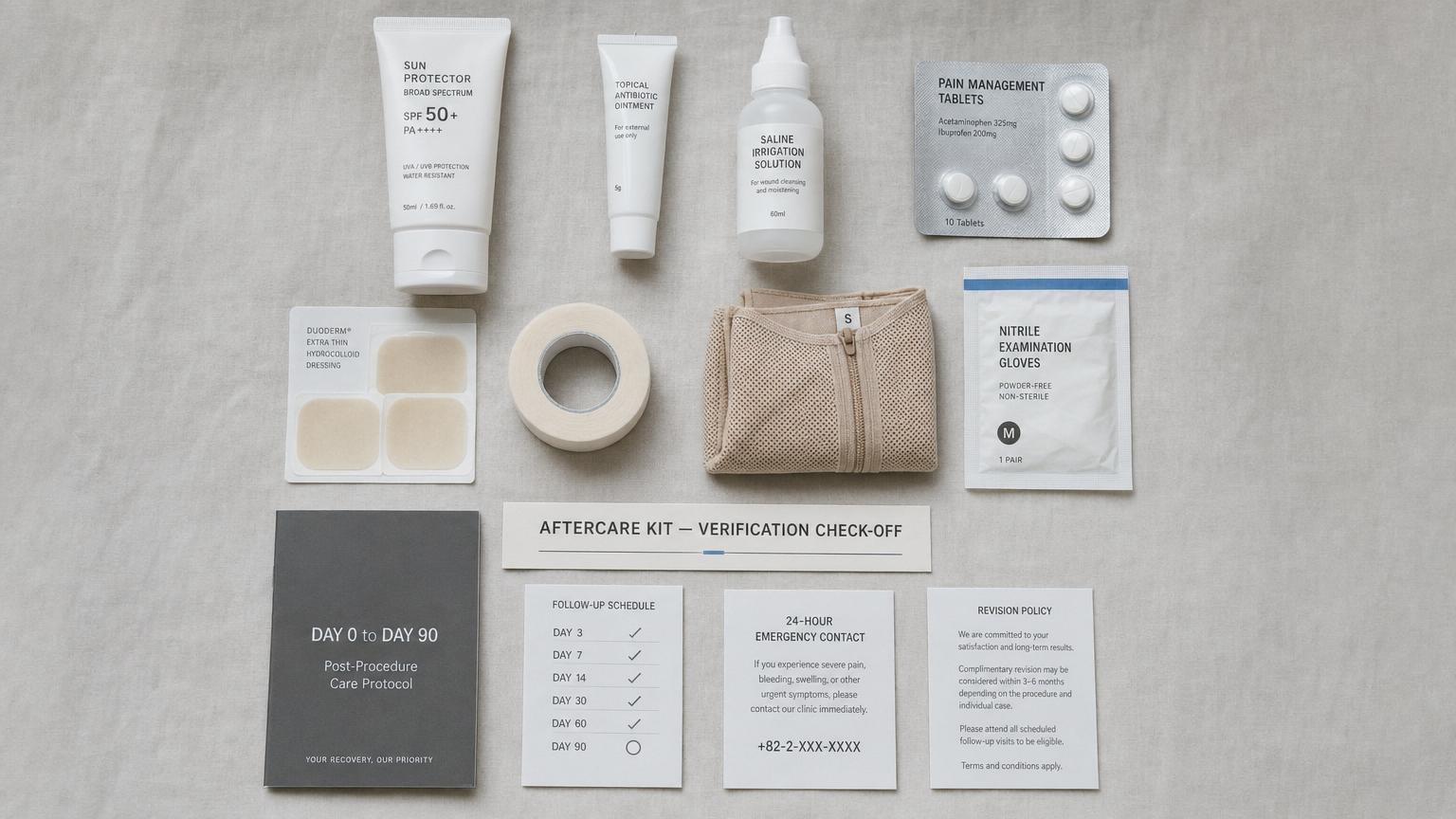
Point 12: Aftercare and revision protocol. The clinic’s aftercare protocol should be written and provided to the patient before booking, not after. It should cover: post-operative medication regimen, dressing change schedule, follow-up appointment timeline, emergency contact protocol for the first 72 hours, return-to-activity guidelines week by week, and a written revision policy specifying what is covered, what triggers a revision consultation, and what the revision cost structure is. A clinic that hands the foreign patient a verbal aftercare summary at discharge and trusts memory to carry it home has not invested in the aftercare infrastructure that produces consistent results. A clinic that has a printed aftercare booklet, a follow-up schedule card, and a 24-hour emergency contact line is operating at a different level.
How to Run the Verification Before Booking
The framework above is not theoretical. Each point can be checked from outside the clinic, before the consultation begins, using publicly available sources or specific questions asked in the booking conversation. The recommended sequence is below.
Recommended for Your Recovery
Products commonly used before and after Korean plastic surgery clinic verification compendium — same items routinely recommended in the recovery instructions Seoul clinics hand out at discharge.
- Beauty of Joseon Relief Sun SPF 50+ — Korean SPF 50+ — universal aftercare staple across every procedure category covered in this guide. Check price on Amazon
- COSRX Advanced Snail 96 Mucin Power Essence — Korean skin barrier essence used widely in Seoul post-procedure aftercare routines. Check price on Amazon
- Arnica Montana Tablets — general bruising support — pack 1 bottle in your pre-trip kit regardless of procedure type. Check price on Amazon
- Silicone Scar Sheets — general scar support sheets — useful if any of your scheduled procedures include incision work. Check price on Amazon
As an Amazon Associate, GlobalBeautySpot earns from qualifying purchases at no extra cost to you.
Step 1 — Pre-booking research (one week before consultation)
Search the surgeon’s name in the KSPRS and KSAPS public registries. Search the clinic facility name in the MFDS public registry. Cross-reference any device brand the clinic claims to use against the manufacturer’s authorized provider list. This step takes approximately thirty minutes and eliminates the clinics that fail the most basic regulatory verification.
Step 2 — Booking-stage questions (during initial inquiry)
Send the clinic five specific questions in your initial KakaoTalk or email exchange: (1) the surgeon’s annual case volume for the specific procedure you are considering, (2) the device brands used for any energy-based procedure in your plan, (3) the anesthesia policy used for your procedure type, (4) the partnered hospital for emergency transfer, and (5) a copy of the written aftercare protocol and revision policy. A clinic that responds with five clear specific answers within forty-eight hours has already passed roughly half the verification framework. A clinic that deflects, delays, or offers generic responses has revealed the gap before you have booked.
Step 3 — Consultation-day verification (in person)
Ask to see the surgeon’s board certification, the clinic’s MFDS facility license, and the device authorization certificate for any device used in your plan. Ask the surgeon directly which alternative approaches were considered for your case and why this one was chosen. Ask how the surgeon will handle a result that does not meet expectations at the six-month follow-up. The depth of the answers in person is the final verification layer, and the patient who has already done Steps 1 and 2 walks into this conversation able to evaluate the answers in real time.
Step 4 — Pre-deposit decision window
Korean aesthetic clinics typically require a deposit to secure a surgical date. The verification framework should be complete before the deposit is paid. A clinic that pressures the patient to pay a deposit on consultation day, before the patient has had time to review the consultation notes and complete the verification framework, is operating outside the recommended decision-making protocol. The standard pattern is consultation, written follow-up summary within 48 hours, patient review period of one to two weeks, and then deposit if the patient decides to proceed.
The 12-Point Decision Tree With GBS Cross-Reference
The verification framework above is general. The decision tree below maps each verification point to the specific GBS articles that explain how that point applies to the procedure category you are considering. Each link opens an in-depth article on the specific procedure, the verification challenges unique to it, and the misconceptions that lead foreign patients to weaker outcomes.
Eye Surgery Procedures
Eye surgery procedures account for the largest single share of foreign patient bookings in Korean aesthetic clinics. Verification depth matters because the recovery window is short enough that mistakes become permanent before the patient can return for revision consultation. Specific procedure deep-dives: Korean double eyelid surgery — incision vs non-incision, Tear trough vs eye bag — which Korean surgery applies, Under-eye fat repositioning recovery — day by day, Upper eyelid fat removal, Comprehensive blepharoplasty, Epicanthoplasty — inner corner.
Rhinoplasty Procedures
Rhinoplasty procedures concentrate the highest revision rate of any cosmetic surgical category, which makes Point 2 (surgeon-specific case volume) and Point 11 (gallery authenticity) particularly important. Specific procedure deep-dives: Korean rhinoplasty — Asian and Western noses, Revision rhinoplasty for foreign patients, Korean alar reduction, Rhinoplasty 1-month recovery, Korean rhinoplasty primary procedure overview.
Body and Breast Procedures
Body and breast procedures involve longer recovery windows and higher anesthesia exposure than eye or rhinoplasty procedures, which makes Point 5 (emergency protocol) and Point 9 (anesthesia transparency) especially important. Specific procedure deep-dives: Korean breast augmentation with Mentor implants, Korean umbilicoplasty — 4 belly button types, Korean liposuction — micro cannula, Elastic tummy tuck — postpartum diastasis recti.
Face Contouring and Lift Procedures
Face contouring and lift procedures span surgical and non-surgical approaches, and the verification challenge here is partly disambiguating which category a procedure actually belongs to. Specific procedure deep-dives: Korean full-face fat grafting combined with under-eye, Korean lip lift and philtrum reduction, Korean flower lift — PDO thread lift.
Petit Aesthetic Procedures (Injectable and Booster)
Petit aesthetic procedures depend critically on Point 3 (device and product authorization) because the active ingredient is the procedure — counterfeit Rejuran, counterfeit Restylane, and counterfeit Juvelook circulate in unauthorized clinics. Specific procedure deep-dives: Korean Rejuran skin booster, Korean Exosome therapy, Korean Juvelook PLLA collagen booster, Korean Lip Rejuran (PN), Korean lip filler with Restylane Kysse.
Laser and Energy-Based Procedures
Laser and energy-based procedures depend on device authentication (Point 3) more than almost any other category, because the device is the procedure. Specific procedure deep-dives: Korean Ultherapy — verify real Merz MFU, Korean Fraxel Dual — verify real Solta, Korean Volnewmer monopolar RF, Korean Accento dual wavelength, Korean CO2 laser mole and spot removal.
Patient-Specific Frameworks
Two GBS articles address frameworks that cut across procedure categories: Korean plastic surgery for men — refinement without feminization, and the overall category overview from Korean facial procedures overview, Korean body procedures overview, Korean petit aesthetic overview, and Korean laser and energy-based procedures overview.
Red Flags and Common Manipulation Patterns
Verification is partly a check for what should be present and partly a check for what should not be present. The following patterns are signals that a clinic has prioritized marketing visibility over clinical infrastructure. Each of these patterns is independently observable before booking, and any one of them on its own is not disqualifying. Two or more in combination — particularly involving Categories A or B — is grounds to reconsider.
Manipulation Pattern 1 — Same surgeon, dozens of clinics
A surgeon whose name appears as the consulting or director-level surgeon at multiple unrelated clinic addresses is typically a hired consultant who does not personally perform surgeries at most of those locations. The “director” title in this configuration is a marketing label rather than an operational role. Foreign patients booking a clinic based on a director surgeon’s reputation often discover post-booking that the actual operating surgeon is a different physician.
Manipulation Pattern 2 — Gallery photographs with inconsistent lighting
A before-and-after gallery in which the lighting environments of the two photos differ substantially is comparing two different lighting setups rather than two states of the patient. Sharp overhead fluorescent before-photos and soft window-light after-photos make the same face look like two different results, and the result is in the lighting rather than the surgery. Authentic galleries use identical lighting environments and identical camera distances.
Manipulation Pattern 3 — Vague timeline labeling
“After photo” without a timeline is meaningless. Three months post-rhinoplasty looks different from one year post-rhinoplasty, and a gallery that omits the post-operative time point is hiding the most important variable. Ask the clinic to provide gallery photographs labeled with specific post-operative time points and to show photographs from the same patient at multiple time points if possible.
Manipulation Pattern 4 — Excessive same-day commitment pressure
A clinic that pressures the patient to pay a deposit on consultation day, threatens that scheduling will fill if the patient delays, or offers a “consultation day discount” that disappears if the patient takes a week to decide is operating on a sales protocol rather than a clinical one. The standard pattern is consultation, written follow-up within 48 hours, patient review window of one to two weeks, then deposit. Pressure to compress this timeline is a signal.
Manipulation Pattern 5 — Generic answers to clinical questions
A clinical question deserves a clinical answer. If you ask why the surgeon recommends a specific approach for your case and receive a generic procedure description in response — the kind of answer that would apply to any patient — you are speaking with someone who is presenting marketing material rather than evaluating your specific anatomy. The depth of the answer to clinical questions is the highest-fidelity signal of clinical capacity.
Manipulation Pattern 6 — Coordinator-only consultation booking
If the surgeon performing your procedure is not personally available for at least one consultation conversation before the surgical date, the clinic is operating on a coordinator-led model in which the surgeon meets the patient only briefly on the day of surgery. Ask explicitly: will the surgeon performing my procedure meet with me personally before the surgical date, in a consultation that lasts at least twenty minutes? If the answer is no, the surgical accountability structure of the clinic is unclear.
Frequently Asked Questions
How long does the verification framework take to complete?
Pre-booking research (Step 1) takes approximately thirty minutes. Booking-stage questions (Step 2) takes one to three days for the clinic to respond. Consultation-day verification (Step 3) adds approximately twenty minutes inside the consultation itself. Total: a few hours of patient time spread over one to two weeks. The cost of skipping it is measurable in the second-visit complaints that fill clinic chairs.
What if a clinic refuses to answer some of these questions?
A refusal to answer is itself an answer. A clinic that cannot or will not provide procedure-specific case volume, device authorization documentation, or written aftercare protocol has revealed which parts of the verification framework it does not pass. Move to a clinic that does pass.
Is this framework specific to surgical procedures, or does it apply to petit aesthetic procedures too?
It applies to both, but the weighting shifts. For surgical procedures, Points 1, 2, 5, and 9 (board certification, case volume, emergency protocol, anesthesia transparency) carry the highest weight. For petit aesthetic procedures, Points 3 and 4 (device and product authorization, MFDS licensing) carry the highest weight because the active ingredient is the procedure. Points 7, 8, 10, 11, and 12 apply equally to both categories.
How do I verify board certification from outside Korea?
The Korean Society of Plastic and Reconstructive Surgeons (KSPRS) and the Korean Society of Aesthetic Plastic Surgery (KSAPS) maintain public member registries searchable by surgeon name. Many clinics also display the certification number on the surgeon’s profile page. A surgeon whose certification is not findable in either registry, and whose claimed certification number does not resolve to a verified record, is operating without the most basic verification document.
How do I verify the device authorization for procedures like Ultherapy or Fraxel?
The device manufacturers (Merz for Ultherapy, Solta for Fraxel, DEKA for Accento, Classys for Shrink Universe) maintain authorized provider directories. Search the clinic name against the directory. Counterfeit or grey-market device usage is more common than foreign patients assume — the device authentication step is one of the higher-yield verification points.
Can I run this framework remotely without traveling to Seoul?
Most of the framework can be completed remotely. Steps 1 and 2 are entirely remote. Step 3 requires the in-person consultation. The patient who completes Steps 1 and 2 before traveling arrives at the consultation already able to evaluate the surgeon’s answers in context, rather than starting from zero in the chair.
What is the most common single verification failure?
Across thousands of foreign patient consultations, the most common single failure is Point 8 — surgeon-led consultation. Patients book based on a director surgeon’s reputation, arrive in Seoul, complete a consultation with a coordinator and a brief introduction from the director, and discover after surgery that the operating surgeon was a different physician. The verification question to ask explicitly during booking: “Will the surgeon performing my procedure personally lead my consultation before the surgical date?”
Does a higher price indicate a higher-verification clinic?
Not reliably. Korean clinic pricing varies more by marketing budget than by surgical quality. A clinic that ranks highly on paid advertising and influencer marketing often charges premium prices to amortize those costs, and the additional spend does not necessarily reach the surgical infrastructure. Conversely, some of the most rigorous verification-passing clinics in Seoul price in the middle of the market because they invest in clinical infrastructure rather than marketing. Price is not a verification signal.
What is the role of online reviews in verification?
Online reviews are a noisy signal at best and a misleading signal at worst. Korean clinics commission reviews through agencies, exchange treatments for positive reviews, and selectively respond to negative reviews to bury them in chronological feeds. Treat reviews as one input among many, never as the primary verification signal. The verification framework above does not depend on reviews at all.
What should I do if I have already booked a clinic that fails the verification framework?
If the procedure is petit aesthetic and reversible (Rejuran, Exosome, Juvelook, lip filler), the cost of pivoting to a verification-passing clinic is the deposit and the booking time. If the procedure is surgical, the cost of pivoting before the surgical date is almost always less than the cost of revision surgery later. Korean revision rhinoplasty and revision eye surgery costs are substantially higher than primary procedures, and the verification cost ratio runs heavily in favor of pivoting before surgery rather than after.
For foreign patients planning surgical or petit aesthetic procedures in Seoul, Link Plastic Surgery’s official website displays board certification documentation, device authorization records, and English-language consultation booking details organized by procedure category.